Ken Kramer's About San Diego
Two Mountains
Clip | 8m 13sVideo has Closed Captions
A volcano in San Diego County? It’s true. Also the history of the highest spot in the city.
A volcano in San Diego County? It’s true. Also the history of the highest spot in the City of San Diego, Cowles Mountain.
Problems playing video? | Closed Captioning Feedback
Problems playing video? | Closed Captioning Feedback
Ken Kramer's About San Diego is a local public television program presented by KPBS
Ken Kramer's About San Diego
Two Mountains
Clip | 8m 13sVideo has Closed Captions
A volcano in San Diego County? It’s true. Also the history of the highest spot in the City of San Diego, Cowles Mountain.
Problems playing video? | Closed Captioning Feedback
How to Watch Ken Kramer's About San Diego
Ken Kramer's About San Diego is available to stream on pbs.org and the free PBS App, available on iPhone, Apple TV, Android TV, Android smartphones, Amazon Fire TV, Amazon Fire Tablet, Roku, Samsung Smart TV, and Vizio.
Providing Support for PBS.org
Learn Moreabout PBS online sponsorship(light upbeat music) - [Narrator] Here's a little something "About San Diego" with Ken Kramer.
(light upbeat music) - I think it is a nice day in Carlsbad for a walk.
Super easy to get to, off of Tamarack Avenue, the trail crosses a small dam that impounds rainwater down there.
And it is, you see, the way to get to the volcano.
And you say "What?
There are no active volcanoes in San Diego County today."
And you'd be right.
See, this was a very, very long time ago, and if you were right here- (explosion roaring) (bright upbeat music) Really?
There's the sign and here's the volcano.
Mount Calavera means skull in Spanish.
And, yes, it really is what's left of a little volcano not far from the residential streets of Carlsbad today.
It was back in its day in a very tiny way, very spectacular, as a geologist could tell us.
And luckily we have one.
- Good to see you Ken, come on in.
- [Ken] Dr.
Pat Abbott, professor emeritus Earth and Environmental Sciences at San Diego State.
Okay, first thing he says, we shouldn't think of it as like a Hawaii volcano with lava spewing.
No, this was more like a Mount St.
Helens blowing up rock and gas, but on a much, much, much smaller scale.
- It's the kind of thing that people living in the neighborhood would've been able to move away from, watch it for a few years and it would've quit, it would not have killed or harmed anybody.
- [Ken] That's, if there was anyone around to see it, which there wasn't.
- It's most definitely prehistoric.
Nobody was around when that volcano was erupting.
- [Ken] And when was that?
Well, maybe 20 or 25 or 30 or 35 million years ago, or so.
- I can say, as a geologist looking at it in the field, where the sandstones nearby that are like 40 million years old, I can show that they're baked or burnt.
So the magma shows it's younger than 40 million years, but I can't be more specific than that.
- [Ken] Okay, so it's very old.
And a couple of things, you think of a volcano as being cone shaped, right?
And back then this was, but... - But it's also loose material.
So that erodes easily, and what's happened there in Carlsbad is the side has eroded away here.
We now see inside the throat of it.
- [Ken] And walk right into that throat, right into the middle of the volcano and look up, look around.
- And in the throat of it, you see these hexagonal columns, they almost look like Greek architecture.
It's the kind of a thing that when the magma was cooling in the throat of the volcano, it shrinks and cools into hexagonal shaped vertical columns.
- [Ken] See them?
Yes, there are big geological forces that work here, but Dr.
Pat Abbott says... - But this is just a tiny little thing, a little thing where below the surface a bit of magma had accumulated, some gas bursts through the surface, blowing stuff into the air for a while, the gas is expended, a little bit of lava comes out.
It took place at maxima for a few years, and it's a one and done.
It is now extinct, it will never erupt again.
- Which is good news for Carlsbad and their volcano, known as Cerro de Calavera, Skull Hill, which holds the distinction of being, in fact, one of the smallest volcanoes in North America.
In the Lake Calavera Preserve in the city of Carlsbad, an easy walk on a nice day to see some ancient history about San Diego.
(bright upbeat music) All right, to another peak now, this one within the city of San Diego at Mission Trails Regional Park.
A lot of people take a look at it and they say, "Oh, it must be a volcano too."
But we checked with Pat Abbott and he says, "No, it actually has no volcanic origin whatsoever."
What it does have though, is a lot of visitors.
Estimates are that a million people a year visit Mission Trails Regional Park, and 100s of 1,000s of them climb this mountain, never knowing its history.
Well, since we're right here and it's right there, what is the story?
(light upbeat music) October, 1984, and notice if you will, this plaque being dedicated because we're gonna come back to it.
(car engine humming) It recognizes this mountain as being the highest one in San Diego, 1,591 feet above sea level and very hikable.
♪ I love to go a-wandering along the mountain trial ♪ ♪ And as I go I love to sing ♪ ♪ My knapsack on my back ♪ - [Ken] Of all our rocky trails and dirt paths, this particular one offers a timeless invitation.
Come see where this leads.
How many San Diegans have taken that to heart, testing themselves physically, hiking up here, maybe not knowing its history.
The Kumeyaay marked its shadows and observed the winter solstice here, 1,000 and many more years before any American settler came and climbed it or thought to name it S Mountain.
(light upbeat music) Students rushed to somehow claim it as their own.
From the early 1930s through the 1960s, every year in a ritual of fall, they too climbed the mountain with sacks of lime and spelled out the letter S for state, the state college, bright and on clear days visible to the sea.
Today, nature has overgrown the scar, but the hike is the thing.
The air, as you climb clearer and oddly sometimes warmed by the inversion layer, the traffic noise below slowly starts to fade and you find yourself above the city that is your home, with people who may be neighbors or strangers but all have come here, all are walking here, all experiencing that familiar combination of physical workout of the body in the escape of nature.
(light upbeat music) ♪ High overhead the skylarks wing ♪ ♪ They never rest at home ♪ ♪ But just like me they love to sing ♪ ♪ As o'er the world we roam ♪ - [Ken] There is the matter of what this mountain is called today, it's worth a minute because Mr.
Coles deserves that.
In 1887, George Coles owned about 4,000 acres in the El Cajon Valley where he planted a wonderful variety of fruits, olives, and grain.
He also raised thoroughbred horses and polo ponies, and tirelessly worked to create and build his little community called Coles town, and then he died.
The story is that he worked so hard on Coles town that it killed him at age 51.
His widow married a man named Milton Santee, so everything in Coles town got changed to Santee, except the mountain which rightly ought to be called Coles mountain.
Do people here, 100s, sometimes 1,000s a day, think of him or of the S or of the Kumeyaay for whom this mountain holds a place of honor?
♪ Oh may I go a-wandering ♪ ♪ Until the day I die ♪ ♪ And may I always laugh and sing ♪ ♪ Beneath the clear blue sky ♪ - [Ken] It might have been lost to development, but voters approved a measure that provided the money for open space and the city bought it on a New Year's Eve more than 50 years ago, and several years after that, dedicated that plaque and carried it up here to the very top of Coles mountain, thank you.
Crowded?
Sure sometimes, but it is a place of nature in our city limits, a rocky trail, a particular dirt path that has become something rightly treasured about San Diego.
(bright upbeat music)
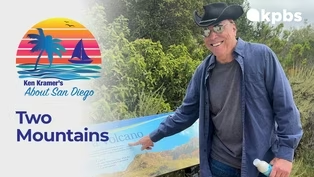 Now Playing
Video has Closed Captions
Clip | 8m 13s | A volcano in San Diego County? It’s true. Also the history of the highest spot in the city. (8m 13s)
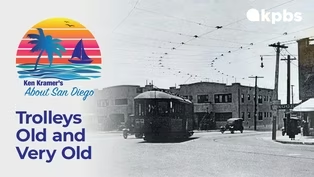
Video has Closed Captions
Clip | 6m 27s | A restaurant built from a trolley car and a peek at when you could take the trolley to Balboa Park. (6m 27s)

Saving History One Image at a Time
Video has Closed Captions
Clip | 7m 14s | The story of Pea Hicks, who discovers old bits of history in cast off film video, slides, and photos (7m 14s)

Sandy the Sea-lion Guy & Ramona Grassland
Video has Closed Captions
Clip | 7m 49s | An underwater photographer and a visit to the Ramona grasslands. (7m 49s)
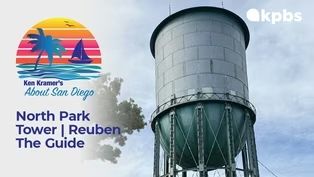
North Park Tower & Reuben The Guide
Video has Closed Captions
Clip | 8m 55s | The story of North Park's Water Tower, and meet the city's 1st tour guide. (8m 55s)

Video has Closed Captions
Clip | 6m 42s | Join Ken aboard the majestic Star of India, the world's oldest active sailing ship. (6m 42s)

The Impossible Railroad & A 100-Year-Old Candy Shop
Video has Closed Captions
Clip | 9m 1s | Journey back in time with the Pacific Southwest Railway Museum and see the "Impossible Railroad." (9m 1s)

Video has Closed Captions
Clip | 6m 32s | Discover the charming and surprising history of a clever broadcasting trick, (6m 32s)
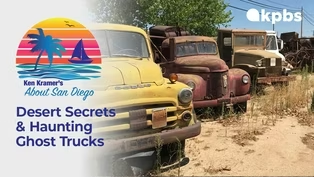
Desert Secrets & Haunting Ghost Trucks
Video has Closed Captions
Clip | 9m 36s | Take a fascinating journey to two remote San Diego County destinations. (9m 36s)
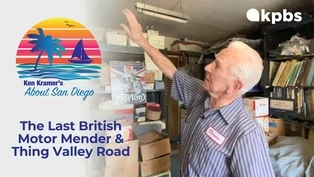
The Last British Motor Mender & Thing Valley Road
Video has Closed Captions
Clip | 7m 29s | Meet Dennis Tolley, a British mechanic and local treasure. Then the story behind Thing Valley Road. (7m 29s)
Providing Support for PBS.org
Learn Moreabout PBS online sponsorship














Support for PBS provided by:
Ken Kramer's About San Diego is a local public television program presented by KPBS