One-on-One
Tyler Henry; Nick Asselta & Amy Osborn
Season 2023 Episode 2662 | 27m 22sVideo has Closed Captions
Tyler Henry; Nick Asselta & Amy Osborn
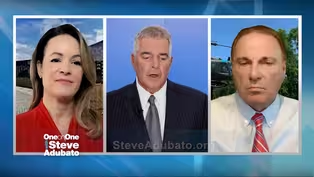
Tyler Henry, medium and best-selling author, talks about growing up with the gift of clairvoyance and how he’s able to assist others with the grief process; Then, Nick Asselta, Former NJ State Senator and Board Member of the NJ Vietnam Veterans' Memorial Foundation, and Amy Osborn, President and CEO of the NJ Vietnam Veterans' Memorial Foundation, discuss the revitalized and expanded museum.
Problems playing video? | Closed Captioning Feedback
Problems playing video? | Closed Captioning Feedback
One-on-One is a local public television program presented by NJ PBS
One-on-One
Tyler Henry; Nick Asselta & Amy Osborn
Season 2023 Episode 2662 | 27m 22sVideo has Closed Captions
Tyler Henry, medium and best-selling author, talks about growing up with the gift of clairvoyance and how he’s able to assist others with the grief process; Then, Nick Asselta, Former NJ State Senator and Board Member of the NJ Vietnam Veterans' Memorial Foundation, and Amy Osborn, President and CEO of the NJ Vietnam Veterans' Memorial Foundation, discuss the revitalized and expanded museum.
Problems playing video? | Closed Captioning Feedback
How to Watch One-on-One
One-on-One is available to stream on pbs.org and the free PBS App, available on iPhone, Apple TV, Android TV, Android smartphones, Amazon Fire TV, Amazon Fire Tablet, Roku, Samsung Smart TV, and Vizio.
Providing Support for PBS.org
Learn Moreabout PBS online sponsorship- [Narrator] Funding for this edition of One-On-One with Steve Adubato has been provided by The New Jersey Economic Development Authority.
Valley Bank.
New Jersey Sharing Network.
The Fidelco Group.
Holy Name.
Delta Dental of New Jersey.
Everyone deserves a healthy smile.
PSE&G, committed to providing safe, reliable energy now and in the future.
Johnson & Johnson.
And by The Adler Aphasia Center.
Promotional support provided by Meadowlands Chamber.
Celebrating 50 years of building connections and driving business growth.
And by NJ.Com.
Keeping communities informed and connected.
- This is One-On-One.
- I'm an equal American just like you are.
- The way we change Presidents in this country is by voting.
- A quartet is already a jawn, it'’s just The New Jawn.
- January 6th was not some sort of violent, crazy outlier.
- I don't care how good you are or how good you think you are, there is always something to learn.
- I mean what other country sends comedians over to embedded military to make them feel better.
- People call me 'cause they feel nobody's paying attention.
-_ It'’s not all about memorizing and getting information, it'’s what you do with that information.
- (slowly) Start talking right now.
- That's a good question, high five.
(upbeat music) - Is there a Harold?
- That's my grandfather.
- It's always creepy when that happens.
I keep getting kind of a famous feeling like... - You'’re right on.
- It'’s such a gift that Tyler has.
- I never thought that I would get this experience.
- Everything he said was spot on.
- We are not forgetting.
- Do you want to know everything?
- We are honored to be joined by Tyler Henry, who is a world-renowned medium.
You don't need me to tell you that.
You know who he is.
Best-selling author, and when my wife found out that we had you.
She goes, in person?
I go, no, remotely.
It's not gonna work that way.
But Tyler, it is an honor to have you with us.
Thank you for joining us.
- Steve, thank you for having me.
I'm so excited to get to talk today and say hello to your wife for me.
- I will, I will.
But what I'm curious about is this.
I've read so much about you, and I've watched you for years.
This ability you have, describe what it is and when you knew you had it, please.
- Sure, so I consider myself a medium, which really just means an intermediary between this realm and the next.
And that's not an ability that I really identified as such early on.
It was something that took years of moments of knowingness to kind of acquire.
But my first moment of a premonition happened when I was 10 years old.
I woke up one night and just had a total knowingness that my grandmother, my best friend, was going to pass away.
And I went into the room to try to explain this to my mom, and we were interrupted with a phone call from my dad breaking the news to my mom.
So that was really the catalyst, but at 10 years old, you don't recognize that as an ability and certainly not a gift.
It was just something that happened.
- It's interesting.
I call that an ability.
It is a gift.
- There's definitely different terminology around it.
I think there's something to be said about it being a faculty that's developed like a muscle.
And I also try to avoid calling myself gifted.
I think it's kind of pretentious, right?
And I think we all have different talents that we can embrace, so.
- I want to understand a little bit about you in this way.
The description, the word health anxiety, you experience health anxiety.
- Absolutely.
- You may be able to tell remotely that I do as well.
I do.
I don't like talking about it, but it's true.
To what degree, Tyler, for you is your anxiety about health tied to the way you view death?
- That's a great question.
I definitely think that over the thousands of readings that I've done, I've seen so many examples of the fragility of life.
How quickly life can be taken away under the most unexpected of circumstances.
I remember in filming my recent show, how overwhelming that was in being able to sit with somebody who had a loved one pass, who had passed in an umbrella accident of all things.
And so an umbrella pole had flown off in a gust of wind and ended this person's life.
So I have seen so many freak accidents and strange things as far as that kind of reflect that truth, that it's given me an appreciation for every day.
I'm very much hypervigilant in some respects.
I can kind of completely relate to hypochondria in the sense that I am one myself.
Just I think by nature of probably how morticians are hypervigilant, you know?
And people who see crime scenes are probably going to have a different approach to life.
And so I think of it as kind of similar.
- First of all, thank you for your candor in that regard.
I'm curious about this as well.
Reading people.
We do this remotely.
We do some of our broadcasting in person, but the vast majority of it is this way.
Is it harder to read people for someone who has the gift, the ability to have this way versus in person?
And if so, what's the difference?
- I found that there definitely are distinct differences, but the process is fundamentally the same.
When I sit with someone in person, sometimes there are actually more distractions.
You have the physicality component.
People are inclined to respond and sometimes react and sometimes interrupt.
And as a medium who has to kind of interpret, that can be a challenge.
So sometimes there actually is an added layer of benefit to have a degree of disconnect, just so that one can kind of act as the interpreter.
But equally, it varies.
Every reading is different in its strength.
And some connections even from a distance have been stronger than ones in person and vice versa.
- Skeptics.
- Yes.
- First of all, do you even care?
- Yes, I think it's important to always care and to never stop listening to what people say on some level as far as what you do.
- Well, caring is one thing.
Trying to convince people is another.
Is there a significant part of you, Tyler, that tries to convince people who are skeptics of your ability in this regard, not to show off, just because, because you care deeply, please?
- Well, some of the most transformative readings I've ever done were for skeptics, people who were either scientifically skeptical, some were religiously skeptical.
You have very many different bases of skepticism.
And so to be able to kind of give someone like that a transformative experience is almost more gratifying than if I were already reading a believer.
But my philosophy around skepticism is that it is important, especially in this day and age, to never lose sight of our critical thinking, to always have rationality.
And that can be kind of surprising sometimes when we think of spirituality as being more subjective, but, and it can be, but I equally put weight on objective truths and having an awareness of the difference.
And I think it's just important to see where the answers lead, you know?
Through firsthand experience, I think a lot of these things have to be witnessed firsthand to fully feel the weight of, and that speaks to the subjective nature of it.
- Let's go back a little bit, talk about skeptics and actually doing it in real time.
I could be wrong about this.
The producer notes, tell me that you were 10 years old.
You were 10 when you foretold your grandmother's death, but also you were reading your classmates?
- That's right, yes.
- Explain, how does that, do they ask you?
Do you just say, explain that to us?
- Well starting off there was, as one kind of expect, a very strong degree of immaturity.
I was 10 years old.
I had my first moment of knowingness and I didn't really understand it or have any context, but as I would kind of go to school and particularly navigate the PE track and kind of walking with the other boys, you know, walking my 30 minute mile, plucking dandelions, I would find that that kind of would get me into a daydream kind of like state.
And for some people it happens during class, for me it was outside.
And in that state, I would sometimes share these feelings that I would get with classmates.
In one instance, I told a kid about his grandfather, who he shared a peanut butter and pickle sandwich with, and that floored him.
He didn't understand how I knew that, it floored me.
I didn't understand how I knew it.
But as time went on there were certainly varying degrees of opinions about this weird thing that I was doing.
- But now I have to ask you, not only how did the pickle and peanut butter kid respond, how did most, I'm sure you had a variety of reactions, how did most kids respond?
- Yeah most were kind of curious and found it to be cool.
It was only after people I found went home and told their parents that we started getting a little bit more of the religious fear, people started coming back, and I started getting a little bit more isolated and bullied, which I think on some level gave me a thick skin that was an early predecessor to what I would need, you know, being in public.
But it definitely was a lesson on identity and courage and being true to oneself.
- What's the religious response?
I mean, what's the religious resistance?
I mean, I'm Catholic, and I, is it in, okay, I'm sorry, go ahead, just talk to us.
- Absolutely, I come from a Presbyterian background, my mom's side is Catholic, so we're a bit of a mixed bag.
And unfortunately, it is a little bit of stigma around firsthand spirituality among certain religions.
A lot of religions encourage people to look outwardly, to a doctrine, to a priest, to a preacher.
There's kind of a little bit of a scariness around firsthand subjective religious experience.
Protestants kind of are a little bit more in that, in accepting of that in some respects.
But there's definitely within the text of religion, opposition, people who view that book as defining their morality and ethics through and through.
I encourage people if they have that resistance to consider what Leviticus says about haircuts or eating shellfish or wearing two fabrics.
So there's a lot of nuance there, and I think so long as the focus is on leaving people better than you find them, that to me is divinity.
- The Collective.
What is The Collective?
- The Collective was something we launched in the past year.
It was a membership service that we are able to connect with people virtually all over the world.
And that was such a fun opportunity because during the pandemic, we all got used to virtual connections.
And I was able to basically launch the service and do group readings with people who might never have the chance to come to LA or let alone California.
So it's been a really, really awesome opportunity to connect with different cultures, do readings unedited in real time.
And that for me is really where the real magic is to see it live in person, see that process and really see the responses.
It's something when you're seeing a celebrity, it's something else when you're seeing a person who is more of a private individual.
- You know, Tyler, do me a favor, team.
There's a chat that we have over here.
Put up the number again, because you just, is this accurate?
We don't engage in fake news.
600,000 people.
What, waiting for, I don't have six people waiting for me.
I have nobody waiting for me.
- You know, if you do readings, I can kind of defer some to you.
(laughing) - 600.
What is it like to be in such demand?
- No, I really view it as a privilege and something that I don't take lightly.
And it is so deeply humbling.
I've kind of viewed those 600,000 as less of a wait list and more of an interest list in the sense that I would have to be Methuselah to probably knock out all those readings.
But it is so humbling.
And I just think speaks to that universal nature of those questions that we all have and how that really connects us.
And at a time now more than ever, particularly through The Collective, even we see how people are united, not just through their loss, but through their love.
And that's a testament of that.
And one I don't take lightly.
- We're taping on the 17th of October.
This will be seen later.
Yesterday, and I know my mom watches every show we do, every segment, and then critiques it, of course.
Yesterday, October 16th, was the third anniversary of my dad's passing.
And so I'm not gonna ask you to do anything with me because that's self-centered.
And while that's natural for me, I won't do it here.
That being said, to what degree in the grieving process are you helpful to people?
Please.
- I think it really depends on where someone is in their grief.
I don't encourage people to run off to a medium the second that their loved one passes.
I think that a medium reading is most healing when a person is at a place where they have accepted grief as a natural part of life.
I don't think that readings are a cure for grief.
I don't think spirituality is a cure for grief.
Grief is an ongoing process, I think akin more to a comma than a period, right?
It's ongoing.
And it's not something that I think we ever resolve or ever really find true closure around.
When I started this work, I used to think, what is closure?
You know, closure, closure.
And I found that there really is no true close.
That love would have to go away for there to be a true close of that grief.
And so because that continues on, it's a relationship and one that I think evolves as time goes on.
- Tyler, can you turn this ability, this gift off?
- It's more of like a bit of like a radio dial in the sense that I can kind of turn it down.
There's always some kind of degree of background noise, usually vague impressions, either from the readings I'm gonna do later on.
Sometimes my environment, but basically when I go to do a reading, I scribble.
And scribbling is just my modality of kind of turning on, turning that volume dial up, so to speak.
And it just gets me to an altered state of consciousness where then you can kind of focus and put the other part of my brain to rest.
- Before I let you go.
Someone's not asking you, but you see someone on the street, you come across them and something hits you.
You read something about them, their life, someone who's passed over.
Do you proactively, assertively engage?
- I've learned that there's a time and a place.
And the last thing I wanna do is ever be counterproductive in someone's grief process.
And I think it's so important that if a reading is given, it's given at the right time, when someone is open, when someone is receptive, when someone wants the experience.
To be frank, some people might find a reading frightening or contradictory to their beliefs.
And those beliefs might be essential to their healing and growth.
So I really am kind of against, in essence, walking up to people.
Consent is so important, widely in so many respects, and it's true for spirituality.
- And before I let you go, I wanna... Tyler does live shows.
And can they check out on The Collective, also where you are?
- That's right, yes, my website, TheTylerHenryMedium.com.
I have a whole list of tour availabilities coming up and they're gonna be really exciting and it's all through The Collective.
- Let me say this to you Tyler, I've known about you, read about you, I've seen you for years.
To actually listen to you talk about what you do, why you do it, how you do it, and how much you care, is at least as interesting.
And I cannot thank you enough for joining us.
- Thank you Steve, I'm so appreciative.
It's so wonderful to get to talk to you today and I can't thank you enough.
I look forward to next time.
- Absolutely.
I'm Steve Adubato.
That is Tyler Henry and he makes a difference every day.
Stay with us.
- [Narrator] To watch more One on One with Steve Adubato find us online and follow us on Social media.
- Folks, we wanna welcome two very special guests.
Nick Asselta is former New Jersey State Senator and Board Member of New Jersey Vietnam Veterans' Memorial Foundation.
Amy Osborn, President and CEO of that same foundation.
Great to have you both with us.
- Good to be here, Steve, - Thank you.
- Nick, let me ask you, Nick.
We've known each other for a while.
You've been connected to public life in the state for a long time.
Your connection to the New Jersey Vietnam Veterans' Memorial Foundation.
Talk about it because I know it's very personal and poignant for you, please.
- Sure.
When I was first elected to the New Jersey Assembly, I dedicated my legislative service to helping veterans because my oldest brother, who was four years older than me, served in Vietnam as a First Lieutenant.
Was the commander of the Northern forces of Saigon, protecting the capital city, and died in service in Vietnam in March of 1968.
So that has been my mission.
Legislatively, I did a lot of legislative pieces of legislation.
Most importantly, we rebuilt the Vineland Veterans Memorial Home with Congressman LoBiondo.
And that's it in a nutshell, why I'm involved.
- We have the website up Amy, right now, because part of our role, we've been doing more and more programming and frankly, not nearly enough on our veterans.
Check out our separate programming on veterans' homes.
That is not the subject today.
But there's a whole range of programming we need to do about our veterans and what their needs are, and how we're not responding to their needs.
That being said, as the website is up right now, Amy, describe the memorial, and describe how people can be supportive beyond simply saying, and it matters to say, "Thank you for your service," but it's not nearly enough.
Please, Amy.
- Well, I think, for what I've noticed for visitors who come here for the first time is how shocked they are at, first of all, it's a sprawling piece of property.
It's about five acres.
And we have boots on the ground, Vietnam veterans as our tour guides.
They call themselves docents.
And it's a very special part of the experience.
So I think for people to visit and what Nick and I are really trying to do is get that publicity out there so that people know who we are.
Because we're finding, and I've been in this role for six months now, we're finding that people in Monmouth County don't even know we're here.
And we are the only place of its kind in the country, Steve.
So we are really trying to promote the place.
And what I noticed when people come here to to visit, they are absolutely blown away.
- What will they see?
I'm sorry for interrupting.
We're gonna show some pictures.
What will they see?
'Cause one of the things, the Wall of Faces, I hate to direct this so much, but I know there's a Wall of Faces.
- Yes.
- And I know there's some other pictures.
As we show the photo, or the photos of the Wall of Faces, talk about what is that?
- The Wall of Faces was created by, I think, maybe 10 or 15 years ago by a gentleman who did the original website for the memorial.
He created a program so that we could show a photo, so we could put a face to a name of every single person on our wall.
And on social media and on our website, you can go there and you can see, I believe the date is the killed in action date, the date of death of that particular person who served in Vietnam.
And I think that is so important because it humanizes it, right?
We can look at the wall behind me.
You can visit the memorial and see the granite with the names etched into it, but to actually put a face to the name of that person who paid the ultimate sacrifice, that takes it to a whole other level.
And it brings in emotion to it that a lot of people are surprised, happens for them.
And getting back to your original question about visiting the memorial, without even seeing that Wall of Faces, it is so impactful.
People are emotional when they come here.
And, - Amy, where are you?
Amy, I'm sorry for interrupting.
Where are you physically?
Where is it located?
- We're in Homedale, Exit 116 off the Garden State Parkway.
We actually share the property with the PNC Arts Center.
So when you turn in, off of Exit 116, you'll see signs to turn into the memorial.
- Nick, this is obviously, as you talked about at the beginning with your brother, losing your brother Charles, 1968, you said?
- [Nick] Yes.
- Is obviously highly personal.
To what degree do you believe, Nick, that beyond, that for public officials that you've been around a long time, politicians slash public officials, government officials, beyond what they say, how committed do you find most people in government who can do something to show our veterans, particularly Vietnam veterans, how much we care?
How much action is there compared to the rhetoric, please?
- Well, I think it's an educational situation.
I've been embarking on this educational situation to rebuild the museum and do an addition that is gonna be very important and impactful because most of these Vietnam vets are aging out.
They have many artifacts and they're dropping 'em off at our doorstep to display.
We need an expansion, we need help from government, we need help from state government, in particular.
And I've been in so many legislators' ears and the governor's office ears for the last two years since I've been on this board, to help us build and form this new foundation to expand this educational center.
We have tens of thousands of students that come here every year to memorialize this and to educate the next generation as to why this war happened and what was the result of it.
- Let's be more specific about, as we put the website up again.
- Yeah.
- Some of the additions.
First, there's a film, correct?
- I can speak to that.
When I came on board, Steve, about six months ago, I tried to think about what the most impactful changes that I could make for this place moving forward.
And two of those things were a film about this place, not about the Vietnam War, necessarily.
There have been more than 600 films about the Vietnam done.
- Yes.
- We're not trying to - - What about the veteran?
- Well, there have been tons of films done about veterans themselves.
This is how this place impacts the lives.
This place impacts the lives of Vietnam veterans and their families and their friends.
And so I wanted to capture that and by doing a film.
And then the second part of that is to give the existing building a facelift.
A much needed facelift.
- What does that mean?
What will be added?
- Well, it's still in time for 25 years, Steve.
I remember coming to this place when they cut the ribbon on it.
And fast forward to today, it looks exactly the same.
And the wall is not gonna change, obviously, and the memorials.
But the education center really does need to come up to date with the necessary media that we need.
Nick talked about students coming through.
Those students are about, they're about electronic communications.
They wanna see things.
They don't necessarily wanna stand and read an entire wall of history.
So it's going to be aesthetically pleasing.
We're going to bring the museum up to date.
And we're going to incorporate some of that electronic media that most museums have.
And we feel like that's going to really make a difference for us.
- And we encourage all of our colleagues in the media to make the investment of time and effort to feature the work of the museum, the foundation, the memorial and this cause.
Let me ask you, Nick, before we let you go.
The biggest misconception, from your perspective.
And you've been at this for a long time, and this isn't endorsing, this isn't political, it's totally factual.
Nick has been fighting for this initiative for many years.
If it were not for Nick Asselta, not convinced we would be where we are today.
That being said, Nick, what do you believe the biggest misconception for many, as it relates to Vietnam veterans and the Vietnam War, please?
- Well, I think the war was a very controversial war.
Many of our veterans who did come home were treated unfairly.
And I think what we're trying to do is make absolutely sure that these 1,564 New Jerseyans who put their lives on the line and did not come home with the rest of their colleagues and comrades, that they are remembered and that most importantly, we can continue to memorialize their service and the Gold Star families and what they've lost in the process.
That's what I think we need to do, most importantly, is to make sure that Gold Star families are acknowledged and respected for what they sacrificed.
- Amy, 30 seconds.
Why should people go to the memorial?
- 30 seconds.
It's life changing.
I promise you it will be life changing.
And we are here to honor the sacrifices of everyone on this wall.
And when they come here, they will see for themselves why it is so important that this place remain here and that it continue moving forward.
- That being said, to you, Amy, to you Nick, this will not be the last program we do, dedicated to this cause and greater public awareness.
I wanna thank both of you for your work, and just thank you.
We'll be back.
I'm Steve Adubato.
These are two folks doing important work.
We'll see you next time.
- [Narrator] One-On-One with Steve Adubato has been a production of the Caucus Educational Corporation.
Funding has been provided by The New Jersey Economic Development Authority.
Valley Bank.
New Jersey Sharing Network.
The Fidelco Group.
Holy Name.
Delta Dental of New Jersey.
PSE&G, Johnson & Johnson.
And by The Adler Aphasia Center.
Promotional support provided by Meadowlands Chamber.
And by NJ.Com.
- Hi, I'm Abbie.
You might see me as an ordinary person, but I've been living with a brain injury since 2018.
Opportunity Project gave me hope and I've gained confidence through job skill training and helping my family.
Despite my challenges with memory, I see a possibility to keep improving.
- [Narrator] If you have a brain injury, you don't have to face your road to recovery alone.
Learn more about Opportunity Project and its partnership with Children's Specialized Hospital.
Revitalized Veterans Museum Opens in Holmdel, NJ
Video has Closed Captions
Clip: S2023 Ep2662 | 10m 59s | Revitalized Veterans Museum Opens in Holmdel, NJ (10m 59s)

Tyler Henry Discusses His Gift of Clairvoyance
Video has Closed Captions
Clip: S2023 Ep2662 | 15m 54s | Tyler Henry Discusses His Gift of Clairvoyance (15m 54s)
Providing Support for PBS.org
Learn Moreabout PBS online sponsorship
- News and Public Affairs

Top journalists deliver compelling original analysis of the hour's headlines.

- News and Public Affairs

FRONTLINE is investigative journalism that questions, explains and changes our world.












Support for PBS provided by:
One-on-One is a local public television program presented by NJ PBS