
Tylonn Sawyer, Mario Moore, Glenn Stevens, Thank You Christy
Season 5 Episode 49 | 26m 47sVideo has Closed Captions
Tylonn Sawyer, Mario Moore, Glenn Stevens, Thank You Christy | Episode 549
This week on One Detroit, Arts & Culture: One Detroit’s Will Glover talks with Detroit contemporary artist Tylonn Sawyer about a new Northwest Detroit mixed-use development being named in his honor. Then, the team checks in with silverpoint artist Mario Moore about his new exhibition at the David Klein Gallery. Episode 549
Problems playing video? | Closed Captioning Feedback
Problems playing video? | Closed Captioning Feedback
One Detroit is a local public television program presented by Detroit PBS
Tylonn Sawyer, Mario Moore, Glenn Stevens, Thank You Christy
Season 5 Episode 49 | 26m 47sVideo has Closed Captions
This week on One Detroit, Arts & Culture: One Detroit’s Will Glover talks with Detroit contemporary artist Tylonn Sawyer about a new Northwest Detroit mixed-use development being named in his honor. Then, the team checks in with silverpoint artist Mario Moore about his new exhibition at the David Klein Gallery. Episode 549
Problems playing video? | Closed Captioning Feedback
How to Watch One Detroit
One Detroit is available to stream on pbs.org and the free PBS App, available on iPhone, Apple TV, Android TV, Android smartphones, Amazon Fire TV, Amazon Fire Tablet, Roku, Samsung Smart TV, and Vizio.
Providing Support for PBS.org
Learn Moreabout PBS online sponsorship>>Hi, I'm Christy McDonald and here's what's coming up this week on "One Detroit Arts And Culture".
An artist's contribution to an affordable housing development.
Plus asking the question, is it ever possible to truly rest?
And then a book highlights the beauty we have right here in Michigan.
It's all just ahead on "One Detroit Arts And Culture".
>>From Delta faucets to Behr paint, Masco Corporation is proud to deliver products that enhance the way consumers all over the world experience and enjoy their living spaces.
Masco serving Michigan communities since 1929.
>>Support for this program is provided by the Cynthia and Edsel Ford Fund For Journalism at Detroit Public TV.
The Kresge Foundation.
Community Foundation For Southeast Michigan.
>>The DTE Foundation is a proud sponsor of Detroit Public TV among the state's largest foundations committed to Michigan focused giving.
We support organizations that are doing exceptional work in our state.
Visit www.dtefoundation.com to learn more.
>>Business Leaders For Michigan, dedicated to making Michigan a top 10 state for jobs, personal income, and a healthy economy.
Also brought to you by the Fred A.
And Barbara M. Erb Family Foundation and viewers like you.
(upbeat pop music) >>Hi there and welcome to "One Detroit Arts and Culture" I'm Christy McDonald.
Thanks so much for joining me.
Let's escape into the arts and culture world this cold month of January coming up on the show, an artist collaborates on an affordable housing development in Detroit.
Plus a silver point artist takes us through his process, an exhibition that asks if Black men can ever truly rest.
Then our state beautifully photographed and celebrated in a book and the proceeds go to a very special cause.
It's all coming up on "One Detroit Arts And Culture".
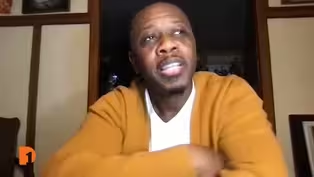
A new mixed use development project is coming to Northwest Detroit, and the top goal for the development is offering affordable housing to Detroit citizens who have never left the city, and it will have some beautiful touches.
Artist Tylonn Sawyer will provide artwork for the interior and the exterior of the building.
One Detroit's Will Glover caught up with Tylonn to discuss the development and they also talked about the role of digital media helping or hurting Black artists.
>>So Tylonn, the themes of your work delve into the cross sections of race, politics, identity.
When you create this work, who is it for and what do you hope that they get out of it?
>>I guess you can specifically say White people, but that's not necessarily the case because I consider myself American.
And when I referred to like the founding fathers, I noticed that I put our in front of it, right?
So like, obviously that's a type of ownership that I take on, some other people may not.
But even, I would say, I bet you if they're American somehow subconsciously they still maybe think that way.
And so creating works like that, similarly that to most things that I do, I think that it's about getting the viewer to engage with our history and even recent history in a more thoughtful way than just a romanticized way that we've become accustomed to it, you know?
I hope that my art does sorta influence younger people or people to think in a much more nuanced way about these problems 'cause we have heavy handed problems, but they're so intricate.
It's hard to just say, "Do this and this'll fix that", you know?
You know, "Defund the police that's going to!
That?
Is that what's going to stop all of the killing?
You know?
And I get where it comes from.
But I mean like it's such a complicated problem, you know, like you can't just use, you know, like something that needs a scalpel, you come in with, you know, like a sledgehammer or something like that.
Unfortunately, that's the way I think that's how we've gotten to where we are socially in this country.
And so a lot of my work kind of deals with that.
Like you mentioned that painting, like, "A Gentle Reminder", you know?
And it's a Black power fist with butterflies on it that have, but instead of the Monarch designs, it's a Confederate flag.
You know, and butterflies are a metaphor for reincarnation in certain Eastern religions.
And so racism kind of suddenly reincarnates itself in a different way.
It's not that good old boy, mass lynching, pickup truck, or angry like Southern Confederate sort of thing now.
Now it takes place subtly in boardrooms.
It's policies that disproportionately affect people of color.
It's the way that we may not see people who look like us on television shows.
When we do see folks that look like us on television shows, it's a script written by a person who never lived our lives.
So when we hear the dialogue, there's this disconnect from like who I am versus who they're presenting like on television.
And so, yeah, like when I do my work, I try to pay attention to like those little subtleties, the little things that are causing these bigger problems.
You know, 'cause a lot of times that's what it is.
It's just a bunch of little things that compound themselves into these big mass problems.
>>So, as an artist with a resume like yours, what advice do you give to artists who, you know, want something similar for themselves?
>>Usually it's young people and I would say, you have to have hard work and you have to have passion.
Like, all these things have to kind of coalesce at the same time.
Like, my work is heavily research-driven.
My paintings are very laborious.
I spend a lot of time working on them.
Sometimes it happens quick, but that isn't the case the majority of the time.
Like I say, how many books I have to read, the networking aspect of it.
It's a lot of hard work.
It exhausts you.
And sometimes you have to be pushed and you have to push yourself because one else is gonna do it.
We live in a time where a big chunk of the messaging to younger people about safe spaces, take your time, you know, like your anxiety.
You know, like take care of yourself, your anxiety, you know, self care.
You should have been doing.
You should, yes, you should take care of yourself, but all humans have anxiety.
I don't know.
I have a lot of anxiety right now, you know?
Just from speaking and (indistinct) and I can imagine when you do.
Like, this is just a part of the human condition.
And I've often, I don't know, like from what I see, the narrative seems to make these aspects which are the tribulations.
But they are average parts of the human condition and they are given like this special credence to stop people from putting their best foot forward.
I do think that you should address those issues via therapy or whatever it takes, whether it's considered self-care.
But simultaneously, man, I get in the studio and I work.
I come from a blue collar family who went to, you know, they go to work every day to take care of their families, their homes, and so I have to go to work everyday, rather I'm teaching.
When I'm not teaching, I need to be in the studio doing the same thing with that type of ethic.
Yes, it's a lot of hard work and I am drained at the end of the day, but man, what a labor of love.
What great problems to have, to be exhausted from painting rather than filling out TPS reports in the office?
And I made a very conscious decision to change my life to what it is now and be an artist and be an educator.
And I'm 1,000 times happier.
>>For more about Tylonn Sawyer, just head to our website at www.onedetroitpbs.org.
All right, next up Silver Point artist and muralists, Mario Moore.
We met up with him at David Klein Gallery for his exhibition that asks the very important question, is it ever possible for Black men to truly rest?
(soft piano music) >>I'm interested in like creating the stage that the audience can kind of come into.
(soft piano hip hop music) Art to me has always been involved in my life.
I grew up around the DIA.
I used to go visit a museum when I was a kid.
I would walk through the galleries.
But as far as like inspiration, that came from my mom's Sabrina Nelson, because, you know, I would see her do these large paintings.
Just the idea to look at a canvas that's blank or a piece of paper and her just like make something was always interesting to me.
The way that I begin my work is usually through sketches and ideas.
It's usually that I have a thought and I have a process and I sketch out or I think about that thought, And I say, "What is the best way to portray this thought "or to talk about this idea?"
So that can go to sculpture, that can go to drawing, that can go to video, that can go to painting.
But the majority of the time I'm interested in like a massive narrative.
We're in the David Klein Gallery and the show is called "Recovery".
And the show is about considering how Black men rest and relax and take time for themselves.
What happened was I was working on a body of work where I was thinking about myself personally and how I move my body through the world and how the world considers me as a Black man, and then I had brain surgery.
I had brain surgery and literally I was forced to rest.
So, that made me think about things historically.
Like, how did historic Black men that we know and the world knows like a Martin Luther king, or a Malcolm X, or a W.E.B.
Du Bois, and when we look up their names, they're always speaking really loud.
They're on the podium.
They're always active.
Like, in times of turmoil, like what we're dealing with today as far as everything politically and socioeconomically, how do I rest?
'Cause we're kind of in a similar state.
And in some ways, in some senses, as far as education and other things like that, it's worse.
It's gone backwards instead of forwards.
So, but at the same time, we're human.
So these men took vacations.
They took time with their family, they took naps.
So I started to think about that and the work presents a question because I don't have the answer.
So how do Black men rest?
How do they relax?
And what does that look like?
It has to do with just the history of America and that Black men and Black people just in general, we're in the process of constantly having to stay ahead, right, just to catch up economically, Since we got to the country or the Americas, we were slaves.
You know, it was things that the country were built on the labor that we put in.
So that is passed down as far as trying to catch up, you have to work extremely hard.
So the idea of resting and relaxing is not a part of the process when you're always thinking about what do I need to do next?
Silver point is a technique that was used in the 16th and 15th century, and it's literally a piece of silver and drawing with a piece of silver.
Most of the silver point drawings that have the historical, like, the larger ones that have the historical figures in the background, it's a concept.
And the idea is that, can a Black man look relaxed and calm and present himself in that way, but also at the same time, be powerful?
Like, I'm letting the background, you know, the historical figures do all the work for me while I relax.
And I think that's part of the importance and a part of the process.
I like the amount of texture and detail that went into the silver point, but there's a limited number of values that you could reach.
So no matter what I draw, no matter how hard the subject matter is, it's always going to be this softness to it, and I really like that.
The other thing I really like about silver point is that you can't erase, so it's almost like drawing with a pen.
Like, whatever you put down is permanent, right?
So, everything that goes into that drawing, you have to deal with it, right?
It's there to exist forever.
Another thing I like is that in dealing with silver point, you're literally leaving behind silver on paper.
So you're creating something that has an initial value.
And with the work that I was working on, I'm dealing with the subject matter that people don't see as valuable.
America often sees us as invaluable as far as Black men and also this idea of rest, this idea of relaxing.
So I think that material has worked for me really well in thinking about these ideas and concepts.
There's one piece in particular in the show, I read this book called "Medical Apartheid".
It has to do with the experimentation on Black people from slavery to contemporary times.
And I also got this huge photography book called a "Stiff Skulls and Skeletons".
Through that book, you can see how they like experimented in practice on cadavers.
And the most cadavers you will see are Black or African-American cadavers.
And the way that that happened is they were like, "Well, we don't really care about this community, "so we can dig up these graves and use these bodies."
Right?
So those bodies became objects.
They weren't even people anymore.
So it was like, "Well, the thing that just happened to me "with my brain surgery, what would that look like "you know, back in these times?"
And I wanted to show an opposition to that, that shine the light on me as a person as a human being instead of an object, and kind of like mute the light on the figures that are above me.
The American bulldog, for me, it's a literal representation of the history of America.
And I use it as a symbol for America itself.
And often you'll find the dog is sleeping or relaxing as it's ignoring really big issues that are happening right above it.
I include history in my work because as far as social issues we kind of roll around all the time back to similar issues over and over again.
So I look at the past and I consider it and I'm saying, "Well, what was happening then, kind of looks like now.
"What did they do then?
What can we do now?
"What can we do to change it and what does that look like?"
I think there's a ton of stuff to take away from this show.
I think about a lot of different narratives that go into one piece, but there's a lot of stuff that I don't think about.
And I think those are the important things that people that come and see the show, that they can pull out for themselves.
I think it's important for the people to answer, "Well, these are the things that I've noticed.
"These are some ideas that I'm thinking about.
"This is a question that I have."
And I think if it becomes more participatory that the people that come and see the show, they provide the answers.
I think hearing their perspective and hearing their ideas about resting and what that looked like for them was extremely important.
I think hearing my dad talk about how he's worked since he was 16 years old, and talking about his perspective was important.
But I think the most important thing that happened after the show was I went into the barbershop, and one of the barbers that was in there, he told me after seeing my show, he literally took a week off of work.
And then also hearing that several men, you know, after seeing the show were going outside and crying.
You know, which is like, that they honestly never thought in this way.
So I think those were probably the most important things that happened.
(empowering guitar music) >>For more on Mario Moore, just go to our website at www.onedetroitpbs.org.
All right, rich Fall, colors, gorgeous dunes, intriguing architecture, Michigan really does seem to have it all in terms of natural and man-made beauty.
Glenn Stevens knows this fact all too well.
So he turned his photographs into a book called "Michigan Street" that not only shares the beauty of our state, but it helps out a special friend.
(soft xylophone music) >>Well, Glenn, you and I met through our work with the Detroit Regional Chamber years ago.
And I remember a couple of years ago, you know, just watching your social media feed and seeing all the beautiful photos of Michigan that you would post.
And you really started posting a lot of these photos during the pandemic time.
You started kind of going around the state and you're a Marquette guy by birth, and so you love this state.
But yet being able to capture the pictures that you do and then start to put it together in a book, take me back to the pandemic when you started going around the state.
>>Sure.
Well, I appreciate that.
And it's been a pleasure to get to know you and work with you on these different things.
You know, first of all, when you look at our state, I don't think I need to tell you, but we have an incredibly visually stunning state.
And, you know, when the pandemic kit, I really, like a lot of people, we took a pause literally but I think figuratively too.
And I just, you know, did a lot of assessment and said, "Okay, well, what am I going to do with this time?"
'Cause we did have more time.
And because I have such a passion for photography, I'm not a professional photographer, I'm just an amateur, but I wanted to put that work to some kind of use but I couldn't determine what it was.
And then it hit me.
And I met this gentleman through church, through a church group right around the same time named Manny Dines.
Got to know each other a little bit and found out that he has ALS and they needed a handicap minivan.
So talking to some friends, we said, "Well, let's make a picture book of Michigan.
Let's put all the proceeds towards raising money for this wheelchair accessible van, and that's how it all came about.
>>It's beautiful.
And the images you've captured and be able to put in this book which is called "Michigan Street" because?
>>Because I grew up literally on Michigan Street in Marquette.
And so Michigan Street is a physical place but it's also kind of a state of mind for me, and I think for all of us.
>>Take me through some of the images that we see here.
They're stunning.
Some of them bring me to tears because I can see myself in those places.
When you look to capture some of these photos, what are you looking for?
And how do you set it up in your mind before you take that picture?
>>My father always taught me and my mom did too, you know, look up, look around and see what's in front of you.
But I think you hit on something there is that, almost every one of those pictures, there's a little bit of a story going behind it.
I didn't just take the picture.
I took it in.
I memorized it.
And then some of them literally have stories behind them.
So that's where it all comes about.
>>What are some of your favorites?
Can you share one with us?
>>I'll give you two perfect places that I love.
One is Detroit.
One is Marquette.
You know, and they're vastly different places, but they're connected for a variety of different reasons.
But in Marquette, you know, the cover, and some of the places in Marquette along Lake Superior, Little Presque Isle, Cardie's Cove, those are kind of my places, you know?
That special place.
That happy place that people talk about.
But in Detroit, I've got a picture of when they first started to renovate the train station.
And then the second floor of the Detroit Public Library on Woodward, the main branch, up in the court, the murals there.
You know, those are just pretty special places.
So those would be a couple.
>>When you think about putting them all together and saying, "Well, not only are we going to put this out for people "to enjoy and to love", but the connection that you have with Manny and where he's at right now.
Explain or kind of describe that connection that you two have and what has come of that since "Michigan Street" has been out?
>>Well, you know, one of the things I didn't know about Manny when I first met him is, come to find out, they literally have traveled this entire state as a family.
When I first started to put the book together, I didn't know that and then I found out that.
So I wrote an intro to the book and I asked Manny and his family to write the closing of the book, to talk about those places.
When I first met Manny, the ALS, which I've learned a lot about, it's an incredibly progressive and horrible disease, it wasn't that advanced.
It had set in but now it's pretty advanced.
And what I've really gotten out of it is the resiliency of him and his wife Annie.
It's incredible.
It's inspiring.
So, to be able to help them along with my friends who purchased the book or made donations towards the van, it's been a pretty cool journey.
>>All right.
So tell us, Glenn, how can we help out?
Where can we find the book "Michigan Street" and continue to help out Manny and his family?
>>Thanks, Christy.
So it's www.michiganstreet.org.
And when you go to that website, you'll find a link to Mandy's Machine where you can either make a donation or you can purchase the book and I'll ship it to you.
And my distribution center, which is my folks up north, they've been helping ship the books all throughout this year.
>>(laughing) It's good to have connections like that.
It's good to have a distribution center.
>>They're great workers and they're passionate about the project too.
It's been fun to do it with them.
>>Glenn Stevens, thanks so much for joining me.
It's great to see you and it's just a wonderful project and our best to Manny and his family as well.
>>Thanks, Christy.
Really appreciate the time today.
(inspiring piano music) >>Christy, you're wrapping up your time with us here at Detroit Public Television.
And both Nolan and I want to say a really sincere thank you for your professionalism, for your elegance, for all of the things that you've done for us as a host, as a partner, and as anchor on "One Detroit" and other programs.
We will miss you.
We will never be able to replace you.
But we want you to know how much we cherish all the work that we did together.
>>And Christy, we also want to thank you for being such a long suffering referee between Steve and I.
We know we tested your patience and it wasn't always easy.
As you move to the next chapter, we do want to wish you and your family health and happiness, and take a few minutes now to celebrate your amazing work for our station.
>>Welcome to Mi Week.
We're glad that you're with us.
I'm Christy McDonald.
This morning, Emergency Manager Kevin Ore announced the chapter nine municipal bankruptcy filing.
Governor Snyder says this is a new beginning for the city.
Gentlemen, thank you so much for joining us on Mi Week.
Welcome to American Graduate Community Town Hall.
The American Graduate Initiative is a national public media commitment to help communities find solutions to the high school dropout crisis.
Now how Detroit is tackling a staggering amount of blight with some unusual help.
Christy McDonald has this report.
Detroit's new Mayor is focusing on the demolition of the tens of thousands of houses stripped beyond repair.
And what kind of speed are we seeing and what are the numbers that we're seeing?
Welcome to the gubernatorial town hall.
Now let me introduce the candidates for Governor, Governor Rick Snyder and Congressmen Mark Schauer.
And Flint residents who can't drink their tap water are picking up bottled water that has been brought and donated.
>>This is like the second or third time that we've actually came and got water.
>>I don't- >>These were not illegal guns.
>>I don't think that we can have, hang on, we can have this gun debate and just look back at the most recent mass shooting.
A DACA recipient who came to the US at the age of one undocumented.
>>But now it's our nation.
>>Have people said, "Juan, stop talking"?
"Like, you're going to get yourself into trouble."
Or are they saying, "Thanks for talking because I don't feel like I can"?
Hi there and welcome to "One Detroit".
I'm Christy McDonald.
It's our first show.
Guys, we're out on the road in a little something new this time around.
A subtle sign of change in island view.
Beyond the counter, you realize The Commons isn't just a coffee shop.
So where did you have to go before to get laundry done?
What are the main issues that you're thinking about?
>>Me?
>>Yeah.
>>The character of our President.
>>Hey, "One Detroit" it's Christy.
I'm coming to you from my basement.
I'm sure a lot of you are working from home now.
Governor Whitmer , it's good to see you.
How are you doing?
>>I'm fine.
I'm hanging in.
>>Thank you for having us.
>>And that is going to do it for our "One Detroit" virtual town hall.
That's going to do it for Mi Week and for all of us at Detroit Public Television.
I'm Christy McDonald.
Be safe, take care.
(upbeat pop music) >>Hey!
>>How are you guys?
Thank you so much for that tribute.
It is my last weekly show here with Detroit Public Television.
I am so proud of this arts and culture show we've created during the pandemic to keep you in touch with the music, theater, art exhibitions, and so much more that we were missing.
It has been a privilege to join you each week for the last 10 years here on Detroit Public TV, to give you context with the news, share stories from around our area, and have some fun along the way.
"One Detroit" is in solid hands with its tremendous staff.
I thank you for your trust and your support.
I am staying put here in Detroit where I've grown up and where I'm raising my three kids.
You'll probably see me at musicals downtown or outdoor concerts and events that celebrate our city.
I'll also continue to moderate important conversations and elevate the voices of the amazing people who make Michigan unique.
New beginnings are truly great and I'll be sure to see you again.
Until next time, I'm Christy McDonald.
Take care.
>>From Delta faucets to Behr paint, Masco Corporation is proud to deliver products that enhance the way consumers all over the world experience and enjoy their living spaces.
Masco serving Michigan communities since 1929.
>>Support for this program is provided by the Cynthia and Edsel Ford Fund For Journalism at Detroit Public TV.
The Kresge Foundation.
Community Foundation for Southeast Michigan.
>>The DTE Foundation is a proud sponsor of Detroit Public TV among the state's largest foundations committed to Michigan focused giving.
We support organizations that are doing exceptional work in our state.
Visit www.dtefoundation.com to learn more.
>>Business Leaders For Michigan, dedicated to making Michigan a top 10 state for jobs, personal income, and a healthy economy.
Also brought to you by the Fred A.
And Barbara M. Erb Family Foundation and viewers like you.
(upbeat pop music) (soothing piano music)
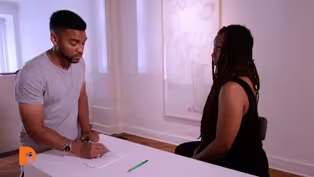
Silverpoint Artist Mario Moore
Video has Closed Captions
Clip: S5 Ep49 | 7m 48s | Silverpoint Artist Mario Moore Discusses New Gallery Exhibit (7m 48s)
Video has Closed Captions
Clip: S5 Ep49 | 5m 2s | Northwest Detroit Development Named After Artist Tylonn Sawyer (5m 2s)
Providing Support for PBS.org
Learn Moreabout PBS online sponsorship
- News and Public Affairs

Top journalists deliver compelling original analysis of the hour's headlines.

- News and Public Affairs

FRONTLINE is investigative journalism that questions, explains and changes our world.












Support for PBS provided by:
One Detroit is a local public television program presented by Detroit PBS