
UK Professor Discusses Current Conflict
Clip: Season 2 Episode 241 | 6m 17sVideo has Closed Captions
Prof. Robert Farly talks about campus protests and helps us better understand the current conflict.
Professor Robert Farly with UK's Patterson School of Diplomacy and International Commerce, talks about campus protests and helps us better understand the current conflict.
Problems playing video? | Closed Captioning Feedback
Problems playing video? | Closed Captioning Feedback
Kentucky Edition is a local public television program presented by KET
UK Professor Discusses Current Conflict
Clip: Season 2 Episode 241 | 6m 17sVideo has Closed Captions
Professor Robert Farly with UK's Patterson School of Diplomacy and International Commerce, talks about campus protests and helps us better understand the current conflict.
Problems playing video? | Closed Captioning Feedback
How to Watch Kentucky Edition
Kentucky Edition is available to stream on pbs.org and the free PBS App, available on iPhone, Apple TV, Android TV, Android smartphones, Amazon Fire TV, Amazon Fire Tablet, Roku, Samsung Smart TV, and Vizio.
Providing Support for PBS.org
Learn Moreabout PBS online sponsorshipToday, I sat down with Professor Robert Farley with the UK Paterson School of Diplomacy and International Commerce to talk about the protests and better understand the current conflict.
Dr. Farley, thank you so much for a few minutes of your time.
Thank you for having me.
It's such an important topic.
The Associated Press reported today that the arrests related to these protests over the Israel Hamas conflict has now top 2000.
And we know that college campuses across this nation, even some in Kentucky, have had demonstrations.
The ones in Kentucky have been far more peaceful.
What's the message that protesters are sending about this conflict, about this war that they want policy makers to pay attention to?
Well, the protesters are a varied group, and so they're sending a few different messages.
But the central message, the real message is that Israel should stop its offensive against Hamas in Gaza, that the United States should stop its support for Israel, the delivery of military equipment, and that in particular, the universities that the protesters are on should take a set of steps that essentially divest them, cut any connections between the university and the state of Israel and even parts of the United States military and the United States military industrial complex.
And that's a shift, perhaps in popular thinking about supporting Israel, is it not?
I'm not sure It's a shift from sort of where students and young people have been in the past.
This is a Palestinian cause, has long been popular on campuses.
And if you'd been five years ago, you would have seen Palestinian flags, not as many as you do now.
You know, I think certainly it is more vocal now because of the events that are happening in Gaza.
But I'm not sure we've seen a transformation in the sort of the source of opinion.
It's just that the opinion has gotten louder.
Gotten louder.
Well, because since the mid 20th century, of course, this is nothing new, Middle East conflict.
And we know that Israel hasn't been engaged in wars and they face threats from Hezbollah to Hamas.
What events or circumstance make this particular conflict unique?
So what makes this particular conflict unique in the context of the conflicts you just talked about?
This is a much bloodier conflict than we have ever seen between Israelis and Palestinians.
This is a conflict for the for the longest time was characterized by, you know, dispossession and the seizure of land and territory, but not by tremendous numbers of deaths.
Even when Israel was waging war against Syria or Egypt, really what's happened in the past six months in Gaza has seen a level of bloodshed that this conflict had never seen before and the level of destruction.
And so that, I think, is what has really changed in this conflict and in the US response to this conflict and that since the fall, since October 7th, I believe it was in 2023, right, since October 7th, which was a devastating attack that killed over a thousand Israelis.
And since that time, the numbers vary, but people place it above 30,000 Palestinian deaths.
Help us.
It may seem like a very pedestrian question.
Define pro-Palestinian.
Well, that's a that is a very complicated question.
At its maximum, pro-Palestinian means and the idea that Palestinians, who were the people who lived in British mandate in an Ottoman Palestine in the 20th century should be restored to the political rights to that territory.
And so sometimes when people say from the river to the sea, Palestine will be free, that's what they mean.
The Palestinians should control this territory, a different way of being pro-Palestinian is to say the Palestinians should have all the same rights and privileges that Israelis enjoy within this particular territory.
And that's a one state solution.
Palestinians where Jews and Palestinians live together.
And another way of being pro-Palestinian is to say that there should be a two state solution where the Israelis have their state, the Palestinians have their state, and that these are separate and distinct that have their own sovereign existence.
Mm hmm.
Being pro-Palestinian doesn't mean you're pro Hamas, though, correct?
It does not necessarily mean that you are pro Hamas.
There are certainly lots of people who are pro Palestinians who are also pro Hamas.
But being pro-Palestinian does not necessarily mean that you are endorsing Hamas's viewpoint or Hamas's actions.
So let's talk about the US role.
We know that the US was the first to recognize Israel as an independent state in 1948 with President Harry Truman.
Every US president, correct me if I'm wrong to follow, has been supportive and an ally of Israel.
When we look at the current political conditions that we're in and dynamics in an active presidential election year, we know that recent polling shows that President Biden is losing ground with young people, in part, not in whole, because of his handling of the Israel-Hamas war.
Is this a liability for him?
And it could it.
Bouie Former President Donald Trump in some way.
So you bring up the history is very interesting because most U.S. presidents have been pretty pro-Israel since the founding of Israel.
But that's very true.
The relationship has not always been close between Israel and the United States.
We're in a very interesting position right now in that President Trump has staked out a very clear former President Trump staked out a very clear position that he is strongly pro-Israel.
And so by any way you can measure President Trump as a stronger pro-Israel, really anti-Palestinian position than President Biden does.
President Biden's political problem is that and the United States is almost entirely unique in this, that the coalition of the Democratic Party includes both Jews who are pro-Israel and Muslims who are pro-Palestine.
That's not a connection you see in many other democracies.
And it creates a huge problem for President Biden because he has to, on the one hand, keep this one constituency happy and then this other constituency, which has an entirely opposite view of what should be happening in the Middle East.
So it creates a massive problem for President Biden in terms of keeping his own coalition together.
And it does, I think, open up some opportunities for for former President Trump in this election.
Well, thank you, professor.
We appreciate your time.
Thank you for having me.
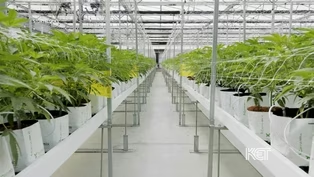
DEA Moves to Reclassify Marijuana
Video has Closed Captions
Clip: S2 Ep241 | 1m 56s | What impact might the DEA's proposal to reclassify marijuana have on those researching cannabis? (1m 56s)

Impact Of Bird Flu In Kentucky
Video has Closed Captions
Clip: S2 Ep241 | 4m 18s | Commissioner Jonathan Shell talks about the impact a new outbreak of bird flu is having in KY. (4m 18s)

Video has Closed Captions
Clip: S2 Ep241 | 3m 19s | Most women should get their first mammogram earlier, according to an expert panel. (3m 19s)
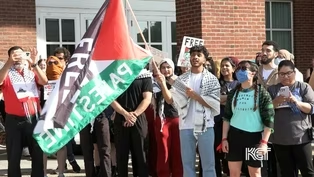
Video has Closed Captions
Clip: S2 Ep241 | 3m 35s | A pro-Palestine protest gets loud, but stays calm, at the University of Kentucky. (3m 35s)
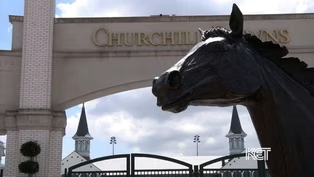
Upgraded Paddock at Churchill Downs
Video has Closed Captions
Clip: S2 Ep241 | 3m 41s | Churchill Downs is showing off a two-year, $200 million dollar upgrade to its paddock. (3m 41s)
Providing Support for PBS.org
Learn Moreabout PBS online sponsorship
- News and Public Affairs

Top journalists deliver compelling original analysis of the hour's headlines.

- News and Public Affairs

FRONTLINE is investigative journalism that questions, explains and changes our world.












Support for PBS provided by:
Kentucky Edition is a local public television program presented by KET