
Ukraine War, Detroit Rewards TV, Labor Shortage, Belle Isle
Season 6 Episode 8 | 26m 46sVideo has Closed Captions
Russia-Ukraine War, Detroit Rewards TV, Labor Shortage, Feeding Fish at Belle Isle
One Detroit hears how the Russian-Ukraine conflict overseas is affecting Michigan's Ukrainian population. Then, Detroit has a new weapon for solving crimes: the community. One Detroit learns more about DPD and Crime Stoppers' new Detroit Rewards TV program. Plus, grocery stores are still grappling with worker shortages— find out why. And feed the Belle Isle Aquarium fish with Great Lakes Now.
Problems playing video? | Closed Captioning Feedback
Problems playing video? | Closed Captioning Feedback
One Detroit is a local public television program presented by Detroit PBS
Ukraine War, Detroit Rewards TV, Labor Shortage, Belle Isle
Season 6 Episode 8 | 26m 46sVideo has Closed Captions
One Detroit hears how the Russian-Ukraine conflict overseas is affecting Michigan's Ukrainian population. Then, Detroit has a new weapon for solving crimes: the community. One Detroit learns more about DPD and Crime Stoppers' new Detroit Rewards TV program. Plus, grocery stores are still grappling with worker shortages— find out why. And feed the Belle Isle Aquarium fish with Great Lakes Now.
Problems playing video? | Closed Captioning Feedback
How to Watch One Detroit
One Detroit is available to stream on pbs.org and the free PBS App, available on iPhone, Apple TV, Android TV, Android smartphones, Amazon Fire TV, Amazon Fire Tablet, Roku, Samsung Smart TV, and Vizio.
Providing Support for PBS.org
Learn Moreabout PBS online sponsorship- [Announcer] Just ahead on One Detroit, Russia's invasion of Ukraine.
What's fact, and what's fiction.
We'll look at efforts by Michigan's Ukrainian community to tell the real stories about the conflict.
Plus Detroit police and Crime Stoppers, turn to the web and television to close unsolved crimes.
Also a future of work report on what's causing grocery store workers to leave the industry.
And we'll go behind the scenes at the Belle Isle Aquarium to see what's on the menu at feeding time.
It's all coming up next on One Detroit.
(soft music) - [Narrator] From Delta faucets to bear paint.
Masco Corporation is proud to deliver products that enhance the way consumers all over the world experience and enjoy their living spaces.
Masco, serving Michigan communities since 1929.
- [Announcer] Support for this program is provided by the Cynthia Edsel Ford Fund for journalism at Detroit Public TV.
The Kresge Foundation.
- [Narrator] The DTE Foundation is a proud sponsor of Detroit Public TV among the state's largest foundations, committed to Michigan focused giving.
We support organizations that are doing exceptional work in our state.
Visit dtefoundation.com to learn more.
- [Announcer] Business Leaders for Michigan.
Dedicated to making Michigan a top-10 state for jobs, personal income, and a healthy economy.
Nissan Foundation, and viewers like you.
(upbeat music) - [Reporter] Coming up on this week's One Detroit.
it's a new way to catch criminals in the city of Detroit.
The police department has teamed up with Crime Stoppers for a web and television program that encourages citizens to report criminal activity in return for a cash reward.
Also ahead, they were frontline workers at the start of the pandemic, but now many have left their jobs in the grocery store business.
Our future of work initiative takes a closer look at why grocery store workers are calling it quits.
Plus, have you ever wondered what fish like to eat?
We'll take you inside the Belle Aisle Aquarium for a look at what fish bed and how it keeps them healthy.
But first up the developments in the Ukraine are being watched closely all over the world.
Here in Michigan, some Ukraine Americans are fighting their own battle to make sure the online stories about what's going on in the region are true and not a disinformation campaign led by Russian supporters.
One Detroit senior producer, Bill Kubota has the story.
(upbeat music) - [Narrator] A rally for Ukraine over at the University of Michigan last weekend.
- So my father-in-law's very conservative and he attended that rally with me on Saturday.
A few months ago, he was calling Vladimir Putin's man, and now he wants to give money to any charity that he can, to end this war.
- [Narrator] Natalia Kujan Gentry Detroit attorney and Ukrainian American lending a voice to the fight trying to change minds.
- And so I convinced him and I'm sure I convinced other people, but the only way you can do that is by telling your very deep, personal story to make it real.
- [Narrator] Gentry, a U of M history major growing up steeped in tradition and culture.
- We played soccer together.
We played Bandura together, which is the instrument behind me.
I had to pull it out.
(laughs) - [Narrator] Gentry taught others how to play.
The Bandura has a special place right here in Michigan.
(Bandurist chorus) Here's the Ukrainian Banduras chorus, the national ensemble based in Metro Detroit.
- We've preserved our language.
We've preserved our music.
We kept it all alive.
- It's interesting because Ukrainian was my first language, even though I was born in and raised in Metro Detroit.
- Dan Terleckyj is in Chicago now.
Also an attorney while bringing news to Ukrainian Americans through an online radio speed.
(dramatic music) - Today on Ukraine Watch I'm speaking with Hans Petter Midttun.
I know the true story.
Hey, I'm just a guy.
One person here with a laptop and a cell phone.
- [Narrator] He's talking to people from all over and inside the war zone.
- Maria and Yuri, please, please stay safe.
Please stay in touch.
I know what's going on.
And I know the people who can tell the true story, and I'm just trying to magnify their voices.
- The communication and the direct pipeline to what's happening is different than any other war.
- Vladamir Putin's never lost a war.
He's invaded sovereign territory four times.
But I think that this time is different because of the social media.
'Cause the world is finally starting to see what Ukraine is.
Not that it's some dark Soviet remnant.
It's a beautiful, vibrant metropolis with history that goes back thousands of years.
- [Narrator] The last century, Ukrainian struggle with Russians the Soviets, it's been ongoing.
- My grandmother was an immigrant to this country.
She came to Detroit in 1949 after World War II.
- [Narrator] Here's Terleckyj's grandmother, symbolizing Lady Liberty freedom chain to a hammer and sickle.
- They organized their own media for the time.
It wasn't what I'm doing.
But I'm just doing what they're doing with new technology.
- [Narrator] Ukrainian and Americans can connect this war with history they know well, and more of us ought to.
- But we know about the Armenian genocide.
We know about the Holocaust.
- No one knows about The Holodomor.
The Holodomor was again, a Soviet reaction to, you know, what was considered to be mild resistance.
The Soviet idea is that you punish the people anytime that they act up.
- [Narrator] The Holodomor 1932 to 1933, an intentional mass starvation that killed many, many millions, mostly Ukrainians.
- So my grandparents, all four of them were young kids when the genocide happened, they were all less than 10.
Some of their siblings were starved to death.
The world did not know about Ukraine's genocide you know, the iron curtain was real.
No information came out and no information came in from the outside world.
- [Narrator] Now attorneys Terleckyj's and Gentry are networking with others, trying to bring Ukrainian refugees to the US.
Nearly 700,000 have fled mostly women and children.
The men held back to fight the Russians.
but who else will fight with them?
- Ukrainians have a say.
(speaking foreign language) Your ancestors don't make you Ukrainian.
Your descendants do.
So to every single person in the world who's fighting for freedom and democracy.
We are all Ukrainian now.
- [Announcer] The Detroit Police Department has a new weapon in its efforts to close criminal cases in the city.
Detroit Rewards TV is a website and television show produced in partnership with Crime Stoppers of Michigan.
The goal is to encourage citizens to speak up if they know something about an ongoing investigation and possibly receive a cash reward.
Bryce Huffman of bridge, Detroit talks to One Detroit about the pros and cons of the new program.
(upbeat music) - We have shot spotter.
We've talked about facial recognition.
We've talked about project green light, and now we have Detroit Rewards TV.
- Yeah.
So to give like the brief summary.
Detroit Rewards TV is the, name's a little bit misleading 'cause it's not just a TV show, but it's a website and a TV program that gives information on ongoing Detroit police investigations.
And it gives people the chance to earn money by providing tips to the police.
And they do that by actually providing the tips to Crime Stoppers of Michigan.
They're a nonprofit that's been working with the police department for nearly 30 years on getting people to provide information on cases.
- What was the deciding factor or what pushed DPD to allocate resources, financial resources to this Detroit Rewards TV program?
- I think DPD realized a while ago that they're best at solving crimes when they have the support and the help of the community.
And Crime Stoppers of Michigan has been helping them get information on cases for a long time now.
So that part of it isn't necessarily new, but I think the department, they wanted to reach people where they're at and they figured if we give them a TV program that they can tune into regularly and see information about the cases that we're looking for info on, or if they can go to a website and just see, okay, these are the kinds of cases that we're trying to solve right now.
Do you know anything about them?
It gives the community kind of a chance to weigh in on and provide input on cases that are actually happening in their community.
And I think that's one of the things DPDs really been trying to focus on in the past couple of years is making residents understand that the fight against violent crime is something that it's not just the police.
It's not just the criminals, it's everyone in between.
- Is there any evidence that programs like these actually help solve crimes?
Does it help reduce crime rates?
What is the outcome of stuff like this or do we know yet?
- We don't know yet.
And I think that's like the short, easy answer.
We do know that the department did look at some examples from other cities to see, all right, how do these rewards programs typically work?
Detroit kind of did their own thing with having a TV program and a website.
They kind of decided we're gonna do it a little bit differently than we've seen it done before.
Just so you know, it kind of has our own unique spin on it.
So we don't know exactly how it will work here, but the chief and other people in the department are really happy with the idea that people in the community who've been fed up with crime rates and with shootings and carjackings in their area can now directly help the police solve those issues.
- Is it a concern that majority of the people who are on the website are African American young men and the photos aren't always the clearest because they're usually security camera photos.
Have they expressed any concern about misidentification or over policing or any of the ancillary things that go along with posting people's faces, potential criminals faces along with, a dollar amount for what's essentially almost a bounty?
- The department hasn't expressed any concern about that.
That's something that me as a reporter who's been in critical department has a little bit of concern about because there is the financial incentive to report things now.
But again, it's one of those it's too soon to tell things, I could personally see some bad things happening with it.
I could see some misidentification being a possibility just like with facial recognition.
But I think the department has policies in place that at the very least, if someone is misidentified, it wouldn't necessarily lead directly to a wrongful arrest.
- Do you think that this is a worthwhile endeavor or do you think that maybe the efforts should be put more towards the image of police to get more people to want to cooperate?
Is there a better way or a better thing that they could be focusing on right now?
- This maneuver, this initiative kind of signals to me that they do wanna work with the community and they do want residents to feel comfortable reporting things that they know are happening that are wrong.
And I don't have any problems with that part of it.
I think the thing to be careful of is to not just spread traumatic black stories for the sake of spreading traumatic black stories.
And luckily for me, I do get the sense that they're spreading these stories, 'cause they're trying to get help solving these crimes and bring closure to families.
It doesn't necessarily come off as though they're sensationalizing black trauma just for the sake of doing it.
- What are some of the things that you'll be keeping an eye on as we learn more about the program as it develops?
- So you kind of hit it on earlier.
I'll be looking out for things like wrong influence.
I'll be looking out for some of the like you said, there's a dollar amount next to these pictures does that wrongfully incentivize people to report things that might not actually be violent crimes or might not be that serious type of crime just for the reward money.
As with any system where money's involved people might try to corrupt it.
So I'll be looking out for those kinds of things as like on a watchdog level.
But for the time being everyone in the departments, seems really excited about it.
Crime Stopper seems really excited about it.
So we'll just keep an eye out and see if it goes well or it doesn't go well.
- [Narrator] Since the start of the pandemic, millions of people have quit their jobs for various reasons, such as safety concerns, low wages or desire to switch careers.
The labor shortage is impacting several in industries, but one of the hardest hit areas is retail.
Especially the grocery store business.
In this future of work report, we take a look at the pandemic's toll on grocery store workers.
(upbeat music) - [Walker] The grocery business in this time of COVID an industry disrupted online shopping, supply chain troubles.
The biggest challenge seems to be the loss of workers.
They're quitting.
Some just can't take it anymore.
- I was working as hard as I've ever worked in my entire life yet I was still struggling to pay my basic bills.
So it was, is like, why suffer like this?
- [Walker] A labor shortage has turned many industries upside down, a lot of retail businesses like grocery stores.
- Right now there's an unprecedented number of jobs available in the United States.
- [Walker] Eric Schulz, professor of management at Eastern Michigan University tracks labor trends.
- Almost 11 million jobs currently are open within the United States.
And at the same time, there's 8.4 million employee workers.
So if you think about it, that means there's less than one American currently looking for work for available jobs that are out there.
- [Walker] Despite the pandemic people have to eat.
And many grocery store chains have posted record profits that while many grocery workers have abandoned their jobs permanently.
- Prices are up about 3% across the board.
The stocks are bare particularly at night.
I mean, when you go in, it's really difficult.
And again, the whole supply chain has been disrupted because there is simply is a labor shortage in that industry, not enough truckers to move things.
- [Walker] Jeff Wells, a reporter from the industry publication Grocery Dive says that many people left because of health concerns and because more jobs a opened up.
- You saw a lot of burnout from working in stores and people realizing that they can find jobs in other sectors.
If you can work from home from a call center that might seem more appealing than a grocery store job right now.
- [Walker] Sydney McClowsky former cashier remembers her job changing almost overnight from ringing up customers to managing customers.
Trying to enforce COVID safety protocols.
- We were enforcing masks.
We were trying, trying to maintain social distancing, especially at the very beginning.
A lot of people were panic buying.
So there was just like tons of people in the store buying tons of stuff.
And I feel like some of that never really ended.
- [Walker] The virus wasn't the only safety issue.
Corinne Sikorski the longtime general manager at the Ypsilanti Food Co-op leads to staff with safety concerns.
There can be unruly customers because of mask rules.
- I think that was one of the biggest challenges we faced knowing that on the news, we're hearing about people who are bringing out their guns, if they don't wanna put a mask on.
And so that gave the staff a whole nother fear, probably a more or visible fear.
Like it's the virus isn't visible.
Whereas somebody, the thought of somebody bringing out a gun is more scary than something you can't see.
- [Walker] Stephanie Moebs another former grocery store worker tells of altercations with customers who wouldn't mask.
- And he started screaming at me, threatening me, saying things to me that I don't wanna re repeat.
And another worker came over and defended me.
Later it had come out that he'd rants actually the story.
So he went to the produce department, started throwing oranges and apples, and it was quite an ordeal.
- [Walker] Sydney and Stephanie left their jobs because of the stress part of the mass exodus of workers.
People who have found the confidence to quit, even if they don't have a new job in place.
- So many people were leaving.
And then it kind of was interesting to me that so many people were quitting and then they were like, fine.
And then I was thinking, well, I'll probably be fine too.
- Stephanie's now teaching at a Montessori school in Detroit.
- I have a regular schedule.
I have weekends holidays off, which is really nice and not something I ever got to experience.
I get to be around children.
And the most important thing I think is I do feel respected.
I do feel seen as a human being, as a fellow person, it's been wonderful not to be in a grocery store anymore.
- [Walker] For her, a given better pay, better working conditions and more staff to handle the load.
Maybe she'd still be a grocery store worker.
- Not skeleton cruise.
We don't need to see a one or two people doing the work of eight or nine or 10 people.
No one is gonna be happy under those working conditions.
No one's gonna stay.
- [Walker] Big box stores have tried many different strategies to attract workers.
Walmart is giving employees, cell phones, other stores offering big hiring bonuses.
Smaller more community based grocery stores can offer something that is often left out of the conversation, of values oriented workplace.
- We continue to find people in spite of the labor issues that we know are out there.
But I think in another way, some people might be dissatisfied with the job that they have and they are looking for something that is more community based.
So they come to work at the co-op.
So in some ways it's actually, I won't say it's been an advantage, but I guess it has had it silver linings for the co-op as well.
- [Walker] Well says automation will solve some staffing woos, but groceries still needs workers to run new machines and help customers.
- They're gonna have to get creative in how they market these jobs and the benefits that they offer if they wanna bring workers back, because no matter how much automation they bring into store, you still have to have human workers in there to make that a good experience.
- [Walker] One of the biggest changes that could help retain staff making grocery into a career path, not just a temporary job.
- I think that would do a world of good where people can see this is an industry I wanna be in where I can see a career for myself rather than just sort of a temporary job that I'll remain in.
That I think is really vital.
Because again, one of the things that people are truly reassessing they're working it is an opportunity for employers to reassess their workforce.
- [Narrator] The team at Great Lakes Now is getting an up close look at what the fish are fed at Belle Isle Aquarium and they're inviting you to join them for a live watch party on Facebook and YouTube on March 4th.
You'll get a behind the scenes glance at how the staff care for the fish and a chance to ask question about the favorite foods of the various species.
Great Lakes Now producer Anne Marie Seling has a preview.
(upbeat music) (kids mumbling) - [Narrator] Here at the Belle Isle Aquarium visitors gather on tanks full of both familiar and exotic species of fish and aquatic life.
But have you ever wondered what goes on behind the scenes at this popular Detroit destination?
We're pulling back the curtain and getting an up close look at what goes into caring for and feeding the fish who call this aquarium home.
- All right, we're gonna feed these guys right here.
- [Narrator] And as we take you through the process, you might be surprised to find out where it all begins.
If you don't immediately recognize this place.
It's Detroit's Eastern market, like many who come here for their produce on Saturday mornings, Belle Isle Aquarium curator, Paul Shuert shops for lettuce, zucchini and cucumbers.
But instead of the dinner plate, these veggies will end up in fish tanks.
- And we like to get fresh because you know, it's better for better nutrition for them.
So that's why we come to the market every Saturday.
- [Narrator] Once Paul is back at the aquarium, he and senior aquarias, Amanda Murray unload the bags of produce Paul along with boxes of fish, which also come from the market.
- So today we're actually in our lab space and this is an area nobody gets to see.
This is where all the magic happens, but this is where we food prep.
- Amanda spends time shopping the vegetables and then moves on to preparing fish for the aquariums carnivores residence.
Along with a vitamin gel mixture that will get chilled and then cut into cubes.
- We have a variety of fish here.
We have shrimp, we have tilapia, we have sardines, we have smelts and all the fish take different things depending on their size and what they require.
- [Narrator] Once the preparations are complete.
- And now for the fishes favorite time of the day and mine too, feeding.
- [Narrator] Amanda begins with the Frontosa Cichlids from Africa, moving on to the Texas Cichlids.
- They love the lettuce.
They're probably the fish that love it the most.
- And then the rainbow trout, the stingrays, the lionfish and piranhas are just some of the others in line for food today.
She says that some of the species here eat just once or twice a week while others require more frequent meals like these big-bellied seahorses.
- They get fed probably two to three times a day because they don't have a stomach.
- [Narrator] Feeding time is also a good opportunity to take stock of each fish's health.
- As a behaviorist, and as someone who takes care of these fish, it's really important to observe their behavior.
And one thing you can actually know about their behavior is watching them eat.
And that's when you're gonna notice things that are off.
So not only is it fun, but it's super important to pay attention to their feeding.
- [Narrator] After most of the fish are fed Amanda checks in with Paul.
- So I just finished B co and C co. And so they're done feeding for today.
Just gotta get the rest of 'em, which I'll hit later.
- Very good, very good.
- [Narrator] With the fish taken care of visitors begin to trickle in and before long another day at the aquarium is in full swing.
- They just ate a little bit ago.
- Oh, they ate, they're taking a nap.
- They're gonna probably take a nap.
Yeah.
- [Announcer] And go to onedetroitpbs.org for information on how to sign up for the upcoming Great Lakes Now First Friday Watch Party on March 4th at 1:30 PM.
That will do it for this week's One Detroit.
Thanks for joining us.
Make sure to come back for One Detroit Arts and Culture on Mondays at 7:30 PM.
Head to the One Detroit website for all the stories we're working on.
Follow us on social media and sign up for our weekly newsletter.

Detroit Police, Crime Stoppers Premiere Detroit Rewards TV
Video has Closed Captions
Clip: S6 Ep8 | 6m 25s | Will Glover and Bryce Huffman talk about DPD and Crime Stoppers new Detroit Rewards TV (6m 25s)
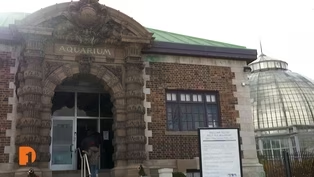
Feeding Frenzy: Watch the Belle Isle Aquarium’s Fish Get Fed
Video has Closed Captions
Clip: S6 Ep8 | 3m 51s | Great Lakes Now shows viewers how the Belle Isle Aquarium fish are fed and cared for. (3m 51s)
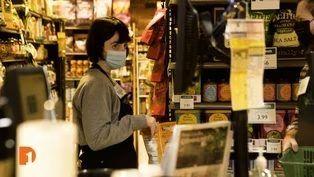
Grocery Stores Remain Hardest Hit by Employee Shortages
Video has Closed Captions
Clip: S6 Ep8 | 13m 39s | One Detroit's AJ Walker investigates the pandemic's toll on grocery store workers (13m 39s)

Ukrainian-Americans React to Russia Conflict, Misinformation
Video has Closed Captions
Clip: S6 Ep8 | 4m 38s | Local Ukrainian-Americans share their thoughts on the Russia-Ukrainian conflict (4m 38s)
Providing Support for PBS.org
Learn Moreabout PBS online sponsorship
- News and Public Affairs

Top journalists deliver compelling original analysis of the hour's headlines.

- News and Public Affairs

FRONTLINE is investigative journalism that questions, explains and changes our world.












Support for PBS provided by:
One Detroit is a local public television program presented by Detroit PBS