
Uncovering Albany's Midnight Politics
Clip: Season 2023 Episode 37 | 12m 20sVideo has Closed Captions
Exploring NY's push for budget transparency with Sen. Jim Tedisco.
Dive deep into New York State's legislative practices, particularly the controversial use of "messages of necessity" during late-night sessions and their impact on transparency.
Problems playing video? | Closed Captioning Feedback
Problems playing video? | Closed Captioning Feedback
New York NOW is a local public television program presented by WMHT
Support for New York NOW is provided by WNET/Thirteen.
Uncovering Albany's Midnight Politics
Clip: Season 2023 Episode 37 | 12m 20sVideo has Closed Captions
Dive deep into New York State's legislative practices, particularly the controversial use of "messages of necessity" during late-night sessions and their impact on transparency.
Problems playing video? | Closed Captioning Feedback
How to Watch New York NOW
New York NOW is available to stream on pbs.org and the free PBS App, available on iPhone, Apple TV, Android TV, Android smartphones, Amazon Fire TV, Amazon Fire Tablet, Roku, Samsung Smart TV, and Vizio.
Providing Support for PBS.org
Learn Moreabout PBS online sponsorshipif you watch the show, you already know how our government works.
But what you might not know is how the state legislature operates when they're on a tight deadline.
It's not uncommon for big, controversial bills, like the state budget, to be passed in the middle of the night, like 2 or 3:00 AM.
And a procedural rule to speed up the legislative process in an emergency, called a message of necessity, is often used casually, without a clear reason.
For some, those are ways to make the legislative process more efficient.
But others say it reduces transparency in state government.
That includes State Senator Jim Tedisco, who sponsors a bill aimed at that.
We spoke earlier this year about the bill, and how it could change things at the State Capitol.
Senator Tedisco, thank you so much for being here, I appreciate it.
- My pleasure, it's good to get out of the rain a little bit here.
- (chuckles) I Know.
We're looking forward to some drier days here.
- I'm praying for some sun and a little bit less humidity.
Hopefully we'll get there.
- Yeah, I hope so.
So this bill is actually a pretty simple bill, but the interesting thing about this bill that we're talking about, is, I think, what's inside of the bill, and the intent of the bill, are things that the public has no idea about, because the bill is kind of targeted towards things that the public doesn't know anything about.
I want to go over the first part first, which is something called messages of necessity.
These are used when a bill is introduced, and usually a bill would have to age three days in the legislature.
The governor can issue a message of necessity that just bypasses that at all.
So somebody could introduce a bill, and 10 minutes later you could vote on it and pass it.
What this bill would do, would require lawmakers to have two-thirds of a majority in each chamber to accept that message of necessity and move forward with a bill.
So talk to me about that.
Why do you think that that is the right way to go?
Why should it be two-thirds of people, and not just kind of an automatic thing from the governor?
- Well, the bill itself is called the New York State Budget Transparency Act.
And you know, we're not only public servants, and senators, and assemblypeople, we're representatives.
And the real purpose of it is transparency.
You know, someone once said that in darkness, democracy dies, had a little bit to do with the Watergate issue.
And that's a fact, and that's a truism.
But in this case, you're right.
The Constitution and our founders were very smart.
They said, if you're a representative, you've gotta have a bill on your desk, and you've gotta be able to read it in at least three days, give us the opportunity to read it.
But they also said, you may need a message of necessity.
Now what is a necessity?
It's an emergency.
99% of the time they never use it as an emergency.
They use it as a message of convenience, not to have to answer to ourselves, who are the representatives, which should interact with the public so we can get their input, and the media, like yourself, and others, who can report on it, and tell us what direction it's going, and what we should debate, and the questions we should ask.
So my bill tries to take care of those two areas, and really provide a representative democracy approach where people, not senators, assemblypeople, and governors are the most important part of this government.
- Now, you've been in the legislature for about 40 years now.
First in the assembly for a long time, now you're in the State Senate.
How have you seen this evolve over time?
Has it always been this way since you've been here?
That they've used messages of necessity pretty liberally?
- I just passed a bill, VIP, Veteran's Internship Program.
It took me 10 years to get that bill to the floor, and I finally passed it this year.
Believe it or not, I've had this bill for 12 years, okay.
And for 12 years, in many cases, both sides of the aisle have used messages of necessity.
Democrats would blame Republicans for late budgets, Republicans would blame Democrats.
But in this case, now, truly, there's only one group to blame, 'cause there's only one voice from one political affiliation, from one region of the state.
Super majority in the Senate, super majority in the Assembly.
And a Democratic governor, who's maybe a little bit more moderate, but still very progressive, 'cause they're turning her in that direction.
So this has been an old chestnut.
But, this year, I think we made some headway, because the other part of this whole thing, when I said in darkness, democracy dies, besides this message of necessity, where they give us an hour and a half and say, "Here's a 200-page budget document."
And by the way, it's not only for the budget bills themselves, it's for extenders.
They know three, four days in advance.
They know a week in advance.
they won't give it to us for an hour and a half before so we can read it.
You only use message of necessity when it is a necessity.
'Cause it's supposed to be for an emergency, like a terrorist attack, a financial disaster, an impending storm, maybe a pandemic.
You might want to have used it back when the pandemic was taking place.
But not for the convenience of not having to answer questions.
So yeah, it's been a long haul.
We've talked about it a lot in the past, but this year we put so much pressure on them, they did most of the work between 8:00 AM and 12.
But they still use that message of necessity, really as a message of convenience.
And that's a slap in the face to our constituents, and to all the rank and file members, as well as ourselves.
Of course, when I say rank and file, the majorities have the bill way in advance of us.
We're the ones who have to catch up.
And that's an affront, I think, to the people who I said are most important in this representative democracy, and those are the constituents, the voters, and the people we represent, the taxpayers.
- Right, the majorities, as you mentioned, have a kind of ongoing conversation within their conferences about how the legislation is developing.
But by the time that they get to it and have a deal, they kind of have an understanding of where it's headed, or maybe what's gonna be in it.
The minorities don't get anything unless they're leaked something by another member, or the media uncovers it.
That being said, this is such a common practice in Albany to, as you said, I think, intentionally, a lot of the time, to shadow what's happening at the Capitol.
The majorities are so entrenched in this.
I think on when Republicans were in the majority, as you said, they used this, too.
Democrats did, too.
This bill, I should mention, importantly, is a bipartisan bill.
It's not being just led by one party.
How do you convince everybody else who's so used to this system to come over to your side, and see that you could work in a different way to benefit constituents?
- Well, as I said, the most important, but also the most powerful individuals in this representative democracy are not senators, assemblymen, or governors.
They're the public.
Because I'm in the minority, my colleagues in the assembly are in the minority, all three parts of government are controlled by one body.
And by the way, first time in 40 years that's the case that they've controlled this.
And they really have proven, Dan, they can't do a budget (chuckles) in a timely fashion, 'cause it was, the latest budget in the last 10 years, 30 days late.
So I think we have to do our best to harness the public and say, you have to put the pressure on them to help us get the message that you want some transparency.
You want your elected officials not only to be senators, not only to be public servants and the assemblypeople, you want them to be representatives.
And a representative can only do that if they can tell them what's happening at the Capitol, and get their input, and find the direction they want their state to be taken in.
That's not happening right now.
- So the second part of the bill would deal with when you work, as you mentioned before, you wanna work, or should work, from 8:00 AM to 12:00 AM, to midnight.
This bill would say that the legislature can't pass a bill between midnight and 8:00 AM, unless, again, there's a two-thirds majority of members who want to do that when there is an actual emergency at 3:00 AM.
The timing element is interesting to me.
Why just 12:00 AM to 8:00 AM?
Why not go, even from, you have to pass bills from 9:00 AM to 5:00 PM?
- Well, we wanted to give a reasonable amount of time, because we don't want to rush the debate.
That's another part of transparency.
But because they'd love to limit the debate on some issues that are controversial, that's a part of this whole thing.
And that two-thirds vote is giving them a way to really have a message of necessity.
If we said you couldn't do a two-thirds vote to override the message of necessity when it really is a terrorist attack or something like that, that would kind of be problematic.
Sometimes there are real issues, very rarely I think, but on occasion, like we talked about the pandemic.
But I think you need that debatable time.
And sometimes we'll go, we each get two hours of debate.
So if my 21 members took two hours, of course, that would go way past the 8:00 AM to 12.
So I think it's reasonable to do that.
And we want to give a reasonable proposal, especially when we know they have a super majority, and we'd have to bring them kicking and screaming.
And I think Hochul brought them kicking and screaming to make some type of reforms with the cash bail thing.
But she didn't go to the place where, I think, makes it plausible to have safety, like 49 other states have, to put in place the judge having discretion to consider danger to a certain extent.
But yeah, I think 8:00 AM to 12 is reasonable.
It'll allow us to debate, but it won't be in the middle of the night.
The media can follow through and get a report the next day, or the day after, and we can get back to the public, our constituents, which, as I said, they're the most part important part of this representative democracy.
- You know, the system in place right now is really designed in ways, as we've mentioned, to not be very transparent, to sometimes slip things kind of under the cover of darkness, if you will.
It's a strategy that I've never quite understood, because as a reporter having to watch a debate at 2:00 AM, I'm really not getting the information that's there unless I've had eight hours of sleep beforehand.
So for us as journalists, too, it's tough to kind of have to tune in at 2 or 3:00 AM and decipher what you guys are talking about, because it might be a part of the budget that I know nothing about.
- You know nothing about.
- And here's something I just thought about, and I've said it before.
They like the media, my colleagues, both sides of the aisle.
That's the way we get our messages across, and during an election period, that's how we get elected.
We have press conferences, we tell 'em what we're supporting, what we've worked on, what we've done.
So I say to my colleagues, here's the argument I make.
If it's so good to do a budget bill, the most important thing we do, 2, or 3, or 4:00 AM in the morning, on the floor when the TV camera has us on TV, why don't you hold your press conferences 2 or 3 or 4:00 AM, in the middle of the night?
You know why?
'Cause the media won't be there.
The press conference won't take place when you want to talk about something positive you're putting forward, or a bill you want support for, or an honor you've received, or something like that.
You don't do it 3 or 4:00 in the middle of the night.
You do it at 10:00 AM in the morning when the media, 10 30, when they're ready to report the full extent of the day.
So that's an indication that they want some confidentiality about some of the issues that they feel a little bit uncomfortable about, but they wanna still support and get in place.
So I asked them, you know, if you wanna do it at 4:00 AM in the morning, you should do your press conferences at the time.
But nobody does that right now, Dan, you know that.
- I do quite know that.
(laughing) So this would be an amendment to the State Constitution.
Meaning the legislature would have to pass it either this year if you come back, or next year, and then you would have to pass it again after the next election of the legislature, and then it would go to voters on the ballot.
We've had a in-depth conversation about this, but if I was a voter watching this, give me your 30-second elevator pitch.
- Well, I would just tell them, you are the most important part of our representative democracy.
I know you have a busy life, and this is a problem with that.
And when you have a lack of transparency, they don't sometimes even know, this is a process that is not working.
The working process they use is not working, 'cause I think every extender for a late budget, every budget bill itself this year, was voted upon with a message of necessity.
There was no reason for that, to rush it through, to not inform the public.
So if you want representative democracy, call your governor, call your elected official, and tell my colleagues across the state, all sides, south, west, east, north, tell their elected officials and their constituents, relatives, friends, pass this bill so you have more transparency, so we involve more fully the most important part of this representative democracy, and that's the taxpayers and the voters.
So that's the best we can do right now, because we do have that lack of transparency, and that's a key part of representative democracy.
- Senator Jim Tedisco, thank you so much.
- Thanks for having me, Dan.
An important issue, I appreciate you taking it up.
- Of course.
And we'll let you know if that bill gains support.
There is talk of the legislature coming back to Albany before the end of the year to focus on specific issues, like the state's migrant crisis.
But the next legislative session will begin in January.
In the meantime, we've got more content from the State Capitol and across the state on our website.
That's also where you can find us on social media.
All that and more is at nynow.org.
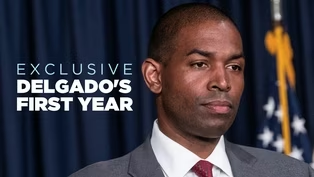
Lt. Gov. Delgado on Hate, Bias Prevention, First Year
Video has Closed Captions
Clip: S2023 Ep37 | 12m 49s | Delgado discusses his first year in office and NY's future. (12m 49s)
Providing Support for PBS.org
Learn Moreabout PBS online sponsorship
- News and Public Affairs

Top journalists deliver compelling original analysis of the hour's headlines.

- News and Public Affairs

FRONTLINE is investigative journalism that questions, explains and changes our world.












Support for PBS provided by:
New York NOW is a local public television program presented by WMHT
Support for New York NOW is provided by WNET/Thirteen.