
Under the Baton Pacific Symphony's Carl St. Clair
12/18/2024 | 28m 9sVideo has Closed Captions
The Pacific Symphony history and growth under the direction of Maestro Carl St.Clair.
Under the Baton offers a glimpse into the rise of the Pacific Symphony from its founding in 1978 to becoming the youngest Tier One Orchestra in the nation. Carl St.Clair has served as Music Director since 1990 the longest tenured American born conductor of a major U.S. orchestra. Mentored by Leonard Berstein, John Williams and Seiji Ozawa, St. Clair has become a national icon beloved by all.
Problems playing video? | Closed Captioning Feedback
Problems playing video? | Closed Captioning Feedback
Under the Baton Pacific Symphony's Carl St.Clair is a local public television program presented by PBS SoCal
Under the Baton Pacific Symphony's Carl St. Clair
12/18/2024 | 28m 9sVideo has Closed Captions
Under the Baton offers a glimpse into the rise of the Pacific Symphony from its founding in 1978 to becoming the youngest Tier One Orchestra in the nation. Carl St.Clair has served as Music Director since 1990 the longest tenured American born conductor of a major U.S. orchestra. Mentored by Leonard Berstein, John Williams and Seiji Ozawa, St. Clair has become a national icon beloved by all.
Problems playing video? | Closed Captioning Feedback
How to Watch Under the Baton Pacific Symphony's Carl St.Clair
Under the Baton Pacific Symphony's Carl St.Clair is available to stream on pbs.org and the free PBS App, available on iPhone, Apple TV, Android TV, Android smartphones, Amazon Fire TV, Amazon Fire Tablet, Roku, Samsung Smart TV, and Vizio.
Providing Support for PBS.org
Learn Moreabout PBS online sponsorship♪♪♪ Carl St. Clair: I remember Dr. Delécluse, he just pulled me very closely.
He says, "My dear young man, with the Pacific Symphony you have one of the greatest opportunities afforded to any American music director.
Get to work."
♪♪♪ ♪♪♪ Paul Hodgins: Did you always have being the conductor of a major orchestra in mind, like most young conductors do?
Carl: I have feet on the ground, really ensconced in reality, and then I have these sort of dreams which I don't share with anybody.
And so I suppose that in somewhere in my mind I had the dream of conducting an orchestra or an opera.
I mean, I remember telling my grandmother when I was like six or seven years old, "Memaw, I might not have a dime, but I wanna be a musician."
♪♪♪ [audience applauding] ♪♪♪ male: Keith Clark, music director, came to Orange County in 1978 as the founding director of the Orange County Pacific Symphony after years of conducting and composing in Europe.
He conducted orchestras and opera in Austria, Germany, Italy, Romania, and Hungary.
How does Orange County attract the 85 accomplished musicians of this orchestra?
Many have come to Southern California to work in the recording industry, performing in film and television, or the entertainment industry.
Climate helps too.
It's simply a nice place to live.
The remarkable accomplishment is that this group of musicians in only four years has fulfilled the demands required for a resident Orange County symphony orchestra.
These musicians are performing six classic concerts at Santa Ana High School auditorium and three pops concerts at Knott's Good Time Theater this year.
Cynthia Ellis: In the early days, we performed at Santa Ana High School.
There were concerts at the Knott's Berry Farm Good Time Theater, which was not such a great time because the acoustics were quite poor.
But it was really fun to come out of a concert and into an amusement park.
That was always kind of a wild thing.
Paul: What was the symphony like, then?
John Evans: Their rehearsals were in a very dilapidated building.
If you walked into the restroom, there would be rats all around.
My first board meetings were a bunch of cardboard tables, and then we sat around those.
John Forsyte: It was pops and classics and family all in one week.
So the orchestra was performing sometimes 16 services in one week, double what would be normal for a professional orchestra.
So, I think we were just developing.
Cynthia: I think '86 is when the Segerstrom Hall was first built, the first hall, and it was such a cultural renaissance at that time.
I felt so blessed to be part of the orchestra's history and part of Orange County's history, really, because Henry Segerstrom had the vision to create this hall, and the orchestra was ready to step into that hall, and it was just such a great time of synergy, really, in Orange County and the cultural renaissance, truly, that happened at that time.
Carl: In 1989, John Williams was the conductor of the Boston Pops.
Just by a stroke of luck I became the assistant conductor of the Boston Symphony.
Just on a fluke, I think.
And I was around John a lot and I did a lot of pops concerts.
I admired what he did, I was excited when he came because we'd do all this film music that nobody else was playing.
♪♪♪ And he goes, "Carl, you know, I was just there in California, Southern California, and I conducted this crackerjack orchestras.
The Pacific Symphony down in Orange County," he says, "you know, they're looking for a music director.
They should know about you and you should know about them."
John: John Williams tells Carl, Carl throws his hat in the ring with 200 other conductors, we boil it down to 15 that we actually invite to come.
And so that first board meeting we ever had with Carl, there were 40 of us sitting around a U-shaped table, and he spent 45 minutes telling us about his history, his background, and so forth.
And then each of us went around and introduced ourselves and what our outside activities were.
And then he said, "Just so I can refresh my memory, I would like to go around just to make sure I know your names."
He went around with all 40 and told us our names, no notes, no nothing.
And from that I realized this guy is a modest person and he values other people.
Carl: Frankly, I didn't know about the search and I didn't know about anybody else.
I just came and did a concert with the Pacific Symphony.
And it just happened that the chemistry work, the spirit and the power of our connection and the music making we did seem to ignite a relationship, which has been a great blessing to me.
♪♪♪ ♪♪♪ Paul: What were your first impressions of Carl as he worked with you in rehearsal?
What was he-- Cynthia: Oh my gosh, I remember incredible enthusiasm, incredible attention to detail.
I remember he was one of the first conductors that came through as a guest conductor who was really working with the percussion section to get just the right tambourine beater, or just the right triangle for this sound.
And he was so specific, and I think that's a really great quality in a music director.
You know what you want.
Attention to detail, absolutely.
Barry Perkins: The energy that he brought to the stage was incredible.
I mean--and very--what I enjoyed is the accuracy, I guess.
Very easy to follow, for me.
Very easy to follow him, because sometimes you'll get conductors where they're very flamboyant and throwing things left and right and--yeah, right, and it's more about the conductor than it is about the musicians.
Playing for Carl St. Clair, it was obvious that he wanted the best out of the musicians, you know.
And that made my job a whole lot easier.
That I know that when I looked up, I'll see the same thing, that nothing will change from rehearsal to performance.
Tony Ellis: You know what I love about Carl, is when he steps off the podium and you talk to him on a personal level.
His Texas roots come out a little bit.
He's very family oriented and he wants to know about how you're doing, how your family is doing.
And it's like, for me, it's like talking to an uncle.
I mean, he's just--he's a regular guy.
He--as a genius conductor as he is and everything, when you talk to him away from the music, he's just a regular guy.
♪♪♪ Paul: So you arrive here, you're young conductor in your 30s, Cadillac of an orchestra.
What were your immediate goals?
Carl: We need to be an orchestra of color.
We need to have various colors.
We need to have the--especially percussion and harp, and the strings could play with this kind of quality of finesse and elegance.
We are going to do the classical canon of what makes orchestras great.
Carl: I would like to see the Pacific Symphony Orchestra become an indispensable part of the life of everyone in Orange County so that if we had a disaster of some sort, it would be: women, children, and the Pacific Symphony Orchestra.
♪♪♪ ♪♪♪ Carl: Almost nothing I've done has been happenstance.
And this I learned from Bernstein.
Everything has a purpose, everything has a meaning, everything sends a message.
There is no moment in history that doesn't lead to another moment by design.
And of course, we've--we haven't just cemented ourselves into these boxes.
I mean, we've really ventured out into many different areas.
But this was sending a strong indication of who the Pacific Symphony was going to be under my leadership.
♪♪♪ ♪♪♪ ♪♪♪ John: We definitely don't look like any other major American orchestra in our collective bargaining agreement, or how we employ the musicians.
It's very unique.
Barry: You have to realize that Pacific Symphony, back when it first started, was all studio players.
Most of the greatest players in Southern California played in the studios.
So the Pacific Symphony was designed, I think, for the studio players to participate, so rehearsals were at night.
Cynthia: One of the things that started happening, we got our first official bigger union contracts.
And when you get a contract, there's certain things, like attendance requirements, and it's no longer such a freelance orchestra, so you're having a body of musicians, or consistent group of musicians.
So, that in and of itself really helped shape the sound of the orchestra.
And I think that helps the orchestra change and grow.
Tony: The personnel became consistent enough to where we could adjust our sounds.
If you, being a second trumpet player, if you can imagine, having a different principal trumpet at every concert would be difficult to match and play with the same phrasing and articulations.
But when you have the same person sitting next to you, those things become a lot more consistent.
Carl: And when I came here, the musicians were just spot on.
They were terrific.
They could sight read.
I mean, they spend their life reading, you know, music which is still wet, you know, still being passed out and--and the virtuosity and the versatility.
And I've said for many years, the virtuous versatility is, like, a mark of the Pacific Symphony.
We can play pops and ballet and opera and classical music all in the same day and it all sounds right.
♪♪♪ ♪♪♪ ♪♪♪ Barry: Sometimes orchestras, you get your schedule and it's like, "Oh, we're gonna play this piece again," or, you know, "We're doing this again."
But Pacific Symphony, it seems like there's something interesting happening year to year.
♪♪♪ Barry: You know, Carl has this unique ability of letting the strings do what they do best, you know, letting the woodwinds shine where their strengths are, and letting the brass play, letting us have the freedom to play certain dynamics, soft or loud.
I think Pacific Symphony has a certain character in the sound.
Carl: I came from the Boston Symphony, which played in Symphony Hall.
And Symphony Hall in Boston is this rich acoustical environment, and the Boston Symphony had this huge lush sound.
And this was sort of in my ear for a long time.
And so in Segerstrom Hall, which is a 3000 seat multi-purpose hall, that had an acoustic which could fit many different genres.
But it didn't fit certain ones.
Cynthia: I remember the acoustics being drier than anticipated because it is a multi-purpose hall.
So when you're building something that's gonna house opera or Broadway or even dance or spoken events, you know, lectures and so forth, you're gonna have to compromise a little bit there.
So, yes, it was, acoustically, not fabulous, but acoustically good.
And I think that was the perfect stepping up place for the county.
Tony: The original Segerstrom Concert Hall, I remember, that was a big step up for us, to have an actual home that we had never had before in a place we can say is, "This is our concert hall."
Paul: About 20 years ago, Carl's European career really started to take off, with positions in Berlin and Stuttgart.
Was that a concern for you?
What are the dangers when your conductor suddenly starts getting an international reputation and career?
John: Well, I was, first of all, thrilled for him and I thought it was actually--it conferred a certain amount of prestige on the Pacific Symphony that his career was growing, and in interesting ways.
He was in Berlin, I think, almost 240 days.
He almost lived there more than he was living in Orange County.
Cynthia: He wasn't there as much as he could have been, but I think he was always there as much as he should have been.
John: And that German career in particular really made it possible for that European tour that we undertook in 2006.
It would not have happened had he not had a reputation in so many different cities in Germany.
♪♪♪ Carl: The one thing that we started working on was the tone of the orchestra, so that it became richer and darker and deeper.
And those are things which are often tabooed in Hollywood studios.
I was so proud that when we took our 2006 European tour, that the critics there commented that this doesn't sound like your typical American orchestra.
It has a deeper, darker, almost middle European, Germanic kind of sound.
And of course, my time as music director in opera houses and with orchestras in Germany has sort of, also, a big influence on my inner ear.
John: So one of the papers, and this is all in German, which I loved, but one of them wrote, "Where shall the praise begin?"
There was not a bad review.
The European tour was a milestone for the symphony.
♪♪♪ Cynthia: It was a great tour.
I felt that that was a big step up in the camaraderie of the orchestra because we were playing together every single day and it was just, really, just such a wonderful thing to go and play on these great stages, to surprise audiences every night with who we were.
We're not coming in as, you know, the Chicago Symphony with decades of tradition.
We're coming in as sort of the new kids on the block, if you will, and stepping into those concert halls where there's such tradition and being able to stand on the shoulders of giants who've come before and stand with equality.
I thought it was really exciting.
It was a great tour.
Loved, it, loved every minute of it.
Carl: We took the tour to Europe very strategically because I said that until we put the Pacific Symphony under the litmus test of European audiences, European critics, we have to prove to the rest of the world that we deserve this glass slipper, that Cinderella glass slipper, that we can put our foot into it.
And we came back with an astonishing, you know, list of successes and beautiful critiques from Vienna and from all the cities of Munich and all the cities we came from.
And that was really an amazing boost for us.
Tim Mangan: The halls that they are playing in allow them to hear themselves in a new way.
And for musicians, of course, their ears are the most important thing.
And they come together as a team differently when they hear each other differently.
On Monday night, they played the Prokofiev of "Romeo and Juliet" probably better than they ever had before because they heard themselves better than they ever had before.
Carl: It started to give us the idea that we have a whole new palate, you know, dynamics, colors, depth, warmth, volume, just the impressiveness of an orchestral sound, and how it reached the audience and embraced the audience.
These were all new dynamics that we had never experienced.
It formed a new relationship with--within us, with our public, and also with all of us with music itself.
Paul: So your move to the concert hall in 2006, that was a major turning point for the orchestra.
Was that also an opportunity to sort of fine tune the sound now that you were in an acoustically superior venue?
Tony: In 2006, when the Segerstrom Concert Hall was built as an acoustical orchestral live hall, that was, to me, the biggest step the orchestra has had musically.
You know, like every major orchestra in the country, we had a home concert hall finally.
♪♪♪ ♪♪♪ Cynthia: We had, of course, a preview, with our European tour in 2006, going to other halls and it was fabulous because we knew what we might get when we got home.
Barry: We had just gone--gotten off tour and then the concert hall was built.
But I remember being on tour and experiencing all these concert halls--yeah, in Europe, and then playing in, you know, Disney Hall and places like that.
I didn't know what this hall would be like.
Would it be like Disney Hall?
Would it be like halls that we've experienced in Europe?
Carl: We got there and I remember everybody's just, like, looking at one another, like, wow, we sound great, you know?
And I remember looking at the players, and they're just, like, looking around.
It's like, oh my goodness, what an acoustical home we are going to be in.
♪♪♪ ♪♪♪ ♪♪♪ ♪♪♪ Cynthia: The biggest thing about our concert hall is that you can play as soft as you want to with no worries.
It--the hall itself is the gem, or the missing instrument, if you will, because the--it was built to amplify acoustic music.
Paul: Two thousand eighteen was a milestone year for the symphony.
You had Carnegie Hall and the China tour, I believe, and then your PBS debut.
It all happened in a very short period of time.
Did that really sort of elevate the orchestra to a new level?
John: Absolutely, and I still remember the PBS Ellis Island because that connected with me because of my own ancestry, having emigrated.
And that was so touching to me.
♪♪♪ ♪♪♪ The symphony has continued to deepen in its reputation.
Carl: It's almost herculean, the growth and the development of this orchestra.
And I will say that after I'd been here, maybe in ten years, and I realized, wow, I don't see a ceiling forming above this orchestra.
In other words, I don't see limitations.
At some point I realized, wow, the mission now is to create the last tier one orchestra in America.
And as I look around the country, I'm not sure that there will be another tier one orchestra that is going to be formed in America.
♪♪♪ ♪♪♪ ♪♪♪ Carl: Remember, I started out by saying I have feet in reality but these silent dreams, these quiet dreams that I have.
And this became a dream of mine: to be the first of a different kind of tier one orchestra.
Not necessarily to model ourselves after the great institutions of the Cleveland and the Chicagos and the New Yorks and the Bostons, but to become an orchestra that is really grown from the loins of Orange County and who we are and who California is.
And I think we've, in many ways, we've accomplished that, and in many ways we haven't discovered who we're gonna be when we, quote, "grow up," because, in the life of orchestras, 45 years is youth.
I mean, it's teenage, it's adolescence, yeah.
We have a great future.
♪♪♪ ♪♪♪ ♪♪♪ Paul: Time to ask about the future.
Carl: I think it's really helped stabilize the trajectory, the philosophy, the path, the journey of the Pacific Symphony that, in its 45-year history, that we've had two music directors and two executive directors, John Forsyte, Louis Spisto, you know, Keith Clark, and myself.
And I think this is really important to note.
But now I think the orchestra is established to a degree that it can flourish even more so with a different vision, a different voice.
Cynthia: When Carl announced that he was leaving, he told the board not to be sad about that.
And I thought that was really a wise thing because it is an exciting time for us and it should be an exciting time.
Barry: I don't want the conductor to take the character out of the Pacific Symphony.
Pacific Symphony has colors, it has character.
And people who have heard other orchestras and heard us, that's what they say.
I have a student that listen to us all the time, comes to concerts, and then he listened to another orchestra, professional orchestra, out there, pretty well-known orchestra, and he calls me up and he says--I said, "Hey, how was it?"
He said, "No goose bumps."
♪♪♪ ♪♪♪ Carl: It's been an incredible chapter.
And it's not ending.
I mean, that's the great thing about it.
It's--a new chapter is just beginning.
I mean, this is the most exciting thing.
In order for the orchestra to continue its trajectory into its 50th anniversary and into the middle part of the 21st century, a new voice, a new vision, a new feeling will help get it there.
♪♪♪ [audience applauding] ♪♪♪ ♪♪♪ ♪♪♪ ...
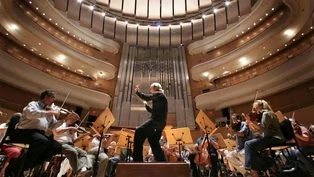
Under the Baton Pacific Symphony's Carl St.Clair (Preview)
Preview: 12/18/2024 | 30s | The Pacific Symphony history and growth under the direction of Maestro Carl St.Clair. (30s)
Providing Support for PBS.org
Learn Moreabout PBS online sponsorship
- Arts and Music
The Best of the Joy of Painting with Bob Ross
A pop icon, Bob Ross offers soothing words of wisdom as he paints captivating landscapes.













Support for PBS provided by:
Under the Baton Pacific Symphony's Carl St.Clair is a local public television program presented by PBS SoCal