
Unexpected
Season 2 Episode 4 | 20m 1sVideo has Closed Captions
Bad art, dead animals, and top dogs. Discover art in places you wouldn't expect.
Art can be strange, art can be bad, art can be dogs! Explore the Museum of Bad Art, where the best finds are sometimes discovered on the side of the road. Meet a Specimen Artist, and the generations of women taxidermists who came before her. See what it takes to be best of the breed at a local dog show.
Problems playing video? | Closed Captioning Feedback
Problems playing video? | Closed Captioning Feedback
Art Inc. is a local public television program presented by Ocean State Media
Unexpected
Season 2 Episode 4 | 20m 1sVideo has Closed Captions
Art can be strange, art can be bad, art can be dogs! Explore the Museum of Bad Art, where the best finds are sometimes discovered on the side of the road. Meet a Specimen Artist, and the generations of women taxidermists who came before her. See what it takes to be best of the breed at a local dog show.
Problems playing video? | Closed Captioning Feedback
How to Watch Art Inc.
Art Inc. is available to stream on pbs.org and the free PBS App, available on iPhone, Apple TV, Android TV, Android smartphones, Amazon Fire TV, Amazon Fire Tablet, Roku, Samsung Smart TV, and Vizio.
Providing Support for PBS.org
Learn Moreabout PBS online sponsorship(radio shuffling) - Art is everywhere.
It might be a dance with your favorite partner, or the dance of a butterfly's wings.
It might be a delicate fragrance, or a delicate orb made of glass.
It might be something you've never even imagined.
Because art is incorporated into almost everything, and we're excited to share that everything with you.
Welcome to Art Inc. - [Presenter] If you want to know what's going on... (upbeat groovy music) (crows cawing) (birds chirping) (upbeat groovy music continues) (cars honking) (static hisses) (mellow surf rock music) - [Narrator] The Museum of Bad Art.
- The adjective "bad art" is problematic, because it brings up the idea of bad art versus good art, and I prefer to talk about bad art versus important art.
(mellow bass jazz music) (mellow bass jazz music continues) We do indirectly ask the questions, "What is art?"
And the fact that we're a museum, ask the question, "What is important art?
And who gets to decide what's important art?"
I'm Michael Frank.
I'm the Curator-in-Chief of a Museum of Bad Art.
- I'm Louise Reilly Sacco.
I'm the Permanent Acting Interim Executive Director of the Museum of Bad Art.
(upbeat jazzy music) Scott Wilson and my brother, Jerry Reilly, both are kind of quirky people.
And when they saw this painting of a woman who was maybe sitting, maybe standing in a field of flowers, and the sky was yellow, it was just something that made them smile, and enjoyed looking at art that would never make it in a fine art museum, but that had heart and soul and raised question.
(mellow jazz bass music) We started in my brother's basement, Jerry Reilly's basement, in a small house in West Roxbury.
The owner of the Dedham Community Theatre was a friend of a friend, and he gave us his basement space.
We were there for many years.
The Somerville Theatre, another old, old movie theater, gave us their basement.
(mellow jazz bass music) In 2019, we were trying to find space and just didn't.
For almost three years, we were homeless.
And through some City of Boston Economic Development people, got connected here to the Dorchester Brewing Company.
They ended up giving us wall space all over the place, so we're throughout the brewing company now.
(mellow jazz bass music) - I don't remember how I heard of the museum, but as soon as I was aware of it, I thought it was pretty interesting, and I donated a number of paintings that I had collected from yard sales.
(mellow jazz bass music continues) The conceit of the museum is that we take pieces that either come from yard sales or thrift stores, and present them in a formal way, the way any traditional museum would present them.
This painting was a gift.
That person thought it was kind of a funny painting, and gave it to his friend as a gift.
(snappy jazz music) At one point, one of the families went to Italy on vacation, and came across this image in the Sistine Chapel.
This is a copy of one of the 300 images in the Sistine Chapel, painted by Michelangelo.
(snappy jazz music continues) Here, in this case, the artist did a pretty good job of copying the image, but added his own details, such as the eyeball spewing some sort of slime.
(snappy jazz music continues) We have a number of images of presidents.
(snappy jazz music continues) There's a photograph of John Kennedy on his sailboat.
(camera shutter clicks) You can actually see that he's dripped some ice cream onto his shirt.
But by eliminating the background information, and focusing on his face, the artist probably created the most repugnant image of one of the most photogenic leaders that the world has ever known.
(snappy jazz music continues) This was clearly inspired by "Madame Matisse".
It's part of my nature to not be able to pass a yard sale or a thrift store without checking it out.
Just to see if there's something interesting.
I don't know why.
It's part of my personality.
The same is true for an interesting pile of trash on the side of the road.
(mellow music) (text dings) We have upwards of 900 pieces in the collection.
Clowns are like low hanging fruit.
This is something I bought this winter in a flea market.
This is Thomas Edison, and this is Henry Ford.
And here's a bird feeding two babies.
This is baby Aladdin.
This is called "Stealth"...
I think it was "Stealth Victory".
Oh, actually, it goes this way.
Let's see what's here.
(mellow calming music) Never shared this one.
Actually, I don't remember where this came from.
If my fellow curators from the MFA could see this place, they would be appalled.
(mellow calming music continues) (mellow guitar music) - [Louise] The Museum of Bad Art, it's a gateway drug to museums and to art.
(mellow guitar music continues) - [Michael] We relieve people of feeling somehow that they're missing something.
When the people look at our collection, they really don't have to think that they're missing anything.
(upbeat groovy music) I think I can tell pretty quickly whether the artist had some purpose, the artist was trying to make some sort of an artistic statement.
- [Louise] We don't say negative things about the art or the artist.
Our stated goal is to collect, exhibit and celebrate this art that would be appreciated nowhere else.
(lighthearted upbeat music) (mellow surf rock music) - [Narrator] Consider the Taxidermist.
(dramatic piano music) - If you saw me at the grocery store, you wouldn't think, "Oh, that girl skins animals for a living."
Hi, I'm Mickey.
If I had to take all the things that I love to do, and summarize them into one job title, I would call myself a "Specimen Artist".
I have a box of squirrels, I have a box of rats, I have a fox, some baby beavers, minks, lizards, pheasant chicks, ducklings, geese.
I have a big, big snake.
Four baby emus, a sparrow, a starling, a bunch of pigeons.
Thank you all so much for signing up for my class.
My name's Mickey.
I'm an art...
They say that art imitates life, but we also have life that has turned into death, that we then can turn into art.
Let's preserve a scorpion together.
Come take a specimen preservation class with me.
A private class on beetle specimen spreading.
If you think about it, taxidermy is a sculpture made from a real animal.
I try to keep a natural flow or shape, and then I try to just put the...
The specimens that we're collecting today contain basically a snapshot of what our world looks like at this moment in time.
- Okay, Hannah, show us your beetles.
- Let's get into it.
So just be gentle with your specimen.
You aren't gonna kill it, 'cause it's already dead.
But if you hear the cracking noise, and you're like... (Mickey gasps) It's fine, it's fine, it's normal.
It's been very, very cool, just to go from skinning a squirrel under lamplight at my friend's kitchen table, to now, 11 years later, teaching here at the Harvard Museum of Natural History.
(lighthearted mellow music) I did a Caucasus beetle class, where they got to lift up the elytra, and then spread the wings out.
Has everyone done their little beetle dance?
The front legs point forward, so they go like this, and the back two sets of legs point down, so they go like that.
And then we end of the day with a rat embalming class, so each student got to leave with a finished embalmed rat.
(student chuckles) I think that there are definitely stereotypes in the taxidermy industry today.
It's seen as primarily white male dominated.
A lot of people don't know this, but that work is directly a reflection of a woman who is widely considered to be the first female taxidermist.
Martha Maxwell exhibited her work at an expo in Philadelphia, where she built a full mountain inside of one of those fair buildings, and she filled it with her taxidermy animals that she had hunted and prepared herself.
And my favorite thing about her is that, she made a little plaque that said "Woman's work."
And she stuck it to the front of her exhibition.
So it's very cool to see how these patterns of taxidermy have held up over time.
(lighthearted piano music) My great-grandma, Mickey, who I'm obviously named after, was like the biggest champion of my work.
And she had these framed butterflies on the wall of the guest room when I was a kid.
And over the years, a couple of the butterflies came detached from the back glass, and they fell down.
And so she asked me, "Can you fix this?"
And I didn't even know this, but her aunt was the one who had made the frame, spread the butterflies, framed the butterflies.
So this had to have been back in the 1910s, 20s, 30s.
(soft piano music) So she actually got to come to one of my classes, and we spread butterflies together that matched the same color tones.
And then once they were dry, I snuck those butterflies into her frame, and I returned it to her.
So it was cool the last couple years of her life, every time I visited, I got to see butterflies that we spread together.
(soft piano music continues) What I'm doing right now is beyond my wildest dreams.
Taxidermy and specimen preservation are in my blood, whether I realized it when I started doing this or not.
(soft piano music continues) (mellow surf rock music) - [Narrator] The Art of the Dog Show.
(lighthearted music) (lighthearted music continues) - [Host] Could I have Australian terrier #8, please.
(lighthearted music continues) - Fred Matuszewski is my husband.
He's an architect, and he has his dog, Mickey, who is an Australian terrier.
No, leave it.
Not your business.
(person laughs) No, not your business.
(car honks) Leave it.
Thank you.
Ah-ah.
And then we have Bridget, who is my dog, and she's a Glen of Imaal terrier.
Good girls.
It's more than just a beauty pageant.
When you have a dog that ends up going through all the dog showing, they're checking it against the standards for that breed.
And out of that, you end up with dogs that would be the best for reproducing.
You know, I'm boyfriend shopping.
(wondrous choral music) It is a very subjective sport.
When you go to a baseball game, if somebody hits a home run, it's a home run.
In this sport, you will have a judge who looks at a group of dogs, and they'll decide, "Yeah, this one may have that fault, that one has that, but I like this one better."
They are looking at each individual dog, and comparing it against the American Kennel Club, AKC standards for that breed.
Diet, exercise, nutrition, grooming, training for what to do in the show, the behavior within the show ring.
Because when you go into the show ring, there's protocol.
So you go in, you know that you're first going to stack your dog, the judge will come along, kind of look, then they'll tell you to go around.
In our case, both of these dogs are dogs that go onto the table.
As you put them on the table, you learn, put the front feet right at the edge of the table, because that way the dog is less likely to be moving around.
There's everything from, "What's the distance across the top of the head, what's the shape of it?
What's the distance from the set of the eyes versus the nose?"
So they're checking all of these things out.
They'll tell you, "Show me the teeth."
Then the judge runs their hands down the dog, feeling for the height to the length.
Each judge is trained on and tested on each breed, before they can go and judge them.
We usually try to bathe them the night before, have the car pretty much packed.
You're hauling a lot of stuff, so you have to think about the location you're going to.
Do I wanna take the trolley?
Or do I wanna take collapsible crates that I'm going to set up?
Oh, you are so handsome.
It's almost like, if you've ever gone camping, you develop relationships with different people, you get to know a lot of the same people, because you're usually from the same district area, and you're traveling around to the same shows.
So you get to see friends or faces that are familiar.
I'm in envy of a lot of the people who come to shows, because I do have a partner who's interested in it, and has the same passion.
And we've had people ask us, "Is it tough when both of you go into the ring at the same time?"
It's like, "No".
The only thing we have to watch is, that we can never have Bridget walking behind Mickey, 'cause then she wants to run up to her and play.
It's about them.
And that you're all having fun.
If you're not having fun, don't do it.
(Linda chuckles) (lighthearted surf rock music) - [Narrator] An Art Inc. extra.
Paint night at the MOBA.
(mellow bass jazz music) (mellow bass jazz music continues) - Thank you everyone for coming.
My name's Raheem.
This is Pour Art.
End result, we're gonna have a puddle of paint that we're gonna be tipping the canvas.
So first, how about we grab some gloves.
(mellow bass jazz music continues) I'll teach you all how to mix the paints with the pouring medium and a little water, to get the right consistency to be able to make the art.
(mellow bass jazz music continues) We want it to be between warm honey, and a warm hot chocolate drizzle.
It's still a little thick, so maybe another two squirts.
(mellow bass jazz music continues) - This is a kind of a metallic gold that I chose here.
It's kind of a hot pink, if you will.
Wasn't until he mentioned, or maybe it was you that mentioned the Museum of Bad Art.
(person screams) (eerie music) And I was like, "Oh, yes, right.
There is art on the walls all around us."
(lighthearted music) - Make sure you're really like mixing the bottom to the top.
You don't want it perfect.
There's no such thing as perfect, right?
(upbeat funky music) Really beautiful art.
- I think it came out really wild.
I wasn't expecting these splots in here.
I am very proud.
Going in the front hall.
(person laughs) (upbeat groovy music continues) - [Narrator] Thanks for watching, and we'll see you next time on Art Inc. (mellow surf rock music) (mellow surf rock music continues) (mellow surf rock music continues) (mellow surf rock music continues) (mellow surf rock music continues) (mellow surf rock music continues) (mellow surf rock music continues) (mellow surf rock music continues) Watch more Art Inc. A Rhode Island PBS original series, now streaming at ripbs.org/artinc.
Video has Closed Captions
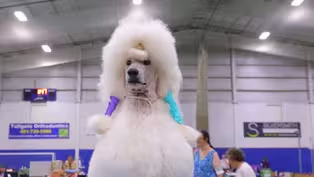
Clip: S2 Ep4 | 4m 13s | Linda Seabury gives us her take on participating in AKC Confirmation shows. (4m 13s)
Video has Closed Captions
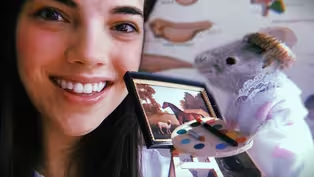
Clip: S2 Ep4 | 4m 43s | Taxidermist, artist, educator, and social media star: Meet Mickey Alice Kwapis. (4m 43s)
Video has Closed Captions
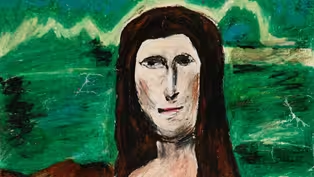
Clip: S2 Ep4 | 6m 47s | What is bad art? The Museum of Bad Art displays, and challenges, the idea of "bad art." (6m 47s)
Providing Support for PBS.org
Learn Moreabout PBS online sponsorship

- Arts and Music
The Best of the Joy of Painting with Bob Ross
A pop icon, Bob Ross offers soothing words of wisdom as he paints captivating landscapes.













Support for PBS provided by:
Art Inc. is a local public television program presented by Ocean State Media