
United Way for Southeastern Michigan’s Racial Equity Fund
Clip: Season 52 Episode 2 | 10m 10sVideo has Closed Captions
United Way for Southeastern Michigan awards latest round of Racial Equity Fund grants.
United Way for Southeastern Michigan (UWSEM) President & CEO Dr. Darienne Hudson shares details with guest host Trudy Gallant-Stokes about the latest round of Racial Equity Fund recipients. The grants total $1 million and were awarded to BIPOC-led nonprofit organizations to help them address racial inequities in the region. Plus, they talk about the expansion of the fund into Washtenaw County.
Problems playing video? | Closed Captioning Feedback
Problems playing video? | Closed Captioning Feedback
American Black Journal is a local public television program presented by Detroit PBS
United Way for Southeastern Michigan’s Racial Equity Fund
Clip: Season 52 Episode 2 | 10m 10sVideo has Closed Captions
United Way for Southeastern Michigan (UWSEM) President & CEO Dr. Darienne Hudson shares details with guest host Trudy Gallant-Stokes about the latest round of Racial Equity Fund recipients. The grants total $1 million and were awarded to BIPOC-led nonprofit organizations to help them address racial inequities in the region. Plus, they talk about the expansion of the fund into Washtenaw County.
Problems playing video? | Closed Captioning Feedback
How to Watch American Black Journal
American Black Journal is available to stream on pbs.org and the free PBS App, available on iPhone, Apple TV, Android TV, Android smartphones, Amazon Fire TV, Amazon Fire Tablet, Roku, Samsung Smart TV, and Vizio.
Providing Support for PBS.org
Learn Moreabout PBS online sponsorship- United Way for Southeastern Michigan has announced the 2024 recipients of its Racial Equity Fund.
The 28 local organizations are receiving grants to help address racial and systemic inequities in the region.
All of the organizations have black, indigenous, and people of color leadership and focus on a variety of community issues.
Here's my conversation with United Way's president and CEO, Dr. Darienne Hudson.
Everybody knows what United Way is, but it just seems like you continue to grow and just encompass more and more things as you become involved in the community.
So you have some new things to share with us now.
- So excited to jump right in and talk about the work that we've been doing with our Racial Equity Fund.
We are now in our third year and we've been able to invest $3 million back into our community.
These are all organizations that are BIPOC led, so they're led by blacks, indigenous people, and people of color and all of these organizations are focused on addressing racial inequities, historic inequities, systemic inequities in our region and trying to make sure that now over 57,000 people are getting the help that they need and getting connected to the resources that they need.
- That is very exciting and we know that that's kind of the last frontier in terms of supporting businesses.
We've worked on voting rights and other rights over the years, but we have to make progress in that area.
- We do.
There is quite a bit of research now when you look at philanthropy and how organizations that are led by people of color are invested in and we just continue to be behind and so we felt that it was our responsibility if we're serious about talking about issues of diversity, equity, and inclusion to make this type of investment into our community and so we're able to give grants of all sizes.
They range from $10,000 to $50,000 annually and, again, not only are they getting those resources, but we're able to provide them what we call capacity-building support in partnership with Resilia.
So they're getting coaching and mentoring, learning better operations for their nonprofits.
So it really is full circle support.
- So let's talk about maybe some of those businesses, maybe some you're, and I know that's hard.
It's like picking your favorite child, but maybe some examples you're most excited about because I think you just finished a round where you awarded some of these.
- We did.
So Caleb's Kids is one that I always want to lift.
We talk so much about mental health, about what our young people are experiencing, the fact that we've seen such a drastic increase in suicides in our community and Caleb's Kids is committed to helping our most troubled youth and helping them find a pathway forward that allows them to get out of that ideology of wanting to harm themselves and we've been partners with Caleb's Kids for a long time, so we're proud of that investment.
We also work with Accent Pontiac and, again, an organization that is committed to that full continuum of support, specifically focusing on mental health.
We had an intense focus on mental health issues this year with our investments in the community.
But we serve four counties now and this gives us the opportunity to partner with a number of organizations, again, large and small, to be able to support our most vulnerable populations.
- Yes, and I should clarify, I was calling them businesses, but really nonprofit organizations that are providing great service to the community and sometimes you find organizations say, "Well, maybe I'm too small to apply or maybe I shouldn't be involved."
But it sounded like you have such a wide variety of the types of services that you can help provide to these organizations.
Go into a little more detail as to what kind of assistance they can receive.
- Sure.
Well, it starts with the application process.
So we've partnered with Detroit Future City now for almost five years and they have something called a Centering Community Voice toolkit and it actually helps us with the grant process.
We have a committee made of individuals outside of United Way.
They come from a universities, other nonprofits, businesses, community organizations that come together to actually help us build our application process.
They help us review those applications.
They work with the nonprofits as they are applying for these resources and once they receive the resources, not only are they getting that capacity building and helping with their operations, with their finances, deliver their programs, but we want them to be able to go beyond United Way.
We're just one organization.
We want them to be able to apply for grants from foundations, from national partners, from getting state resources and federal resources as well.
- And how are you able to see the impact that they've made?
How do you go back and reflect and see how things worked out?
- So we have a team in-house led by Tanya Dare.
She's our Chief Diversity and Development Officer and also Andre Ebron, who is our senior director for our DEI work.
And they are partnered elbow to elbow on the ground with these organizations and so each organization has a set of metrics.
A large part of that is the number of people that are served.
But again, it could be counseling services.
It could be receiving food, receiving housing support, and so we look at each organization as its own entity, look at how many people are served, and then the effectiveness of these investments.
We do have some partners who've received funds every year.
We have people who not only are receiving Racial Equity Funds, but they also, again, they're able to apply for other resources around the region to help them meet their goals.
- So I know that 2023 obviously is behind us now and you've made those grants, but we're coming into a new cycle, correct?
- Yes, so of the past three years, we have been investing in Wayne, Oakland, and Macomb counties to be able to provide those resources.
We are newly merged with Washtenaw County as of October 1st and so we are now able to provide resources.
We are investing $200,000 of our racial equity funding in Washtenaw County only and so, again, this is for 501c3 organizations that are BIPOC-led and that are trying to do that work of addressing these historic inequities and those grants are available in the next few weeks and we're really excited about the opportunity that it's going to present.
- So talk about Washtenaw County.
I don't know.
What's different or the same about that area because, for so many years, you'd hear about the Tri-County area, but obviously population is shifting?
- Yes and this merger, as it happened, we are mission-aligned organizations and you've heard United Way talk about the 21 day equity challenge.
That actually started in Washtenaw County with their United Way.
So they've been talking about equity for quite some time.
We have an ALICE Report.
Alice is an acronym that stands for Asset-Limited, Income-Constrained and Employed, and it's an assessment of our working families and their abilities to be able to meet their most basic needs.
The state average is 39% of our families living below that threshold and the same is true for what was our Tri-County region.
Now, as we come together, in Washtenaw County alone, Trudy, two years ago they had 30% of their families that were living below that threshold.
Just two years later in 2021, that data went up to 40% of their families living below the threshold.
- So the need is there?
- The need is very great.
- So now we're getting into, like you said, the timeline where you're wrapping up for applications for 2024.
So what do you tell people and what do you suggest, and I dunno, how much time should they allow to be able to figure out how to go through that application process?
- So we've been working.
This is a special round of funding outside of our normal cycle.
So it was $200,000 for the Racial Equity Fund and additional $225,000 for the basic needs grants that we always offer in the spring and this is specifically for Washtenaw County.
We've actually been working in the community since our merger on October 1st to help them understand our systems, to make sure that they already had a portal set up, their logins, all of those things set up.
So once the grants became available to them, and I can't remember the exact date, I'm sorry, but it is within the next week and a half, they will be able to actually go right in.
They already have all of their information set up.
They've been working with our team to make the grant process as smooth as possible.
We cannot guarantee funding, but we do wanna ensure that we've done our part to make sure that people are prepared, they feel that they have the information and the resources necessary.
We've also had four town halls with local community partners in Washtenaw alone, just to help them prepare for these resources that are available and for those of you that are listening and wondering, "What about everyone else?"
We are still going to have our basic needs funding available, our Equity in Education dollars, that will be available in our wraparound services available in the spring.
- So first of all, Washtenaw County folks, don't be shy, go ahead and give it a try.
Get to that portal and see what the expectations are and go ahead and apply.
- That's right.
- It's worth, even if it doesn't work out this year, maybe you'll learn something and it'll work out next year.
Dr. Hudson, thank you so much.
Thank you to United Way for continuing to always embrace the community and I'm sure everything's right at the website.
Is that a website you wanna mention right quick?
- Yes, UnitedWaySEM.org.
- Very important.
Thanks again and have a wonderful 2024.
- Thank you.
I wish you the same, Trudy.
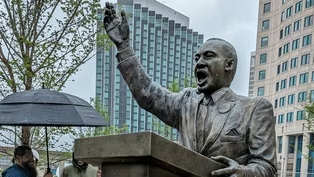
Wayne State’s two-day Dr. Martin Luther King, Jr. Tribute
Video has Closed Captions
Clip: S52 Ep2 | 10m 10s | Two-day tribute to Dr. Martin Luther King, Jr. to share the arts’ impact on civil rights. (10m 10s)
Providing Support for PBS.org
Learn Moreabout PBS online sponsorship
- News and Public Affairs

Top journalists deliver compelling original analysis of the hour's headlines.

- News and Public Affairs

FRONTLINE is investigative journalism that questions, explains and changes our world.












Support for PBS provided by:
American Black Journal is a local public television program presented by Detroit PBS