
UofL Hospital Treating Victims of UPS Plane Crash
Clip: Season 4 Episode 93 | 3m 49sVideo has Closed Captions
A UofL Hospital trauma surgeon talks about treating victims of the UPS plane crash.
Two remain in critical condition in Intensive Care units at University of Louisville Hospital following the crash of a UPS plane in Louisville. UofL Health CEO and trauma surgeon, Dr. Jason Smith, spoke about the range of injuries they had to treat at the hospital and how they prepare for situations like this.
Problems playing video? | Closed Captioning Feedback
Problems playing video? | Closed Captioning Feedback
Kentucky Edition is a local public television program presented by KET
UofL Hospital Treating Victims of UPS Plane Crash
Clip: Season 4 Episode 93 | 3m 49sVideo has Closed Captions
Two remain in critical condition in Intensive Care units at University of Louisville Hospital following the crash of a UPS plane in Louisville. UofL Health CEO and trauma surgeon, Dr. Jason Smith, spoke about the range of injuries they had to treat at the hospital and how they prepare for situations like this.
Problems playing video? | Closed Captioning Feedback
How to Watch Kentucky Edition
Kentucky Edition is available to stream on pbs.org and the free PBS App, available on iPhone, Apple TV, Android TV, Android smartphones, Amazon Fire TV, Amazon Fire Tablet, Roku, Samsung Smart TV, and Vizio.
Providing Support for PBS.org
Learn Moreabout PBS online sponsorshipMore than a dozen people were injured in the crash.
They were all treated at local hospitals.
Two remain in critical condition and intensive care units at university of Louisville Hospital.
That's where we find our Kelsey Starks.
Kelsey.
UPS is Louisville's largest employer, employing some 26,000 people.
So as you can imagine, everyone in this community somehow knows someone who is part of the U.P.S.
family.
So this community has truly been rocked by this tragedy.
Right now, we're told there are still two patients in critical condition at university of Louisville Hospital's burn unit here.
And we talked to Doctor Jason Smith earlier about the range of injuries they have had to treat here in just the past 24 hours.
And how they prepare for situations just like this one.
We've seen, burns, obviously based upon the fire, and we've seen those from being very severe to, to minor.
We've seen blast injuries from the explosion itself.
We've also seen some, some shrapnel injuries where flying pieces of debris have hit either bystanders or people in relatively close proximity to the accident when it occurred.
So really a gamut of that, as well as conditions that were exacerbated from the smoke and all of the other things that came into the hospital that were treated.
Code yellow is our internal term for our disaster preparedness.
So we actually drill very consistently, both with, the local EMS and the local police as well as internally for management of disasters.
Since we are the trauma response hospital for the area and the region.
That allows us to mobilize all of our staff.
And so, for example, last evening we were able to keep staff on premises or call staff in in case we had a number of casualties.
Particularly early on, we didn't know the, the, type of airplane that might have crashed.
And so, you know, thinking, worst case scenario, if it was a massive passenger airplane, you can talk hundreds and hundreds of casualties.
And so we would stand up all of our capabilities in order to treat those patients, as well as work with, the local providers to say, hey, other hospitals can help, and how can we support those hospitals with knowledge as well as other help that we can provide?
When something like this occurs and you really don't know the extent of the injuries, you always think worst case scenario.
So for this, we brought in everything that we possibly could to the hospital and the health care system at large.
We place all of our hospitals on standby for disaster alerts so that we could be able to, to afford whatever care was needed.
And then as the night progressed and we saw that there were fewer and fewer casualties coming in, we were able to kind of draw that down a bit and get back to normal operation I think it talks to the level and dedication of our staff.
Even before we declared the disaster alert, when people started seeing this on social media or the news and we didn't know what was occurring.
We had folks really starting to come back in and we're staging.
They said, I'm in the parking lot in my car.
Call if you need me.
I'm in the cafeteria.
I came back into work.
And I think that just talked to the dedication of the people here at UVA health.
Like, this is what we do.
This is why we're here.
We're here to serve the community.
It's a role that we take very seriously, and we're honored to be a part of.
In fact, once a year, the hospital trains for a massive disaster drill where they pinpoint and tweak their procedures and their last one happened just about a month ago, where they did a simulated plane crash drill.
Renee, back to you.
Thank you, Kelsey, for that.
We will continue to follow this story throughout the week as we get more information about the investigation and those injured.

Video has Closed Captions
Clip: S4 Ep93 | 3m 7s | A look at how SNAP works and who's on it. (3m 7s)
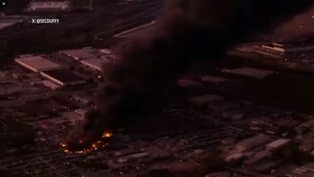
Death Toll Climbs to 11 Following UPS Plane Crash
Video has Closed Captions
Clip: S4 Ep93 | 5m 12s | The governor says a child was among those killed when a UPS plane crashed in Louisville. (5m 12s)
Helping Federal Employees Find Resources During Shutdown
Video has Closed Captions
Clip: S4 Ep93 | 3m 42s | How one county has stepped in to help federal workers during the government shutdown. (3m 42s)
Providing Support for PBS.org
Learn Moreabout PBS online sponsorship
- News and Public Affairs

Top journalists deliver compelling original analysis of the hour's headlines.

- News and Public Affairs

FRONTLINE is investigative journalism that questions, explains and changes our world.












Support for PBS provided by:
Kentucky Edition is a local public television program presented by KET