
Upcycling accolades in Madison
Clip: Season 12 Episode 10 | 5m 18sVideo has Closed Captions
The National Trophy Recycling Program repurposes trophies to make new ones for nonprofits.
The Nationwide Trophy Recycling Program started 40 years ago at a small-town trophy shop after customers would drop off old trophies in hopes that they could be reused. Volunteers with the program take old trophies, disassemble them, sort them and then uses those parts to rebuild trophies to deserving nonprofits nationwide.
Problems playing video? | Closed Captioning Feedback
Problems playing video? | Closed Captioning Feedback
Wisconsin Life is a local public television program presented by PBS Wisconsin
Funding for Wisconsin Life is provided by the Wooden Nickel Fund, Mary and Lowell Peterson, A.C.V. and Mary Elston Family, Leon Price & Lily Postel, Stanley J. Cottrill Fund, UW...
Upcycling accolades in Madison
Clip: Season 12 Episode 10 | 5m 18sVideo has Closed Captions
The Nationwide Trophy Recycling Program started 40 years ago at a small-town trophy shop after customers would drop off old trophies in hopes that they could be reused. Volunteers with the program take old trophies, disassemble them, sort them and then uses those parts to rebuild trophies to deserving nonprofits nationwide.
Problems playing video? | Closed Captioning Feedback
How to Watch Wisconsin Life
Wisconsin Life is available to stream on pbs.org and the free PBS App, available on iPhone, Apple TV, Android TV, Android smartphones, Amazon Fire TV, Amazon Fire Tablet, Roku, Samsung Smart TV, and Vizio.
Providing Support for PBS.org
Learn Moreabout PBS online sponsorship[playful music] - Janet L. Gray: I wanna say that only fun people can work here.
You gotta laugh.
We have a lot of fun.
If you're too serious, I'm sorry.
Trophies, that's not for you.
[chuckles] Hi, I'm Janet L. Gray.
I am a volunteer at the Nationwide Trophy Recycling Program.
My family owns Total Awards and Promotions, and we've been in business for almost 50 years.
[groovy music] I proposed the idea that we should be recycling for everyone.
Because we have been doing this for over 40 years, where people would bring in their trophy and say, "Hey, I don't know what to do with this."
We would take it and give it to another nonprofit or another people who needed it.
[metal clanks] So, we did launch the program, and by 2017, we went nationwide.
That allowed anyone in the country to send us their trophies to be recycled.
We knew that nonprofits needed the help.
Nonprofits don't have the money to thank their volunteers, to give out awards.
And so, this was an easy connection.
We could then work with the nonprofits and give them free trophies for their events.
We gave out over $1 million in plaques over those decades.
This program really exploded during COVID because everybody was home.
They had a chance to clean their attics and basements, clean every corner, and they found the trophies, and they sent 'em to us.
Everyone was thinking the same thing because we got over 55,000 trophies during the years of COVID.
In 2021, we had to become a nonprofit because our business was completely filled.
From the floor to ceiling, every hallway, every office was completely filled with boxes.
- Jay Koritzinsky: My name is Jay Koritzinsky.
In my real life, I'm an attorney here in Madison.
And I'm also a volunteer.
And I help in unpacking boxes and sorting and recycling the trophies that people send in to us.
And then, I became addicted to starting to unpack boxes that folks send into us, and participate in the recycling process.
[volunteers exclaim] - Janet: I love it!
- I challenged myself one week to see how many boxes I could do.
And I ended up opening 50 boxes one day.
They actually built a trophy for me for that week of work.
Look at this!
It has a clock!
I love it because as I'm opening boxes, I'm realizing that every trophy is a memory for somebody.
Lots of people do have trophies.
Historically, what happened with all these trophies is they would go in the landfill.
As you can imagine, a marble base on a trophy will never disintegrate, and we can repurpose it.
- If a trophy comes in and it has any part of it that can't just be perfect, we have to take it apart.
And then, we're able to make new trophies out of those parts.
- Jay: And we separate the figures, we separate the columns, we separate the bases.
All of those figures, all of those columns are sorted.
The columns by color and size, the figures by whatever it is.
[saw buzzes] We have every sport available that I could possibly think of.
But then, we have other things, like folks who got trophies for a horse judging competition or a go-kart race, or a derby race, and other figures of just awards that people got for participating in an organization.
If someone comes in and says, "Can you build me a trophy?"
for whatever they need, I'd say nine out of ten times, we can create that trophy for them.
And that's really fun.
- We have restaurants that contact us for trophies.
We also had Hollywood find us.
So, Chicago PD, Chicago Fire, Chicago emergency shows.
So, we've created a showroom that allows the general public to come in and purchase those funny joke trophies for their family games.
When a nonprofit applies for trophies, they are telling us, they're requesting the type of sport, how many they need, male or female, what color.
And then we go to our stock, and we try and accommodate to fit exactly with the request.
It's very important that we see what it is we're donating to, so all the volunteers can get behind it, get excited, and be proud of what we're doing to help them.
[volunteers laugh] Our volunteers are at every age, and it doesn't matter.
We all bond together over trophies.
- It's just a wonderful mission that we can just come in here, focus on, spend our time, and then there's always a sense of accomplishment, whether it's how many boxes did we open, how many trophies did we build, whatever the case might be.
- I think it's a place to come to feel great, and to volunteer to put that time in makes you feel good too.
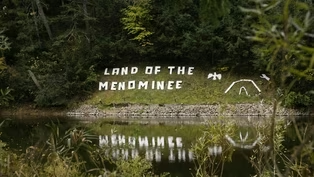
Nature trail weaves Indigenous knowledge with Western science
Video has Closed Captions
Clip: S12 Ep10 | 4m 16s | A Menominee "phenology" trail labels plants in three languages. (4m 16s)

Preview: Food + Farm Exploration Center
Preview: S12 Ep10 | 30s | Learn about agriculture in our state at Farm + Food Exploration Center in Plover. (30s)
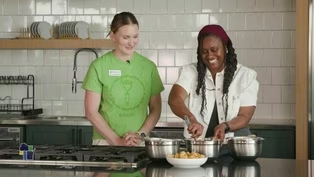
Teaching agriculture through hands-on learning
Video has Closed Captions
Clip: S12 Ep10 | 3m 37s | Inside Plover's ag learning center where families explore where their food comes from. (3m 37s)
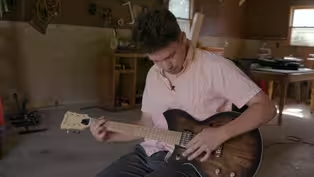
Teen builds custom guitars from scratch
Video has Closed Captions
Clip: S12 Ep10 | 4m 4s | Pulaski teen Ian Vanveen taught himself how to build electric guitars. (4m 4s)
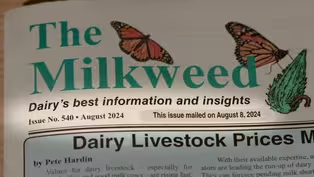
45 years covering Wisconsin's dairy industry for The Milkweed
Video has Closed Captions
Clip: S12 Ep10 | 5m 12s | Pete Hardin is one of the last true originals in the world of agricultural journalism. (5m 12s)
Providing Support for PBS.org
Learn Moreabout PBS online sponsorship











Support for PBS provided by:
Wisconsin Life is a local public television program presented by PBS Wisconsin
Funding for Wisconsin Life is provided by the Wooden Nickel Fund, Mary and Lowell Peterson, A.C.V. and Mary Elston Family, Leon Price & Lily Postel, Stanley J. Cottrill Fund, UW...