
Negotiations continue between CCSD, CCEA
Clip: Season 6 Episode 7 | 9m 40sVideo has Closed Captions
Update on negotiations between Clark County School District and Clark County Education Ass
Update on negotiations between Clark County School District and Clark County Education Association
Problems playing video? | Closed Captioning Feedback
Problems playing video? | Closed Captioning Feedback
Nevada Week is a local public television program presented by Vegas PBS
Negotiations continue between CCSD, CCEA
Clip: Season 6 Episode 7 | 9m 40sVideo has Closed Captions
Update on negotiations between Clark County School District and Clark County Education Association
Problems playing video? | Closed Captioning Feedback
How to Watch Nevada Week
Nevada Week is available to stream on pbs.org and the free PBS App, available on iPhone, Apple TV, Android TV, Android smartphones, Amazon Fire TV, Amazon Fire Tablet, Roku, Samsung Smart TV, and Vizio.
Providing Support for PBS.org
Learn Moreabout PBS online sponsorshipHow much money should the Clark County School District spend on teacher raises?
That debate between the District and its largest teachers union rages on, as does the threat of a teacher strike.
Here to explain how valid of a threat a strike is, is Nevada Independent Reporter Rocio Hernandez.
Rocio, welcome to Nevada Week.
(Rocio Hernandez) Good to be here.
-All right.
So as you have reported, it would be illegal under state law for the teachers union, the Clark County Education Association, to strike against the School District.
However, the District thought that the threat was real enough.
They decided to sue the teachers union.
There was a decision in that case, and what was it?
-So the judge ultimately decided that, despite some concerning messages from CCEA Executive Director John Vellardita and a couple of other members, that there wasn't enough evidence to clearly show that a strike will happen unless the Court steps in and tells CCEA, no, you cannot strike.
And that's just because at the moment, right now, CCEA has said that they're going to take work actions, which aren't clearly defined right now.
But they're not really using the word "strike."
They're kind of suggesting that maybe there will be like a stoppage of teachers doing extra work outside of their contract hours, which is about 7 hours and 11 minutes.
So that could be anything from like before school activities, after school activities, teachers staying after class to prepare for the next school day, meeting with parents, you know, things that teachers still do in their day-to-day jobs but aren't necessarily, quote/unquote, required under their contract.
So that could be one example of something that CCEA could do to apply pressure as it continues these negotiations with the School District.
But whether there will be a strike or not, we won't really know until the meeting on Saturday, where the members are getting together to vote on what they're going to do and whether they're going to do it.
-Okay.
And that meeting is August 26.
As we tape this, it's the morning of August 24.
The judge in that case said it's possible she would revisit this case.
And what would make that necessary in her opinion?
-Well, if there's more evidence to show that, yes, what "work actions" definitely means is a strike.
Because as you noted, it is illegal for public employees to strike in Nevada.
And I believe the law kind of makes it that way because as public employees of public, you know, entities, those services CCSD schools offer to parents isn't something that they can just say, you know, I'm gonna go take my kid to a different school that day.
That school is your kid's school.
There's nowhere for you to go.
It's not the same as saying a business's employees are going on strike and you could just find another similar business anywhere else.
You can't.
Parents can't go anywhere else.
If they were to raise the level of a strike, it could be potentially harmful to the education of students and interrupt their learning.
-Right.
How real of a threat do you think a strike is?
-Well, I think it's very serious to get to the level of a strike, but I will say we've seen a lot of back and forth right now between the School District and the union.
I think more than anything, the union is trying to apply pressure to the District, you know, to make them take their demands of pay increase seriously.
You know, they're asking for about 18%.
The School District last offered an increase of 10.5% over the next two years.
The union has been saying that they're standing firm on what they're looking for.
Teachers are suffering right now, as we all are, with inflation, high cost of living, you know, more money being taken out of their take-home pay because of an increase in retirement funds.
So teachers are saying, you know, We need to get this increase in order to not only improve the recruitment of our veteran teachers and retention of veteran teachers, but also recruit more teachers to address the vacancy issue that the District has.
-It's funny because just prior to recording, one of our videographers was talking about his energy bill this past month.
It's something that everyone is feeling, especially teachers who are on those fixed incomes.
The School District claims it's going to be in a budget deficit if it honors what those teachers want, which is 10% in the first year, 8% in the second year.
The union counters, Hey, what about all that historic education funding that the state just approved in the last legislative session, including Senate Bill 231, which is a matching fund of $250 million, specifically for teacher raises.
The School District sent out a press release this week clarifying its stance on that money.
What did the School District say?
-So the School District has already finalized their contract negotiations with the union that represents their support staff.
And they, as support staff, qualify for a portion of that SB 231 money.
The District hasn't received that money.
It still needs to apply to it and get approval by the interim finance committee.
But the District estimates that they'll get between 170 to 180 million dollars for both teachers and support staff pay raises.
But what the District is saying is that this money is one time.
There's no guarantee that the legislature will renew this money again, so they're trying to be cautious about it.
And by saying that any raises or bonuses that can come out of that fund, whatever amount that is, should be treated as temporary raises.
So they won't be added permanently, you know, you'll be told in two years that if that money runs out, that's the end of that bonus money.
If the legislature renews it, then we can use it again.
But at this time, the District and other districts across the state don't feel safe telling teachers and support staff, this will be part of your permanent salary that you can expect going forward.
-I'm glad you brought up other school districts, because they have access to this matching fund too.
How are they responding to this situation?
-From the districts we talked to, everyone's taking this approach.
They all have with their bargaining units that they've already agreed with, included language in their contracts, that says, This money will be sunsetted.
It's separate from the other raises that we're already giving you.
This will be treated more like a bonus, and we should just wait and see what happens with the legislature.
Lawmakers have countered back, and they've said, you know, everything that we budget for K through 12 education, all the funding that we give, you shouldn't expect that to come every year.
The situation can change for the state.
We could be in a recession.
The political will of the legislature could change.
So no one should necessarily expect that even though we've already appropriated X amount of dollars for K through 12 education that that money will continue into the next biennium.
-So lawmakers are saying give the raises even though we don't know what will be done two years from now at the legislative session.
-Exactly.
-Rocio, as a K through 12 CCSD student, you went kindergarten through 12th grade, how does all this make you feel?
-Well, I think more than anything, I feel like parents, they want to see that their students succeed.
And a part of that is having a qualified, licensed teacher in your classrooms.
We all know that the CCSD, the state, and all across the country, there is a struggle of teacher shortages.
And so I think parents, you know, they want their best for their kids, they want to see their kids succeed, and teachers being in the classrooms are a part of that.
So understandably, there's probably going to be a lot of support for teachers and also a lot of concerns about what's gonna happen.
Will this lead to a strike or lead to just smaller interruptions of before and after school activities, which one can argue are part of the educational experience for students?
And they're just as essential as the things you learn on your day-to-day, your math, reading, writing classes.
Yeah.
A lot of parents depend on those teachers being there before and after school as well.
Rocio Hernandez of The Nevada Independent, thank you for joining Nevada Week.
-It was great to be here.
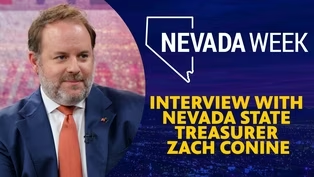
Interview with Nevada State Treasurer Zach Conine
Video has Closed Captions
Clip: S6 Ep7 | 17m 13s | NV State Treasurer Zach Conine discusses affordable housing and Nevada’s finances. (17m 13s)
Providing Support for PBS.org
Learn Moreabout PBS online sponsorship
- News and Public Affairs

Top journalists deliver compelling original analysis of the hour's headlines.

- News and Public Affairs

FRONTLINE is investigative journalism that questions, explains and changes our world.












Support for PBS provided by:
Nevada Week is a local public television program presented by Vegas PBS