
Update On RSV
Clip: Season 2 Episode 92 | 3m 58sVideo has Closed Captions
Dr. Ilhem Messaoudi Powers from U.K. joins Reness Shaw to discuss RSV vaccines.
Dr. Ilhem Messaoudi Powers from University of Kentucky joins Reness Shaw to discuss the recent progress being made in developing vaccines for respiratory syncytial virus.
Problems playing video? | Closed Captioning Feedback
Problems playing video? | Closed Captioning Feedback
Kentucky Edition is a local public television program presented by KET
Update On RSV
Clip: Season 2 Episode 92 | 3m 58sVideo has Closed Captions
Dr. Ilhem Messaoudi Powers from University of Kentucky joins Reness Shaw to discuss the recent progress being made in developing vaccines for respiratory syncytial virus.
Problems playing video? | Closed Captioning Feedback
How to Watch Kentucky Edition
Kentucky Edition is available to stream on pbs.org and the free PBS App, available on iPhone, Apple TV, Android TV, Android smartphones, Amazon Fire TV, Amazon Fire Tablet, Roku, Samsung Smart TV, and Vizio.
Providing Support for PBS.org
Learn Moreabout PBS online sponsorshipThis time last year, Kentucky was seeing a large spike in a common respiratory virus.
It's called for shorthand, RSV, and almost all children contracted by the age of two.
Earlier this week, I sat down with an immunologist at the University of Kentucky to ask her if we can expect the same thing this time.
More in tonight's Look at.
The RSV is one of those respiratory viruses that has eluded Vaccinologist for so many decades.
We did not have an effective vaccine against RSV forever, but in one year, we don't only just have one effective vaccine, we have two vaccines and a monoclonal antibody therapeutic.
Which means.
Waiting.
So we have two vaccines that are both FDA approved for those over the age of 60.
So RSV is a is like influenza in the sense that the most at risk are very, very tiny babies under one year of age, especially those who are premature.
Have any sort of chronic disease or any heart problems, and then those over the age of 60, 65.
So we we definitely want to protect those two populations.
So the two RSV vaccines, one of them is from Pfizer, one of them is from GSK.
They're both FDA approved for those over the age of 60.
But the Pfizer one is also approved for pregnant women and recommended at 32 to 36 weeks of gestation.
And the idea behind that is to protect the baby by vaccinating the mom.
And this is not a novel idea.
We do this with whooping cough immunity.
So most pregnant women are recommended or encouraged to get both the flu vaccine as well as tied up when they're pregnant to protect the baby from whooping cough and influenza, because, again, they're not eligible for most of those vaccines until they're six months of age.
And many, many studies have also shown this true to be for COVID vaccine.
So pregnant women who get vaccinated against COVID not only protect themselves because they are at higher risk of ending up in the intensive care unit, but they're also transferring a ton of antibodies through the placenta to the fetus.
And therefore the newborn will also be protected against COVID because, again, they're not eligible until they're six months of age.
Now, on top of that, we have AstraZeneca has a monoclonal antibody against RSV, and that's now a great alternative for babies who we know are going to be at very high risk.
So those preemies and babies with any heart issues, they can get this one shot of monoclonal antibodies and they're protected for six months.
Oh, wow.
Which is amazing because.
You repeat that every six.
Months.
So really, again, our vulnerable period is that under one year.
Right.
And so you're really trying to protect them during that window that we know they're going to be at risk.
And even though it's great that we have this vaccine for pregnant women, but if you go into labor prematurely, you may go into labor before the 32 to 36 weeks of age.
And so you want to be able to protect those babies who were born prematurely.
And so this monoclonal antibody, again, is is just an amazing step forward.
We know there are a lot of people, either pregnant women or women who are trying to get pregnant, who are really concerned about any type of vaccination, whether that's COVID flu or RSV.
Can you allay those fears?
So the immune system of the pregnant person is is actually adapting and therefore subdued in order to tolerate the growth and promote the growth of the fetus?
And it's important for us to protect ourselves so that we can be there when that baby's born.
So I would say don't take any risks because we're a high risk because of this dampened immune response, where a high risk of ending up in the ICU during pregnancy getting really severe complications.
And think of getting the vaccine as another way to protect yourself, to be there for that baby.
And protecting that baby during those first six months when they're incredibly vulnerable to almost every infectious organism out there.
Federal Child Care Dollars Set To Expire
Video has Closed Captions
Clip: S2 Ep92 | 4m 4s | Funding that provided hundreds of millions of dollars for Kentucky child care centers runs (4m 4s)
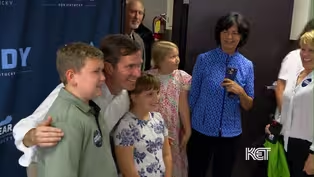
Gov. Beshear Campaigns In Owensboro
Video has Closed Captions
Clip: S2 Ep92 | 3m 27s | Hadley Duvall, an advocate for abortion exceptions, campaigns with Gov. Andy Beshear. (3m 27s)

Inside Kentucky Politics (10/6/23)
Video has Closed Captions
Clip: S2 Ep92 | 6m 26s | The latest political developments in KY, including a new poll in the governor's race. (6m 26s)
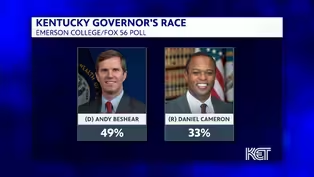
Poll Shows Double Digit Lead For Beshear
Video has Closed Captions
Clip: S2 Ep92 | 47s | A new poll from Emerson College and Fox 56 in the Kentucky governor's race. (47s)
Providing Support for PBS.org
Learn Moreabout PBS online sponsorship
- News and Public Affairs

Top journalists deliver compelling original analysis of the hour's headlines.

- News and Public Affairs

FRONTLINE is investigative journalism that questions, explains and changes our world.












Support for PBS provided by:
Kentucky Edition is a local public television program presented by KET