VPM News Focal Point
Urban Renewal | April 25, 2024
Season 3 Episode 9 | 26m 46sVideo has Closed Captions
We explore where urban renewal is fostering promise and where it creates conflict in Virginia.
The movement to reinvigorate cities and towns is exploding across Virginia. We consider the impact of gentrification, disagreements about architectural integrity and explore where urban renewal is fostering promise and where it creates conflict.
Problems playing video? | Closed Captioning Feedback
Problems playing video? | Closed Captioning Feedback
VPM News Focal Point is a local public television program presented by VPM
VPM News Focal Point
Urban Renewal | April 25, 2024
Season 3 Episode 9 | 26m 46sVideo has Closed Captions
The movement to reinvigorate cities and towns is exploding across Virginia. We consider the impact of gentrification, disagreements about architectural integrity and explore where urban renewal is fostering promise and where it creates conflict.
Problems playing video? | Closed Captioning Feedback
How to Watch VPM News Focal Point
VPM News Focal Point is available to stream on pbs.org and the free PBS App, available on iPhone, Apple TV, Android TV, Android smartphones, Amazon Fire TV, Amazon Fire Tablet, Roku, Samsung Smart TV, LG TV, and Vizio.
Providing Support for PBS.org
Learn Moreabout PBS online sponsorshipANGIE MILES: Making our cities better, healthier, safer, that is the goal of urban renewal.
When it comes to revitalizing Virginia's urban centers, is what's best for some, best for all?
What are the lingering harms from the history of mass-scale makeovers?
What is happening to people least able to afford shiny new cities?
And where is the help that so many need?
The ups, downs, and developments of redeveloping, next on VPM News Focal Point.
Production funding for VPM News Focal Point is provided by The estate of Mrs. Ann Lee Saunders Brown.
And by... ♪ ♪ ANGIE MILES: Welcome to VPM News Focal Point.
I'm Angie Miles.
Everything is in a constant state of change.
It's scientific.
But the social impact of planned change can be challenging.
When it comes to improving our cities, it's hard to please everyone.
Updating the urban landscape can prompt delight, disillusionment, and destruction.
What are the lessons from history, and where are the opportunities to do the most good?
Charlottesville has been dealing with opposition over a recently approved zoning change.
Our Multimedia Reporter Keyris Manzanares explains the debate, including why some residents have concerns over population density, infrastructure capacity, and preservation of the city's charm.
JAMES FREAS: I think we're ready to vote.
KEYRIS MANZANARES: The City of Charlottesville's new zoning ordinance went into effect on February 19th.
James Freas, deputy city manager for operations, says this is about addressing issues of affordability and equity in the housing market.
JAMES FREAS: One of the core values of the City of Charlottesville is that it's a welcoming community and it's a diverse community.
And with that being a core value, I think it was a significant concern that with the increasing cost of living in the city, that we were losing that sense of diversity.
KEYRIS MANZANARES: The new zoning ordinance calls for higher density; requires buildings with 10 or more units to make 10% of them affordable, defined by 60% of the area median income; and eliminates all single-family residential zoning.
Matthew Gillikin with nonprofit group Livable Cville says.
MATTHEW GILLIKIN: Well, the great news is that the new zoning code's not going to destroy any neighborhoods, whereas the existing zoning code was destroying neighborhoods.
And I think if you look closely at certain neighborhoods, they've had major changes in who's able to live there and what the physical landscape of the neighborhood looks like as well.
So this is a way for everywhere in Charlottesville to be part of the solution to our housing crisis.
KEYRIS MANZANARES: But not everyone is on board.
A group of residents from the Barracks Rugby neighborhood is suing the city, alleging the ordinance is void.
VPM News reached out to the attorney representing the residents.
He provided this statement, saying, quote, "This case is about the City of Charlottesville failing to follow specific statutory requirements adopted by the General Assembly to ensure that there is adequate infrastructure for an upzoning like this."
Freas declined to comment on ongoing litigation.
For VPM News, I'm Keyris Manzanares.
ANGIE MILES: The City of Charlottesville responded to the lawsuit in March by filing a motion to dismiss, saying, quote, "The plaintiffs already have that which they now seek to deny to others: good, affordable housing in a desirable locality."
A hearing has been set for June 27 at 1:00 p.m. ANGIE MILES: Understanding that change can be difficult for many reasons, we asked people of Virginia to talk about how important it is to consider the past when planning for a city's future.
TAMEKA ATWOOD: I think it's really important, and I think like here in Wytheville we really take that that prideful.
There's a lot of different places around here that we've restored, but we want to make sure that we can still tell the history of it, and they keep pieces of like the history in it.
ARIANA MORRIS: I think it's really important to preserve and recognize the past.
It's like that saying of, “If you dont know history, it really does repeat itself.
” So I think being aware of that, honoring that, but also modernizing things.
Again, to make sure we're maximizing the popularity of things and making it a place that people want to visit.
ELLIOT RANDOLPH: The old residents, generally are the ones who end up getting kicked out of where they've lived for their whole lives.
They're also kind of demonized in a lot of ways and, you know, viewed as... there are issues but, you know, they're lumped together as like criminals and whatever, like, you know, people messing up the city.
And then a lot of the people who come in to the city are not respectful of the people who were already there.
ANGIE MILES: In Roanoke, many people are still haunted by what happened to their homes, churches, and businesses in the '50s, '60s, and '70s.
City leaders oversaw the destruction of these properties in the name of urban renewal.
News Producer Adrienne McGibbon spoke with Roanoke community members who see echoes of the past in a newly proposed development plan.
ADRIENNE McGIBBON: George Riles has fond memories of his early childhood in Northeast Roanoke.
GEORGE RILES: The neighborhood would come together in the backyard barbecue, especially on fight night.
ADRIENNE McGIBBON: Northeast had a vibrant Black community filled with churches and hundreds of businesses and homes.
But in 1955, city leaders began tearing it all down with the help of federal funding for urban renewal.
GEORGE RILES: Being young, I didn't know what was taking place.
I just knew that people was moving.
I knew they was tearing their homes, and I knew they was building Lincoln Terrace projects to absorb these people that were moving out.
ADRIENNE McGIBBON: Riles was in third grade when he and his family were forced to move.
GEORGE RILES: Like I said, they took down churches, they took homes, and when they got to the grave site, they took the graves up.
Leaving my mother very disturbed about it because her grave site of my grandfather was dug up, but she never did really find out where her father was buried at.
ADRIENNE McGIBBON: Nearly 1,000 bodies moved to make room for the new highway.
And when the city was done in that part of town, they did the same thing in the places where many of those people had relocated.
MARY BISHOP: It was just mass heartbreak and terrible for people's health.
I heard of so many old people who just died, died of heartbreak.
ADRIENNE McGIBBON: Journalist Mary Bishop covered the story for the Roanoke Times.
MARY BISHOP: They wanted to spruce up how downtowns looked, the approach to downtown.
Many of the older white people told me they didn't want them to see Black children sitting on curbs.
ADRIENNE McGIBBON: Despite outcries from the Black community, city leaders destroyed 1,600 homes, 200 businesses, and 24 churches, all replaced by new roads, the civic center, and the post office.
Now, plans to develop the last remaining green space in Roanoke are reopening old wounds and coming right to George Riles's back door.
GEORGE RILES: Oh, Evans Spring.
Evans Spring is right behind me.
(water rushing) ADRIENNE McGIBBON: Evans Spring is 150 acres of undeveloped land in Northwest Roanoke.
In March, City Council approved a plan for the area surrounded by predominantly Black neighborhoods.
Chris Chittum is leading the project.
CHRIS CHITTUM: We're encouraging a mixed use development bringing retail, restaurant, along with new housing.
ADRIENNE MCGIBBON: But leaders are facing a backlash from a weary community.
BRENDA HALE: We stand in opposition of the master plan concerning Evan Springs.
CHRIS CHITTUM: We have documented in the plan how we have heard concerns.
ADRIENNE McGIBBON: Concerns about the development's environmental impact and about what will happen to the people living around Evans Spring.
CHRIS CHITTUM: We really abhor what happened during urban renewal, and this is not the same thing.
ADRIENNE McGIBBON: The city says its plan reflects community concerns, preserving nearly half of the green space, and adjusting traffic routes around existing neighborhoods.
ADRIENNE McGIBBON: Cam Terry runs Lick Run Farm in Northwest Roanoke.
CAM TERRY: We do a lot under the banner of community building here.
ADRIENNE McGIBBON: This three-and-a-half acre urban farm is half mile downstream of Evans Spring.
Terry attended one of the city's community meetings.
CAM TERRY: It's literally the same people looking up and saying, "I remember when this happened 50 or 60 years ago, and we were forced to move.
Now they're just going to develop around us and not tell us we have to move, but change again everything about the neighborhood that we moved to and have loved since we were forced to come here."
ADRIENNE McGIBBON: At 82, George Riles has lived in his Northwest home for nearly half a century.
He acknowledges he may not be able to stop the change.
GEORGE RILES: Ideas, you know, got new ideas, young ideas and so forth, but sometimes it's nice to hold on to the old sometimes.
ADRIENNE McGIBBON: For VPM News, I'm Adrienne McGibbon.
ANGIE MILES: Over the past year, Roanoke city leaders have been drafting a formal apology to present to those uprooted by urban renewal.
Regarding Evans Spring, the city is waiting for developers to submit proposals that meet the requirements set for the area.
Community groups are still working to stop the development.
ANGIE MILES: VPM News Focal Point is interested in the points of view of Virginians.
To hear more from your Virginia neighbors, and to share your own thoughts and story ideas, find us online at vpm.org/focalpoint.
ANGIE MILES: Public housing in America is undergoing a major metamorphosis.
Most would call it a crisis.
Unlike public safety net programs like Medicaid and Food Stamps, funding for housing assistance does not automatically adjust to inflation or need.
Congress must continually approve demand-responsive spending increases, and Congress has not done that.
As housing costs and homelessness have risen significantly, only about one in four households that qualify for housing support actually receive any.
Two years ago, Focal Point gave an overview of plans to redevelop public housing in Richmond.
We have an update and a check on public housing across the state.
What we found is leaders pressed to find creative ways forward.
ANGIE MILES: Shovels in the ground.
Richmond leaders are celebrating a fresh start for one of the city's public housing communities.
Creighton Court is the first of six Richmond Redevelopment and Housing Authority properties slated for demolition and total makeover, a project years in the making and expected to impact about 10,000 current and former RRHA residents.
But it's not exactly a new beginning as this is just another step in the fulfillment of promises made to housing development residents in an effort to eliminate pockets of poverty, improve safety, and modernize homes.
STACY FAYSON-DANIELS: I would like to see our families to have the amenities that we have in terms of, you know, wifi, washer, dryer, 21st century stoves.
DENISE WINFREE: It cooks good, but it takes a lot for me to have to keep cooking and cooking when I can use a bigger stove space.
ANGIE MILES: Two years since Mosby Court resident Denise Winfree invited us into her home and listed her wishes.
The housing authority has a new CEO in place.
Steven Nesmith grew up in public housing and considers himself credible proof of what's possible for those who want more than what they've experienced so far in public housing.
STEVEN NESMITH: The challenge is making sure that we can move from articulating a vision to implementation, to literally closing out on deals.
Can we show that we made a difference for the residents?
ANGIE MILES: Since the demolition of the old units commenced, starting with Creighton, and the promise of better, newer, mixed income, mixed use residences was made, Winfree remains hopeful and engaged.
DENISE WINFREE: This new crew that we have up here now at the rental office is a good... Me, personally, I feel like they're a good crew.
They're pulling together with one another to pull with us.
STEVEN NESMITH: I tell my team, we're very smart people.
But at the end of the day, it's not our vision for what those communities should look like.
It should come from the residents.
So in Mosby Court, we have a developer, and we've begun community conversations.
DENISE WINFREE: The first time the company came out, oh, I wasn't really comfortable with what they showed.
Who wants to live in an apartment building, a tall building, where you're going to have some people, families are going to have children, children stomping and running over top of your heads.
Then you're going to have some people on medication that have health issues.
Some are afraid of heights, some people don't have families there to help them.
STEVEN NESMITH: The residents tell us what they want to look, what they want it to look like, and for us to go out and come back to them with architectural drawings and say, "Here are some possibilities after having listened to you."
DENISE WINFREE: Second meeting I went to, I saw different plans.
Very much interested.
Very much interested.
They had layouts that we had a chance to pick from and they were right interesting, rather good.
ANGIE MILES: Public housing throughout Virginia and nationwide started as a dream of affordable, but temporary shelter.
Former communities, mostly inhabited by Black people, and usually labeled as ghettos or slums were demolished to create something brighter.
However, challenges associated with poverty persisted and the consequences of isolation, limited transportation, and scarcity-driven crime have remained.
SECURITY OFFICER: We've had the fights.
STEVEN NESMITH: We brought in our own security force, not a police force, a security force.
And before that security force put one boot on the ground, we had 'em go out and talk to the residents.
It's been a resident-led initiative before they put one boot on the ground.
ANGIE MILES: Another challenge is similar to one faced all over Virginia, sufficient affordable units to address extensive waiting lists and household incomes that are not a match for rising rents.
These were concerns for community organizer and housing advocate Omari Al-Qaddafi when the promises of reinvention were first made.
OMARI AL-QADDAFI: I would much rather see public housing renovated and not turned over to a private developer or a private landlord.
ANGIE MILES: The skepticism remains central for him now.
He says he watches with caution as RRHA seems to be moving forward with plans as promised, but continues to displace public housing residents through planned and supported temporary relocation as well as through evictions for nonpayment of rent.
OMARI AL-QADDAFI: I can't even say that I'm optimistic.
Over the past few administrations, our residents concerns haven't really been taken into account.
ANGIE MILES: RRHA is having to manage with less public funding and with an evolving federal mindset.
The Federal Housing and Urban Development Program and those supported by its dwindling dollars are invested in moving more low income residents to a voucher-based system, enabling them to live in housing authority properties if they choose, or in privately owned units partnering with housing authorities.
And you'll see a similar set of solutions in play in cities across the commonwealth.
STEVE MORALES: As we look at the funding that we get from HUD, we know as we move forward in the future, that we will need to make some changes, some transformations.
And so a big thing that we're looking to do right now actually is we're working towards a conversion of much of our senior housing from public housing to project-based Section 8 housing.
A lot of the housing authorities across the nation have moved in that direction.
JOHN SALES: The voucher is the only route to make that happen, unfortunately.
We would love the federal government to step up and close that subsidy gap or bring more money to the table for housing authorities to redevelop public housing and then bring 'em back.
TOM FLEETWOOD: We do not have public housing in Fairfax County anymore.
We converted all of our public housing to a Section 8 subsidy, which is a much more stable funding platform.
Gives a lot more opportunity to residents and gives a lot more opportunity to the housing authority in terms of being able to do new development on formerly public housing land.
ANGIE MILES: Residents who've made the move into new facilities away from their previous homes.
Like those here in Richmond's Armstrong Renaissance, have expressed satisfaction with many upgrades and the emphasis on safety, support, and amenities.
But what about those displaced by demolition who've not found a suitable replacement?
Those who may want to move back to their old neighborhood when it's rebuilt, but without enough available units for them?
Or those who may be relying on rent remaining reasonable over time in a privately owned apartment.
DENISE WINFREE: Over in Creighton, some people went on and got their own place 'cause they don't want to live in public housing anymore.
Some people, from what I understand, are waiting for the new place to come up over there.
I'm hoping that over here would be the same, give us vouchers, from what they told us, that everybody would be eligible to come back to the new place.
That was what was said a few months back.
Now, you know, things change all the time, so I don't know what it's going to be.
ANGIE MILES: Mixed-income housing, the use of vouchers, mixed-use development that brings services closer to residents are all mainstays of the new outlook.
Also, homeownership programs are prominent in most places, and Richmond boasts that its program is game-changing, relying on factors other than the traditional credit score.
Cities must also address where public housing residents will go during demolition phases and where they will ultimately land, as well as updating and repairing existing public housing units for as long as they remain standing.
We have part two on the state of public housing on our website.
ANGIE MILES: Many cities across Virginia are dealing with a shortage of available, affordable rental homes.
And renters who can't keep up with the increasing costs, do sometimes face eviction.
Charvalla West is the interim CEO of the United Way of the Virginia Peninsula, which runs the Peninsula Eviction Reduction Program.
Thank you so much for joining us Charvalla.
CHARVALLA WEST: Thank you for having me.
ANGIE MILES: So I'd like to actually start by talking a little bit about public housing because it has really been evolving.
How does that impact your work at the United Way and your efforts to help people find pathways out of poverty?
CHARVALLA WEST: I think it's a heavy lift for any community that's considering the work of revitalizing public housing.
I think it's necessary to ensure that everyone has a safe home in a safe neighborhood that they can afford.
ANGIE MILES: Five Virginia cities out of ten nationwide are in the top tier of cities that evict people.
You uniquely have a program to help mitigate evictions.
Talk about that program.
CHARVALLA WEST: So what we've done at United Way is we administer this pilot on behalf of the entire community, and we engage partners from the sheriff's department who have to execute evictions, our local judges and attorneys, landlords, tenants, the nonprofit and human services community, all of us are working together to look at what we can do differently to help stabilize folks who are struggling to pay their rent.
One of the ways we do that at United Way is we provide an advocacy and referral service called the Community Assistance Network.
It provides access to more than 150 partners across our community who are working to keep people housed, make sure they have basic needs, and provide some other stabilization supports.
(upbeat music) ANGIE MILES: You can watch the full interview on our website.
ANGIE MILES: Nestled in the hills of southwest Virginia, the small town of Martinsville is undergoing a revitalization.
One of the key businesspeople driving the town's development was a local high school football star who did well in Texas real estate and decided to bring his business skills back home to Virginia.
Senior Producer Roberta Oster caught up with him outside his office.
DERRICK ZIGLAR, JR.: So we're in the middle of uptown Martinsville, right in front of the old courthouse.
From Fayette Street up, which is everything going this way, this would've been pretty much where all your white businesses were, whereas everything from Fayette Street down would've been where your African American businesses in those neighborhoods as well.
As you're seeing in the scheme of everything here change, you're seeing more African Americans come up here for business, we're seeing more African Americans as building owners as well, and so they're starting to bring that mix within our community and closing the gap of what that separation has been.
So I came from Fayette Street.
That was like the rough area of Martinsville, and so my mom did a lot, been through a lot, and I had to grow up fast.
The unique thing is because I'm in my hometown, everybody knows that.
They've seen me go through high school and playing sports, and then go off to VMI.
Now I return home, I buy property, I sit on the boards and I'm spending time with my fraternity, investing in our community.
So right now we're on the corner of Church Street.
Right here you have the setback building, so in this space particularly, we have my office in the basement, we have an ice cream shop, Sweet Heaven, that's right there on the main floor.
And then on the third floor, there's an apartment there that I actually leverage as an Airbnb.
The other building beside it is called the Jefferson Plaza.
We have insurance agents.
We have some different like self-care type of things for women.
We have an adoption agency, we have therapists, we have mental health facilities, hairstylists, we have gyms, we have an event space.
So we have quite a few different things within our building, which is good because it brings a mix of different people uptown, which is ultimately the goal to see that growth there.
SPENCER KOGER: The second floor is basically done.
Derrick's ownership of the Jefferson is absolutely critical.
That area has become a focal point for downtown.
It's connected with everything from the Bridge Street parking lot all the way up.
Derrick's building, as well as the centralness of the other buildings beside of it, are really going to pop off between one or the other and really showcase that businesses can survive here and businesses can grow.
NATALIE HODGE: When they put the banner up, it was around the time we were opening... Derrick is the catalyst for a lot of great things that are going on in the community because he represents a young person who's come back and who's investing time and talent into the community.
When that happens, people start to imagine the possibilities.
DEVYN GILL: Derrick is revitalizing Martinsville because it gives the small town kid hope that they can do it, too.
There's a lot of kids that are driving past a lot of these buildings and whatnot, never even thinking about owning them.
And so now that they see him do it, they see that it's possible.
DERRICK ZIGLAR, JR.: So we're heading into Gill Fitness training.
DEVYN GILL: I'm one of the hometown kids that I was talking about.
I saw him do it and I'm like, okay, while everybody else is clapping and whatnot, which I was too, I'm like, it's not just me looking at him with adoration saying must be nice.
I'm thinking if he got it, so can I. DERRICK ZIGLAR, JR: Whats up, man?
DEVYN GILL: I told Derrick, if somebody gave me an opportunity, I was going to take it and run with it.
He was the one that gave me the opportunity so my goal every day is to prove him right in that regard.
DERRICK ZIGLAR, JR.: It's not about just me being successful and me living a life that's fulfilling for what I want to do when I'm an old man, but it is truly about helping others do the same.
And if I can enjoy that with other people that I've got to be a part of their story, then it makes life even more enjoyable.
ANGIE MILES: Striving, struggling, succeeding.
These are the stories of those working to improve Virginia cities.
And in every case, many thousands of urban dwellers' lives are in the balance.
To hear the full interview with Charvalla West of the United Way, part two of our public housing story, and more on this topic, visit our website, vpm.org/focalpoint.
You can share your story ideas there as well.
We thank you for joining us, and we'll see you next time.
Production funding for VPM News Focal Point is provided by The estate of Mrs. Ann Lee Saunders Brown.
And by... ♪ ♪
Video has Closed Captions
Clip: S3 Ep9 | 4m 46s | Community Land Trusts Aim to Innovate for Affordability (4m 46s)
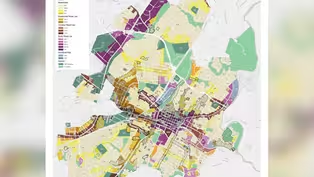
Charlottesville’s new zoning ordinance sparks lawsuit
Video has Closed Captions
Clip: S3 Ep9 | 1m 55s | Charlottesville facing lawsuit as residents sue over newly implemented zoning ordinance (1m 55s)
Community-based solutions to Virginia’s eviction crisis
Video has Closed Captions
Clip: S3 Ep9 | 13m 28s | A United Way pilot program helps families avoid eviction and move out of poverty. (13m 28s)
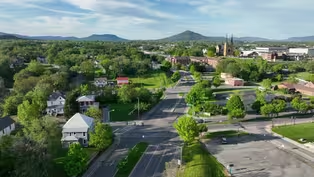
Harmful history of urban renewal
Video has Closed Captions
Clip: S3 Ep9 | 5m 39s | Many Roanoke residents are still haunted by their memories of urban renewal. (5m 39s)
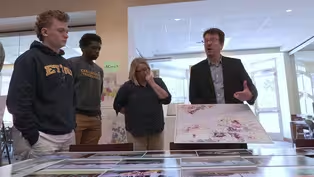
Video has Closed Captions
Clip: S3 Ep9 | 4m 14s | An exhibit shows the impacts of redlining, a discriminatory housing practice, with a series of maps. (4m 14s)
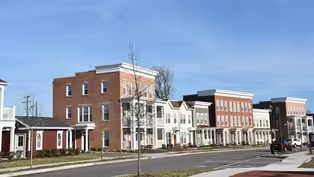
The metamorphosis of public housing
Video has Closed Captions
Clip: S3 Ep9 | 11m 36s | What was public housing is shifting to affordable housing. Managers lay out the vision. (11m 36s)
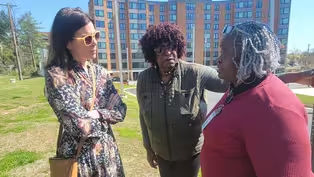
New partners in public housing redevelopment
Video has Closed Captions
Clip: S3 Ep9 | 6m 55s | When private donors and public housing residents come together, they find new ways forward (6m 55s)
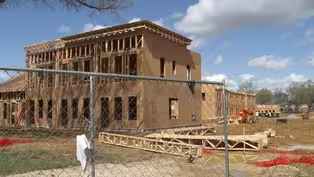
The promises of public housing
Video has Closed Captions
Clip: S3 Ep9 | 7m 42s | Are those who’ve relied on public housing reaping benefits from redevelopment. (7m 42s)
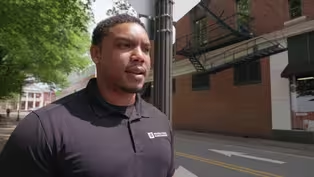
Revitalizing Martinsville: local man is catalyst for change
Video has Closed Captions
Clip: S3 Ep9 | 3m 33s | A VMI Cadet returns to Martinsville to help revitalize his hometown and mentor others. (3m 33s)
Providing Support for PBS.org
Learn Moreabout PBS online sponsorship
- News and Public Affairs

Top journalists deliver compelling original analysis of the hour's headlines.

- News and Public Affairs

Today's top journalists discuss Washington's current political events and public affairs.












Support for PBS provided by:
VPM News Focal Point is a local public television program presented by VPM