
US Bombs Iranian Military Sites as Ceasefire Under Threat
Clip: 6/1/2026 | 14m 5sVideo has Closed Captions
The latest on the ongoing conflict between the U.S. and Iran.
U.S. officials on Monday said radar and drone sites in Iran were bombed after Tehran shot down an American drone over the weekend. Iran then said it targeted American soldiers in Kuwait with missiles, which the U.S. says it shot down. We breakdown the latest on the tenuous ceasefire talks.
Problems playing video? | Closed Captioning Feedback
Problems playing video? | Closed Captioning Feedback
Chicago Tonight is a local public television program presented by WTTW
WTTW video streaming support provided by members and sponsors.
US Bombs Iranian Military Sites as Ceasefire Under Threat
Clip: 6/1/2026 | 14m 5sVideo has Closed Captions
U.S. officials on Monday said radar and drone sites in Iran were bombed after Tehran shot down an American drone over the weekend. Iran then said it targeted American soldiers in Kuwait with missiles, which the U.S. says it shot down. We breakdown the latest on the tenuous ceasefire talks.
Problems playing video? | Closed Captioning Feedback
Where to Watch Chicago Tonight
Chicago Tonight is available to stream on pbs.org and the PBS app.

WTTW News Explains
In this Emmy Award-winning series, WTTW News tackles your questions — big and small — about life in the Chicago area. Our video animations guide you through local government, city history, public utilities and everything in between.Providing Support for PBS.org
Learn Moreabout PBS online sponsorship>> In the latest developments in the Middle East, President Donald Trump says Israel and Lebanon have agreed to dial back their fighting.
>> While over the weekend, the U.S.
and Iran traded fire testing in nominal cease-fire that has jeopardized peace talks.
It's not clear how close the 2 sides are to a deal.
Meanwhile, Ron's grip on the Strait of Hormuz continues to disrupt global energy supplies here to help us understand the back and forth are Ari on to bottom by vice-president of research for security and defense at the Chicago Council on Global Affairs to I previously worked at the State Department and the Department of Defense, Ibrahim, Abu Sharif, journalism and Middle Eastern studies professor at Northwestern University.
He's author of the book Social Media, Religious Authority and the Arab Gulf Crisis.
>> Richard Porter and attorney and longtime member of the Republican National Committee from Illinois.
He was White House adviser to President George HW Bush and Vice President Dan Quayle resume Robert Pape, political science professor at the University of Chicago, a terrorism specialist and founding director of the Chicago Project on Security and threats.
Welcome back to the 3 of you.
Welcome to you.
Thanks for joining us.
Are out about a violent start with you first, please.
Let's briefly sort of break down what we saw this past weekend when came to the back and forth strikes.
>> Yeah.
that the United States and Iran have been negotiating back and forth to achieve a sustainable cease-fire and also to settle and rent range of issues that have been for a long time for decades.
Actually kind of under penned the threats landscape and have been the source of tensions between the U.S.
and Iran.
That includes Iran's nuclear program, but also its support for terrorism across the region.
Negotiations seem to have stalled for now.
What I do want to caution is that, you know, there's always a lot been flow in any negotiations.
So we shouldn't read too much into the tea leaves and too much into true social posts and Twitter post from the Iranian side, I should say Expos because, you know, you do have and any kind of complex negotiations, especially with 2 countries that have such distressed as the United States and Iran due these things can be tricky complex issues and sometimes you make some progress and sometimes things come to a bit of a halt.
>> How does the how does this impact the U.S.
A strategy for negotiations?
What's been going on?
>> it seems like for now where a come back to a tip for tat response is across the region.
There have been missile and drone strikes and so back to tension.
So the tensions coming back between the 2 sides.
So, you know, I think right now the administration just kind of nice to take a step back and think about what its sure is going to be going forward and what is acceptable ultimately, right.
This is about what kind of deal is acceptable from the United States perspective.
From the president's perspective and what he's willing to live with the ice and the U.S.
is not get everything it wants.
Neither is Iran.
So it's a matter of figuring out what's on the table and what is acceptable.
>> Richard Porter about you, how do you sort of see what went on this weekend?
And you know where the U.S.
stands when it comes to negotiations.
So I think you have to recognize that when Donald Trump is negotiating, he's a little game theory and that's how he operates a so a lot of what he was doing.
I think over the course the weekend by going back was trying to establish dominance in could.
This is ultimately a surrender, its a negotiated surrender.
But you're going to do it on our terms.
He starred in a second to get all the terms he wants.
But I think he's trying to establish that kind of a dynamic and he did it by basically saying, well, we have be with the table, have a few more points.
want to go back back to you on that.
And so I the Iranians are usually the ones that are hard to bring to the table.
And so by playing coy, I think the president's trying to do the same thing Iranians are doing, but he's been emphasizing his patients let him work.
His is negotiation.
Magic in the meantime, we're choking them with a ongoing blockade.
And I think he's what he's trying to convey is I can wait you out.
You guys are drowning.
We're not.
We're short of.
We have a record high stock market.
You know, gas prices are high.
But beyond that, we can which you guys out and so if that's the message is trying to deliver.
>> Ibrahim, you going back to sort of like the start of this war.
Initially, the Trump administration justify the war as an effort to destroy the nuclear capabilities of Iran.
But prior to that, former intelligence director Tulsi Gabbard argued that the operation midnight Hammer from 2025 did that that it that it Iran would not be able to rebuild its nuclear program at the time sort of contradicting the president with the sort of conflicting reports.
Why do you think the U.S.
has started this work?
first of all, I don't think they're conflicting cause.
I think the intelligence reports were right.
>> And so I think conflicting what seems to be conflicting is the erratic nature of President Trump's mediation and his use of Twitter, Twitter under the social media is not that it's not the relevant to be very honest with you.
It is new way of doing diplomacy.
But you know, just like all social media they do tend to be erratic.
So the problem of trying to find the off-ramp, I don't think surrenders on table.
But if you're looking for the off-ramp and we can't find it, I think we have to look at what we could find the beginning.
That's the on ramp the United States made declarations that Iran is an imminent threat to the United States.
Intelligence agencies around the world said no, nobody won this war, not the Europeans, not the the people in the Gulf.
Nobody won this war, the Ronnie's and want this more.
And so what happened was lost.
I would say without whole lot of with them.
But I think there is an off-ramp available.
But that requires a steady hand.
if this is a being erratic is is a strategy for negotiations.
I have a hard time accepting that, but I do think there is an off ramp and at the end of it in Iranians are going to be much more powerful than they were before.
>> Robert Pape, this war has consistently polled as having some of the lowest approval ratings for any U.S.
conflict in history.
With such an unpopular war.
Do you think the president is like to the likely to find that off-ramp before the midterms?
>> I don't think it's going to find it very easily.
It's important understand that this war has been a colossal strategic disaster for the United States.
We started this war of the idea would be a weekend, essentially maybe a few weeks.
Here is.
We were going to topple the regime.
Well, that just simply didn't happen.
And we did.
The bombs hit targets.
Military did a splendid job what happened here is that as we went our strategic position, not worth are on now is control of the Strait of Hormuz.
Those that's 15% plus the world.
Evergy's supplies.
That is an enormous game for Iran and they're in the driver's seat.
And you saw today you saw what Israel vary as to whether Iran called negotiations and within an hour, President Trump was on the phone Netanyahu to get him to pull back.
Now, how many people in the world can get President Trump to do something in one hour and he's had multiple tweets.
Turn to say 2 are in.
This is directly directed toward Iran.
Understand I'm Israel back.
Well, this shows you that Iran is in the driver's Trump isn't what's called a classic escalation trap.
Where you get one strategically behind position worse?
Now choice is are essentially capitulated to the stronger power, which of course he doesn't want to do or didn't ask away.
And he's bouncing back and forth between want to get has been for weeks now.
Richard Porter's reaction to that.
What are you?
What do you think or what are options here?
>> Why that's not to say that Iran is the stronger power that's just not.
>> I mean, the reality is that we could take that straight anytime.
We wanted to put the president showing a real regard for human life.
He's been fighting an entire were without losing any casualties.
I mean, essentially that's what he's been able to do.
And he's he's trying to get this thing done with the economic hammer without putting troops the ground is necessary to clear out the straits now.
But the reality is they're are vulnerable targets on both Kharg Island is just as vulnerable as the Saudi facility, which is enormous on the other side of the of the Gulf.
And I think our allies in the region have been saying to us, look, lets you get this thing done without further for, you damage being done to these very important facilities.
But the idea goodbye to let's see just over that this was a huge role to law justice.
>> He's been focusing if I'm for president.
want to come back return.
A simple question.
yes, we are So why did President Trump called Netanyahu this morning that he just was he going to do it anyway or is this direct response to Iran's behavior?
>> Yeah, well, why was Netanyahu choosing this moment to go into penned into to I mean, so, look, there's a whole lot of gamesmanship.
he's installing may, and he's not dealing fact that it's all obvious that you're overstating the case for an Iranian power that do not on the United States common to get.
going him in here.
Go I think we're we're getting lost in weeds here and no one said Iran is more powerful.
The United States, everybody knows United States have the big I know you're not saying that.
Norm Eisen were saying in comparatively before the war, Iran is much stronger now.
No one saying it's a superpower.
Nolan saying that it is upset the balance superpowers and in the world.
Nobody saying that.
And so I think that if you if you want to make a point, let's stick to fact Robert and sit say that the loss of our property nice I didn't say Nobody's thing that nobody in their right mind would say that.
So let's let's establish the facts about what we said rather than you you know, almost to the point of who's more powerful.
I'm not going to that question.
But are you on how much damage can be us really do Iran's nuclear capabilities at the time that she will bowl.
>> I think I land somewhere in the middle of all all of conversations where, you know, I do think that militarily we have actually made quite a bit of dense in terms of rolling back Iranian capabilities.
That's true on Iran's nuclear program must run Iran's missile and drone programs able program naval capability.
Certainly I think the bigger question is what does that mean strategically, right?
At the end of the day, you can roll back tactically a lot of Iranian capabilities.
But what does Iran retains so to come back to the nuclear program, as you mentioned?
You know, I think we've actually boost between midnight hammer the operation last summer and between those conflicts.
We have rolled back a lot of Iran's nuclear capabilities.
Key facilities have been damaged.
What I think is important here, though, is that Iran does continue to maintain highly enriched uranium, but it has its disposal enough to make several nuclear weapons if it chooses to do so if it chooses to do so is the operative piece here.
So we need to know if Iran is going to make the decision after this conflict or during conflict to acquire a nuclear weapon.
We don't know that we don't have the answer to that question yet.
The second piece of that is that there is still a knowledge base that exist within a run to be able to reconstitute its nuclear program.
taken technical experts, scientists and as the director general of the National Atomic Energy Agency keeps saying unless you're willing to kill every single person there, they are going to maintain that knowledge base to be able to reconstitute their program.
It's going to take time.
It's not going to happen overnight, but they can do for him.
There's a point you disagree.
first of all, I don't think your mom has enough for preached at percentage.
A six-person Richmond is not enough to make a weapon.
>> It has here on 90%.
However, we've been living with the science fiction time continue on fallacy.
And as for last 30 years, Iran has been 2 weeks away from the bomb.
So I think we need to stop dipping into that retention pond of talking points.
It's not it's not the main issue here.
The main issue President Trump, thought that Iran is going to be Venezuela.
Venezuela.
System where you we take out the leadership and then we got oil.
They seriously this calculator on anyone who is familiar with the region could have said it's impossible for you to repeat and the Caribbean what you want to do this to do same thing Iran, impossible.
Anyone who has a modicum understanding.
But however, there's a certain arrogance in a certain brash about the president and he's a sorry his body.
And that has has something on him because he's listen to is really it the Israeli point.
I'm not saying because I don't know.
But if you look at the action, president's not holding control it's very it's very Robert Pape, just a couple of seconds left.
What is an off-ramp look like here?
>> It has no off-ramp.
There's no path that we would have taken about 6 or 7 weeks.
We're going to run out of the while.
Inventories in the world is all the oil.
Most of the oil ours.
>> Are now telling almost every single day.
So this idea of just wait it out.
See what President Trump does.
Well, the problem we're running out of oil inventories and that's happening every single day that he can't find off-ramp.
And I'm saying that you know how get reported.
It's off ramp.
Look like seconds deal thing to be doing.
A lot of the shorter, I think by the end of the month mean Trump on Sunday, Yeah.
I think one of his ripped up by the 4th of July.
Obviously, I think that's his game.
>> Okay.
I'm gonna leave it there.
Hopefully will be back sooner to talk about this
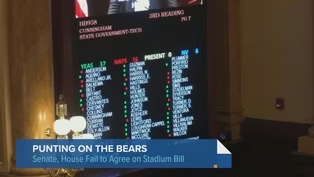
Illinois Lawmakers Pass a Budget but Bears Stadium Bill Stalls Out
Video has Closed Captions
The budget and the Bears were the talk of Springfield over the weekend. (7m)
Providing Support for PBS.org
Learn Moreabout PBS online sponsorship New Episode
- News and Public Affairs

Top journalists deliver compelling original analysis of the hour's headlines.
 New Episode
- News and Public Affairs

Today's top journalists discuss Washington's current political events and public affairs.


 New Episode
 New Episode
 New Episode
 New Episode
 New Episode
 New Episode

 New Episode
Support for PBS provided by:
Chicago Tonight is a local public television program presented by WTTW
WTTW video streaming support provided by members and sponsors.