State of Affairs with Steve Adubato
U.S. Rep. Andy Kim; Dianne Grossman; Benjamin Dworkin
Season 7 Episode 2 | 27m 58sVideo has Closed Captions
U.S. Rep. Andy Kim; Dianne Grossman; Benjamin Dworkin
U.S. Rep. Andy Kim joins Steve Adubato to address the need for bipartisan policy; Dianne Grossman, Co-Founder of Mallory's Army, joins Steve for a compelling conversation about teen suicide and the prevalence of this nationwide epidemic; Benjamin Dworkin, Ph.D., Director of the Rowan Institute for Public Policy & Citizenship talks about the implications of social media on public policy.
Problems playing video? | Closed Captioning Feedback
Problems playing video? | Closed Captioning Feedback
State of Affairs with Steve Adubato is a local public television program presented by NJ PBS
State of Affairs with Steve Adubato
U.S. Rep. Andy Kim; Dianne Grossman; Benjamin Dworkin
Season 7 Episode 2 | 27m 58sVideo has Closed Captions
U.S. Rep. Andy Kim joins Steve Adubato to address the need for bipartisan policy; Dianne Grossman, Co-Founder of Mallory's Army, joins Steve for a compelling conversation about teen suicide and the prevalence of this nationwide epidemic; Benjamin Dworkin, Ph.D., Director of the Rowan Institute for Public Policy & Citizenship talks about the implications of social media on public policy.
Problems playing video? | Closed Captioning Feedback
How to Watch State of Affairs with Steve Adubato
State of Affairs with Steve Adubato is available to stream on pbs.org and the free PBS App, available on iPhone, Apple TV, Android TV, Android smartphones, Amazon Fire TV, Amazon Fire Tablet, Roku, Samsung Smart TV, and Vizio.
Providing Support for PBS.org
Learn Moreabout PBS online sponsorship- [Narrator] Funding for this edition of State of Affairs with Steve Adubato has been provided by The Turrell Fund, supporting Reimagine Childcare.
Veolia, resourcing the world.
New Jersey Sharing Network.
RWJBarnabas Health.
Let'’s be healthy together.
The North Ward Center.
Horizon Blue Cross Blue Shield of New Jersey.
Here when you need us most.
Operating Engineers, Local 825.
Eastern Atlantic States Regional Council of Carpenters.
And by Choose New Jersey.
Promotional support provided by ROI-NJ.
Informing and connecting businesses in New Jersey.
And by NJ.Com.
Keeping communities informed and connected.
[INSPRATIONAL MUSIC] - Hi everyone, I'm Steve Adubato.
Thank you so much for joining us.
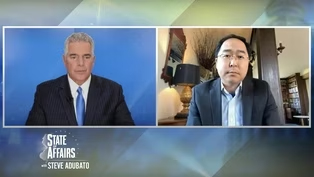
We kick off the program with United States Congressman Andy Kim.
Congressman, thanks for joining us.
- Thanks for having me.
- Congressman we're taping this on the 21st of March.
A lot going on.
We'll talk about former President Trump in a moment.
Biggest lesson for you to date, given what we know from the Silicon Valley Bank collapse and other banks that have collapsed since then as it relates to the role of the United States Congress with respect to regulation.
- Well, look, the I think the biggest lesson that we're all learning is that, you know, we have to have greater attention to what these banks are doing and make sure that they're being good stewards of the money of the American people.
And that's something that we recognize that you can't ever assume that these banks are just gonna be okay.
We do need to make sure that we understand the repercussions that are out there.
And we saw a system with the Silicon Valley Bank that could have very well decimated a lot of our startup innovation here in this country.
And that's something that we had to make sure that we took action to be able to stop.
But we're not out of it yet and I'm still worried about where things are looking.
- Hmm, shift gears.
You're also worried significantly about US-China relations.
You are in fact on the House Select Committee on Strategic Competition between the United States and the Chinese Communist Party.
What is the greatest concern you have, Congressman?
- Well, look, the greatest concern that I have is about ensuring that our country continues to be the strongest country in the world.
But we gotta make sure that we're looking at that not just through the lens of the military, I worry that sometimes Congress is putting too much of the emphasis on this idea of a security threat.
There are real, legitimate security threats.
But I believe that we need to be engaged in efforts like investing in our own economy, fixing and healing our democracy to show that our democracy is not on the decline, and making sure that we're taking steps to be the innovators of the future.
Those are some things that I'm hoping to be able to get bipartisan support to be able to push forward on, but we're gonna try to do our best in Congress to try to do that in that way.
- You know, Congressman, you talk about bipartisan support.
How much bipartisanship is there these days when the speaker, the new speaker, the relatively new speaker in the house, Kevin McCarthy, and many of his members who are most vocal, seem to be talking most about the importance, the significance, the imperative of investigating Joe Biden, everyone in his family, particularly Hunter Biden, not what you're talking about.
- I do think there's a big disconnect.
You know, this is something that I've heard from Speaker McCarthy.
He was talking about how he wants to make sure that we're tackling this challenge that we're faced when it comes to China.
But then I talked to him and others of saying, well, look, one of the biggest things we can do to make sure that US strength and leadership continues is to make sure we're not defaulting on our debt.
To make sure that we don't have a situation where a political impasse when it comes to the debt ceiling is something that's gonna put our economy in jeopardy, especially as we're seeing the shakiness with these banks.
So, you know, that is something I tried to push, but I do feel like there's a number of my colleagues that are putting the politics ahead of just getting things done to be able to support our country right now.
So it is something I worry about a lot.
As we're taping today there are many who believe former President Trump will be indicted in Manhattan, the DA in Manhattan.
Assume that happens, again, this will be seen later, not from a criminal or legal point of view, what do you believe that means politically for, forget about the Republican Party or this country, given the fact that President Trump is running again for president in 2024?
- Yeah, well, look, I don't know what's gonna happen next, but one thing- - And also an investigation in Georgia.
We don't know what's happening in Georgia either.
Go ahead, please, I'm sorry, Congressman.
- Yeah, well, I don't know what's gonna happen next, but what I do hope is that whatever does happen that we as a country approach this with calm and with respect and try not to have this be something that throws gasoline on the fire.
I do worry about our state of our politics.
I say that as someone who's been in the last four years.
I was there at the Capitol complex on January 6th.
I've seen with my own eyes just the level of of tribalism that has taken over our country in that kind of way.
What I'll say is that we unfortunately live in an era of great division within our politics and we certainly see people and leaders, again, using that for their own advantage, weaponizing the fear that's out there to be able to push their own agenda and their own ambitions.
And that's something that I am fearful of.
I really worry about this in terms of how our democracy is gonna survive and go forward.
- And we'll show a picture right now of Congressman Kim.
It's an iconic picture that I think the Library of Congress has capturing what happened on January 6th.
It was the congressman, I think it was the day after January 6th, or on January 6th, it was that night attempting to work with others to clean up what they could clean up after the devastation that happened, the attack based on the attack of the House of Congress.
The Dad's Caucus in Congress, what is it?
And is childcare a part of that discussion, Congressman?
- Yeah, when I came into Congress I had a one-year-old and a three-year-old, and there were not that many people that were young dads, young parents in Congress.
And over the last couple years there have been more and more, you know, young parents.
And I remember I was talking to one of my colleagues who helped start the the Dad's Caucus, Jimmy Gomez.
He was changing his baby, his newborn, on the floor outside the House of Representatives.
And I pointed to him and I said, "You know, there's a there's a changing table and one of the bathrooms at the Capitol."
So we just started by just kind of sharing tips of how to be dads in Congress, how to just deal with this.
I am down in DC almost half the year.
I have now a five year old and a seven year old.
I have a wife that I'm trying to work on this with to try to be the dad I need to be.
And then as we had this conversation, we realized that, you know, this is something that needs to be talked about more broadly.
So about childcare, about the child tax credit, about child hunger.
A lot that I've been trying to do to make sure that kids in our country are not going hungry, which unfortunately many are by the thousands.
So this is something that we wanna make sure that we're addressing and putting that forward, that this is something that needs to happen.
It's not just for moms to talk about, it's about dads, it's about everyone.
It's about our future of our country.
And we're trying to use this Dad's Caucus to bring attention to that.
- And real quick, the impact of childcare on the US economy.
- Well it's devastating.
You know, I know that people are paying upwards, a huge percentage of their paychecks are now going to childcare.
This is something that is becoming a huge problem right here in Jersey.
I'm just talking to parents that just can't afford to be able to have their kids go to childcare, which is then having an impact on our workforce.
You know, dads and moms are not able to go to work because they're struggling to get childcare.
That impacts our entire economy, that impacts our workforce at a time when we're struggling to fill jobs.
So that is something that I hope we recognize.
This is something that benefits all of us.
Our country is stronger when we have stronger childcare and better taking care of children.
- Got a minute left, Congressman, lemme ask you this.
You went from being in the majority party to the minority party, right, based on the last election.
The biggest difference for you and your life and your work in the United States Congress because of that change in party stature and control of the House.
What's the biggest difference?
- Well, I think one of the biggest differences is what I think is possible in terms of legislation right now.
Last year I was able to pass legislation.
Bill that I wrote that capped out-of-pocket costs for seniors on Medicare when it comes to their prescription drugs at $2,000 a year.
No senior on Medicare will ever have to pay more than $2,000 a year for prescription drugs.
I was hoping to be able to build on that.
I was hoping to be able to take further steps to lower prescription drug costs and healthcare costs.
All that has come to a screeching halt with this new Congress because I just don't have leadership there, a speaker there, or committee chair people there that share my priorities.
And that's sad because people are struggling right now.
So I'm trying to figure out other things to do.
I'm working on mental health.
I'm trying to deal and tackle the opioid crisis.
Other things where I might be able to get bipartisan support on.
But, unfortunately, a number of the big priorities, whether it's prescription drug costs and healthcare costs or climate change and others, we're seeing a real stagnation on this for the next two years.
- United States Congressman Andy Kim, I wanna thank you so much for joining us.
We appreciate it.
Best to you and your family and to your colleagues in Congress doing the work of the people.
Thank you, Congressman.
- Thank you so much.
- You got it.
Stay with us, we'’ll be right back.
(grand music) - [Announcer] To watch more State of Affairs with Steve Adubato, find us online and follow us on social media.
(phone dialing) (somber music) - [Operator] 9-1-1, where is your emergency?
- It was a new school, lockers.
Was supposed to have all the elements of a fresh start.
There are no words to describe a child laying in a casket that's yours.
- You were just watching some video from the movie, Mallory.
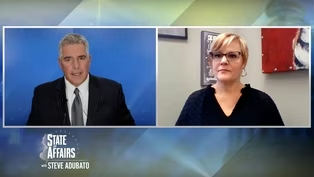
And we are honored to be joined by Dianne Grossman, co-founder of Mallory's Army.
Good to see you, Dianne.
- Thanks for having me, Steve.
- We've spoken before, through the Healthcare Foundation of New Jersey, talking about a whole range of issues but tell folks about your 12 year old daughter, Mallory, whose legacy lives on in the work that you and your colleagues are doing.
- Yeah, so you know, I started sharing Mallory's story.
She's just an average, every day, all-American little girl.
She loved making crafts, she was outgoing, she was a cheerleader, she was a gymnast.
So, you know, we always referred to her as just the everyday, all-American little girl and one of the reasons we decided to speak out is that, we wanted people to understand that every child could be a victim to what Mallory experienced at school and online.
- You know, I remember when we talked, Dianne, I asked you what, if any, signs did you see?
Because obviously, parents right now are, while respect and appreciate the work that you're doing and taking this horrible tragedy and turning it into something meaningful and positive, what, if anything, did you see?
- So obviously, hindsight is a really unfair and, you know.
But look at it, you know what's really tough and it's very confusing, and I would share this to parents is that, every day experiences like puberty, those were some of the things that we saw that could be identified as characteristics for self-harm.
So, it's kind of difficult.
In hindsight, I started to see, she did quit gymnastics.
She started to stop doing the things that she loved.
Her lunchbox came home full.
So, you know, she would say things, "Well, I wasn't hungry," when the truth is, is that she was sitting in the library alone.
We did see her grades plummet.
And by plummet, she was normally like an 80, 90 grade student and she got a 60 in science, which was so out of the norm.
So, you know, we had a meeting with the teachers and they thought that maybe she was having comprehension issues, when it turns out, obviously, she was being picked on and bullied by her peers.
- Dianne, talk to folks about the, we'll put up the website as we speak, again, of Mallory's Army.
What are you, what are you and your colleagues looking to do?
- So, I think Mallory's Army is, it's a, it's a flowing organization.
Meaning that we are trying to adapt as the need comes into play, and I say that because of COVID.
You know, Mallory died in 2017, and when we started Mallory's Army, it was an organization that went to schools and gave an incredible school presentation talking to parents, talking to teachers, talking about the culture of the school, talking about the blue band and the Ivy League case study.
The film came out to, again, give more information, introduce the world to our family, so that everyone could see that it's a normal, everyday family.
And so Mallory's Army is once again in a state of evolution.
We look to be converting a lot of our school presentations to electronic platforms so that this can be a one-to-one style teaching in the classroom.
I don't wanna use the word curriculum-based, because it's more of gonna be a cultural change based program that can be licensed and leased into the schools so that we can have a much larger reach than just a school presentation.
- So, you know, as you listen to Dianne, you look at the website for Mallory's Army, let's put the suicide among young people in context.
The US suicide rate among 15 to 24 year olds grew by 7% in 2021.
The pandemic has clearly had a tremendous impact on teen and younger people.
Teens and younger people, in terms of anxiety, depression, and greater likelihood of suicide.
For those of us parents who somehow told ourselves don't talk about suicide, don't bring up the issue or the topic of suicide, because obviously, you may be promoting the idea or bringing up the idea that may or not be there.
I've talked to mental health professionals who say that's not true.
You say- - Correct.
Yeah, so I do say that, and here's the thing.
I say parents and school administrations, teachers, guidance counselors, everyone should be talking about this epidemic.
And the reason for that is, the kids are talking about it.
So, who do you want leading the conversations?
Do you want the professionals who can teach children how to navigate through suicidal ideation, suicidal thoughts, or do you want the fifth graders on the playground leading the conversation?
- Or on social media.
- Right, right.
- Let's talk about the social media part of the discussion about suicide and also, the horrible things young people say to each other about hurting?
Go ahead and pick it up from there, I'm sorry.
- Yeah, that's okay.
No, you're exactly it.
So, who's leading the conversation?
You know, it's so quickly for a child, and I say child, I'm talking a teen or a tween, to decide that they wanna have healthy eating habits, right?
And so, they Google or search healthy eating habits and before you know it, like you and I do, we're five clicks in and all of a sudden, she's in a chat room with people who are teaching her about bulimia and anorexia, right?
So it's not just about, it's about self-harm and it's not just about suicide or, it, the social media component gives our children access to content they're just not mature enough to navigate.
And so we, as adults, and the professionals, and mental health community, we should be leading the conversation.
The thoughts are already there.
Let's engage with our children and let them understand that, in all understanding, the thoughts are normal.
It's what you do with those thoughts that really matter.
- Dianne, I remember when I, when I interviewed you at the Healthcare Foundation, we talked about a lot of things but I did not ask you this and I wanna ask you this now, and if you don't want to answer, that's your prerogative.
I respect that.
What have you taken from this, personally?
This experience since Mallory's tragic death.
The work that you're doing, what have you taken from that?
- Oh, first of all, 80% of the population is amazing.
That's what I say, is that the only coverage that really gets news coverage is the 20% that are just angry, mean, hateful people.
So, but when I talk to people like you, and all the other reporters, and people who share Mallory's story, overall we're a great community.
We're a great group of people who are just trying to make the world a nicer place.
I think our school systems are broken.
They are just so fractured.
I think it's the administration against the teachers, the teachers against the administration, the parents want a right fight.
I think that our public school system is in crisis and it's broken.
And we, as a community, throw money at problems, right?
Like, we think that we can just throw money at it.
I've also learned that I have an incredible group of friends, I have an incredible family, and I do cherish life a lot more than I think I did prior to losing Mallory.
So, I definitely have a better outlook on life and where I spend my time.
And I can tell you right now, personally and professionally, the last place I wanna spend my time is in apps, right?
And I think that we should be teaching that to our children, that there is a life worth living and it's, we need to put the word "human connection" back into humanity.
We need to stop calling it social media and call it isolation media, because all it does is isolate us from real relationships, real opportunities.
And I think that we need to remove schools systems, remove social media from that, stop leaning on it to solve our problems, and really get back to some of the basics.
- Thank you, Dianne.
That's Dianne Grossman, co-founder of Mallory's Army.
You're making a difference, a big difference.
- Thanks Steve.
- Thank you Dianne.
All the best.
- Thanks.
- We'll be right back.
(grand music) - [Announcer] To watch more State of Affairs with Steve Adubato, find us online and follow us on social media.
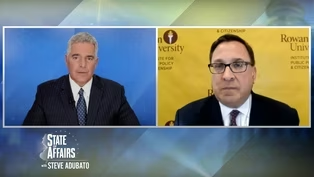
- We are honored to be joined once again by Dr. Benjamin Dworkin, Director of the Rowan Institute for Public Policy and Citizenship.
Good to see you, Ben.
- Good to see you, Steve.
Thanks so much for having me.
- Hey, Ben, one of the things you and I talked about offline the other day was the importance of promoting public service in young people., having young people get into government, public, not just government, just public service.
Question, with all the garbage going on, all the dysfunction going on, how hard is it to do that?
To get young people to say, (claps) "I want to be in public service because that looks like I can make a difference."
- It's not as tough as I think it used to be, and here's why.
You know, there was a certain point when I was growing up in the '80s that people just thought it was all corrupt and they just wanted to stay out of it.
No one wanted to be involved.
They just wanted to go and make money.
At a certain point, a little bit of a generation later, people said, "Well, I want to do something," right?
We began to see a new movement, a resurgence in youth activism, but it wasn't through politics.
And what we've seen in the last decade is a move where people who want to be active, who want to change the world, who believe in something and want to make a difference, understand that politics is an avenue for them to do it.
Politics, government, issue advocacy.
You know, it used to be the "think global, act local," right?
Just work in your local soup kitchen, things like that, and now people understand, whether they're inspired by a member of Congress or somebody running for president, that through politics, through the system, you can actually make a difference.
So, we're seeing an increase in many ways in people who are participating.
It's not as hard as it used to be.
Granted, I'm still dealing with college students, and it's always going to be tough.
Any number of different things on their plate these days, but I think people understand that no matter what you do, politics will intrude on your life, and so you should know something about it.
- I'm curious about this, Ben.
So many questions about the outcome of elections.
If I don't like the outcome of the election... Obviously, we saw what happened in 2020.
We know what January 6th was and why it matters.
To what degree do you believe there has been a significant diminishing of public confidence in the outcome of elections?
- I think it has been significant, but this- - And what does that do with citizenship?
Is there a connection between that and citizenship?
- Yes.
Of course there is.
Look, the point about citizenship is that it can't be rented.
You have to take ownership for what's going on.
You know, my father used to tell me, "You know, Ben, in the history of the world, no one ever washed a rented car."
And the idea- - Good one.
- Was you have to take ownership for your democracy.
I think that is where citizens have an absolute role to play, even if these things you watch on TV seem distant to us.
The role that folks like we play here at Rowan University and with RIPPAC is really to try and reduce that connection, to reduce the intimidation, the fear factor of getting involved.
- By the way, RIPPAC is the acronym for the Rowan Institute for Public Policy and Citizenship.
Ben, let me try this.
So, we're taping on the 21st of March.
We don't know what's going to happen.
Former President Trump, criminal issues, legal issues.
Let it play out.
Politically, though, say the president runs again.
What do you say if the former president runs again, the current president runs again.
Investigations going on back and forth.
Republicans in Congress investigate Hunter Biden, Joe Biden, every family member.
Back and forth investigating each other.
What does that do for our representative democracy when it's very difficult to separate the electoral process, the political process, from the prosecutorial criminal accusation?
That's not even a category.
I don't know what it is, but they're all meshed together in the world of social media.
How's that for a complicated question, my friend?
(both laugh) - Let me try and give you a straightforward answer.
It makes it much tougher.
I mean, that's the bottom line.
But here's why I believe America comes through, because- - You're going to tell me there's a silver lining, Ben Dworkin, aren't you?
- There is, there is, I won't say it's a silver lining, but I think there's an opportunity to find that silver lining, and this is what I mean by that.
This election you were hypothetically describing is for president.
People run for president in a different way than they run for state legislature or for even governor or Congress.
Running for president is a grander exercise.
It's about a vision for the future, whether it's make America great again, or bring stability, or whatever theme, hope and change, whatever theme comes through, morning in America, all of these things that we understand- - By the way, Ben makes reference to the former President Reagan and former President Obama, but go ahead, and their slogans.
- I'm sorry for- - That's okay.
Ben, we're insiders.
- Dating myself.
- We're political junkies.
Go ahead.
- But the point is that running for president is more of a visionary exercise, and so even as the mudslinging goes back and forth, there is an element of where are we going as a country?
And the country may be divided, but we are arguing about where we want to go.
This direction or that direction?
I think that gives us hope, because in the end, everybody gets a chance, in theory, to vote.
I mean, what we had in 2020, more people voted for Donald Trump than any other candidate running for president in the history- - And he lost by five million votes.
- Of the republic, except for one, Joe Biden.
So, you know, I think that was a tremendous testimony to the brilliance of democracy.
- And a lot of young people, Ben.
A lot of young people voted.
A lot of young people voted.
- Absolutely.
Absolutely.
Young people, young people voted in record numbers.
We've seen that again.
Certain analysts and folks do studies about young-person voting.
We see a surge in it in 2022 as well, so we'll see how things play out in '24.
- And we'll keep the conversation going with Dr. Ben Dworkin, Director of the Rowan Institute for Public Policy and Citizenship.
My good friend Ben, thank you so much.
We'll talk soon.
- Thank you, Steve.
- I'm Steve Adubato.
That's Dr. Dworkin.
We'll see you next time.
- [Narrator] State of Affairs with Steve Adubato Is a production of the Caucus Educational Corporation.
Funding has been provided by The Turrell Fund, supporting Reimagine Childcare.
Veolia, New Jersey Sharing Network.
RWJBarnabas Health.
Let'’s be healthy together.
The North Ward Center.
Horizon Blue Cross Blue Shield of New Jersey.
Operating Engineers, Local 825.
Eastern Atlantic States Regional Council of Carpenters.
And by Choose New Jersey.
And by these public spirited organizations, individuals and associations committed to informing New Jersey citizens about the important issues facing the Garden State.
And by Employers Association of New Jersey.
Promotional support provided by ROI-NJ.
And by NJ.Com.
- I am alive today thanks to my kidney donor.
I am traveling and more active than ever before.
- I'm alive today thanks to my heart donor.
I'm full of energy and back singing in my church choir.
- I'm alive today thanks to my lung donor.
I'm breathing easy and I'm enjoying life'’s precious moments.
- They are about 4,000 people in New Jersey waiting for a life-saving transplant.
- Donation needs diversity!
- For more information or to become an organ and tissue donor, visit NJSharingNetwork.org.
The Implications of Social Media on Public Policy
Video has Closed Captions
Clip: S7 Ep2 | 8m 34s | The Implications of Social Media on Public Policy (8m 34s)
The Nationwide Epidemic of Teen Suicide
Video has Closed Captions
Clip: S7 Ep2 | 9m 58s | The Nationwide Epidemic of Teen Suicide (9m 58s)
Rep. Andy Kim Addresses The Need For Bipartisan Policy
Video has Closed Captions
Clip: S7 Ep2 | 10m 31s | Rep. Andy Kim Addresses The Need For Bipartisan Policy (10m 31s)
Providing Support for PBS.org
Learn Moreabout PBS online sponsorship
- News and Public Affairs

Top journalists deliver compelling original analysis of the hour's headlines.

- News and Public Affairs

FRONTLINE is investigative journalism that questions, explains and changes our world.












Support for PBS provided by:
State of Affairs with Steve Adubato is a local public television program presented by NJ PBS