
U.S. Rep. Andy Kim; NJ Sen. Declan O’Scanlon
8/14/2021 | 26m 59sVideo has Closed Captions
U.S. Rep. Andy Kim (D) – NJ; NJ Sen. Declan O’Scanlon (R) – NJ
U.S. Rep. Andy Kim reflects on his personal experience during the Jan. 6th Capitol riots, the future of our democracy, and the long-term impact of disinformation on the nation; Sen. Declan O’Scanlon discusses the state of the COVID vaccine distribution in New Jersey, Gov. Murphy’s leadership throughout the public health crisis, and the impact of the pandemic on small businesses in New Jersey.
Problems playing video? | Closed Captioning Feedback
Problems playing video? | Closed Captioning Feedback
Think Tank with Steve Adubato is a local public television program presented by NJ PBS
U.S. Rep. Andy Kim; NJ Sen. Declan O’Scanlon
8/14/2021 | 26m 59sVideo has Closed Captions
U.S. Rep. Andy Kim reflects on his personal experience during the Jan. 6th Capitol riots, the future of our democracy, and the long-term impact of disinformation on the nation; Sen. Declan O’Scanlon discusses the state of the COVID vaccine distribution in New Jersey, Gov. Murphy’s leadership throughout the public health crisis, and the impact of the pandemic on small businesses in New Jersey.
Problems playing video? | Closed Captioning Feedback
How to Watch Think Tank with Steve Adubato
Think Tank with Steve Adubato is available to stream on pbs.org and the free PBS App, available on iPhone, Apple TV, Android TV, Android smartphones, Amazon Fire TV, Amazon Fire Tablet, Roku, Samsung Smart TV, and Vizio.
Providing Support for PBS.org
Learn Moreabout PBS online sponsorship- [Narrator] Funding for this edition of Think Tank with Steve Adubato has been provided by New Jersey Institute of Technology.
NJIT makes industry ready professionals in all STEM fields.
PSE&G, committed to providing safe, reliable energy now and in the future.
The New Jersey Economic Development Authority.
New Jersey Sharing Network.
The Robert Wood Johnson Foundation.
Choose New Jersey.
Fedway Associates, Inc. Operating Engineers, local 825.
And by St. Joseph's Health.
World-class care, just around the corner.
Promotional support provided by NJ.Com, keeping communities informed and connected.
And by Insider NJ.
[MOTIVATIONAL MUSIC] - Hi, I'm Steve Adubato, and we kick off this program with a very important interview with United States Congressman, Andy Kim, who represents the third congressional district, most of Burlington County and parts of Ocean County.
Congressman, good to see you.
- Thanks for having me, Steve.
- Congressman, we have you on for a variety of reasons, but I wanna just confirm something as part of our New Jersey leaders Who Matter initiative.
You are the first Asian-American law maker to represent New Jersey in Congress.
Is that true?
- That's right, I am.
Yeah, I am the first elected from New Jersey.
I'm the youngest Asian American elected for federal office in the country right now.
- And your background before Congress?
- I worked in diplomacy and national security at the state department in the White house and the Pentagon.
- So, let's get right into it, particularly given your background.
And in just a few minutes, we're gonna show the iconic for all the wrong reasons.
Photos of you cleaning up the rotunda floor after the riots, the insurrection of January 6th, but we're also going to show some video just to remind people, people say I've seen it enough, have you?
I'm not sure.
Describe what was going on that day for you, what you saw, what you felt.
- You know, it's, as you know, when you're talking about, come from a national security background and I have the chance to work in Afghanistan and Iraq, and I've been in lockdown situations and shelter in place situations before, but it was just never imagined in my wildest dreams that we would have anything remotely like that at the United States Capitol.
You know, to have a situation.
I remember, you know, when we were, I was, you know, here hiding away, trying to figure out what was going on.
I received an email from the Capitol police describing the situation and what they described was you know, that we should not be going anywhere near the Capitol building because we have lost control over the building.
And, you know, it was just such a surreal moment to understand what they were saying there, that for a period of time, we have lost control over the United States Capitol building.
That the United States government did not have control over this most sacred of buildings.
And that's what happened on that day.
It's not something that we should ever forget, and it's something that we should all dedicate ourselves to never allowing happen again.
That should be something that people across the political spectrum should be able to agree upon.
- Yeah, by the way, I want to show the picture of the congressmen, cleaning up the rotunda floor after the riots, which now is over at the Smithsonian National Museum of History as for your blue suit and the artifact and other artifacts connected to that day.
Yeah.
Beyond the historical significance, what, what would you say to those who say, come on, cause I've talked to friends and others, and we've done programming on January 6th and we've been, I've been obsessed with this series.
we've been doing called Democracy at a Crossroads.
And I'm like, you see we're at a crossroads, right?
Like you see that the rule of law about elections and people decide that they won no matter what the courts say, no matter what the electoral college says, and it's not my job to editorialize here, but I have, there are a fair number of people that watch right now who are like, come on, not that big a deal.
You say.
- Well look, for me, you know when I got to have request from the Smithsonian to have my blue suit.
And I was, I was wondering about, I was like, why the suit?
Now this is a ordinary suit.
And what I came to understand is that, that they were asking for it not because of any accomplishment on my behalf, I do not consider myself to have done anything extraordinary that day.
What I did was not brave nor heroic.
So this was not because of an accomplishment.
The Smithsonian is not like the hall of fame or anything like that.
They asked for a suit because I was a witness to a tragic day.
That suit tells a particular story.
It is one of many things and objects and people that would tell that story.
So my story is not unique.
It is not the only one that's there, but it is part of this story about not just what happened that day.
And the fact that our building, this beautiful building, this temple of our democracy was defiled and desecrated that day.
But it's also about what comes next.
- What does come next?
Congressmen?
What comes next?
- What comes next is is our country decided whether or not we are going to move away from this dangerous trajectory that we're on right now, we are on an unsustainable trajectory when it comes to hyper-partisanship when it comes to combativeness and toxicity in our politics.
So the question is, are we going to get off of that trajectory?
Are we going to try to meaningfully change the way that politics operates within our nation or not?
And I don't, I don't have the answers for you right now.
I think that is something that we, as a nation are trying to deal with.
- Stay right there congressmen.
Stay right there.
A very close friend of mine.
Who's a very smart attorney said to me the other day.
I mean, it's a really close friend.
He says, Steve, you don't understand, we have to pick sides.
And I said to him, and I'm not gonna say his name.
What sides are you talking about?
He goes, whose side you're going to be on?
And I said, well, we're Americans.
He goes, no, no, I don't mean that.
He goes, which side are you going to be on in this war?
And he meant a war between those who are quote with Donald Trump and whatever that means, and those who are not.
And he ultimately believed that it was that we were heading towards, and I'm not an alarmist in that way, but we were heading towards something terrible.
And I said, what about people who are in between, people who are, I'm not going to say what people's ideology is, but that they want to work together.
And he said, it's impossible.
What do we tell our kids?
Work things in school, find a way to compromise, find a way to negotiate.
Nope, go into your corner and demonize each other.
Am I over-exaggerating what it's like down there in Congress?
- Well, look, the, the environment that you're describing is very often what we see in terms of toxicity here, but that doesn't mean that we have to accept that premise.
I disagree that it has to be binary.
I disagree that our politics have to be based off of personalities.
I, for one, believe that I am a part of, and all of us are part of something that's bigger than all of us.
And we should not be pledging allegiance to any single individual.
- Or a party or to the Democrats or to Nancy Pelosi or to Donald Trump or Joe Biden.
- Yeah, that's right.
And so, you know, the question then is how do we anchor ourselves?
And I think that, that's why for me, you know, as someone that, you know, I've worked as a career public servant, I told you I've worked in government before, but I was a non-partisan government employee.
There is a way to anchor ourselves in service.
There is a way that we can anchor ourselves in that kind of patriotism that doesn't have to be so overtly political.
I know it sounds cheesy, but it's possible.
- Even with Republicans not participating in the investigation as to what happened on January 6th, they're like, no we're not, we're moving on and that's not editorializing that's a fact.
They said, no, we don't want to go there.
We don't want to participate.
So frankly it is not bi-partisan yes, Liz Cheney is on it.
I get it.
It's not bipartisan Congressman.
And it's going to be seen as not bi-partisan.
- No that's absolutely right.
And look, we have certainly an assault on truth.
We have a level of disinformation in our country that is eroding us from the inside, is hollowing us out.
But if we cannot at least agree upon a shared truth, what chance do we have to be able to heal?
What chance do we have to be able to move forward?
So you're right though, this is something that sadly, that we've gone through this state where we-- - Give me a silver lining.
I'm sorry for interrupting.
Give me some silver lining, please.
- Well, look, silver lining is that we have a lot of Americans that are engaged.
You know, we have the highest turnout in American history with this last election.
We had the highest turnout, even about a hundred thousand more people in my congressional district voted in 2020 than they did in the previous presidential election of 2016.
And the silver lining is that I see young people in my district engaged in ways that I certainly was not when I was their age, that is hopeful for me, you know?
And so I believe that we are a resilient nation.
I believe we have a lot of bend before we break.
And we've seen a lot of problems in the past, but we have to recognize what it gives us that resilience and that resilience comes off of that commitment of service.
And that recognition that we are part of something bigger than us.
It's about humility not hubris.
So that is what I hope, we can restore our anchoring.
Help me understand, in terms of discrimination and the attacks against the Asian American community, how much worse is it today than it was a year ago, two years ago, five years ago, A, and B what does it have to do with COVID?
- Yeah, well, one thing I wanna say is that the discrimination existed before COVID, it'll exist after COVID.
So this is not just, because of what we've seen over the last year.
But that being said, this is the worst I've ever seen it in my lifetime, in terms of just outright open, discrimination and racism, the fear of violence in the Asian American community.
Especially with our elders who have been targeted, attacked, all across this country.
That is visceral.
And that fear is so potent right now.
So it is alarming and yes, we've gotten a lot of attention from across country, that's important.
Shining a light on what exactly we're talking about.
But it's something that I worry, how do we sustain that and how do we turn that into real action?
- Let me ask you, do you feel a particular responsibility being, as it relates to the issues we're talking about, discrimination against the Asian American community, being the first Asian American to serve in the congressional delegation of New Jersey, and one of the first federal officials, if you will, of Asian American background, do you feel a particular responsibility?
And if so, what is it?
- I do feel responsibility in terms of giving a voice to a community that I think has not been able to get its voice heard as much as others have.
And have not been able to tell that story.
Especially here in New Jersey.
We have such a large and vibrant and beautiful and dynamic, Asian American community.
We have one of the largest Asian American communities in the entire country.
And right now, they're scared and they're hurting and they're fearful about what happens next.
So part of it is about me being an Asian American legislator, but part of it is also about me being a dad.
I grew up in this state and I got two baby boys.
I've got one that just turned four and another that's five.
And I'm thinking about what kind of state, what kind of country, are they gonna grow up in?
Am I going to have to worry about any discrimination or violence against them?
I want to give them everything that they deserve.
And I want to have that peace of mind.
And me as a United States Congressman, I do not have that peace of mind about my own kids.
About their future.
That's not something that we should be able to have the worry about and the richest most powerful country in the world, in one of the most powerful and dynamic prosperous states in the country.
New Jersey should be able to provide that, America should be able to provide that.
So I approach this both as a dad, as well as a Congressman.
- Congressman, let me ask you this, the biggest lesson you have learned as a top federal official in Congress, as it relates to COVID, and particularly in a district like yours, that is not overly congested, that is spread out, that is down the Jersey Shore and in Burlington County as well.
Biggest lesson you've learned, A.
And B, what concern do you have for your constituents as we do this program at the end of July 2021?
- Biggest lesson I've learned is about making sure that we have that clear and constant communication with the district.
One thing that we've been very successful, we had an email list that we started at the beginning of COVID with zero people on that email list.
It is now up to, I think, 30 or 40,000 people in my congressional district that is getting information on a daily basis, weekly basis.
It's just the facts, giving people an understanding of where to go for more information and engaging.
That was one of the most successful things that we've done.
So, I think we need to make sure that we continue to find ways to communicate in that clear way.
And in terms of concerns about what comes next, for me, a lot of my concerns right now are on small businesses.
I'm on the small business committee in Congress.
I'm the only congressional member from New Jersey on the small business committee.
So I've made it a personal mission of mine.
I'm very worried about what comes next.
And if I'm worried about the owner and these small business owners and workers, they're even more concerned.
So we've got to make sure we're focused on that.
And giving them every shot to be able to come out of this, hopefully stronger than they went in.
- By the way, real quick, food insecurity an issue that matters to you greatly, right?
- Yeah.
Hugely.
I'm so worried about hunger issues in our district.
I was worried about this before COVID.
Before COVID we had an estimated, what was it?
I think 16,000 kids in the New Jersey third congressional district that were considered food insecure, which is just a fancy way of saying hungry.
So this is even worse.
The number of calls that I've gotten from folks that, just never had to face this question.
I've had people, they're so, they're breakdown crying on the phone because they've never in their life thought that they'd have to ask where they can go for a food pantry.
Where they can go to get a helping hand and a meal.
These are people that are, have pride.
They have jobs.
They never thought they'd get there.
So this is something we need to focus on.
I mean, food is just a basic necessity.
We should all be able to agree.
Nobody in the richest, most powerful country should go hungry.
- Yeah, Congressman this is the fourth time I've said it's the final question, but they keep telling me I got another minute with you.
So I'm gonna take advantage.
You have a military base, Maguire.
Not just a military base.
It's a very important one over in, down in Burlington county.
I say down because I'm up in north Jersey.
What, there's so many things going on around the world.
Our military is so engaged in so many situations, both domestically and around the world.
Support for military members at this time, who have got to be overworked and exhausted, is a gross understatement.
What's your message to them?
- First of all, I say, thank you for your service.
You know, at this time more than ever we have to support those that are fighting for us.
And, we not only have problems domestically here, but we haven't had a chance to chat about it, but we have so much problems going globally, right now.
We are entering a new era of global competition that with our competition and our challenges with China and with other countries, this is something I'm deeply worried about.
It's a new era of global competition.
And as a former diplomat, I see that.
So our military is so important right now.
And we should be proud of our contributions to that here in New Jersey.
I hope we're proud of the joint base.
I hope we're proud of Picatinny.
These are elements where we are giving the country the service that it deserves, and I'm proud to support them on the armed services committee.
- Thank you, Congressman.
- Thank you so much.
- We'll be right back after this.
To watch more Think Tank with Steve Adubato, find us online and follow us on social media.
- We are now joined by someone who's now in the national news, he's State Senator Declan O'Scanlon, Republican from the 13th legislative district.
How you doing Senator?
- I'm doing really well Steve, how are you?
- I'm great.
We're taping on the 20th of July, it'll be seen later.
I'm not sure if you're gonna be national news then.
But I will say this, we'll talk about the state budget, we'll talk about the economy, can we talk about freedom of speech and Twitter?
You got taken off of Twitter, was it 12 hours, 24 hours?
- 12 hours.
- What did you do to get them to throw you off for 12 hours?
- Well nothing.
Nothing justifiable.
My tweet was perfectly reasonable.
It was an opinion.
It was an accurate opinion based on facts.
And- - What was it exactly?
About vaccines and COVID.
- Yeah look, I've been a big vaccine supporter.
I've encouraged people to get vaccines, I've organized clinics.
It was my office that helped get, I think we were the first county to make vaccines accessible to every senior and to every teacher in the state.
I'm a big backer.
But I am also a big believer that our government should not mandate things if it doesn't have to, if there's not a compelling safety reason, and here there's not.
We have had amazing voluntary uptake of the COVID vaccine.
Also, by the way, it's emergency use authorization as well.
So mandating such a medication when there's already great voluntary uptake is completely uncalled for.
- But Senator, even for children under than 12, as we speak on the 20th of July, with the Delta variant just sweeping across the nation.
Really?
No sense that children should be vaccinated?
- I will- - Because I believe the tweet said something about that, no?
- No, no, we didn't talk about child vaccinations.
I don't think you're gonna see child mandatory vaccinations or discussion of it until the vaccine is fully approved.
And I don't think that's gonna be 'til January.
The real discussion that was going on at the time was vaccine passports and mandating people get the vaccine before they're allowed to do certain things.
Adults.
- What do you think of that?
- So that was the discussion- - What do you think about the passports?
- I think it's uncalled for at this point.
Certainly in New Jersey.
We have one of the best vaccination rates in the nation, in the world.
We're over 70% vaccinated.
If you add in the people that have naturally acquired antibodies, people that had it, of that remaining 30%, we're probably approaching 85% of adults in New Jersey have some level of substantial immunity.
You don't have to mandate anything, you don't have to talk about vaccine passports.
It's gratuitously provocative to those people that have concerns that choose not to get vaccinated.
- By the way real quick, Twitter put you back on and you're waiting for an apology.
By the time this air you may have gotten it and you may not, I don't know.
But I wanna ask you this, real clear, and by the way, we love having you because you always speak your mind.
Quick question.
In the fall, September into October, should school-age children under 12 wear masks?
- At this point, no, because of our low transmission rate.
This isn't a great threat to children, they are proven not to be vectors.
Look, but we have to be fair.
It's possible that could change if our transmission rate goes, if there's a variant that starts hitting our kids.
So we have to be open to that.
But right now people shouldn't worry about their kids going back to school wearing masks.
- Shift gears.
By the way, if you're listening on the radio side, State Senator Declan O'Scanlon, 13th legislative district.
He knows a lot about the fiscal affairs in the state.
Give Governor Murphy a grade of his fiscal, regarding his fiscal management of state resources.
- F. Because, and here's why- - Come on!
Declan, seriously.
- Look.
Okay, I'll... F?
You know what?
Here's what I'll do.
I'll give him a D plus because he did do what Republicans requested.
The leadership in the legislature and the governor, at the end of the day, did pay down some debt, did do some things and make a full pension payment and then some.
And look, I think they partly did that kicking and screaming because Republicans were pushing and they knew we were breathing down their necks.
But, on the flip side, we borrowed $4.5 billion that our kids and grandkids are gonna have to repay that we didn't have to borrow, that Republicans warned at the time we didn't have to borrow.
We have done nothing to control our budget long-term.
There's billions of dollars in this budget that are one-shots, that are counting on us maintaining the level of revenue that we had this year, which could easily be an outlier because of the gyrations of the market.
So no, no more than a D plus.
We should have done better, we should have put more money away, we should be controlling our spending, and we should be reforming our long-term fiscal obligations so we can be sustainable.
- Talk about the governor's track record in terms of supporting small business.
- Been a disaster.
It's been dribs and drabs.
You talk to almost any small business person trying to gain access to the minimal amount of money.
Well, we should have done 300, and I had a bill to do 300 million 15 months ago.
We would have saved hundreds and hundreds more businesses.
We would have kept people employed.
So, it's been a disaster.
It's been dribs and drabs and the programs are oversubscribed in 10 minutes.
That's been a disaster, we could have done much- - Hold on, Senator, and sorry for interrupting.
And on one hand you talk about it's important to be fiscally conservative, it's important to manage the resources we have in the windfall from the federal government, from the COVID dollars, federal support, but then give more money to small businesses.
Is that a contradiction?
- Not at all.
That's exactly what the money was designed for.
You take the money that you get and you put it where it's supposed to go, and where it prime our fiscal pump.
We didn't do that.
We held onto it.
There's still money that that we're holding on to.
And the governor used it, rather than to help small businesses, we used it to pay salaries of people that were already budgeted for.
So no, it's not inconsistent at all if I'm calling to use money exactly as it was intended to save our economy.
- You know, I feel like for 20 years, I've been doing this for close to 30, it just makes you really old, but for 20 years we've been talking about, not you and me, we've been talking about school regionalization.
There's a school regionalization bill.
Real quick, what is it, why is it important, and why is it going nowhere fast?
- No, I think it's gonna move.
I think... We did the... Now what are you saying isn't gonna move quickly?
The regionalization itself, or... We passed the bill- - Let's just say they've been talking about regionalizing schools for at least two decades.
- We have a new bill.
- There are way too many school districts, they're way too expensive, it has a big impact on property taxes.
You tell me what's going on.
- We've been our own worst enemy.
In many instances, you've had districts that wanted to merge, but our own laws, our own restrictions, our own mandates about dealing with contracts and salaries got in the way.
So you'd have, you know, three districts trying to merge and two out of the three would be big winners, one would be a loser and they'd kill it.
You also would have other, um... Issues, which we're removing with our new bill.
And there's tons of districts that are looking at regionalizing.
So, hold tight on that.
- Okay, so you'd have one superintendent instead of three.
You'd have not as many administrators.
And we're not looking to have people lose their jobs, but it is very expensive.
A small school...
There are school districts that don't have a high school.
There are school districts that I'm not even sure how many schools they even have to have a superintendent, an assistant superintendent, a deputy.
It's expensive!
- Our bill will go a long way to solving that and it's paving the way for districts that want to merge and make it easier for them to do it and remove these hurdles to doing it.
- By the way, how do people follow you on Twitter?
- Declan O'Scanlon, @DeclanOScanlon.
Very easy.
- And by the way, as we speak right now, your account is active.
- It is, yes.
- Just checking.
- I'm gaining followers every day, it's wonderful.
(laughing) - Senator, my good friend, Declan O'Scanlon.
I don't know, are we supposed to say legislators are good friends?
I don't know, I don't know the rules anymore.
But- - It's okay, we're allowed.
- And we're always civil.
And you always are.
Thank you, Senator.
Appreciate it.
- Thanks Steve.
- We'll be right back.
- [Narrator] Think Tank with Steve Adubato has been a production of the Caucus Educational Corporation.
Funding has been provided by New Jersey Institute of Technology.
PSE&G, The New Jersey Economic Development Authority.
New Jersey Sharing Network.
The Robert Wood Johnson Foundation.
Choose New Jersey.
Fedway Associates, Inc. Operating Engineers, local 825.
St. Joseph's Health.
And by these public spirited organizations, individuals and associations committed to informing New Jersey citizens about the important issues facing the Garden State.
And by Employers Association of New Jersey.
Promotional support provided by NJ.Com, And by Insider NJ.
(hands clapping) (drums banging) (fingers snapping)
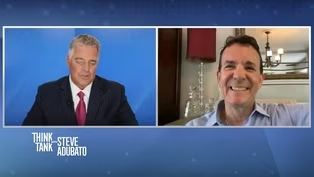
Sen. O'Scanlon Discusses Vaccine Distribution in New Jersey
Video has Closed Captions
Clip: 8/14/2021 | 9m 46s | Sen. O'Scanlon Discusses Vaccine Distribution in New Jersey (9m 46s)
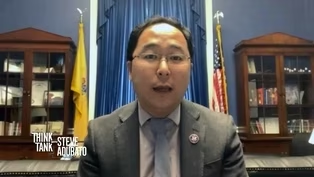
U.S. Rep. Kim on Capitol Riots, COVID and Confronting Racism
Video has Closed Captions
Clip: 8/14/2021 | 17m 4s | U.S. Rep. Kim on Capitol Riots, COVID and Confronting Racism (17m 4s)
Providing Support for PBS.org
Learn Moreabout PBS online sponsorship
- News and Public Affairs

Top journalists deliver compelling original analysis of the hour's headlines.

- News and Public Affairs

FRONTLINE is investigative journalism that questions, explains and changes our world.












Support for PBS provided by:
Think Tank with Steve Adubato is a local public television program presented by NJ PBS