State of Affairs with Steve Adubato
US Rep. Frank Pallone; Tom Kean, Sr.; Elizabeth Maher Muoio
Season 5 Episode 8 | 27m 57sVideo has Closed Captions
U.S. Rep. Frank Pallone; Tom Kean, Sr.; Elizabeth Maher Muoio
U.S. Rep. Frank Pallone, Jr. discusses President Biden’s American Rescue Plan, the CLEAN Future Act and the importance of following safety protocols during the pandemic; Tom Kean Sr. talks about the 9/11-style commission that should be created in light of the Jan. 6th riots; Elizabeth Maher Muoio shares the impact of COVID on NJ’s economy and the impact of the pandemic on small businesses.
Problems playing video? | Closed Captioning Feedback
Problems playing video? | Closed Captioning Feedback
State of Affairs with Steve Adubato is a local public television program presented by NJ PBS
State of Affairs with Steve Adubato
US Rep. Frank Pallone; Tom Kean, Sr.; Elizabeth Maher Muoio
Season 5 Episode 8 | 27m 57sVideo has Closed Captions
U.S. Rep. Frank Pallone, Jr. discusses President Biden’s American Rescue Plan, the CLEAN Future Act and the importance of following safety protocols during the pandemic; Tom Kean Sr. talks about the 9/11-style commission that should be created in light of the Jan. 6th riots; Elizabeth Maher Muoio shares the impact of COVID on NJ’s economy and the impact of the pandemic on small businesses.
Problems playing video? | Closed Captioning Feedback
How to Watch State of Affairs with Steve Adubato
State of Affairs with Steve Adubato is available to stream on pbs.org and the free PBS App, available on iPhone, Apple TV, Android TV, Android smartphones, Amazon Fire TV, Amazon Fire Tablet, Roku, Samsung Smart TV, and Vizio.
Providing Support for PBS.org
Learn Moreabout PBS online sponsorship- [Narrator] Funding for this edition of State of Affairs with Steve Adubato has been provided by RWJBarnabas Health.
New Jersey Sharing Network.
Summit Health a provider of primary, specialty, and urgent care.
IBEW Local 102.
Lighting the path, leading the way.
The Adler Aphasia Center.
The Russell Berrie Foundation.
Making a difference.
Operating Engineers, local 825.
NJM Insurance Group.
Serving New Jersey'’s drivers, homeowners and business owners for more than 100 years.
And by Georgian Court University.
Promotional support provided by New Jersey Globe.
And by Northjersey.com and Local IQ.
Part of the USA Today Network.
[INSPRATIONAL MUSIC] - Hi, I'm Steve Adubato and we are honored to welcome, when this new set, I don't know when this show is gonna air but this is a new set, new look, but the same Congressman, Frank Pallone, who is in fact the chair of the House Energy and Commerce Committee.
That's a very important committee to deal with.
Energy policy, environmental policy, a whole range of things.
Congressman, thank you so much for joining us.
- Thank you, Steve.
Good to see you.
- Good to see you.
Congressman, let me ask you this, the most pressing issue in the Biden, 1.6 trillion, excuse me, $1.8 trillion stimulus package, as it relates to environmental and energy policy.
Please educate us.
- Well, the American Rescue Plan, as you know is designed to do two things.
One, to basically crush the COVID virus, and the other is to bring the economy back.
And I think it's gonna go a long way towards accomplishing that.
The one thing that we have now that we never had before, Steve, under Trump, was a national plan to basically get out vaccines, get out testing supplies, do whatever is necessary.
Under Trump, it was basically, every state was on their own.
And that was part of the problem, It is that there was no coordinated national efforts.
So, I think that the most important thing is if you don't crush the virus, the economy will not come back.
- Let's say, this climate change, I don't call it a thing, but for some people it's a thing.
And I've asked you this before, when you've joined us make the climate change argument real.
Substantive, relevant for people.
So, it's not some abstract conversation, where people are quoting the scientists who believe what they think.
They believe to try to prove a point which isn't productive.
- No, you're absolutely right.
And we have this bill that we propose, that we're gonna try to move called The Clean Future Act.
And this is our response to our Climate Action Plan if you will.
But you're absolutely right.
If you talk to people about, like one of those Sci-fi movies, where the Statue of Liberty is going under the water and hundred foot waves are hitting Manhattan, they think you're crazy.
And so you have to bring it down to the level where this affects your health because people that have... and weather patterns, in other words that it's a health and safety issue.
If you look at the Jersey shore where I am, we know the sea level is rising.
Right?
And we know that people's health are being impacted by these greenhouse cases.
If you have asthma, you have serious respiratory problems, you're gonna have a harder time breathing.
So, that's how you have to link it.
I call it Health and Safety Issues, not sort of catastrophic issues.
- Congressman, I think you may have read this article.
Tom Moran.
We had him recently, by the way, check our website, steveadubato.org To be on the screen.
Tom Moran wrote a very compelling column recently, this political divide is awful for America and it's getting worse.
Moran talks about, by the way, it's on nj.com, check it out.
Moran says, it isn't just the political divide anymore, Congressmen, it is a divide of families, a divide of communities, divide of, we can't be with anyone who doesn't see the world the way we do.
A divide educationally, et cetera, et cetera.
Are we simply no longer the United States of America?
And what would it take for us to even if we disagree, believe we're fighting for the same country?
- Well, I think you're right, and at the same time as a caveat, right?
In other words, if you talk to my mayors, I represent Middlesex, and Monmouth County, Monmouth County is largely Republican, right?
- It's sixth Congressional District.
I'm sorry, Congressman, I should've said that, the sixth Congressional District.
- Right.
But if you talk to my County commissioners, we're all Republican.
Or you talked to a lot of my mayors, who maybe half of them are Republican, they are worried about climate change just like anyone else.
They see the problems with the sea level rising, they understand it, the reason to have more energy, efficiency, and resiliency, to protect various facilities, whatever.
And so there's, a way we really did deal with this, that's very bi-partisan.
But unfortunately I think, and I don't wanna blame the media, but you know how it is, a lot of people just watch Fox News, or they watch MSNBC.
- And if they're really smart they watch PBS, but go ahead.
- (laughs) You know what I mean, in other words, they have this ideological viewpoint.
But I really don't think when it comes down to it, that we disagree.
And so, at the end of the year, we did this bill that had a lot of energy efficiency, resiliency, banned hydrofluorocarbons, which is a massive greenhouse gas.
So we've actually been doing things to address climate action on a bipartisan basis - But Congressman, beyond climate change, and you've done a tremendous job, and people should go to your website.
So people can find out more about the Clean Future Act, tell everyone your websites so that people can follow, Congressman.
- It's just, pollone.house.gov is the website.
pallone.house.gov.
- Got it.
Now, let's talk about beyond climate change.
Latest poll, I believe a Pew poll.
Said that over 50% of Republican men say they will not take the COVID vaccine.
And much of it is based on political ideology, a sense that this isn't science, and that somehow they don't need it.
That, to me, and most other reasonable people say that we're looking at the same set of facts and having very different interpretations, which causes a whole range of division, not to mention the problems relating to getting to herd immunity.
- It's true.
And again, I think a lot of it is the decisions made at some national message level.
Maybe part of the Republican leadership that masks are not good and people shouldn't have to be vaccinated if they don't want to.
And then, this sort of resonates throughout society.
For example, we wanted to go back to have the house, everybody show up in person on the house floor.
- Yep - But the speaker found out that 25%, probably mostly Republicans members of the house, have refused to get vaccinated.
So, that means that we still have to operate virtually.
- Congressman, why have they refused?
- Well, we don't really know.
Because it's a privacy issue.
But it's 25% of the members of the house, according to the survey, have refused to take the vaccine.
So, this makes it very difficult for us to operate.
I'll give you another example.
Went to a funeral, a guy who's a friend of mine, who owns a funeral home, and he says that people make decisions about whether to wear a mask at the funeral based on ideology.
So like, if he's in a town where it's mostly Republican, a lot of the people who come to the funeral parlor refuse to wear a mask.
On the other end of the democratic town, they wear masks.
So, it's absurd.
But this is what happens.
But I think you just gotta (chuckles) try to overcome it as best you can, but it's not easy.
I'm not disagreeing with what you, Steve.
- Yeah.
Last minutes we have left.
The Senate is split 50, 50, With the Democrats controlling the vote with the vice president, former Senator Harris, the Democrats have a very narrow margin in the house.
How narrow is that margin when it comes to Democrats who may not stick with Nancy Pelosi, when it comes to difficult issues?
Particularly on the left, like Congressman Ocasio-Cortez.
There's a division in the Democratic Party.
- There is but I have to tell you, Steve, it has kind of disappeared now because the majority is so narrow.
So like, when we've been doing some of these major bills, or even minor bills, a lot of those differences on the left and the right have disappeared.
You know, there's also a Blue Dog Caucus within the Democratic House, - More conservative?
- More conservative.
Right?
But, I think they only lost like, one or two house members on the American Rescue Plan.
So if anything, the narrowness has brought us more together.
Believe it or not.
- Congressman, before I let you go, a few words to describe January 6th, The Insurrection, for you personally.
We got 30 seconds.
- I was outside, in my office watching all and it was very disturbing cause I saw people climbing up The Capitol, scaling the walls, and I just never thought that would happen.
But, again I think we have to put everything in perspective.
Look, there are people out there that want to destroy the government, they have to be exposed, and they have to be brought to justice.
But I don't think they're typical of what America wants.
And I think the reaction to it has been very much that.
That this is awful and this shouldn't happen in democracy.
- By the way, there's gonna be an investigation into this.
We're also gonna have a conversation with former Governor, Tom Kean, Senior who headed up the 9/11 Commission with former Congressman Lee Hamilton, a Democrat and Republican.
Let's only hope there is such a meaningful investigation of January 6th.
Congressman Frank Pallone from the Sixth Congressional District, the chair of the House Energy and Commerce Committee.
I wanna thank you so much for joining us, Congressman.
- Thank you, Steve.
Good to see you again.
- You got it.
I'm Steve Adubato, we'll be right back.
(grand music) - [Announcer] To watch more State of Affairs with Steve Adubato, find us online and follow us on social media.
- We are truly honored to be joined by the 48th Governor of the Garden State, the great state of New Jersey, the Honorable Tom Kean.
Governor, how are you?
- Fine, Steve, good.
- It's great to have you with us.
Governor, you have a unique perspective on a national crisis.
You were one of the leaders, the chair of the 9/11 Commission with Congressman Lee Hamilton, a Democrat at the time.
As it relates to the January 6th insurrection, what kind of investigation should take place, A, and B, what kind of questions must be answered?
- Well, let's take the second part first.
We don't know very much yet.
I mean, we don't really know whether the conspiracy was planned ahead of time.
Did they really plan to break into the Capitol?
How many groups were involved?
Was it a full conspiracy or was it just a spur of the moment?
They got excited and started to do bad things.
We just don't know that yet.
So, we got a lot of questions to answer and, you know, this is the first time since 1812, I guess, that our Capitol's been breached, so it's a big deal and we have to look into it and find out why and make sure it never happens again, and secondly, I think you probably pick what works.
The 9/11 Commission worked.
I mean, we wrote our report a difficult time politically but it was evenly divided between Democrats and Republicans.
We did it, and the report turned out to be unanimous.
It's still used as a textbook in colleges around the country, so it's stood up very well against the test of time.
And the Congress passed recommendations from our report, 40 of them - really, should've passed 41, they passed 40 of them - but redid the whole intelligence system in the United States to the fact that we haven't had an event like 9/11 since.
So that was successful, so when you've done something successfully, why not do it the same way again?
- Governor, but, you know, it's so interesting, that wasn't even that long ago that you and your colleagues did such an extraordinary job on that commission with you as the chair.
But here's the question: in those years, since that report, since that horrific incident on September 11th, 2001, how much more divided, polarized are we as a nation to the point where it does not seem like many Democrats and Republicans are willing and/or capable of coming together and actually speaking with one voice, even with disagreements, but one voice when it comes to our nation at risk and an insurrection like the 6th?
Because there are different interpretations of it which often seem to be politically motivated.
And that could be perplexing for someone who just simply loves this country.
- Well, it's difficult.
But look, when we did our report we were going into a reelection for then-President Bush.
The time before had been Bush versus Gore with all the hanging chads, there were a lot of conspiracy theories out there and problems, and look, we got it done then, I can do it now.
To me, to say there aren't 10, let's say, Americans of both parties who are willing to put aside politics and do the job, and they don't have to be, you know, we always look to Washington.
They don't have to look to Washington.
Now, it's fine.
There were some good people who served in the Obama administration and the Bush administration who would be willing to serve the country again.
There also some former legislators, but beyond Washington.
I mean, you and I both know there were some good ex-justices.
There are people who have served their country in many ways: at the state level, as governors, Attorney Generals, and it's 10 people.
All you have to do is find 10 people who are willing to put the country above party.
And I think to say that's not possible now is not right.
But the key is the people who are doing the appointing.
If it's like the 9/11 Commission, the President appoints the Chairman and the leaders of Congress appoint the Vice Chairman, and then the leadership of the two parties fill in the Commission.
The appointments are absolutely key.
You've got to have people who understood and understand how you can work across party lines.
How you can make compromises to become what's hopefully another unanimous commission.
- But, you know, governor, you and I have a long history together.
And I often say that it was because of you in 1985 when I was a very, very young member of the state legislature at 27, running for reelection.
And the reason I mention this is because it was one of the biggest landslides that you won as governor.
And some of us were swept out of the legislature at the time who happened to be Democrats and ergo, this career in broadcasting.
The reason I mention that is because you not only worked across the aisle, but you won 70% of the vote.
And a lot of Democrats voted for you.
And a lot of Democratic legislators worked with you.
Here's the question.
It's not about history or me in the legislature, or you as Governor, but it feels like a very different time, Governor Kean.
And my question is, has Donald Trump, when he was president, pushed the Republican party to the point where those who are more loyal to Trump can't be loyal to the kind of Republican, there's a question here, that you were and are?
A moderate working across the aisle?
Is that the Republican party, the Trump party?
- Steve, if Republicans like that, who put personalities or party or whatever ahead of the country can't be put on this commission, that's all.
And if the leadership of the Congress, Republicans and Democrats, and that includes Nancy Pelosi and Chuck Schumer (mumbles), if they're going to appoint partisans to the commission, don't do it.
Don't set up the commission, because it's not going to work.
If you don't feel you can reach out and find people like Lee Hamilton, who was my vice chair who had been known for working across the aisle in Congress, there's still a lot of those people.
And if they're not willing to reach for those people and appoint that kind of person, then I say don't do it, cause you've got to have people who are willing to work with other people and who understand the country is more important than whatever party you belong to.
- Yep.
You've been listening to former Governor, the 48th governor of the great state of New Jersey, Tom Kean, who chaired the 9/11 Commission.
Patriotic, made a difference, and works, always has worked with people across the aisle.
And this is not my opinion but ask most people, we need more leaders like Tom Kean in public life.
Governor, I cannot thank you for joining us enough.
You honor us by your presence.
Thank you, Governor.
- Thank you, Steve.
Thank you very much.
- We'll be right back after this.
(grand music) - [Announcer] To watch more State of Affairs with Steve Adubato, find us online and follow us on social media.
- We're now joined by the Treasurer of the great state of New Jersey, Elizabeth Maher Muoio.
Who, she has to make sure that we have enough money in the state to spend on the most pressing needs.
Treasurer, thank you so much for joining us.
- Thanks for having me.
- You know, I gotta get this out of the way, We had Assembly Republican Leader, Jon Bramnick on recently, Who said, "They're loaded, they've got so much money "in the state budget.
"You know, I mean, it's a good time to be the governor, "with all the federal money coming in," et cetera, et cetera.
The economy is not as bad as anyone thought.
Is it that rosy, Treasurer?
- I don't think if you were to ask every New Jerseyan they'd have quite as rosy a picture.
This was clearly an economic crisis that hit those in New Jersey that are at the lower end of the pay scale.
Those who are already struggling the most in New Jersey.
And that's one of the reasons, to the assemblyman's point that our revenues ended up not taking the hit that everybody predicted they would, because those at the high end of the wage scale, recovered much quicker than those that were not.
I mean, our hospitality and service industries took a tremendous hit and because the higher end of the income did fine.
In the end our revenues weren't as effected as we thought.
They also, you know, our sales tax numbers did better than expected because those high income earners had money in their pockets.
And the stimulus payments that we've seen over the past year have had a big role in helping keep those revenue numbers up.
But there are a lot of people still struggling.
We still have double the unemployment rate in the state that we had going into the pandemic.
So there are a lot of people struggling and that's what this budget is aiming to help with.
- Treasurer talk to us about the say, three top priorities in the governor's budget.
And by the way we'll have the Senate President on, Steve Sweeney and also the Chair of the Senate Budget Committee, Senator Paul Sarlo talking about this as well.
As well as Republicans who have a different perspective.
The top three priorities in the governor's budget in terms of not only what the program is but more specifically who and what it's targeted for.
- I think the top three priorities of this budget, first, are to help the people who have struggled most, not only through this pandemic but the people that were struggling prior to the pandemic.
But this pandemic kind of laid bare what those disparities were and showed us where we really have concerns that need to be addressed in the state.
The second, is to make sure our businesses that have really taken a hit during this pandemic also can get back on their feet and invest in them.
The third, is to make the state more resilient fiscally, going forward.
Making that full pension payment, which has not been an easy point to get to but trying to do some debt avoidance by doing PAYGO on some of our big projects.
Wind in particular going forward.
Trying to get our state on firmer fiscal footing, going forward.
- Let's talk a little bit more about the pension contribution.
The numbers can get very confusing for people.
As we quote, get into the weeds.
Please, Treasurer talk to us about what the pension crisis has been over a long period of time.
The public employee pension crisis.
What is owed?
What's being paid on that debt and why it's so important for this budget to dedicate so much money to paying down on that debt?
I know it's a loaded question, but the average person, who is not a state employee, might say, "Well what does this have to do with me?
", please.
- Well, first of all, you mentioned public employees.
They have been meeting their obligations through the years.
- They've been making their contributions.
- Yup, every paycheck they make their deposit and they've been doing what they're supposed to do.
Unfortunately government, in particular state government, has not been living up to its obligations to the pension fund, for decades.
Both parties to blame, but that has been when in trying fiscal times that has been the payment that is either been shortened below what it should be which is considered the actuarially determined contribution.
What we need to pay every year to make sure that people who are retiring.
That we meet our obligations to them.
So for years, that has been sort of where the state has gone to meet other needs.
Well, we'll pay the pension later.
Oh, we'll pay a little less than we owe and we'll make it up later.
We'll make it up later.
Well- - What was a problem with kicking.
I'm sorry for interrupting.
The problem with quote, "kicking the can down the road" year after year, after year, on making the state's pension contribution.
Why does that effect all of us?
- Well let me, here's some numbers for you.
- Sure.
- The last time that the state made its full pension payment.
What they owed in order to be a hundred percent funded for that year was in 1996.
And at that point, the payment was 228 million with an M. If we had kept doing that every year.
If the state have continued to meet its obligations.
Our payment for this year, to make sure we were meeting our obligation would have been approximately $800 million with an M. Instead, to get to a hundred because those payments weren't made, or were too little over the years, what we are going to have to pay this year in our budget to meet our hundred percent obligation is $6.4 billion with a B.
So the hundreds of millions and billions of dollars that have had to go towards making up for those shortfalls, those are all dollars that we could have spent on so many other worthwhile programs for New Jerseyans.
So that's why we should all care about it.
So we're making that pension payment.
The Murphy administration over the past four years this will total $18 billion.
We've had to pay into the pension system.
- Yeah.
Sooner or later that bill comes due.
- Yeah.
- Let me try this.
Virtually every credible survey that I've looked at, including the research done by the Business and Industry Association.
A little more than 30% of small businesses have closed in the past year.
In your view.
The governor has been, and again we look forward to having the governor on in a one-on-one half hour interview.
We'll continue to try to book that interview and he could speak for himself.
But what do you believe state government quote, owes small businesses in this state, A those who have gone out of business but B those are hanging on by a thread.
- Yeah, no question, small businesses have taken a major hit in New Jersey and across the country through this pandemic.
And through no fault of their own.
This budget invests hundreds of millions to help small businesses.
And multi departmental, we've got the Main Street Recovery Program which is going to help with grants and loans and loan guarantees and tech assistance for small business.
40% of that set aside for women and minority-owned businesses, who have been hurt most during the pandemic.
There's a Premier Lender and Micro-business Program.
There's permit monitorization funds.
There's a lot of money invested in this budget, for small business.
A lot of the money that we received from the Coronavirus Relief Fund last year, the 2.4 billion that the state received.
- Right.
- A lot of that money went to both small businesses, businesses and educational institutions.
And we're going to receive a lot of money with the new bill, the pandemic rescue- - The $1.9 trillion- - American Rescue Fund.
Yes.
- Yup.
- And we're looking now at ways, we're working with the U.S. Treasury and with the guidances for that.
But a lot of our resources are directed towards programs that will help businesses get back on their feet.
- As always Treasurer, thank you so much for joining us.
And we look forward to having that in-depth interview with Governor Murphy on these and other issues.
Treasurer all the best you and your family.
And thank you for joining us.
- Thank you, Steve.
Thank you for having me.
- I'm Steve Adubato.
Thank you so much for watching.
We'll see you next time.
- [Narrator] State of Affairs with Steve Adubato Is a production of the Caucus Educational Corporation.
Funding has been provided by RWJBarnabas Health.
New Jersey Sharing Network.
Summit Health IBEW Local 102.
The Adler Aphasia Center.
The Russell Berrie Foundation.
Operating Engineers, local 825.
NJM Insurance Group.
Georgian Court University.
And by these public spirited organizations, individuals and associations committed to informing New Jersey citizens about the important issues facing the Garden State.
And by Employers Association of New Jersey.
Promotional support provided by New Jersey Globe.
And by Northjersey.com and Local IQ.
Part of the USA Today Network.
- I could feel my lungs fill with oxygen, and I got my life back.
- The Sharing Network means to me hope, life, and everything.
- The Sharing Network was a lifeline to me when I really needed it.
- We are an organ procurement organization.
- The core purpose of the New Jersey Sharing Network is to save and enhance lives, - To honor those who gave, - Pay tribute to those who received, - Offer hope to those who continue to wait, - And remember the lives lost while waiting - For the gift of life.
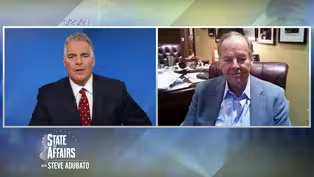
Fmr. Gov. Tom Kean on the Capitol Riots & Our Divided Nation
Video has Closed Captions
Clip: S5 Ep8 | 8m 15s | Fmr. Gov. Tom Kean on the Capitol Riots & Our Divided Nation (8m 15s)
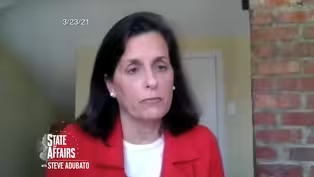
NJ State Treasurer Examines COVID's Impact on the Economy
Video has Closed Captions
Clip: S5 Ep8 | 10m 15s | NJ State Treasurer Examines COVID's Impact on the Economy (10m 15s)
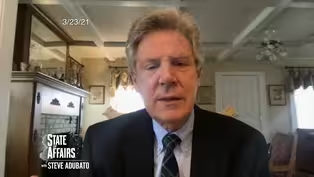
U.S. Rep. Pallone on Climate Change and the Political Divide
Video has Closed Captions
Clip: S5 Ep8 | 10m 29s | U.S. Rep. Pallone on Climate Change and the Political Divide (10m 29s)
Providing Support for PBS.org
Learn Moreabout PBS online sponsorship
- News and Public Affairs

Top journalists deliver compelling original analysis of the hour's headlines.

- News and Public Affairs

FRONTLINE is investigative journalism that questions, explains and changes our world.












Support for PBS provided by:
State of Affairs with Steve Adubato is a local public television program presented by NJ PBS