One-on-One
U.S. Rep. Josh Gottheimer (D); Meryl Frank
Season 2023 Episode 2653 | 26m 40sVideo has Closed Captions
U.S. Rep. Josh Gottheimer (D); Meryl Frank
Steve Adubato sits down with U.S Rep. Josh Gottheimer (D), 5th Congressional District, to provide his perspective on the 2024 Presidential Election; Then, former United Nations Ambassador Meryl Frank, Author of “Unearthed,” shares her heartbreaking family history and the importance of remembering those that were lost in the Holocaust.
Problems playing video? | Closed Captioning Feedback
Problems playing video? | Closed Captioning Feedback
One-on-One is a local public television program presented by NJ PBS
One-on-One
U.S. Rep. Josh Gottheimer (D); Meryl Frank
Season 2023 Episode 2653 | 26m 40sVideo has Closed Captions
Steve Adubato sits down with U.S Rep. Josh Gottheimer (D), 5th Congressional District, to provide his perspective on the 2024 Presidential Election; Then, former United Nations Ambassador Meryl Frank, Author of “Unearthed,” shares her heartbreaking family history and the importance of remembering those that were lost in the Holocaust.
Problems playing video? | Closed Captioning Feedback
How to Watch One-on-One
One-on-One is available to stream on pbs.org and the free PBS App, available on iPhone, Apple TV, Android TV, Android smartphones, Amazon Fire TV, Amazon Fire Tablet, Roku, Samsung Smart TV, and Vizio.
Providing Support for PBS.org
Learn Moreabout PBS online sponsorship- [Narrator] Funding for this edition of One-On-One with Steve Adubato has been provided by Holy Name.
Johnson & Johnson.
New Jersey Sharing Network.
Veolia, resourcing the world.
The Port Authority of New York and New Jersey.
Moving the region through air, land, rail, and sea.
Operating Engineers, Local 825.
Horizon Blue Cross Blue Shield of New Jersey.
Here when you need us most.
Kean University.
Where Cougars climb higher.
And by New Brunswick Development Corporation.
Promotional support provided by Northjersey.com and Local IQ.
Part of the USA Today Network.
And by New Jersey Globe.
- This is One-On-One.
- I'm an equal American just like you are.
- The way we change Presidents in this country is by voting.
- A quartet is already a jawn, it'’s just The New Jawn.
- January 6th was not some sort of violent, crazy outlier.
- I don't care how good you are or how good you think you are, there is always something to learn.
- I mean what other country sends comedians over to embedded military to make them feel better.
- People call me 'cause they feel nobody's paying attention.
-_ It'’s not all about memorizing and getting information, it'’s what you do with that information.
- (slowly) Start talking right now.
- That's a good question, high five.
(upbeat music) - Hi, everyone, I'm Steve Adubato.
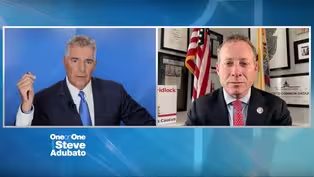
We're joined all the way from Washington, doing his job, Congressman Josh Gottheimer, a Democrat based in Bergen County.
Congressman, good to see you.
- Hey Steve.
Thanks for having me.
- Good to have you.
Hey, so look, right behind you, the common ground, finding common ground on your left, and the gridlock on your right, whatever that is.
Are you serious?
Is that just wishful thinking, or how much of that is going on in Congress?
- More than you'd see on cable news, I'll tell you that much, or on social media.
- Okay, so now it's those of us in the media.
- (laughs) I didn't, wait, I didn't say you.
I said, listen.
- Give us a couple of positive things.
- If you're reasonable, you're the proof that there's reasons still, even in a lot of people who just like to focus on the people throwing mud at each other.
You know, if you look at the debt ceiling deal, which we just got done recently now- - Yeah, I was just gonna talk to you about that.
Tell it, break it down, not in congressional language, but in real people language so we can understand.
What is the deal, and why does it matter, Congressman?
- So, the debt ceiling deal, just for those who don't spend time watching C-SPAN, basically every year we, as Congress, have to do a budget and appropriate resources for everything from our roads to Social Security, you name it.
And then what happens is at the end of the year you gotta pay the bill on your credit card, the nation's credit card.
And if you hit your debt limit, right, hit on how much your borrowing limit is like on your credit card, you gotta make sure that you pay your bill, you have enough credit.
In essence, what some folks wanted to do on the extreme right was say, "You know, I know we spent the money, but now we don't want to pay our credit card bill."
A bunch of us got together, Democrats and Republicans, and figured out a way that would not only help pay down the debt of our country in the short-term, but also focus on long-term debt to make sure that we think about our children and grandchildren, and pay our bills now, and not put the full faith and credit to the country at risk.
So, it was the way things should get done.
Democrats and Republicans sitting down, working it out.
- Is that what, quote, unquote, "The Problem Solvers Caucus" that you've been a key part of for the last several years is all about?
- Exactly what it's about?
It's saying, you know, if you look at the last two years, everything on the Bipartisan Infrastructure Deal which funds the Gateway train tunnel, and fix our roads and bridges and water, to the PACT Act to help our veterans, to Electoral Reform, all of these pieces of legislation, to the CHIPS Act to build semiconductors in the United States, all done in a bipartisan way, all done with us sitting at a table, working together.
I co-chair that group, and it's the best work I focus on here.
- Congressman, I wanna ask you about some other, I don't wanna say local issues or regional issues, like congestion pricing in just a second.
- Sure.
- But I'm curious about this.
You're a policy, not a wonk, but you care deeply about policy.
You went to Congress to try to make a difference.
You have other colleagues, both sides of the aisle, but someone like Marjorie Taylor Greene or Congresswoman Boebert who, and people can research who these people are and what they've said, but when they say things that have nothing to do with policy and everything to do with, it seems to some folks, to be attacking in a personal fashion that's very polarizing in the eyes of many, what goes on in your mind?
- I think, listen, whenever you see- - Because they're not alone, by the way.
They're not alone.
- No, no, no.
There's, listen, there's groups of folks who are just extremists, and they're not here to legislate or get things done.
- Both sides of the aisle.
- We've got people on both sides who are extremists.
And frankly, although I don't like to compare Marjorie Taylor Greene to others on our side, but I'll tell you, when you've got a few people who are just outta touch with where the country is and they just wanna make news by saying the most incendiary, crazy things they can say, you know, it's obviously, you get what they're here for.
They're just here to make news and get headlines and not actually to solve problems for the country, or for the people they represent.
So, you know, what do I do?
I find that incredibly frustrating.
But just a few voices, Steve, right?
And you realize that most folks are here for the right reason, you know, whether to do a bipartisan gun safety bill.
which would pass Congress or, you know, that's the kind of stuff that I believe we should be focused on.
You know, fighting for the people you represent, not trying to, you know, get more Twitter followers and say something crazy on social media.
- I promise we're getting into congestion pricing and some of those other issues in a second.
But one of your colleagues on the Democratic side, and this is not a cable news tit-for-tat, let's find some conflict, but Congresswoman Jayapal, that's her name, right?
"Israel is a racist state."
You heard it, I saw it.
It's what she said.
How is that possibly a way to have a meaningful dialogue?
- It's not, and we came out swiftly, as did Hakeem Jeffries in our leadership, and make it clear not only is Israel not a racist nation, but beyond that, how critically important the US-Israel relationship is to America's national security, to our fight against terror in the region, to advancement of democracy in the region.
Israel, you know, remains a beacon of democracy, the only democracy in the region, but critical to our security at home.
And so, we came out swiftly and strongly, Pramila retracted her statement, and the bottom line is, you know, this is gonna happen, and the question is, "How do you handle issues like this?"
And I think our party acted quickly because the Democratic Party stands with the US-Israel relationship and understands its importance for our country.
- What is congestion pricing?
Why does it matter, particularly those in Northern New Jersey who cross over the Hudson River to get into New York for one reason or another?
Please.
- So, the congestion tax is a new tax that New York City, with working with the MTA, which is their transit system, wants to impose starting- - Metropolitan Transit Authority.
- Yeah, exactly.
Starting next year on all commuters who go into New York City, south of 60th, they'll be charged not only the $17 to go over the bridge or through the tunnels, but an additional $23 tax to go into New York City.
$40 a day, that's an additional $5,000 a year of post-tax income.
It's outrageous.
You're talking about hitting everyone from nurses to restaurant workers to hardworking folks in labor.
And the only reason they're doing it, they admit it, the governor of the York admits it, it's a cash grab for New York.
They literally have a $2 billion a year hole in their MTA, in their transit system 'cause it's so mismanaged, it's a complete mess.
They lost $700 million last year to fare skippers, people who rode and didn't even pay.
So what we've said is, "I don't think so, New York.
You got problems, you're not gonna dissolve that on our back."
And especially, Steve, to add to that the MTA issued a report to the federal government that admitted it's not only gonna add more traffic, but it's not gonna reduce congestion, and it's bad for the environment.
It will lead to more cancer-causing pollution in northern New Jersey and the outer boroughs of New York.
- How do you stop it?
It's a New York thing.
They can make their own policies, their own laws.
How do you stop it?
- Well, I take a different perspective on that.
We've got a hundred plus year cooperative with the Port Authority, right?
We work together on our roads, the bridges in the area of New York City.
- 1921 Compact between the two states.
- The port, the airports, the bus terminal.
We work together on this region where 20% of America's GDP runs through.
You can't decide one day to say, "Yeah, I know that cooperative relationship, we're gonna throw it out the window."
So you're gonna see the governor of New Jersey take legal action, he's already announced that.
I think that's exactly the right move.
Working with some mayors on additional legal action.
We've introduced legislation in Congress to defund the MTAs federal dollars they get.
They get $2 billion a year from us and the federal government.
There's no way folks in New Jersey should be paying their bill twice.
And I think it's completely outrageous what they're doing.
This is not the way to have a collegial relationship with your neighbor of where, by the way, we have so many people commuting and contribute to their economy every single day, including $2 billion a year in income tax to New York from Jersey residents.
So, it's outrageous.
We're gonna fight this thing to the death.
- Congressman, I'm gonna come back to local issues in just a minute.
But, do this for us.
I heard some of your colleagues, many of your colleagues, some would argue too many of your colleagues, who argue, "What are we doing in Ukraine?
What are we doing helping in the war between Russia and Ukraine?"
Ukraine and the invasion of Russia into Ukraine, what's going on there matters to Americans, particularly those in this region, is?
- I sit on the Intelligence Committee, and let me just tell you, I don't understand that argument at all.
Those who question what we're doing in an area where not only is it teaching us a lot about Russia and their weaknesses, but you can't allow Russia just to try to run over another country.
And then the risk of that spreading to our European allies and them going further would be unacceptable.
You've got Russia, the heinous crimes and activity they're committing in Ukraine not only has to be checked by us and by our allies, but Putin's gotta be checked, and you can't allow him who, you know, has obviously gotten very close to our number one adversary, China, you worry a lot, and Iran, you worry a lot about if he's not stopped where he would go.
- I'm gonna talk to you about the police, the Invest to Protect Act in just a minute.
But to those who, and this is not a political prognostication question or horse race stuff, but if in fact the election in 2024 is between President Biden and former President Trump, just assume this for a second.
I've asked many Democratic leaders this question, and I need to ask you 'cause you're always pretty direct and honest.
President Biden, do you have any concerns about his cognitive abilities to be president, particularly on the back end of a second term if he's 86-years-old?
And I don't mean 86 in general, I mean President Biden at 86.
- And I've spent a lot of time with him working on all this bipartisan legislation that I just mentioned, whether it's infrastructure or gun safety or CHIPS.
I'll tell you, and on this debt, most recently on this debt ceiling deal, I have no issue at all with his ability to actually do his job.
And he has been doing a phenomenal job, and the record speaks for itself.
And, you know, in terms of if it's Trump, Biden will win.
- Why are you so confident in that, Congressman?
- Because when you look at the record we have and you look at what the former president has, not only has been doing but continues to do, and his activity.
And this is, the country wants common sense, not extremism.
They want people who put the country first always.
And I believe that's what President Biden does.
I believe those are the values that he shares, things that we fight for, versus extremism and attacking people and putting people down, and acting un-presidential.
To me, that's not what the country wants.
They want people who are bridge builders.
And I think that's what we need more than ever right now in this country.
We need to come together and realize that China is the enemy, the government over there, not one another.
- And by the way, our coverage of the 2024- - You know what I mean, like, how great this country is.
And it's time we remember that and celebrate it.
- Sorry for interrupting, Congressman.
By the way, our coverage of the 2024 Election will be policy-oriented, particularly as it relates to the New York, New Jersey region, especially New Jersey.
Real quick on this, Congressman.
You've been involved in an initiative, Invest to Protect Act.
What does it have to do with police departments and the way they operate, particularly in communities like Paterson where the state government, the Attorney General has stepped in.
Real concerns about how minority citizens are being treated in certain communities.
Please, Congressman, we got a minute left.
- Sure, the Invest to Protect Act actually puts more resources into training, to mental health resources for officers, and retention and recruitment.
Deadly shootings are up 70% in Jersey in the last year.
Bergen County, auto theft up 50%.
You've got more law enforcement leaving with 47% fewer folks staying.
We've got more retirements way up.
We need good officers, we need officers to stay on the job, and we need them well trained.
And I think that's what I believe in.
You know, they get our backs every single day.
We gotta make sure that we give them the tools they need to be trained and to protect us and to protect themselves.
And we're lucky to have the best cops in Jersey.
And, you know, along with firefighters and first responders, we're just lucky overall.
But the bottom line is we've got a lot of small departments who need help and resources.
This Invest to Protect Act gives smaller departments the resources they need to provide all this training, mental health services, and retention and recruitment services.
- Congressman Josh Gottheimer, I wanna thank you so much for joining us.
Once again, we look forward to talking to you again.
Thank you, Congressman - Thank you, Steve.
Take care man.
- You got it.
Stay with us, we'll be right back.
- [Narrator] To watch more One on One with Steve Adubato find us online and follow us on Social media.
- I really had no choice but to write this book.
At a very young age I was introduced to the history of my family and I was told about the lives that they lived.
But when it came to the war, it abruptly ended.
And all they said was that, "They didn't make it," and, "They're all gone."
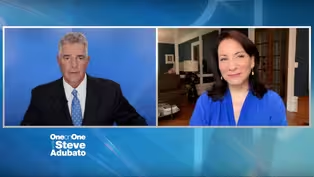
(soft piano music) - We are honored to be joined by Meryl Frank, who is the author of a compelling and very important book called "Unearthed, a Lost Actress, a Forbidden Book, and a Search for Life in the Shadow of the Holocaust".
Meryl, thank you so much for joining us.
- Thank you for having me here today.
- Georgette Timoney, our executive producer, One-on-One and reading your book said she just had to keep putting the book down because it was so powerful.
It is so powerful and moving and emotional.
The premise of the book is?
- Well, it's a complicated story.
It's a story about family memory and secrets that are kept and our desire to find them.
And then also, what do we tell our children about sometimes a horrific past, trauma in the family past?
- Your cousin, Franya Winter.
- Yes.
- [Steve] You wanted to know who she was, how she lived and how she died.
Was that kept from you throughout your entire childhood?
- Well, when I was a child, I was sort of designated as the one that would remember the family history.
Even as a very small child I was told stories about their life in Europe and I would look through the old family photographs.
The kind on the hard stock, they're very solid and serious ancestors.
But I had this one who looked so alive and fun and interesting in costumes.
And it was my cousin, this actress, Franya Winter.
And they were all in black and white, but somehow she seemed to be in color to me and I fell in love with her.
But when I asked what happened to Franya and the rest of the relatives, all I was told was, "They're all gone.
They didn't make it."
And so it was something that I had been interested in since a very, very young age.
But it wasn't until I was older, an adult that my aunt gave me a book.
And the book was entitled "21 and One".
And there was an article on it, a chapter on my cousin, Franya Winter.
And my aunt said to keep the book, to hand it down to the children.
But don't ever read it.
The book was in Yiddish so that wasn't hard to do.
And my aunt was a formidable woman.
She was from Bayonne, New Jersey.
She was a teacher and labor organizer.
And I thought if she told me not to read it, I probably shouldn't.
Now, I should tell you, I'm not the sort of person that if someone says, don't do something, I don't do it.
I usually do it.
(Steve chuckles) But in this case, I thought there must be a reason she doesn't want me to read it.
And I put it on the shelf with the rest of my Holocaust books.
- What is the most significant aspect of Franya's life and what happened to her that you feel people, whether they're Jewish or not whether they feel a direct personal family connection to the Holocaust or not, should care about?
- Well, what I tried to do was to discuss Franya in a way where she was human.
And I spent seven years researching this to make sure that it would be clear that she was a human being with flaws.
And with joys and sadness and that she was someone that they would fall in love with too.
And that's so important.
When we talk about stories, having one person is so much easier to understand than 6 million.
You know, it's sort of the Anne Frank phenomenon.
I wanted people to know that this was a real person and this is what happens when hate goes unchecked.
- For people who minimize the Holocaust, who deny the Holocaust, who say, "Okay, well, let's move on from the Holocaust."
You say what to them?
- I say, "Look, there's no moving on from this."
That these stories are important, that we tell these stories because they are universal stories.
They're stories about trauma and suffering.
And again, what happens if hate goes unchecked?
I'm convinced that the Holocaust was not inevitable.
And that means that if people stand up and speak out when they see injustice that we can prevent something like this from happening.
Now, my story is a Holocaust story like many others and they're all so important to tell.
But I also discuss after discussing Franya's life and what ultimately happened to her, "Okay, what do we do with this information?
Where do we go now?
What do we tell our children?"
- Okay, so let's stay on.
There's clearly a rise in antisemitism in this country and there are an awful lot of folks who either are not moved by it or think, "Okay, so there's antisemitism."
Isn't that how it started?
- Well, you're right, it did start that way and in my case my own relatives didn't want to leave Europe.
My grandmother tried to get her sisters and her nephews and nieces to come to America but they felt comfortable.
They had wonderful lives, and they thought, "You know what?
There's been anti-Semitic attacks before.
This will pass too."
So we have to be vigilant.
We have to know and you can't put your head in the sand.
And this is what I learned from my children.
They grew up in an atmosphere of my constantly talking about the Holocaust.
I wanted them to know and it was my way of keeping them safe.
And they said to me that, "No, I didn't make them paranoid.
I made them aware."
And my one son said to me he understood because of the stories that were told that you have to be constantly vigilant.
You have to believe it.
And if you put your head in the sand, horrible things can happen.
It was interesting that they made a connection with climate change.
My kids said to me, "Mom, there's Holocaust deniers and there's climate change deniers and we have to deal with them both."
- What does it mean to deal with?
- That means stand up, to speak out and to do something.
I think that talking with your children about horrors is important.
The world isn't always a beautiful place.
But at the same time it's equally important to give them a sense of agency, that they can do something about it.
In the case of antisemitism, my children understand that there could be a target on their back.
I mean, when they travel or if they go to synagogues, there are police outside of synagogues.
Can you imagine?
It's a terrible state of affairs and it's something that we get used to.
But at the same time, they need to know that there is a risk and still be able to live a full and beautiful life.
- The book is "Unearthed, a Lost Actress, a Forbidden Book and a Search for Life in the Shadow of the Holocaust."
By the way, you're the former mayor of Highland Park of New Jersey, that sounds like out of the blue, but during what period of time?
- From the year 2000 till 2010, 10 years.
- So in writing the book, it's one thing to ask what you learned about Franya, what you learned about your family's history.
But I actually wanna ask you something slightly differently, a slightly different question.
How do you think it's changed you?
- How has the book changed me?
- Not just the book, the experience of researching, writing and living this book.
- I was told these stories from a very young age but they wasn't in a vacuum.
I was told the stories by my aunt and she was a labor organizer, a teacher in Bayonne, - The same Mollie.
- The same, my Aunt Molle.
And she was the one that made it very clear to me that I needed to understand this history, not just because it happened to us.
But because we need to take action and that we have a responsibility as Jews to act and to call out when we see injustice.
And that was very important.
And it's the reason that I entered politics, - Is it?
- That I did the work that I did.
The Holocaust was always in my mind, that this was something that I had a responsibility to do.
And so I spent many years in politics in New Jersey and then internationally.
And I learned that there was still something else I needed to do.
And it wasn't until I received an email from the Mémorial de la Shoah in Paris, that's their Holocaust museum.
They told me that somebody had delivered 50 photographs of an actress in costume and her family.
And they asked me if I knew her.
And in fact, I did.
It was my aunt and my cousins.
And when I viewed those photographs, I realized there's a story that needs to be told these people who I loved dearly although I didn't know them, I felt that I needed to honor them.
I needed to show that they were real human beings, to give them back their personhood and their dignity.
And so writing this book helped me do that.
It was in many ways healing to be able to do that.
And I feel very fortunate that I was able to in some ways bring them back to life, bring back their story.
- Meryl Frank, an important book, "Unearthed".
We appreciate you joining us.
We appreciate you sharing your perspective on such an important, it's not even an issue.
It's a part of our history, not just in this country, but throughout the world.
And you do not have to be Jewish.
You do not have to have that particular heritage to care deeply, understand and care.
Thank you, Meryl, we appreciate it.
- Thank you, Steve.
- I'm Steve Adubato.
We'll see you next time.
- [Narrator] One-On-One with Steve Adubato has been a production of the Caucus Educational Corporation.
Funding has been provided by Holy Name.
Johnson & Johnson.
New Jersey Sharing Network.
Veolia, The Port Authority of New York and New Jersey.
Operating Engineers, Local 825.
Horizon Blue Cross Blue Shield of New Jersey.
Kean University.
New Brunswick Development Corporation.
And by these public spirited organizations, individuals and associations committed to informing New Jersey citizens about the important issues facing the Garden State.
And by Employers Association of New Jersey.
Promotional support provided by Northjersey.com and Local IQ.
And by New Jersey Globe.
- I am alive today thanks to my kidney donor.
I am traveling and more active than ever before.
- I'm alive today thanks to my heart donor.
I'm full of energy and back singing in my church choir.
- I'm alive today thanks to my lung donor.
I'm breathing easy and I'm enjoying life'’s precious moments.
- They are about 4,000 people in New Jersey waiting for a life-saving transplant.
- Donation needs diversity!
- For more information or to become an organ and tissue donor, visit NJSharingNetwork.org.
Amb. Meryl Frank Addresses Her Heartbreaking Family History
Video has Closed Captions
Clip: S2023 Ep2653 | 12m 5s | Amb. Meryl Frank Addresses Her Heartbreaking Family History (12m 5s)
U.S Rep. Gottheimer Forecasts the 2024 Presidential Election
Video has Closed Captions
Clip: S2023 Ep2653 | 14m 10s | U.S Rep. Gottheimer Forecasts the 2024 Presidential Election (14m 10s)
Providing Support for PBS.org
Learn Moreabout PBS online sponsorship
- News and Public Affairs

Top journalists deliver compelling original analysis of the hour's headlines.

- News and Public Affairs

FRONTLINE is investigative journalism that questions, explains and changes our world.












Support for PBS provided by:
One-on-One is a local public television program presented by NJ PBS