
US Supreme Court Starts New Session. Here's What to Know
Clip: 10/5/2026 | 13m 9sVideo has Closed Captions
Justices will hear arguments on Cook County's ban on assault weapons.
The court is set to hear arguments over the separation of church and state, greenhouse gas emissions and Cook County's ban on assault weapons.
Problems playing video? | Closed Captioning Feedback
Problems playing video? | Closed Captioning Feedback
Chicago Tonight is a local public television program presented by WTTW
WTTW video streaming support provided by members and sponsors.
US Supreme Court Starts New Session. Here's What to Know
Clip: 10/5/2026 | 13m 9sVideo has Closed Captions
The court is set to hear arguments over the separation of church and state, greenhouse gas emissions and Cook County's ban on assault weapons.
Problems playing video? | Closed Captioning Feedback
Where to Watch Chicago Tonight
Chicago Tonight is available to stream on pbs.org and the PBS app.

WTTW News Explains
In this Emmy Award-winning series, WTTW News tackles your questions — big and small — about life in the Chicago area. Our video animations guide you through local government, city history, public utilities and everything in between.Providing Support for PBS.org
Learn Moreabout PBS online sponsorship>> Us Supreme Court justices didn't take much of a summer break this year with a busy emergency docket covering cases for mail in voting changes to the White House ballroom construction.
Nevertheless, the nation's highest court is back to start a new term today in the coming months.
The court is set to hear arguments over the separation of church and state greenhouse gas emissions and even Cook County's ban on assault weapons.
Joining us to preview the coming term are David Franklin, a law professor at DePaul University and a former law clerk to Justice Ruth Bader Ginsburg.
And Harold Krantz, a law professor at Chicago can't College of Law gentleman.
Welcome back.
What we call today.
Happy first Monday of October.
Sure that we're going to college What were some of the emergency cases that kept the Supreme Court busy over the summer?
>> Morkel couple who you mentioned the case terms of fighting the ballroom.
That was certainly important spring but also allow deportations to 3rd countries for those who are not citizens to continue, even though that was incredibly controversial remains so they also talked about whether or not President Trump fire the sun cook the I Director, when he claimed that she engaged mortgage fraud years before she was in service.
And actually one that's probably the most telling nationally is that the Supreme Court blocks Trump's effort to restrict mail-in voting before the midterms.
President Trump to attack court and sort chide him for forgetting who pointed them in the first place.
>> David, our emergency decisions becoming more common.
Oh, absolutely.
I don't have all of the numbers at my fingertips, but I believe that during the 2 term presidencies of both George W Bush and Barack Obama, the federal government went to the court about once per year, asking for emergency relief, basically skipping the queue, jumping the line and saying we want the court to act now on an emergency basis during the first Trump term, the Trump administration did that some 35 earth or 40 times.
So that's, you know, 10 times the amount.
And during the first 20 months or so, the second Trump term boy, the Trump administration has been going back to that.
Well, dozens and dozens of times and and justifiably so in their eyes because they're having success.
Most of the time the Trump administration winning on these emergency docket cases, even though lower court to have the benefit of full briefings, seeing all of the evidence being able to take their time with the cases, those lower courts have overwhelmingly found the Trump administration policies are unlawful and yet they run to the Supreme Court.
And the court allows the administration to continue those policies.
Harold, still on the topic of, you know, the emergency docket, an emergency decisions.
How is that process different from the courts, regular process of deciding cases?
>> Well, there's generally no oral argument.
There's no The decision is dawn on papers from that were filed in the court below.
So the idea is the issues not battling this much is not open process.
And the standard center different because of likelihood of success and they were of the Har are considered much more than the merits themselves, per se.
And indeed, one of criticisms of the show talking recently is that the court is seemingly healthy, any kind of impairment of the presidential agenda automatically irreparable and rises to the level of the need for protective decision by the Supreme Court.
least in most cases.
Obviously there's exceptions mentioned before.
So it's not open to the public.
She's our family.
and sometimes I think many observers think that that seems that our our Courtney not well thought >> David, so the court heard arguments today in a case over greenhouse gas emissions.
Tell us about that one.
>> Yeah.
So the and county of Boulder, Colorado, soon a handful of oil companies basically saying you've deceived the public over the years.
You knew about the risk of climate change that your petroleum products for causing.
And we have to foot the bill.
We're bearing the brunt of the costs of the sort of downstream costs of climate change already.
And those costs are only going to multiply.
So that litigation was basically modeled on cases against cigarette companies, opioid manufacturers that I'm sure your viewers are familiar with.
The question in the case for the justices today.
Well, there were some technical legal questions that only a lawyer could love.
I'll skip those unless you really want to get into that.
I know I made my sound very exciting.
Did not.
But the core question is is really crucial, which is.
Is it permissible for a state through its judicial process to, in effect, regulate what a company from another state did in that other state.
And the lawyer for the oil companies today basically said no, issues particularly of air and water interstate spillover effects are reserved only for Congress and the federal government, not for individual states to regulate.
So we'll see how it comes out.
There was some skepticism on that latter point.
Interestingly enough from the chief justice who normally allies himself with big business and Justice Samuel Alito did the right thing and recused himself from this case because of some investments that he has.
So it's possible that the case ends up in a 4, 4, Thai, which would mean that the Colorado proceeding would be allowed to go forward, at least for now.
And you're right.
I did.
It does have, you know, sort it does remind me of the cases against big tobacco and Big Pharma.
>> Before we move on to that case have possible implications here in Chicago.
Well, Chicago was recently declared one of the more climate resilient cities in the world.
>> So, you know, let's all hope the climate related costs in Chicago and Illinois remain lower than in other parts of the country.
But I think the the broader implications of the case extend not only to this kind of climate based litigation, questions of the to what extent can for lack of a better term, a blue state right?
Tried to regulate harmful activities by corporations in an environment where the federal government is unlikely to pursue those kinds of regulations.
Herald, another case argued today Johnson versus the United States.
This one has to deal with disability benefits but could have broader impacts.
What can you tell us about those?
>> Sure.
has to do with where individual who's been allegedly entered can bring a constitutional right and the individual was receiving benefits.
He was incarcerated as benefits were caught.
And he argued that that cut and benefits was no but That was really Congress against him up because after he'd already been punished without any kind of due process of law, he tried to bring it in federal court and the argument that launched against was that this is a special statute and relegate all constitutional claims not to the federal courts, which usually hear constitutional claims.
But instead to administrative tribunal under of 8 Veterans Administration control with review ultimately in a So outside of the purview of the traditional courts, which means more delay.
less likelihood of a sympathetic reception to the constitutional claims.
This is called the species channeling where Congress either explicitly or implicitly decide particular claims can be brought.
And this has been incredibly important indication against the Trump administration, the hundreds of thousands of federal employees who are wrecked the 500 billion dollars.
grants that were canceled.
All were subject to constitutional claims.
But the court who said you can't a constitutional thing here is you have to go to specialize tribunal that con Congress has created.
That means incredible to wait more expense more time and the injuries are not remedied.
So even though this case has to do with just veterans benefits, one person who made kind of long-shot constitutional argument.
The ramifications could very, very important.
>> David, the courts also going to be hearing a challenge to Cook County's ban on assault weapons.
It's been in place since 1993.
Why is it being challenged now?
Well, the Supreme Court decided in 2008, which is not that long ago for the very first time into cited that.
>> The Second Amendment protects an individual right to have a handgun in your home for self-defense.
since that time, the court is only double down on its originalist sort of history based approach to the Second Amendment.
Basically saying that in order for a state or locality to regulate gun ownership that state or locality has to show that its regulation has roots that go back to the beginning of the republic or at least to air of the civil war.
So in this case, the debate is really about what kinds of arms, what kinds of guns to the Second Amendment protects on the one hand, these assault weapons are unfortunately very common in this country.
There millions and millions of them out there on the other hand, they're basically weapons of war that are the weapon of choice for people who want to engage in mass shootings.
Is that the kind of arm that our founders meant to protect the ability of individuals to possess and use.
That's the question.
>> Harrold, what we know about, you know, how justices have ruled in recent Second Amendment cases.
>> So court has become supporters are backing of second Second Amendment protections.
All cases sort really interesting because obviously through dangerous weapons.
And everybody I think agree with that.
And court in the past has said military-type weapons can be regulated.
They don't have to be, but they can't be based upon the state grenades can be regulated growing not regulate it.
But the difference is the number of people profession.
Franklin suggested all of that on maybe 15 to 20 million people United States and own AR 15 or similar assault weapon.
And so this is a kind issue.
If you want to look at tradition, history can say yes, this is clearly a dangerous type of weapon long has been regulated up to the individual states.
But you look at the number of never you can come out of different way.
So the court has choose between the tracks of of analysis.
>> David, before we run out of time, a Catholic school in called Colorado is suing to get state funding.
But they don't want to admit students who themselves or their parents are members of the LGBTQ+ community.
What is at stake nationally in this case?
Well, there's so many overlapping strands of Supreme Court law that are involved here, but basically in short.
>> The Supreme Court used to believe in separation of church and state.
So it was in permissible for the government to.
Hand over taxpayer money to religious schools or institutions.
Now under the Roberts court, the opposite seems to be the case.
Not only is it permissible, but it often is required.
That is to say if the government has a program has Colorado has here with its universal Pre-K program that provides benefits to schools.
Those benefits have to be available.
Says the Roberts court to religious schools like to have that extra wrinkle in this case, is that the schools at issue here did not want to sign an antidiscrimination pledge that Colorado requires all recipients to sign.
Basically, you've got to let same couples and their children attend these preschools, these catholic schools and dioceses didn't want to sign that pledge and they say it discriminates against religion to fence us out of this program because of our religious refusal to agree to your antidiscrimination
 New
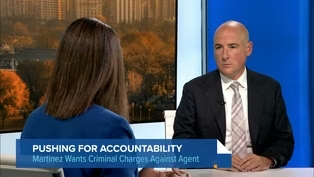
NewWoman Shot by Federal Agent Hopes Lawsuit Could Spur Criminal Charges
Video has Closed Captions
The lawsuit comes almost a year after Border Patrol Agent Charles Exum shot Marimar Martinez. (8m 6s)
Providing Support for PBS.org
Learn Moreabout PBS online sponsorship New Episode
- News and Public Affairs

Top journalists deliver compelling original analysis of the hour's headlines.
 New Episode
- News and Public Affairs

Today's top journalists discuss Washington's current political events and public affairs.
 New Season
 New Episode
 New Episode
 New Season
 New Episode
 New Episode

 New Episode
 New Episode
Support for PBS provided by:
Chicago Tonight is a local public television program presented by WTTW
WTTW video streaming support provided by members and sponsors.