Utah Insight
Utah Black Birth Workers Collective
Clip: Season 4 Episode 6 | 3m 44sVideo has Closed Captions
Learn how a woman's near-death experience shaped her outlook on reproductive healthcare.
In the United States, the risk of death during pregnancy is three times higher for Black women than for their white counterparts. We speak with a woman who knows that reality all too well. Learn how her own near-death experiences have shaped her outlook on reproductive rights and guided her in her career as a doula.
Problems playing video? | Closed Captioning Feedback
Problems playing video? | Closed Captioning Feedback
Utah Insight is a local public television program presented by PBS Utah
Utah Insight
Utah Black Birth Workers Collective
Clip: Season 4 Episode 6 | 3m 44sVideo has Closed Captions
In the United States, the risk of death during pregnancy is three times higher for Black women than for their white counterparts. We speak with a woman who knows that reality all too well. Learn how her own near-death experiences have shaped her outlook on reproductive rights and guided her in her career as a doula.
Problems playing video? | Closed Captioning Feedback
How to Watch Utah Insight
Utah Insight is available to stream on pbs.org and the free PBS App, available on iPhone, Apple TV, Android TV, Android smartphones, Amazon Fire TV, Amazon Fire Tablet, Roku, Samsung Smart TV, and Vizio.
All Episodes Now Streaming
Hosted by Jason Perry, each week’s guests feature Utah’s top journalists, lawmakers and policy experts.Providing Support for PBS.org
Learn Moreabout PBS online sponsorship- [Liz Adeola] When you sit down for a conversation with Ashley Finley, wild uncontrollable laughter abound.
- It was like, I feel like it was like the Twilight Zone.
- [Liz Adeola] You'd never guess it from her demeanor, but the conversation we're having is about matters of life and death.
- I have a hard time like naming that as like oh, I had an abortion.
And not only was it an abortion, it was like a lifesaving abortion.
- [Liz Adeola] At a time when Ashley didn't even know she was pregnant.
- Like drove myself to the ER, like from Planned Parenthood.
- [Liz Adeola] Doctors discovered that she was suffering from an ectopic pregnancy.
- Essentially, the embryo or fetus doesn't fully make it to the ovaries, and it's stuck in your fallopian tube.
The danger is if that you don't catch it in time, what ends up happening is it bursts your fallopian tubes.
After the rupture, it can cause death.
- [Liz Adeola] But Ashley lived through this painful experience twice.
- Yeah, so I guess thinking about it is like, wow, I'm still dealing with it, and it'd be better for me not to think of the fact that I'm still dealing with it.
- [Liz Adeola] But for her, the new battle over abortion rights opens old wounds.
- They should be thinking about that situation.
And every other situation where a woman or a person who can have a baby says I don't want this.
This isn't the right choice for me.
It upsets me, it saddens me, and it angers me that we're still having to have this conversation in 2023.
- [Liz Adeola] Fueled by that lingering feeling of loneliness and despair when she sought medical help for her condition, and alarmed by black maternal mortality rates, Ashley created Sacred Sister Doula.
- So I take it really seriously to have clients who look at me and say, I need to have my baby in the hospital because of whatever diagnoses or maybe complications with the pregnancy.
And then like look at me and just say like, you know, just don't let me die.
You know, I hear that all of the time, specifically from black women, don't let me die.
Don't let them kill me.
- [Liz Adeola] In fact, hundreds die each year from pregnancy related complications.
With the CDC uncovering that over 80% of pregnancy related deaths are preventable, yet the risk of death is three times higher for black women than white women.
- And I think it's really important for like the specific demographics that I work with, which are largely black and indigenous people of color, to have someone there in that way, but also to have someone there to advocate for their choices and for their autonomy.
- [Liz Adeola] Which Ashley says goes beyond matters of life and death, to touch upon destiny.
- You know, there's a simple but powerful statement that I love.
It says black people are in the future.
And look, I'm like already gonna get like teary eyed thinking about it, but we are in the future and work like this is so important.
I want to see those babies not just surviving, but I want to see them thriving and blossoming and living in a world that sees them and loves them and says, yeah like, it may have been really terrible in the past, you know, but we're healing and we're sorry.
And it's different now.
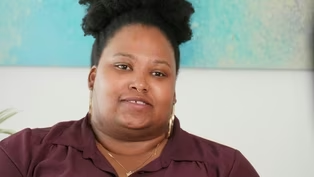
Preview: S4 Ep6 | 30s | With reproductive rights being questioned, how are Utah communities being affected? (30s)
Providing Support for PBS.org
Learn Moreabout PBS online sponsorship
- News and Public Affairs

Top journalists deliver compelling original analysis of the hour's headlines.

- News and Public Affairs

FRONTLINE is investigative journalism that questions, explains and changes our world.












Support for PBS provided by:
Utah Insight is a local public television program presented by PBS Utah