
Utah Voters Receive Ballots
10/16/2026 | 26m 42sVideo has Closed Captions
With ballots arriving in mailboxes, we dig into polling and fundraising numbers from key races.
As Utah voters begin receiving their mail-in ballots, political conversations across the state are intensifying ahead of a pivotal midterm election. Our expert panel digs into polling and fundraising numbers, exploring potential outcomes in several key races. Journalists Sarah Jane Weaver and Robert Gehrke join political insider Marty Carpenter on this episode of The Hinckley Report.
Problems playing video? | Closed Captioning Feedback
Problems playing video? | Closed Captioning Feedback
The Hinckley Report is a local public television program presented by PBS Utah
Funding for The Hinckley Report is made possible in part by Cleone Peterson Eccles Endowment Fund
Utah Voters Receive Ballots
10/16/2026 | 26m 42sVideo has Closed Captions
As Utah voters begin receiving their mail-in ballots, political conversations across the state are intensifying ahead of a pivotal midterm election. Our expert panel digs into polling and fundraising numbers, exploring potential outcomes in several key races. Journalists Sarah Jane Weaver and Robert Gehrke join political insider Marty Carpenter on this episode of The Hinckley Report.
Problems playing video? | Closed Captioning Feedback
Where to Watch The Hinckley Report
The Hinckley Report is available to stream on pbs.org and the PBS app.
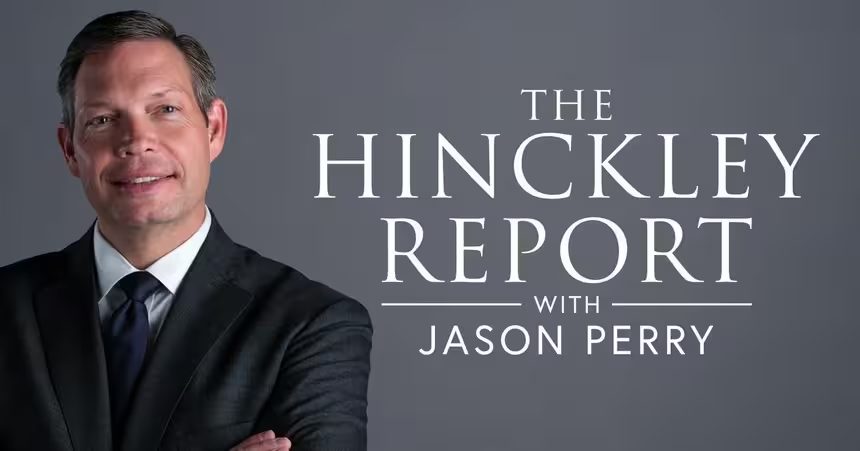
The Hinckley Report
Hosted by Jason Perry, each week’s guests feature Utah’s top journalists, lawmakers and policy experts.Providing Support for PBS.org
Learn Moreabout PBS online sponsorshipJason Perry: On this episode of "The Hinckley Report," ballots arrive in mailboxes as candidates make their final pitch to voters, polling reveals who has the edge as congressional debates conclude, and where is big money being spent in this historic midterm election?
announcer: Funding for "The Hinckley Report" is made possible in part by the Cleone Peterson Eccles Endowment Fund and by donations to PBS Utah from viewers like you.
Thank you.
♪♪♪ ♪♪♪ Jason Perry: Hello, and welcome to "The Hinckley Report."
I'm Jason Perry, director of the Hinckley Institute of Politics.
Covering the week, we have Sarah Jane Weaver, editor of the "Deseret News"; Robert Gehrke, reporter for the "Salt Lake Tribune"; and Marty Carpenter, partner with Northbound Strategy.
So glad to have you all with us.
We've just concluded debates around the state, elections are in full gear, and Sarah, ballots have arrived in the mail.
Talk about that for just a moment because people should have started seeing them.
There's a way to track if you haven't received yours.
Talk about that against the backdrop of there's so many conversations about where Utahns are on mail-in ballots, but this election cycle, the midterms, they're coming.
Sarah Jane Weaver: Yeah, and I got my ballot in the mail this week.
I actually opened it up and started working on it this morning.
Jason Perry: Working on it, love that.
Sarah Jane Weaver: Yeah, that's one of the advantages of having a mail-in ballot.
You get a little more time than you do when you're in the booth.
But people are talking about this.
They're talking about this idea that some people now have to prove that they have a driver's license or a passport to actually cast their vote.
Jason Perry: Yeah, let's talk about that for just a moment, Robert, because that is the requirement here in the state.
This is from a bill, House Bill 209.
This is from Cory Maloy, that you have to provide documentary proof of your US citizenship ahead of this election.
It has some ramifications.
Robert Gehrke: Yeah, it does, because there are people who are on the voter rolls right now who registered to vote well before that was a requirement that they should show the driver's license.
And so, there are some people that fall into that doughnut hole, I guess.
And, you know, it could make it more challenging for them.
Maybe they won't get their mail-in ballots.
They might get one that's streamlined because you can still vote in the federal elections.
But the idea being that, you know, there's been a lot of talk about non-citizens who are voting, even though the audits routinely show that it's pretty isolated.
But the legislature wanted to kind of get out in front of that.
And so that's what they're doing this time around.
Jason Perry: And, Marty, the way they started on this is they sent out over 6,000 letters to people who they have on these rolls that have not done this proof of citizenship or at least not part of their driver's license or otherwise registered.
Marty Carpenter: Yes, there are about 4,300, I believe, who have not gone through the process.
They're going to get a ballot in the mail, but it's going to only have the federal races on it.
That's going to be a good forcing function to say, "Oh, something's not right here.
I need to go fix this."
I think in the end, as long as the process to fix that when they show up and want the other ballot, if that runs smoothly, I think this ends up being relatively a non-story and like a nice really convenient way for people to get in compliance.
And I think generally what people are saying even across our state is, one, we really like mail-in ballots, but two, we also like the confidence we can have in that the people who are voting with their mail-in ballots are the people who should be voting, and if this is a minor inconvenience to get us to where we can have that confidence going forward, then I think you'll see most people say that was worth it.
Robert Gehrke: And those folks can still show up at the polling place, prove their citizenship, and go ahead and cast a ballot as they routinely would.
Marty Carpenter: They're not gonna get to work on their ballot.
Robert Gehrke: They're not gonna have the same time commitment to sit down with it, but yeah, it could be.
Sarah Jane Weaver: I think people will also find it interesting that they got a notice in their ballot that says by 2029 they actually have to opt in to mail-in voting.
Robert Gehrke: I think that's going to be the bigger change because, you know, if you don't get that opt-in, people are going to be used to getting these ballots in the mail, and they're going to stop getting those after the 2028 election in 2029.
And so, you know--but they have tried to make it fairly simple to opt in, the check off on your ballot, or, you know, you can do it--I believe you can do it online at the LG site.
So, but that is gonna be a pretty--that's gonna be the bigger change, I think.
Marty Carpenter: 2029 is an interesting day too, just because who knows what the general feeling amongst voters is a couple of years down the road?
Right now, voter security or election security is one of the bigger topics because it's being driven by the White House.
You get a couple more years down the road, maybe it's less of a hot topic, and you could see somewhere in a session along the way they say, "Hey, let's strike the right balance here and maybe make a modification."
So there's time for things to get ironed out.
Robert Gehrke: Yeah, Senator McKell, I believe, was the sponsor of this, and he said he wanted to give a little bit of runway for people to kind of make sure that if they do want those mail-in ballots, they can keep getting them.
And, you know, there was talk--I mean, there was talk about making people return them in person and so forth, but this was sort of, like you said, trying to find a balance between the security component and the convenience.
Marty Carpenter: I like the convenience of being able to fill it out, study it out, look at the websites and fill it out.
I would say that even though I love the convenience of putting it back in the mail, most times it's still sitting on my desk on election day.
I have to go drop it off anyway, so I like the convenience in theory.
In practice, I'm probably not batting 1,000.
Robert Gehrke: That's a good point, because they have changed the law on that too, where it has to be received by the clerk by 8 o'clock on election day.
So if you're going to mail it in, you've got to mail it a little bit earlier than you used to.
Jason Perry: Yeah, so Sarah, before we leave this, talk about who your reporters--who they're talking to, whether or not some of these provisions have been put in place are making maybe lawmakers or others feel more secure or maybe the voters themselves about their ballots and about, I guess, people who are legal citizens of the United States voting, those concerns that keep being addressed, whether or not they're being addressed by these or not.
What's the general sense that people are being interviewed?
Sarah Jane Weaver: I think we all want to make sure that voting registries are accurate.
I think people who manage voting registries in the state have said, "Hey, this is a natural thing we're going through.
We're making sure that everyone who is on our voting list should be."
And then there's always concern: What are the motivations?
Are these--and what's going to be the ultimate outcome?
But yeah, as a matter of practice, we all want to know that who's casting a vote actually deserves to be casting a vote.
Robert Gehrke: But I think a lot of concerns, false concerns, have been raised by the Trump administration on this, and, you know, they're suing Lieutenant Governor Henderson over getting access to the voter rolls.
Every audit, every review that's been done of Utah's voter rolls--I don't have the numbers off the top of my head.
But these are very, very isolated incidents where people who are non-citizens who end up on the rolls, and even more rare that they actually vote.
And so people, I think, should have confidence, and I think the county clerks around the state are trying to instill that confidence in people that, yes, if you vote, it is secure, your vote will be counted appropriately.
The lieutenant governor obviously fighting back against the Trump administration repeatedly over both the mail-in voting piece of it that the administration tried to shut down and the voter roll piece of it.
It's an interesting time, and there are a lot of people who I think are trying to intentionally cast some doubt on the security and legitimacy of elections.
Marty Carpenter: I've spent some time running campaigns, and that has occasionally led me into a clerk's office to watch ballots being counted.
I think if people understood the process of what happens to your ballot--obviously, you can track it, but actually watching the process of how they make sure that your vote was cast legally and that it's actually you who signed and everything that it goes through in order to be counted, I think more people would have confidence.
So actually, I'm a big proponent of saying if you're the lieutenant governor or if you are the clerks, the best thing to do is talk about the process and how layered it is to make sure that things are done appropriately and that your vote is counted.
That, I think, gives people more confidence.
So, I don't think there's a process issue here, but I think there is an opportunity to communicate about it better to voters to make sure their confidence level stays high in the process.
Sarah Jane Weaver: People will also note when they go to cast their ballot, they either need to put the last four digits of their driver's license or their Social Security number, and that in some cases their signature is going to have to be--well, in all cases their signature has to be verified.
Jason Perry: So, the ballots are all going for someone.
So let's talk about these candidates for just a minute.
Robert, can we start with this on sort of the national stage here?
Sort of the headwinds and the tailwinds that we're seeing right now, midterms, historically, the president who has his party in charge usually doesn't do very well in those midterms.
Talk about that in just a moment, see what we might be seeing.
Robert Gehrke: Yeah, I was looking recently back at some of the, you know, midterm annihilations.
You know, Bill Clinton in '94 with the Contract with America.
You got the Obama, you know, Tea Party election.
This is shaping up to be similar to that, I think, you know, and I think the consensus is that Trump's approval rating is below 40%.
It's below--it's about 45% here in Utah.
And he's been--he's becoming a real drag on some of these candidates in swing districts out there.
There was obviously all the fighting about redistricting and trying to get the advantage that way, but when you have a wave election like this is appearing like it's going to be, that, you know, probably doesn't matter.
And as you mentioned in the introduction, it's a very closely divided--I think four seats in the House, you know, for control, and that can radically change the direction of the country over the next two years because once you have a Democratic control of the House, that's where you can start investigating, that's where you can start impeachment proceedings potentially.
And I think that, you know, if people are concerned about the friction and the dysfunction in Washington, there's a potential for it to get a lot worse after this election.
Jason Perry: I want to break up a couple of pieces, Marty, too.
One about the Trump approval.
Nationally it's around 37%, so he's not on the ballot, but is he kind of on the ballot?
Talk about how you handle that.
Marty Carpenter: Yeah, he's certainly a headwind for Republicans who, at the moment, if you believe the polling, and polling has shown that it can be hit and miss over the last couple of cycles, that first Tuesday or waking up that first Wednesday in November won't be a lot of fun for Republicans across the country.
I've always said this, though.
You can, in a campaign, go out and put out yard signs, and yard signs are impactful, but there's no way you can put out enough yard signs to combat the yard sign that is next to the gas station, the one that right now says about $4.79 a gallon.
And when that number is high, it's bad for whoever is in office.
I don't care which party it is, because people look at that and go, "Now it's costing me money."
Politics can maybe seem like a game to people or just an annoyance to people, but when it comes to the gas prices and people understanding how gas prices connect to the prices they're paying for groceries and other things, that's a yard sign that's really hard to overcome.
And right now, the worst thing that you can do when you're the incumbent, and what the president has done, is put those signs at a high number heading into a really vulnerable spot for Republicans politically.
Robert Gehrke: I've been talking this week with a lot of voters who affordability is their primary issue, people who have two kids and are staying in a two-bedroom apartment or they're, you know, trading in their cars, getting another job, things like that.
That's where politics, which is maybe abstract for a lot of people, becomes real tangible, and, you know, those kitchen table issues.
Jason Perry: Yeah, Sarah?
Sarah Jane Weaver: It feels like affordability is the issue in every debate we saw across the state.
It's the issue of the last election, and people haven't seen any results on that.
And so, the bottom line in this case is the bottom line.
Marty Carpenter: So, if you're Republicans right now, you're hoping that voters are saying, "Hey, inflation was bad and prices were bad before Trump came in.
He hasn't gotten them under control like he said he would, but are we more likely to trend in the right direction if we stay the course or if we go back the other way, is that the right direction to go?"
That's a tough one for people to kind of calculate because they may be making more of an emotional decision than, like, a logical one.
Robert Gehrke: Change becomes the sort of primary driving factor.
"Let's throw the bums out."
Sarah Jane Weaver: But I think it's important to note that midterm elections are always one where often, especially historically, they shift from the party that's in power, but this seems amped up.
This seems much more than that traditional.
Marty Carpenter: I don't know if you guys would agree with this, but I've kind of noticed this particularly with Trump in the two terms that we've had him as the president.
I think for a lot of the middle-ground voters, like, into the center of the bell curve, they can look at it and say, "Hey, this is the right change or this is the right direction.
What he's saying is at least different than where we want--where we have been heading and where we need to head."
And it can maybe seem fun for a while, but there's like a fatigue to the chaos, and there's a fatigue to just the circus that comes with the Trump administration where you get a couple of years in and people just get a little tired of it and go, "I don't know if we can survive many more years of this.
Maybe we need to have some kind of course correction."
I think that's part of their calculation.
Sarah Jane Weaver: And we can't discount the war in Iran either.
Jason Perry: Yeah, so if you take these big issues, Robert, on this last one on this, I'm curious what you're hearing sort of the power of those Republicans from red states, because we're talking about the balance of power shifting.
If these issues are sort of the overriding concerns of voters, are they willing to switch parties to vote for someone else, do you think, based on what you're hearing?
Robert Gehrke: It certainly seems that that's the direction it's headed.
I mean, there's a lot of Senate seats that--in Texas, for crying out loud.
You know, every year we hear Texas, that this is the year it's going to flip, this is the year it's going to flip.
But right now, Talarico's up nine points on Ken Paxton.
You have states like Iowa that are in play, Kansas.
These are states that are typically not really considered to be front and center states, and so control of the Senate is going to come down to whether or not those Republicans flip.
And right now, if you believe the polls, like Marty said, the polls sometimes get it wrong, but if you believe the polls, that seems to be the direction it's headed.
Marty Carpenter: When the polling is wrong, it's usually because somehow we've oversampled a certain group.
So, if you're oversampling Democrats or if you're oversampling young voters who tend to be very enthusiastic about a candidate right up until the time they have to cast a vote, that can throw things off quite a bit.
So like I say, right now it looks like it's gonna be a bad first Wednesday in November for Republicans, but let's see how it actually plays out before we bury them.
Robert Gehrke: And there seems to be a lot of enthusiasm this time.
Over six million people have already voted early.
And that's sort of a sign that people are--you know, like Sarah said, she's got her ballot and she's filling it out right away.
She's working on it right away.
Jason Perry: I'm curious, with so much at stake, Sarah, the "Deseret News" did a very interesting piece about money in politics, including what's happening in Utah in a very specific way, sort of money coming in for more of a moderate approach.
Talk about that story for just a moment.
Sarah Jane Weaver: In Utah, especially as donations come in, we're seeing some groups that for all intents and purposes are promoting a new shade of red within the Republican Party.
They're calling themselves common sense.
You know, let's move this way.
A lot of that money is coming from outside of the state, maybe hoping that some of the common sense politics they see, say, from Spencer Cox, can influence races outside of the state.
But it is an interesting time for the Republican Party in the state, because now you're seeing sort of a division between more moderate Republicans and more traditional conservative Republicans.
Jason Perry: What do you make of this, Robert?
Some of this is outside, but we have some Utahns, part of these PACs also, the push towards a center-right Utah.
Robert Gehrke: I mean, this has been a struggle in the Republican Party since the rise of Trump, right?
And I think--I'm really interested to see what happens after, you know, after Trump is finished with his terms, because that's where the real struggle is going to be, and I think they're kind of laying the groundwork for some of that to reclaim the Republican Party, the sort of Chamber of Commerce, Main Street Republican wing or faction, which I think you're going to see front and center here in Utah because that's always been--there's always been this tension with Trump, you know.
And we've seen, like I mentioned, his poll numbers have plummeted here in Utah.
He's one of the few Republicans who's been underwater.
And so, I think the future of movements like this is going to be real determinative of where the party--what the party looks like in 2028 and beyond.
Marty Carpenter: I read it as not being passive when it comes to the heart and soul of the Republican Party post-Trump.
That will certainly play out at a national level by who's the Republican nominee in 2028.
But you know, even here in Utah, there has been, like, always a group of ultra conservatives, not what I think you would call MAGA conservatives, but--and how they play against sort of the mainstream Republicans.
You'll remember this.
I remember this very well, the 2016 campaign.
You know, you go to the state convention, Gary Herbert, who has a very high approval rating, loses by 10 points to Jonathan Johnson at the convention where he'd won a couple of times before that, and six weeks later he wins by 44 points in a primary.
So, it's always been when you can get to the broader Republican body that you can be more of a Chamber of Commerce Republican, more moderate Republican there.
I just think this is not taking it for granted that that will be the case after the fact and saying, if we want that to continue, we're going to have to have money and some organization to make sure that those are the candidates who come on in a post-Trump world as it trickles down into Utah.
Jason Perry: Sarah, is that the sense of the people who were interviewed for this article too?
Are they feeling like Utah has migrated from that center-right that it has been historically?
Sarah Jane Weaver: Yeah, there is absolutely a trend to move more center.
And I think we'll see this playing out post-Trump.
Jason Perry: I want to get to some congressional races.
We just finished the debates, and they were interesting all over the state of Utah, including one at Snow College, the first time we've had one of those debates at Snow College through the Utah Debate Commission.
But let's break a couple of these down.
Robert, let's start with you.
CD1, this is an interesting one.
Ben McAdams seems to be doing exceptionally well, Riley Owen's primary candidate opponent.
Robert Gehrke: I think we preface this by saying, with the new maps that were chosen by the court, we went from having four solid Republican districts to four non-competitive districts.
I mean, this is a very Democratic district, and Ben is a well-known commodity.
He's going to outraise Riley Owen by tenfold.
And so, I think, you know, the conventional wisdom, I think, is that he's going to win this.
The debate went fairly well for him.
It was an energetic exchange, but I think there's--barring something, you know, catastrophic, the first district seems to be going blue this election.
Marty Carpenter: It's like a lot of the districts now.
All the excitement is in the summer, and if there was some drama here, it was who were the Democrats going to nominate?
Were they gonna go more moderate with Ben McAdams, or were they gonna go with someone a little more progressive?
The question I think that's a big one is, you know, if you look at this, are people looking at Ben McAdams just statewide and saying, "Hey, if I have to have a Democrat somewhere, that's the one I can live with."
He's sort of every Republican's favorite Democrat, I guess you could say, or is, you know, is it a good thing that we're gonna have a Democrat if the House goes to the Democrats?
Not if it goes by one vote.
I think you'll have a lot of people in Utah feeling pretty upset if it ends up being that kind of margin that puts the Democrats in power.
Jason Perry: Robert, you may remember this.
Historically, we've had this conversation even on this show, whether or not if the Democrats have the House, for example, it may be helpful for Utah to have someone that at least gets to go to those meetings.
Robert Gehrke: Yeah, I mean, and when I was in Washington, it was--you know, Jim Matheson was the guy who served that role, right?
You had three Republican House members, and then you had Jim Matheson.
And, you know, he made the argument that, you know, it's nice to have a president who will answer the calls, right?
And so, there will still be those three Republicans, presumably, but, you know, maybe now there will be somebody who can get the Speaker of the House on board with something.
So, there's perhaps--if they can get along and actually work together, that's the other part of the equation.
Can those four members of Congress actually work together on things?
Sarah Jane Weaver: Well, it feels like in these issues that there's a philosophical thing where, of course, we want someone who can take the call of a Democratic president or who can promote Utah issues with that party, and then there's a practical issue, which is the numbers in the House count, and if the numbers are off by one, I don't know how Utahns will feel about that.
Robert Gehrke: It feels like if you're saying it's a silver lining, you're really looking for the silver lining.
Jason Perry: I want to take a second on the 2nd Congressional District because that debate also just happened this past week, and Robert, Blake Moore and Peter Crosby are the two that were qualified to be in that debate, but talked a lot about data centers.
Is that going to be a lingering issue through this election and others?
Robert Gehrke: Yeah, I think the first four or five questions were all either about data centers or the MIDA commission that approved that Stratos data center.
You know, and this district includes Box Elder County, which is sort of ground zero for that particular project.
Data centers are a pretty hot topic right now, and I think it's kind of been a little bit of a drag on Blake Moore and other incumbents who were, you know--that people are upset about that still.
There's some residual lingering effect, and Stuart Adams can certainly attest to that.
The debate was not Blake's best performance, I think.
I think he had a hard time articulating where he wanted to, you know, go on a policy standpoint.
So, I think Peter Crosby--I mean, whether or not we believe these polls, the Utah Debate Commission poll has Peter Crosby down by five points.
It's 39 to 34, I believe is what they came up with.
Peter Crosby's internal polling, he says, shows roughly the same thing.
It would be a shock if the race is that close, frankly, because this is a 33-point Republican-leaning district, and so, you know, we'll watch and see how this one goes, but it looks like it has the potential at least to be a more interesting race than we anticipated.
Jason Perry: Sarah, just before we leave this, I want to talk for just a moment about the 3rd Congressional District here where we had that debate, and Congresswoman Maloy--Celeste Maloy seems to be doing very well in that district also, which--is she gaining more and more popularity in that new district?
Because it's a very large part of the state of Utah, a lot of rural communities there.
Sarah Jane Weaver: Well, and she has a rural background, so she's going to do well with some of that district, but the thing that we just talked about, which is for her the most interesting election, actually took place in the summer.
She's got this.
Jason Perry: Okay, I want to get to very local races.
Marty, start with our state legislature for just a moment.
Utah House in particular.
You've got 60 Republicans, 14 Democrats.
We've got one open spot from Trevor Lee when he resigned.
Talk about what we see happening right there with some of these people who are up right now in races that you're watching.
Marty Carpenter: Yeah, I mean, I think when you look at the House, it's obviously supermajority Republican.
It's going to stay that way, and a lot of the drama was during the summer, so there may be a couple of close ones here and there, but overall it's not going to be anything that shifts the House significantly one way or the other, including shifting it from, you know, being I think what most people would agree is a more conservative House than we had a decade ago.
I don't think that will change this election cycle at all.
Jason Perry: Robert, the Senate, 22 Republicans, 6 Democrats, 1 Utah Forward Party, and at least one or two very interesting races are in the Senate.
Robert Gehrke: Yeah, it seems like every year or every ten years, you know, they redraw the districts, Democrats get knocked down to, you know, their handful of seats, and then they--over the next ten years, they chip away and win a couple back and then they get knocked down again.
So, I think this is the type of election where they're likely to win a couple.
I mean, Rosemary Lesser I think has a good chance.
I think Matt MacPherson and Anthony Loubet are maybe sweating in the House.
Over in the Senate, the race that we're kind of watching is Jill Koford, who is running to take Ann Millner's seat.
And so, I think that one has the potential to be kind of close.
You know, but again, that's one, and the numbers obviously still lean heavily in the Republican favor, and so, you know, it's incremental progress, but for the Democrats, but it's going to remain Republican.
Jason Perry: But of note, Sarah, a lot of money flowing into that particular race that he was just mentioning with Jill Koford and CJ Christina Hernandez.
Sarah Jane Weaver: Yeah, and Hernandez raised a lot of money up front, and then you saw some money coming in the other side in recent weeks, and we'll have to see how money impacts the race.
Marty Carpenter: It was a big gap, like $50,000 to $22,000 raised, but that looks bigger when you say it's twice as much or it's a percentage.
You know, it's like $30,000.
That's money you can come up with in a political race.
A party can certainly help with that and other donors.
Robert Gehrke: And I worry a little bit too about focusing too much on who's got the money, because especially in a House race or a Senate race, you're not running TV ads typically.
I mean, you might put out mailers, you might put out some lawn signs, but really what it comes down to is which candidate is going to work harder, and that doesn't show up on the campaign finance reports.
Jason Perry: But Sarah, of note, it is going to play into the Senate leadership races, which are up right now.
Talk about that for just a minute.
We have about 60 seconds.
Sarah Jane Weaver: Well, these races are critical.
We're going to have to see how those play out, and you always are looking to who has the most money in their coffers.
Robert Gehrke: We are going to have some new people in the Senate for that Senate president who are going to be voting in that Senate president race, people like Doug Fiefia, Stephanie Hollist, and so I think the leadership or the people who are contending or vying for leadership want to make sure that they're out there supporting those candidates so they can earn some loyalty from them.
Jason Perry: Yeah, in our last 30 seconds, because that is definitely playing out right now.
Robert Gehrke: Yeah, I think most people right now have settled into at least what I'm hearing is Kirk Cullimore is going to be the Senate president, but it's going to come down to I think there's also new votes that come into play there, and so they're oddly important votes for those new members.
They're always important votes because you want to make sure you vote for the winner if you're in that position.
So, even if you're in a position where you can help decide the winner, you better be really sure because you want to get on the winning side, especially when you're going to be a freshman in that body.
Jason Perry: Okay, that's going to have to be the last word on this.
So interesting, thank you for your insights, and thank you for watching "The Hinckley Report."
This show is also available as a podcast.
Thank you for being with us.
We'll see you next week.
announcer: Funding for "The Hinckley Report" is made possible in part by the Cleone Peterson Eccles Endowment Fund and by donations to PBS Utah from viewers like you.
Thank you.
 New Episode
- News and Public Affairs

Top journalists deliver compelling original analysis of the hour's headlines.
 New Episode
- News and Public Affairs

Today's top journalists discuss Washington's current political events and public affairs.

 New Episode
 New Episode
 New Episode
 New Episode


 New Episode


Support for PBS provided by:
The Hinckley Report is a local public television program presented by PBS Utah
Funding for The Hinckley Report is made possible in part by Cleone Peterson Eccles Endowment Fund