Roots, Race & Culture
Utah's Black Churches
Season 4 Episode 1 | 26m 45sVideo has Closed Captions
Experience the captivating history and profound legacy of Salt Lake City Black churches.
Experience the captivating history and profound legacy of Black churches in Salt Lake City in an enlightening episode of Roots, Race & Culture. Uncover the remarkable story of Biddy Mason and her role in establishing the Black Church in Utah. Join esteemed guests Rev. France Davis and Reverend Daryell Jackson as we explore the hidden history and experiences of these diverse congregations.
Problems playing video? | Closed Captioning Feedback
Problems playing video? | Closed Captioning Feedback
Roots, Race & Culture is a local public television program presented by PBS Utah
Roots, Race & Culture
Utah's Black Churches
Season 4 Episode 1 | 26m 45sVideo has Closed Captions
Experience the captivating history and profound legacy of Black churches in Salt Lake City in an enlightening episode of Roots, Race & Culture. Uncover the remarkable story of Biddy Mason and her role in establishing the Black Church in Utah. Join esteemed guests Rev. France Davis and Reverend Daryell Jackson as we explore the hidden history and experiences of these diverse congregations.
Problems playing video? | Closed Captioning Feedback
How to Watch Roots, Race & Culture
Roots, Race & Culture is available to stream on pbs.org and the free PBS App, available on iPhone, Apple TV, Android TV, Android smartphones, Amazon Fire TV, Amazon Fire Tablet, Roku, Samsung Smart TV, and Vizio.
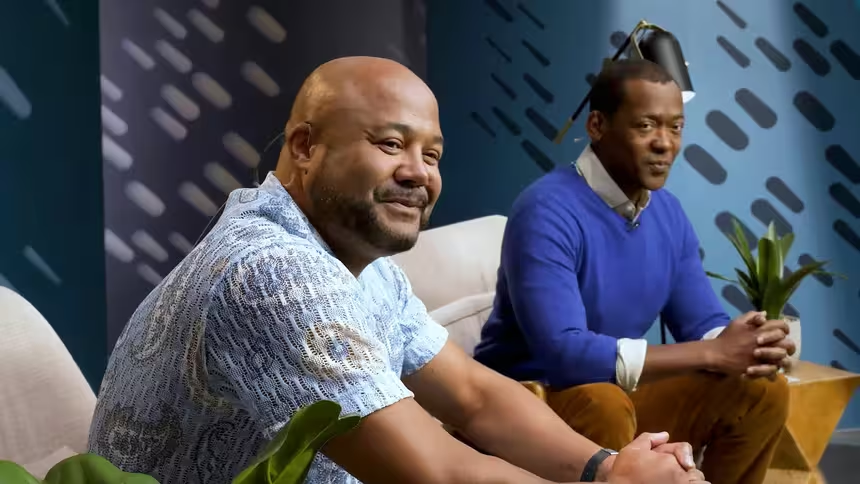
Welcome to Season 7
Bold and honest conversations tackled with humor, insight, and empathy.Providing Support for PBS.org
Learn Moreabout PBS online sponsorship(quiet music) - [Announcer] Funding for "Roots, Race & Culture" is provided in part by the Norman C. and Barbara L. Tanner Charitable Support Trust, and by donations to PBS Utah from viewers like you, thank you.
(cool jazz music) ♪ Yep, yep, yep, yep ♪ ♪ Uh-huh ♪ - Hello my friends and welcome to "Roots, Race & Culture", where we bring you into candid conversations about shared cultural experiences.
I'm Danor Gerald- - And I'm Lonzo Liggins, today's discussion may certainly take you by surprise as we learn about the history of Black churches in Utah.
We've got two dynamic guests with us to shed some light on the subject.
- Salt Lake City's Trinity African Methodist Episcopal Church was founded way back in the 1880's, before Utah even became a state, making it the oldest Black church in Utah and we're pleased to welcome the current pastor of Trinity AME Church into the studio today, Reverend Darrell Jackson.
So, let's start with some introductions.
Reverend Jackson, tell us a little bit about you.
- Like you said, I'm Reverend Darrell Jackson, the pastor of Trinity AME Church.
I am a native, which is awesome, I'm native of Salt Lake City, Utah.
- Okay, wow.
- Yes, and then I also have, I'm a military vet.
- Well, thank you so much for your service, sir, we appreciate that very much.
- Well, appreciate, man.
- And then, of course, we have the legendary Pastor France Davis, the one and only.
Go ahead and introduce yourself.
- Thank you, I came to Utah in 1972, have been here 50 plus years serving as pastor of Calvary Baptist and professor here on the University of Utah's campus.
- [Danor] Oh, wow.
- Yeah, and then Calvary's been around for a while, as well, right?
- Calvary's been around, in fact, longer than statehood.
It was started and established by 1892- - [Lonzo] Hmm.
- And statehood is 1896.
- You know, the thing about the Black church in America, it has been really influential in our community forever, and you know, in fact, Representative John Lewis, who, you know, rest in peace, was a staunch civil rights worker, served for many years afterwards in the House of Representatives for the state of Georgia, has a quote, "The Civil Rights Movement was based on faith.
Many of us who were participants in this movement saw our involvement as an extension of faith"- - [France] Mm-hm.
- And that brings me to you, Reverend Davis, you were a participant in the Civil Rights Movement, you were important.
- Yeah.
- In fact, I knew John Lewis, he and I marched together on the march from Selma to Montgomery, Alabama- - [Danor] Wow.
- And I was with him here, have a picture of it, he and the president of this university, when he spoke here on this campus.
- Wow.
- Wow.
- So, did you feel like your participation in the Civil Rights Movement, marching in those things, was that an expression of your faith in God?
- It was a major expression of my faith.
Dr. King taught us that to believe is one thing, but to believe and to put into practice what one believes is essential- - Not just hear it.
- And that's what we were trying to do with the Civil Rights Movement, put it into practice.
- So, now I wanna shift gears to the State of Utah.
So, what was the Civil Rights Movement like here?
Did the church have any involvement in it?
Do you remember those days or any- - No, I, to be honest, you know, I don't, I don't recall, you know- - Oh.
- As far as the church is concerned, as far as civil rights- - Mm-hm.
- But I just know as me growing up- - [Danor] Mm-hm.
- During that time, you felt the effect.
- And the Black church was involved here locally, historically, in terms of the Civil Rights Movement.
People like Victor Gordon, for example, and Reverend W. I. Monroe, the pastor of Calvary Baptist at the time, were very active in terms of the movement.
- Mm-hm.
- So, were they, like, creating marches or demonstrations or things like that?
I mean, how- - Yeah, marches, they were leading efforts, they were up on Capitol Hill talking to legislators about the need to bring about positive change, and as leaders in the community, they were the spokespersons.
- I have a question for both of you.
So, I know we have Trinity AME, we have Calvary, and I know that there's been a few other Black churches in the area around that time, do you know, can you speak on what other churches were here, 'cause we have Faith Temple that's here, right?
- There are about 30- - Yeah.
- African-American, predominantly African-American congregations in the Salt Lake Ogden and Davis County areas- - Right now?
- Right now.
- So, and it's- - Those 30 churches consist of a majority of African-Americans who live in this community.
- Hmm.
- The history of this Christian faith, you know, in the African-American community is interesting because way back in the early days when slavery was, the slave owners felt like by introducing Christianity to us, 'cause they felt like that was a way to pacify these people against their oppression.
Even way back in the day, Nat Turner, who had a very famous slave, violent slave rebellion, his interpretation of the Bible and some of the sort of prophetic experiences that he was having, supernatural experiences, is what gave him the impetus to start this rebellion.
What are your thoughts about that?
- Well, Fred Douglas, also, was another person who learned how to speak and became a good spokesman for the early Civil Rights Movement during the 1860's.
- Mm-hm.
- It was 1950's and '60's that Martin Luther King then, later on, became the leader of the modern Civil Rights Movement, but it was all rooted in the African-American churches- - [Lonzo] Yeah.
- And out of those churches came the impetus to lead the movement for civil rights.
- And that brings me to this idea of this, like, the oral tradition, how much the Black churches have kept our culture alive and given people opportunities to develop, like, these amazing oratory skills and memorization.
I mean, you have to write a new sermon every week.
That's a lot of work.
- (laughing) Yeah, it's a lot.
(laughing) He could probably speak more on it than I can, but just in my time of being a pastor and, you know, you don't wanna repeat- - Right.
- Right, you don't wanna repeat your sermons, so yeah, you're working on one- - That's 365 days where you're going, wait, 52 weeks at, (Darrell laughing) that's 52 sermons a year, right?
- Yeah, yeah.
- Something around that?
- Something like that.
- And for many of us, it was more than that.
There were two sermons per Sunday, or three, in my case, at Calvary Baptist.
I preached at 8:00 AM, at 11:00 AM and at 7:00 PM and- - They were all different?
- They were different sermons that were each of those three time periods.
- Yeah, there's a great tradition in the Black church, and Danor and I had a wonderful opportunity to go to Trinity AME and see some of that gospel choir singing and we actually- - We appreciate that.
- Have a video of that up here (Darrell laughing) that we want to go ahead and watch and take a look at and we wanna speak on that afterwards.
("We'll Understand It By And By" music) ♪ We'll understand it better by and by ♪ - [Danor] There it is.
- This is it, this is your church right here.
♪ We'll be singing ♪ ♪ By and by when the morning comes ♪ - The strength of my religion.
♪ Oh, the strength of the Lord ♪ - [Danor] So, this idea of preserving our culture, our music, I mean, it, if the church isn't there, do you think that's going to happen as easily in our community?
(gospel music) - Not as easily.
There is here at this station a copy of Calvary's choir singing, for example, back in the '70's, but there, it won't be easy to maintain the oral tradition that has been historically a part of our communities.
- Yeah, and what's interesting to me is that so many popular musics have sprang from gospel music.
- That's right.
- Could you both speak on that a little bit?
We'll start with you.
- Yeah, I mean, it's not just, you know, 'cause when we sing, you know, as far as our choir- - Mm-hm.
- You know, they kinda stay in the element of the old gospel music- - Mm-hm.
- Some of the Negro spirituals- - Mm-hm.
- And so forth, but myself, I kind of progress out there where some of, even though it's kinda like say hip hop, but it's gospel hip hop- - Mm-hm, mm-hm.
- That, you know, that it's formed from the oral tradition of gospel music.
- Yeah.
- There are all kinds of forms of music, it started with negro spirituals- - [Lonzo] Mm-hm.
- That were popularized without written music and without any written, people sang what they feel, what they felt.
- Mm-hm.
- Later on, they added to that jazz beat and they made it gospel music- - Mm-hm.
- And from gospel music it became rhythm and blues and then rhythm and blues later on became hip hop- - And soul.
- And nowadays, hip hop and soul are the two primary musics that are sang in the African-American community.
- [Danor] Yeah.
- I'm curious, I want to take it a little bit local, as well, what impact has Trinity AME had on the Black community here in Salt Lake?
- Well, I think it's helped keep that social, the fabric of Black community together.
- [Lonzo] Mm-hm.
- It's a community, community hub for people to gather, it's kept that spiritual feeling for local Black communities, African-Americans that come to Utah or are already been a part of Utah to- - [Lonzo] Mm-hm.
- You know, to be able to be a part of the African church.
- Lemme ask you this question, like, from the heart, like, in your position, do you feel any pressure?
Like, if people come and they move to this state and they're trying to find a church or a home, do you feel, like, any pressure as the pastor of this historic Black church, of providing that?
- I don't know necessarily if I feel pressure- - [Danor] That's good.
- That they have to, you know, that they have to be, we'd love 'em to be, we open our doors for those reasons, you know, for those that are, again, in that case, that are coming in, you know, from other states and looking for a home.
- So, same question for you Pastor Davis.
- There's only one African-American that was a college president here in the state of Utah, she was president of the college down in Price, Utah, and before she made a decision to come to Utah, she insisted on an opportunity to talk to the pastor of Calvary and other African-Americans that were at the University of Utah and so forth in order to make her decision, so, the pressure- - Right.
- You're talking about is real, it's real for those of us who are well known in the community and it's been real for people moving to Utah.
- I wanna shift gears for a second- - Yeah.
- You know, I'm thinking about 2020, I'm thinking about Black Lives Matter and these other experiences.
I mean, there was a time when people were protesting in Salt Lake City and flipping police cars and stuff.
- Yeah, Danor was one of 'em.
- You- (all laughing) - No, I wasn't on State St. - Flipping cop cars.
- There was, that dude looked like me, but it wasn't me.
(both laughing) - So, I'm wondering, like, how are the churches, the Black churches specifically, dealing with those kind of current event movements that are happening in Black communities?
- They're still modeling how to be effective leaders and how to speak, how to keep people from losing their control and flipping police cars, as you say.
- (laughing) Right.
- They are still, the Black church still has a major place to play in the lives of all African-Americans, and whether they are members of the churches or not- - [Darrell] Mm.
- They tend to search out pastors in order to get input.
When I was pastor of Calvary, for example, the President of the LDS Church of Jesus Christ of Latter Day Saints sought me out in order to get my advice on a speech that he was going to give.
- [Lonzo] Hmm.
- And not only is it for African-Americans, but for non-African-Americans, as well.
- Yeah, do you agree with that, Pastor Jackson?
- I do, I think we have to, as pastors, especially during these times and what you speak of, of Black Lives Matter, that we, you know, that where our presence is felt, that we are a piece, where people can come to- - Mm-hm.
- You know, whether they need to speak on something, talk about something, let their feelings out- - Mm-hm.
You know, or maybe as you know, we can give 'em spiritual advice, you know- - Mm-hm.
- About what's taking place, what's going on and you know?
- That's, you know, there's a quote that I wanna bring up by Karl Marx that a lot of commentary about the Black churches and African-American experiences in the United States is for, and it's here, this Karl Marx quote, "Religious suffering is at one and the same time, the expression of real suffering and a protest against real suffering.
Religion is the sigh of the oppressed creature, the heart of a heartless world and the soul of soulless conditions" and, you know, that quote is sometimes misrepresented in some some ways, but I feel like that's where the connection is between the church and the community and the people.
Like you said, you don't, may not have, you may not be a member of the church, but you still go talk to the pastor 'cause we've all had this similar shared cultural experience of dealing with suffering.
What does that make you think about, any experiences in your life that you've had, either one of you, or- - Well, Calvary has been busy, involved in people's lives in every facet, and so we talk about the mission of Calvary being whatever causes people to hurt- - [Danor] Hmm.
- So, that if people are having housing problems, we build a housing complex, if people are having educational problems, we provide scholarships for people to go to school, if people are politically having problems getting in the system, Sandra Hollins is currently today the only female Black member of the Utah State Legislature, and she's a member of Calvary.
So, Calvary and Trinity that has started many of these movements and then help people to be able to reach their goal.
- Wow, I mean, the things that you have done as leaders in the church, the list is amazing and endless, and, you know, you mentioned Dr. King earlier, and I wanna ask you a question because you were there at the March on Washington when he gave his famous speech- - [Lonzo] Which is incredible.
- Can you tell us what it was like, to, like, to be there and to witness that firsthand?
- Well, all day we listened to boring politicians and other speakers speak, but when Dr. King stepped up and was introduced, stepped up to the microphone, it was like a turning on electrical power in a dark area.
He began to speak and he talked about him having a dream and it was an exciting time.
It was hot, sweltering hot, that August day when 250,000 or so people gathered to hear Dr. King, and I just happened to stumble up on it.
I was coming from Asbury Park, New Jersey, where I'd been working all summer, going back to Georgia to finish high school, and stumble up on it by seeing all of the outhouses, all of the cars and all of the people, and then was able to stay and hear Dr. King deliver the speech.
It was an exciting time.
- Wow, yeah.
- I mean, you were destined to be there.
- Destined to be there.
- I've been thinking about the work that you've done.
- I was also there later on when Mr. Obama was first installed as President of the United States of America, and that he saw as a fulfillment of Dr. King's "I Have A Dream".
- Isn't that amazing?
You know, it's incredible just to see, you know, the impact that the Black church has had, especially in Salt Lake City, Utah.
When a Black person moves to Utah, and Danor and I talk about this all the time, sometimes you almost see like there's an expiration date stamped on their forehead about how long they're gonna be able to stay in Utah because they get here, initially they really enjoy it, initially there's a joy about being here, they feel like there's, you know, there's fresh air, you know, there's plenty of outdoor space, but then they get to a point where they kinda start feeling like they're really not a part of things and what is it that could help other African-Americans who move here be a part of the church and become a part of this community for life?
- Well, I thought about that after we chatted the other day and was reminded that people who are connected tend to stay- - Mm.
- But people who are individuals and disconnected tend not to stay, and after a while they find this a bad place to be.
- Mm.
- They think about the Church of Jesus Christ, Latter-Day Saints as years of when they believed that African-Americans were cursed and therefore not to be a part- - Mm-hm.
- But they forget about since 1978 that that has officially changed, there's still people with attitudes that still have to change.
- Okay.
The LDS Church, so now we know it's hard to speak about the Black Church and the Black in Utah without talking about an element in the church which was the what, what, what, what?
- [Both] The Genesis Group.
- The Genesis group.
Can we speak on that?
Tell us.
- Well, it- - Well- - There's this group that the LDS Church created back in 1971 with the help of a couple of Black members, young men who worked with church leadership, and it's a place where they can have their own Black church experience once a month, basically.
They sing gospel music and that kind of a thing, and it started in '71, but as you mentioned, Reverend Davis, they had this racial discrimination all the way till 1978.
- The day that the revelation came down, which said that now all the eligible males can hold the priesthood, when I got to my office, all of the major television stations were there, and they wanted to know from me what I thought was gonna be the impact.
Fortunately, the attitudes, the people at the top had made a decision that they were about to change, but the people down below never understood that decision and never made the attitude change- - Mm-hm.
- But it was a tense time because people like Darius Gray, who helped to start the Genesis Group, is still alive here in the community and Darius- - A big part of the Black LDS community, yeah.
- Big part of it, but also a big part of the African-American community and so he's still here and still working to make changes.
- I think that the African-American church in Salt Lake City has seen a lot of changes in the Black community here and over the course, at least of your tenures, you know, as preachers, what changes have you really drastically seen happen over the course of your career with our community?
- Well, unfortunately, I'd say for myself and just the experience, I think it's been, it hasn't been a good experience- - Mm-hm.
- And I take it from the point of view of my son- - Mm-hm.
- Who's a senior at Hillcrest High School- - [Lonzo] Mm-hm.
- And plays sports, but he's already had incidents, which is sad to say- - Mm-hm.
- Where he's had been called out of his name in a sports arena.
We still have to deal with those type and you would think that at this point, especially for me, that my son wouldn't have to go through those.
- [Danor] Mm-hm.
- You know, go through those.
- Well, I have a daughter who is in her early 50's, and she refuses to come to Utah because of those kind of four letter, six letter words that were used to taunt her when she was a class officer at her high school.
- Mm.
- So, she refuses to, she'll come to visit us for a couple of days and then she's out of here.
- Mm.
- You know, that's the thing is growing up down South, I lived in Mississippi, Texas, and I had all those same things that I experienced growing up there.
- Well, you don't expect them here in Utah, though, and that's the difference.
- That's the difference.
- Right.
- Yeah.
- You don't expect them and they are more underneath, more hidden.
- Yes.
- [Lonzo] Yeah.
- Yes.
- More of a- - Subversive.
- Yeah.
- That really is a perfect example, what you guys have been talking about, what you gentlemen have been talking about, of why these Black churches are so important to the community.
The changes that are needed are initiated there, they are talked about there, they are built there, that's where the good things have been happening for us, as a people, for hundreds of years.
As we wrap it up, I wanna just offer you gentlemen an opportunity to give us some parting words about your faith, as was mentioned at the beginning, you know, faith is a big part of these movements, of these efforts, it's not just doing it because we look alike, it's doing it because you feel it's right.
- Well, I would say from Psalm 16, Verse Six, "The lines are drawn in pleasant places.
Yes, we have a goodly heritage", and I would remind people that in spite of the problems, it's still a good place to live.
- That's, and I guess, as you know, just on that, I mean, the reason why we're still here- [France] Mm-hm.
- Is because we do feel like it's a good place, so, you know, to live and I think that needs to be shared with, you know, the Black community and I see some, and I talk to some that come in that I've run across and come in from different states and they say, "You know, Utah is a better place than where I came from, you know, and more opportunity than where I came from to have a better life"- - Wow.
- "Here in Utah."
- Wow, lotta- - Yeah.
- (laughing) Lotta layers, man.
Thank you.
- Yeah.
- Thank you so much, gentlemen, for coming down- - Well, we appreciate it.
- Legendary- I appreciate it, thank you.
- Pastor France Davis and, of course, legendary Pastor Darrell Jackson.
- Appreciate it, thank you.
- Well, from all of us at PBS Utah, thanks for joining this conversation and we'll see you next time.
If you have any comments on this episode, we'd love to hear from you, so feel free to drop us a line on social media.
- Yes, or visit our website where you can catch other episodes, just go to pbsutah.org/roots, but until next time, y'all, (cool jazz music) for "Roots, Race & Culture", we are out.
♪ Yep, yep, yep, yep ♪ ♪ Uh-huh, uh-huh ♪ - [Announcer] Funding for "Roots, Race & Culture" is provided in part by the Norman C. and Barbara L. Tanner Charitable Support Trust, and by donations to PBS Utah from viewers like you, thank you.
(cool jazz music continues) (cool jazz music continues)
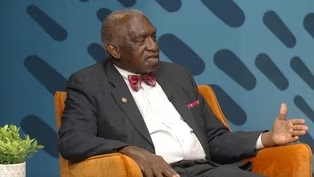
Preview: S4 Ep1 | 30s | Experience the captivating history and profound legacy of Salt Lake City Black churches. (30s)
Providing Support for PBS.org
Learn Moreabout PBS online sponsorship













Support for PBS provided by:
Roots, Race & Culture is a local public television program presented by PBS Utah