Utah Insight
Utah's Energy Future
Season 4 Episode 10 | 26m 10sVideo has Closed Captions
What does the transition from fossil fuels to renewable energy mean for Utah’s future?
The shift from fossil fuels to renewable energy is well underway throughout the world, but what does that mean for Utah? We explore the ways our state can decrease pollution while maintaining affordability and reliability in our electric grid. Plus, how we can protect the economies of Utah communities with long histories of fossil fuel production.
Problems playing video? | Closed Captioning Feedback
Problems playing video? | Closed Captioning Feedback
Utah Insight is a local public television program presented by PBS Utah
Utah Insight
Utah's Energy Future
Season 4 Episode 10 | 26m 10sVideo has Closed Captions
The shift from fossil fuels to renewable energy is well underway throughout the world, but what does that mean for Utah? We explore the ways our state can decrease pollution while maintaining affordability and reliability in our electric grid. Plus, how we can protect the economies of Utah communities with long histories of fossil fuel production.
Problems playing video? | Closed Captioning Feedback
How to Watch Utah Insight
Utah Insight is available to stream on pbs.org and the free PBS App, available on iPhone, Apple TV, Android TV, Android smartphones, Amazon Fire TV, Amazon Fire Tablet, Roku, Samsung Smart TV, and Vizio.
All Episodes Now Streaming
Hosted by Jason Perry, each week’s guests feature Utah’s top journalists, lawmakers and policy experts.Providing Support for PBS.org
Learn Moreabout PBS online sponsorship(soft music) - [Announcer] Funding for "Utah Insight" is made possible by viewers like you.
Thank you.
- [Raeann] Coming up on "Utah Insight", Utah's energy future at a crossroads.
- This planet could use a lot of help.
- [Raeann] The state seeks to balance economic growth and environmental stewardship.
- It's just crazy to me at a time when now, again, energy is getting more expensive, but it's also getting less reliable.
- [Raeann] But with a diverse mix of energy sources, Utah faces critical decisions about how to power its communities and industries for decades to come.
(upbeat music) Welcome to "Utah Insight".
I'm Raeann Christensen.
Utah boasts the nation's most affordable electricity rates, but according to a 2022 study, there's room for improvement in terms of the state's environmental impact.
According to a nationwide study from Citizens Utility Board last year, Utah is number one for the lowest electricity bills, but 43rd in terms of carbon emissions and pollutants generated from fossil fuel-based electricity.
According to the U.S. Energy Information Administration, in 2022, coal fueled 53% of Utah's total electricity generation.
That is down from 75% in 2015.
Natural gas accounted for 26%, about 16% from renewable energy sources, and that's primarily solar power.
But this could all change with the recent announcement coal-fired power plants will be shutting down in Utah in the coming years.
Joining us in the studio tonight, we have Mark Whitney, former Beaver County Commissioner, Sarah Wright, CEO of Utah Clean Energy, and David Eskelsen with Rocky Mountain Power and PacifiCorp.
Thanks so much for being here.
David, I want to start with you.
The decision was made by Rocky Mountain Power to shut down coal-fired power plants by 2032.
Can you talk about how your organization came to that decision?
- Sure.
Every other year, we do a 20-year integrated resource plan.
And that's a roadmap that looks at customer demand that is developing over time and compares that with the company's resources that we have to serve that demand.
Looks for, you know, gaps in the future, because energy use is growing generally year over year, we look at a portfolio of resources that we need to bring online in order to keep customers with the reliable service that they expect and deserve.
And so that plan looks at the economics and the reliability of various future resources.
And that plan determined that the power plants, the coal power plants that were built in the '60s and '70s, are reaching the end of their useful lives and need to be replaced with new resources.
- Okay, and Sarah, do you think that 2032 deadline is too quick, or not soon enough?
- Oh, that's a great question, Raeann.
So, Utah Clean Energy has been working on accelerating clean energy for 20 years.
So, we've been waiting on it.
We would've loved to have seen it sooner, but we're really excited about the trajectory, the scale and pace that we will be taking advantage of the renewable resources that we have.
So, excited about the plan.
- Mark, you come from an area where there's a lot of renewable energy sources.
How do you feel about this transition out of fossil fuels?
- You know, and I've had this conversation with a lot of people throughout the whole country, in Beaver County, we tout ourself, although we tout ourself, we cannot fully prove it, but nobody's challenged it, as the renewable energy capital of the world.
We've got all five renewable energies in Beaver County, and we produce around, I want to say the last that I checked was around 1800 megawatts per year.
That's a lot of power, clean energy.
But to say, for me to sit here and say that we cannot balance it without some sort of a load base of fossil fuel, I would be foolish, because we've gotta either come to a point to where as David's talking about, transitioning these power plants either to natural gas, or at some point we've gotta look at a base load and educate the folks of the great state on nuclear energy.
- Okay, speaking of nuclear energy, a retiring coal plant in Wyoming will soon become the site for a nuclear power plant demonstration by Bill Gates's Company, TerraPower.
This rendering shows what the Natrium reactor plant will look like.
PacifiCorp is looking into this technology as well to replace two coal-fired plants set to retire in Emery County here in Utah.
So how do Utahns feel about nuclear?
A poll released by "Deseret News" and the Hinckley Institute of Politics last week shows 65% are supportive versus 31% that are opposed.
And David, how do you feel about transitioning over into nuclear?
- Well, we look at this particular plant near our Kemmerer power plant, the Naughton plant, as a very exciting opportunity.
And it is TerraPower's responsibility to permit and build this plant.
But we'll take a, you know, a very close look at purchasing that when it's completed.
And if the technology proves, it's very possible that we could locate additional versions of that same technology in other areas where there are the transmission interconnections for our existing power plants.
Nuclear is really the only base load technology that can supply energy around the clock.
And this particular technology also has energy storage, which is really helpful in integrating wind and solar, which is going to be growing exponentially in the next 20 years.
So we think that that is a very critical part of the energy portfolio that we'll be building in the future.
- Sarah, yeah, go ahead.
- Yeah, there's also one more base load that people always forget.
And one thing, we need a flexible system.
Base load is part, you know, people could say that's part of it, but really what we want is a flexible system.
But Utah is a state that is blessed with amazing geothermal resources, and these have not yet been tapped and geothermal runs 24/7.
Now we're moving to much deeper wells.
So the oil and gas industry, we need their expertise in those wells.
So that's just a, sometimes we forget that we also have geothermal in addition to solar and wind.
- We have a lot of experience with geothermal.
We built the Blundell geothermal plant near Milford in 1984.
- I know, you guys, that was the first renewables in the state.
- Right, and so geothermal is part of the resource mix that we evaluate every year.
But geothermal power is very difficult to develop and relative- - As is nuclear.
- And relatively expensive, and its energy density is lower.
So we're not opposed to future development of geothermal energy because we're after any resource type that will serve our customers well.
- [Sarah] Yeah, and I can appreciate that.
- And David, with you saying that, and for the rest of the panel here and for you, Raeann, I'm sure if you're not aware of the FORGE project that's currently going on in, just below the Blundell plant north of Milford, which is in conjunction with the University of Utah and the Department of Energy.
Hundreds of millions of dollars is gonna be expended on that.
It's gonna literally put Utah on the world stage of exploration in geothermal research.
And so even though the Blundell, I think it puts out about 30 megawatts, is that right?
- [David] Yes.
- There's a lot of companies that is in that area 'cause the geothermal resource in Beaver County I think is one of the best there is.
And, but there's different technologies of how they're doing it.
And so we're excited to see that in Beaver County too, 'cause that is, that'd be a great base load also because solar and wind is not a dependable base load.
- Especially right now in the really hot temperatures.
- Yeah, exactly.
(group laughs) - David, how do you think that we protect these communities with the economies built on fossil fuels?
- Well, one of the things that we as a society have been less good at is dealing with the societal impacts when an energy changes.
Think of textiles and steel mills.
And so we can do a much better job in helping these communities transition out of the coal plants that have been there you know, for generations.
And we have quite a bit of experience in retiring coal plants.
You know, there are lots of coal plants that, you know, three or four plants that have been retired over the years.
We are going through this in our communities in Wyoming, and we're working very closely with those communities.
We have talks with the elected officials in Carbon and Emery County.
Some of our employees are elected officials in those areas.
So we want to help those communities to the degree that we're able make that transition from the economic engine that those old power plants had for those areas.
- The state of Utah filed a lawsuit against the Environmental Protection Agency, or EPA.
This is in response to the EPA's Good Neighbor Plan in the Clean Air Act, which is to reduce cross-state smog pollution from power plants.
Governor Spencer Cox took to social media, saying, "As Utah's elected state leaders, we stand united in pushing back against the Biden administration's egregious power grab that harms Utahns."
Here's what he had to say at a news conference here on PBS Utah a few months ago.
- And what this rule again, recklessly does it would cause potentially many of our power plants to go offline before they are scheduled to go offline, which would put, we estimate, upwards of 2 million people at risk for blackouts.
It would make energy much more expensive.
We've seen what happens when we don't have base load energy and the grid is not where it should be in places like California and Texas.
And again, we believe that this is incredibly reckless.
It harms the economy, it harms the people who can least afford it, and it just makes no logical sense whatsoever.
It will not have a net reduction on global carbon emissions.
It's just ridiculous.
- You heard the governor mention it would make energy more expensive and less reliable.
Mark, do you think this conversion would make it cost more and make the grid unreliable?
- Yeah, again, I think that there still needs to be a little work that needs to go into it, but, you know, to bring back and kind of to not get real political, but yet to kind of change and kind of bring something in a full circle.
But we talk about, you know, interstate ozone type things, and I've talked about this earlier, but we should look at inter-country and other interstates on, let's look at the wildfires, for example, and the pollutants that has come into lower 48 from Canada or the pollutants that come in from California wildfires to this valley right here in Utah.
And the pollution or what we breathe off them, is more harmful to humans than these coal-fired power plants would be for 25 years apiece.
So I think we need to look at that special thing too is also look, there's a balance there.
We can't just, sometimes the EPA gets a little overzealous.
So I think we need to look at a balance of more than just, you know, the coal power plants.
- Can I chime in?
Yeah, one of the things, I have a lot of respect for the way that Rocky Mountain Power and PacifiCorp does their 20-year planning that Dave talked about, and they look at every hour and every year and a lot of different scenarios and find the least-cost, least-risk plan.
And so they planned for those needed reductions and they found that adding significant amounts of renewable, significant amounts of storage, and then added flexibility and efficiency, which is the cheapest, cleanest resource, would meet our needs in a cost-effective way.
So I don't believe the grid will be unreliable and I think it will be affordable, based on what we're seeing in the planning.
So, but it is, you know, with all due respect to, it is a change and it is a transition.
And when we talk about the fires, we have to think about what's fueling those fires.
And climate change is fueling those fires.
And PacifiCorp is now taking really significant steps to address climate.
- On this and other environmental issues, we've had a long-running discussion with EPA under a variety of administrations over the last 30 years about how to implement the Clean Air Act and its attendant rules.
And one of the things that we have discussed with EPA is that controls and control systems that are good for the eastern states are not necessarily as applicable in western states.
And that's true of the ozone transport rule as well.
Now, we gave some extended comments to EPA's proposed rule, and we believe that there are a number of deficiencies that need attention.
That said, we have to also plan for compliance, and so we are doing that.
There are control technologies that are less expensive than what the rule requires, as well as operational constraints that we can put on those plants.
So we have plans in place because our job is to keep electricity safe, reliable, and at a reasonable cost, and we're committed to do that.
- Just with that saying, let me just jump in here real quick.
Several years ago, I worked very closely with the Summit County Council, especially at that time, Councilman Glenn Wright, and then also Salt Lake City Council, Salt Lake County Council, and Mayor Jenny Wilson.
And both counties passed initiatives and also resolutions to be so much energy efficient and also renewable energy by certain dates.
And now remember, most of your renewable energies come from rural Utah.
The problem is you don't have the transmission lines to get the power up here.
That is something that's gotta be looked.
Then you've got EP, you gotta look at the environmental impact statements that take years and years.
Do you realize that probably 85 to 90% of our renewable energies right now produced, especially in Beaver County, goes to California?
So we've gotta change that mindset if we're gonna do this and figure out how do we get that energy from where it's produced to where it's needed, and that's the Wasatch Front.
- Okay.
Leaders at schools nationwide are taking steps to be more responsible stewards of the earth.
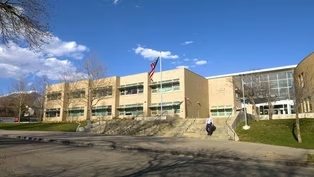
One example is in Salt Lake City, where more than 30 schools are being upgraded with eco-friendly tools.
"Utah Insight"'s Liz Adeola took a tour of this massive project that's happening right now.
- [Liz] You can hear the sounds of progress (tools pounding) echoing down the hallways as you walk with Greg Libecci around Hillside Middle School.
- Here's our recycling.
We have contractors coming in, we'll probably have 20 yellow vests with hard hats.
- [Liz] On the day of our tour, construction crews were busy.
(ceiling tiles rattle) - We, hold on a second, these guys are... You can go in that way too.
- [Liz] Retrofitting old familiar spaces (blinds whirring) with new light.
- [Greg] That is a lot of lights in this school, and we're gonna convert every single one of them to LED.
- [Liz] Equipped with an updated title, Energy and Sustainability Program Manager.
- That is a mouthful, huh?
- [Liz] Libecci is at the helm of this expansive project to make the Salt Lake City School District more sustainable.
- You know, would you mind if I take the box?
- No, absolutely.
- Okay.
These are massive amounts of money that are now out there, and a lot of it is slotted toward K-12 like never before.
That does make now a really good time to implement this stuff.
- [Liz] By "stuff", he means adding new faucets that help conserve water, (water splashes) solar panels so schools and school buses can generate their own electricity.
- [Greg] We're inching closer to two megawatts of solar production at the school district.
- [Liz] As the person in charge, it would be easy for Libecci to take credit for this work.
- I was hired essentially to manage projects that helped us be efficient.
- [Liz] He's been vocal about the need for sustainability changes in the district for years.
- [Greg] This planet could use a lot of help.
- [Liz] But Libecci insists it was a group effort, led by students from Highland East and West High Schools.
In 2020, those students presented a sustainability resolution to the Salt Lake Board of Education, asking the district to create a plan to use 100% clean renewable energy in the district's electricity sector by 2030.
They also challenged the district to meet 100% of all district operations energy needs with carbon-neutral energy by 2040.
The board unanimously approved the resolution.
- Their behavior and decisions are what will make the change.
- [Liz] But even the smallest change, (tool whirs) having a far-reaching impact.
- We want all classrooms and all students to have the best possible learning environment.
- [Liz] That, he says, will eventually pay for itself.
- What we did was look at the solar and the LED conversions as a package and bring in a third party to guarantee what the savings would be from the energy reduction and the production from the solar, and say, "Well, you'll save, if you do all these things, over a million dollars a year.
And you could take that to the bank and use that million dollars in utility savings to actually pay to get the work done today."
- [Liz] Saving the district money while also trying to save the earth.
- It comes from the heart.
So to have some sort of impact on that way of thinking I think would be most gratifying.
- [Liz] I'm Liz Adeola for "Utah Insight".
- Sarah, how does that make you feel, seeing that students are advocating for sustainability?
- Well, you know, (throat clears) it's interesting because I started Utah Clean Energy when I had a three year-old son, and I realized what they would be facing, what he would be facing in his generation.
And the students, they're the ones that are gonna bear the brunt of inaction.
And so they came together in a super respectful way, put together a smart proposal, and worked it through the system.
And what's great is that it made economic sense, that the school district will be saving money by cutting their energy and adding solar and electric school buses.
So it's extremely gratifying and it's a microcosm of what could happen everywhere.
- Okay, the Biden administration is putting a lot of money into clean energy incentives, most of which is funded through the Inflation Reduction Act.
Vice President Kamala Harris said the climate crisis is one of the most urgent matters, as our communities are facing droughts, flooding, and wildfire smoke.
She goes on to say, "The climate crisis impacts everybody, but it does not impact all communities equally.
Poor communities, rural communities, native communities, and communities of color are often the hardest hit and the least able to recover."
I want to go back to you, Sarah.
Can you focus, talk about this and how we can focus on equity?
- Well, within the Inflation Reduction Act, there are a lot of resources for these communities, rural and urban, to help them retrofit their homes.
Utah has an opportunity for $100 million to go to retrofits, partner with Rocky Mountain Power on their programs, and you can help them save a lot of money.
There's also a Solar for All project that can combine efficiency and renewables.
That could be $250 million to the state.
So it's really about making sure that these families and communities that don't have as much means, both rural and urban, that we start paying attention and really focus the programs.
And right now there's the resources to do it.
So, it's an exciting time to really help improve equity across the state and across the nation.
- The Inflation Reduction Act was passed by Congress, but four of our Utah representatives voted against it.
Mark, what are your thoughts on that?
- Well, you know, again, I've not talked with them since I've been out of office, so I haven't really got into the political side of that, of what they've thought about it.
So I won't comment.
I'll let somebody else here, comment on.
You know, I know that I wish they would've been a little more proactive on it.
I can say that, but I don't know the reasons, so I don't want to either tout them or condemn them in any way, and I'm sorry.
- [Raeann] That's okay, that's okay.
Do you have any thoughts there?
- Well, the thought that, I think that it has to do with economics, and it's do we spend money now or do we spend money in the future?
And when you look at climate-fueled extreme weather events, we're spending upwards of $200 billion a year across the nation.
So that, the Inflation Reduction Act I think was around $380 billion.
So we have to put it into perspective that inaction is costing us money as well.
So I'm not sure what went into their thinking, but I think it's important for us to think if we don't spend the money, what happens.
- About, as it stands right now, Utah is only about 16% from renewable energy sources.
That's primarily solar power and we've got a long way to go.
David, do you think that we can get there?
- Well, yes.
Rocky Mountain Power System is about 30% renewable, and that's counting hydroelectric, wind, and solar, which we get a lot of our wind power from Wyoming, also from the Pacific Northwest.
And so we're looking at a concerted effort from now until 2030, 2040, to be completely carbon-neutral.
- That's, at least you have, there's a plan in place and it is helping the environment, so that's great.
We have about 30 seconds each for you guys to have final thoughts.
So Mark, do you want to start us off?
- I do, and first thing I want to do is I want to, you know, thank Sarah for her and her group for great work and for being good watchdogs and making sure that we're looking and looking at, especially for our future, and to David and especially Rocky Mountain Power on their efforts and constantly upgrading this plan, because planning is so important.
You know, I know that when I was in public office that's something, you know, that's where you've done budgets and you constantly updated a plan every year.
So thank you to you guys and your groups.
- [Raeann] Sarah?
- Wow, well, thank you for your leadership over the years as well, and David.
But I guess what I can say is that now we're in the time of implementation.
For a long time, we were working to kind of make renewables economic and to have the, to see that there's a trajectory.
Right now, we just need to get steel in the ground, help people build efficient and retrofit their homes, and we can do this.
This is a solvable problem, and we can do it with economic benefits.
- Yeah, we certainly agree, and we really appreciate the input that we get from organizations like Sarah's and elected officials who comment on our integrated resource plan.
It's a huge undertaking every other year, with an update in the off-year.
But I think the biggest thing for a utility company is certainty of policy.
And I can tell you that the extension of the production tax credits in this latest legislation package went a long way into helping us plan that transition and the renewable energies and storage projects that we'll be building in the next 5 and 20 years.
- Okay, well that's gonna wrap up season four of "Utah Insight".
If you missed any of the season, it's all gonna be online, and we also have some resources online for this show for anyone who may need it.
You can go to the "Utah Insight" page on PBSUTAH.ORG.
There's a list of links there along with this episode.
And again, that wraps up season four of "Utah Insight", and we will see you back here next year.
If you have thoughts on topics that we should cover next season, we do want to hear from you.
You could share your thoughts using the methods you see on your screen, social media, email, or call in.
Thank you so much for watching and we'll see you back here next year.
Sustainability in Salt Lake City Schools
Video has Closed Captions
Clip: S4 Ep10 | 3m 21s | Learn how a student-led movement is putting Salt Lake City schools on a greener path. (3m 21s)
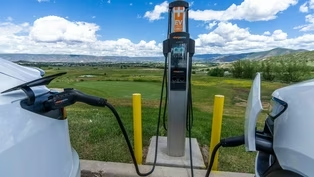
Preview: S4 Ep10 | 30s | What does the transition from fossil fuels to renewable energy mean for Utah’s future? (30s)
Providing Support for PBS.org
Learn Moreabout PBS online sponsorship
- News and Public Affairs

Top journalists deliver compelling original analysis of the hour's headlines.

- News and Public Affairs

FRONTLINE is investigative journalism that questions, explains and changes our world.












Support for PBS provided by:
Utah Insight is a local public television program presented by PBS Utah