Utah Insight
Utah's She-Cession
Season 2 Episode 3 | 27m 10sVideo has Closed Captions
The COVID-19 recession hit women especially hard. What will it take to return to normal?
More women lost their jobs due to COVID-19 than any other group. In Utah, women typically make up the majority of the workforce, but as the pandemic progressed their job market participation declined sharply. We examine the factors that influenced this “pink collar” recession, what’s being done to reverse the trend, and why getting women back to work will be key to rebuilding Utah’s economy.
Problems playing video? | Closed Captioning Feedback
Problems playing video? | Closed Captioning Feedback
Utah Insight is a local public television program presented by PBS Utah
Utah Insight
Utah's She-Cession
Season 2 Episode 3 | 27m 10sVideo has Closed Captions
More women lost their jobs due to COVID-19 than any other group. In Utah, women typically make up the majority of the workforce, but as the pandemic progressed their job market participation declined sharply. We examine the factors that influenced this “pink collar” recession, what’s being done to reverse the trend, and why getting women back to work will be key to rebuilding Utah’s economy.
Problems playing video? | Closed Captioning Feedback
How to Watch Utah Insight
Utah Insight is available to stream on pbs.org and the free PBS App, available on iPhone, Apple TV, Android TV, Android smartphones, Amazon Fire TV, Amazon Fire Tablet, Roku, Samsung Smart TV, and Vizio.

All Episodes Now Streaming
Hosted by Jason Perry, each week’s guests feature Utah’s top journalists, lawmakers and policy experts.Providing Support for PBS.org
Learn Moreabout PBS online sponsorship(serene music) - [Narrator] Funding for "Utah Insight" is made possible by viewers like you.
Thank you.
- [Host] On this edition of "Utah Insight" we explore the pandemic's impact on women who work.
- We survived but it wasn't pretty and as a business owner, I can tell you it was the worst year ever for me to own a business.
- Discover the creative ways women have learned to pivot during the pink recession, plus the latest plans to help more women return to the workforce.
(upbeat music) Welcome to "Utah Insight" I'm Liz Adeola.
Utah is one of two dozen states with plans to end supplemental unemployment insurance early.
That's the extra $300 of unemployment relief the federal government approved with an expiration date of 2021, in September only, in Utah, state leaders decided to end the benefit on June 26th.
This as many people, especially women, are still trying to rebound from pandemic job loss.
The latest figures from the U.S. Bureau of Labor Statistics reveal that nationwide 2.5 million women compared to 1.8 million men have left the workforce since the start of the pandemic.
Vice President Kamala Harris says this is a national emergency and our economy will not recover unless women can fully participate.
Here to chime in on what Utah needs to do to help more women to return to the workforce we have Robbyn Scribner who is the co-founder of Tech-Moms, Lecia Langston, a regional economist, based out of St. George, with the Utah Department of Workforce Services, and we also have Silvia Castro who is the director of the Suazo Business Center.
And Silvia, you saw this issue rise firsthand with a spike, not only in women, but women of color who are looking for help.
Can you talk about what you noticed around the beginning of the pandemic?
- Around the beginning there was just a lot of confusion, there was a lot of, what's going to happen?
The double whammy was also not only dealing with, is my job affected?
Is my industry affected?
But what am I going to do with the kids?
Especially when you have, sometimes, a multiple household of kids all of a sudden go home and you have an option to make.
You either take care of the kids that are home, or you stay at a job that it doesn't look like it's going to even stay around.
And that's a horrible choice to make and this is where, as we're looking not just at the national figures but also the Utah specific figures, you see the woman have left the workforce twice as men in Utah.
And it's having a really tough time getting them back out because even us, the state, is recuperating well, I mean our unemployment rate is now under 3% again.
The saddest thing is that all the industries that were still affected overwhelmingly populated by woman and also woman of color.
You have, basically, leisure and hospitality, which includes food.
Now with the kids, I mean, yes, they're kind of going back home but the location has changed.
Everything is now online and overnight, also, there was this digital literacy gap that got bigger, not just like, I'm trying to figure it out how to do my job online, or how to do my business online, but how are the kids going to do it online and that still has not been resolved?
- Yeah, that's a lot for women to juggle and, Robbyn, I apologize for butchering your name.
I know you just told me it was Scribner, not Schribner, so I apologize for that.
But you work firsthand with women trying to help them get out of what's happening with the pandemic.
What did you notice towards the beginning?
- Well, there are a lot of different things and I love what Silvia mentioned that women were disproportionately working in industries that were very heavily affected by the pandemic.
People working in frontline roles, working in person all the time with a little flexibility and so, so many of those women left the workforce in droves and they are very slow to come back.
And it was one of the things that we're seeing is that these industries are maybe shifting and changing forever.
And so that's been a huge challenge for women, but also the thing that Silvia mentioned in terms of taking care of our children, there were some really interesting research studies that have come out, one from the New York Times at the very beginning of the pandemic, where 45% of men who are at home with their kids working remotely said that they were responsible for more than half of the children's homeschooling activities.
But only 3% of women said that the men were doing more than half of those activities.
So we had a huge disconnect in the perceptions of what was really going on but in terms of the longterm research of the unequal distribution of work at home that really affects women's ability to be successful at their paid employment, this just blew way out of the water when the pandemic hit.
So this was, these were things that were already happening and always existing but the pandemic put a spotlight on all of this and really showed this longterm issue of women taking way more than their fair share of the work at home, to be completely unsustainable.
So, combined with women in jobs where they didn't have the flexibility to be at home and all of a sudden their kids are all at home, it's just created this perfect storm of real trouble for working women.
- And the same story what's happening right here in Utah.
I've been combing through this report that you worked on with the Utah Women in Leadership project that just came out moments before I got to the set, and it was telling the same story about that happening in Utah and just how that just compounded the issue that was already there.
Lecia, I want to hear from you because there's been something kind of different, almost opposite happening in Southern Utah because it's more open than the surrounding states.
Can you talk about that?
- Well, and this is true for Utah as well, our economy because we were able to keep it open because of our demographics, we've seen some of the best job growth in the nation.
Now, not to say we weren't effected by the pandemic but because we were able to open early and more universally we have seen the economy perform better and, again, that's a lot to do with our demographics that we have a very young population.
If you look at the population, or look at the cases per capita of COVID, Utah has one of the highest rates in the nation but we have one of the lowest death rates and that's because we have a young population which wasn't effected by COVID to the extent it was in other places so, we were able to stay open and recover faster than most of the nation.
As Silvia mentioned, our unemployment rate's under 3% we're growing jobs again, second only to Idaho, so, yeah, we're seeing that in some ways we benefited by being able to stay open.
I live in Washington County, I can tell you, I've heard from business owners who said this was their best year ever because we've got so much traffic out of Nevada and California where things were significantly more closed down.
- Yeah, and on Facebook we had a viewer who said, what recession?
What are you even talking about?
But you did share some preliminary data with me that, statewide, in March of 2021 women made up 36% of unemployment claimants in Utah compared to 54% in April of 2020.
So it seems like, and it would appear that women are bouncing back right now, but what aren't we seeing in those numbers and in those figures Lecia?
- Well, part of the problem is we don't have a lot of detailed data for Utah, right yet.
Come September, when the American Community Survey comes out we'll be able to look at that data in detail but, in fact, we have seen that change from the beginning of the recession to now when probably Utah is not in a recession.
So, women were hit hard because they were in industries that were predominated by women but that, come about August, was about where we saw the switch and that's happened nationally as well.
When you look at unemployment rates nationally, about October was when the male unemployment rates started to creep above the female.
Now, typically women have the highest unemployment rates because we're more likely to move in and out of the labor market.
Typically during a normal recession, they call it a man-cession because men are hit predominantly by a typical business cycle recession.
So what you'll see is, you know, during an expansion women have higher unemployment rates, but during a recession, men have higher unemployment rates and that did flip during this pandemic recession.
- Leading to what some have called the she-cession.
We asked you on Facebook, what do you think that Utah needs to do to keep women in the workforce?
And here's what you had to say; Rosemary Hoffman wrote this, "Instead of wasting money on pointless lawsuits, use that money to supplement childcare.
No woman can work effectively if she has to worry about her children or not work at all because of them."
Another comment we got on Facebook came Lakeysha Austin Mapps who had this to say, "It would be nice for Utah to provide a grant or subsidy so that working women can afford daycare.
Unfortunately, when schools closed women were forced to quit their jobs because they simply could not afford the high cost of daycare."
And, Robbyn, that this was one sentiment that we heard again and again and I even saw it in this report that just came out, that women are not opting out of work.
A lot of them felt like they were being pushed out during the pandemic.
- Absolutely and this is something that we see over and over again.
In comment to one of those Facebook commenters, there are subsidies available for childcare throughout the state, there are grants for individuals who are low income or things like that.
The process of getting those grants can be a little bit tricky.
One of our Tech-Moms went through a long, laborious process of trying to qualify once she went back to work and had a new job and kind of hit roadblock after roadblock and that's one of the things that, those grants are super important, we're so grateful for them, but the process could be easier and some women simply just don't qualify.
And so there's these little spaces here where you make enough money to get the childcare subsidy and then above that you don't, and they call it a cliff effect where women lose some of those benefits and it makes it difficult for them to continue with their employment.
Without a doubt, childcare is one of the most critical issues that we need to address if we are to keep women working successfully.
I love some of the moves that we're taking on a national level to look at childcare as infrastructure and recognize that it's every bit as important as roads, or telecommunications, or our internet access and this is becoming more and more true as most of our families are now two income families.
- I agree, and going off of that, researchers Nicole Bateman and Martha Ross had this to say on why COVID-19 has been especially hard on working women, take a look at this.
They said, "While the role of women in our economy has shifted over the last 100 years, our systems have not evolved to support them."
Where is the support?
Silvia, what are your thoughts on that?
- Well, it's like you said, a lot of women were pushed out and that's one of the things that I think is reflected in someone, is unemployment fears.
If you were pushed out, if you had to quit, you could not apply for unemployment.
And that's one story that is harder to track and as women are trying to come back they're trying to, now they have to actually get real skill because if you look at, again, the industries if they were in food, if there were a personal services those are not the jobs that are available right now.
The jobs that are available right now are business services, are professional services, construction, trade and a lot of them are not populated by women but that's where the growth is.
This is where they can not, literally they're like, can we get anyone here?
But I think what is helpful is that there's now this concept of learn and earn that the youth is actually deploying and I think it's a really good model because it's hard to just be able to switch from one industry to another, without any kind of safety net but I would love to see all of these programs include daycare.
If your children are under 13 it's like you're dead in the water.
It doesn't matter how, like it's not even an income issue.
I have talked to anyone from low income to moderate income and it's an issue of there's just not any childcare during the pandemic everything shut down.
But before the pandemic, if you live in Salt Lake City, there's certain areas that good luck finding any kind of childcare.
There's lists and lists that you sit there and you can cannot access.
And that's one of the things that I think, if you look at the social good of what makes the economy grow we have got to take care of childcare so woman, they're not left behind.
- It's crucial, I agree with that.
And while some women left the workforce during the COVID-19 pandemic, others changed the way that they work.
RaeAnn Christensen takes us to a business community that not only survived during the pandemic but also expanded.
- [Tessa] Maven, a trailblazer misfit.
Those who dare to be first and stand alone.
- [RaeAnn] It started as one idea, one business, now it's a district of homes and more than 40 local businesses in downtown Salt Lake.
Behind the Maven District vision, chief boss babe and founder, Tessa Arneson.
- This is a beautiful little flower shop.
And this is actually... - She wants to change the world around her and she's bringing dozens of female business owners with her.
- 85% of the businesses on this block are female owned.
- [RaeAnn] In a business world historically dominated by men, being a woman entrepreneur, Tessa says she's battled a gender narrative.
- I have been almost like patted on the head by the opposite sex, older, thinking, oh, what are you doing out of the kitchen?
And I know that seems silly, but it still happens and it's happened to me even in this position, it happens to me still and so if I can remove that at all, for any woman, I want to.
So, I feel like that's part of my purpose is to change that because that should not exist.
It is now 2021.
- [RaeAnn] Because of her experiences, she wants to empower other women and help them overcome equal opportunity barriers.
- Being underserved as a woman, being believed and being able to stand in a circle and being taken really seriously, that, to me, is such an important value for women to feel, themselves.
- [RaeAnn] A major test for the ladies of the Maven district, the COVID-19 pandemic.
Thousands of women across the state left the workforce but owning a business, there's no stepping away.
- A lot of the working moms had a really hard time because their kids' schools weren't reopened so they were trying to do right both.
- [RaeAnn] They are now seeing a light at the end of the tunnel.
- We're seeing just a lot of innovation which is part of the really cool side of all of this, despite the amount of stress COVID caused.
I'm glad it's almost through but it was hard, hard, hard, hard.
- [RaeAnn] Even more challenging- - [Rilee] It's kind of like a save, plan and book all in one place.
- [RaeAnn] opening a travel tech company during a pandemic but Rilee Butters is doing just that and the Maven district has welcomed her.
- It includes a company matched savings account where the company contributes into the savings account, the employee contributes and together they save for some sort of travel goal or vacation.
- [RaeAnn] She too says she feels the burden of societal expectations.
- I just feel like there's so much pressure on women to be good moms, but then also to show up and prove themselves every single moment in their jobs, or in their career.
- [RaeAnn] Breaking down the gender role walls and helping Rilee in her journey to becoming a business owner, she says can be credited to women uplifting other women.
- I like to tell people that Tessa changed my life, looking at me and saying like, you can do this.
You have the ability to build a company to, you know run your own business and to make your dreams come true.
- A Maven is a person that is the first of the trend or the first to believe, hey, this is cool and I don't care if no one else is doing it.
And to see these brave women going after hard things is just so cool.
- And Paulette Grunwald told us about her very own pivot plan saying, "I learned a lot of VPN, hardware, and network connectivity support skills during the pandemic since folks had to work remotely."
She's taking a class, and Robbyn, this is right up your alley co-founding Tech-Moms.
Can you talk about what women are doing and the programs that are out there to help them get into these other job sectors?
- Yes, and I love to hear that comment.
Paulette is actually one of our Tech-Moms and she's had a great journey over this last year.
So one of the things that we found, when we decided to launch Tech-Moms during this time, we already had it on the roadmap and we really had to stop and say, can we do something like this right now?
And the more we talked about it we realized there was no better time to run a program like this which helps women train and transition into technology careers.
And what we learned is that so many women came to us from education, from healthcare, from retail, from the hospitality sector, who had good jobs but often jobs with very little flexibility and they recognize that they needed more flexibility in their lives as they were taking care of their families and just living their lives.
And so, training women in technical skills that are in high demand, that are good paying jobs, and that give them more of that flexibility has really given women the opportunity to pivot and some of them are making career changes that will last over a lifetime because of what's happened during the pandemic.
- And that goes right back into what Silvia was talking about, programs where women can learn and earn.
Silvia, do you know of any other opportunities that are out there for local women who might be struggling with employment during the pandemic?
- I know that there are some programs for apprenticeships in different industries.
One of the things that it's been fascinating to me, especially from the small business component, is seeing the creativity and seeing some women actually step into construction.
We have had a lot of business coming into the center wanting to be general contractors, they see the opportunity there, and they actually went from personal services to construction.
The other concern is that with some of this jobs, especially seeing who was able to go home and work from home and who wasn't, I think people came to a realization of, I am more exposed.
This might not be the best job for me or for my family, what else is out there?
My concern is that there's all this opportunities and no one's missing in and unfortunately, a lot of women of color are missing out on it because they are so busy trying to keep up with the family.
They're worry about the health and not just of their kids but the whole entire family.
When it came to getting the help for like small businesses there was, you know, the PPP laws, there was the grant subsidies, everything else.
What was fascinating to us is that out of the majority of the businesses that came through the center to get that help, it was usually the woman.
The woman of the business was the one that came in and tried to get the funding, tried to survive it, tried to thrive and some businesses were not even owned by this woman.
They were actually owned by the husband but she was the one in charge of finding the help.
- [Liz] Why is that?
Why do you think it went that way?
- I think as women we take on this roles.
We not only, we have to make sure that we survive, we look at the families and be like, what do we need to do?
There was such a tight economic and health component to everything that happened with COVID that I think it kind of really fell on women but it was just odd to us to see so many more women coming to the center to get that help, even though they both owned the business I think it's mainly was part of their survival and they were just like, where can I go?
- That has to be a heavy burden and take a toll, you know not only physically on women but mentally as well.
Lecia, what would you say to women who may be feeling like they're running out of hope?
They've lost their job, they've been trying to apply for a job or their hours have been cut, what words of wisdom would you have for them at this time?
- I don't know if I have words of wisdom but, you know, at the Department of Workforce Services we do have career and education assistance available for people who meet certain criteria, being laid off or lower income levels.
So if you'd like to contact us we do have that assistance available.
Or get online, our website is jobs.utah.gov and just do /careers and you can learn about that program and the assistance that's available.
- All right, as we're starting to wrap up on time I do want to hear your final thoughts, Robbyn, what kind of words of wisdom or advice would you give to any woman that's watching that may be struggling right now?
- Well, I love to think of things in threes.
I've got three takeaways for what women need to be focusing on as they're facing these additional challenges.
One is start having hard conversations at home because a real roadblock for women is the unequal distribution of care work at home.
So start talking to your partners, other people in your lives that can help you out with this.
We need to really emphasize on a broader level on childcare and this happens from the governmental level but businesses can also do a lot to help their employees with childcare.
And then finally, reaching back to the ideas of the learn and work program, there has really never been a better time to get new training and new skills in a lot of industries that really provide better jobs for women and for everybody and so, looking out for those opportunities right now and taking advantage of them is a really great way to take that step forward.
- Yeah, I heard the state is launching a new program that's starting this summer.
- Yep.
- Absolutely.
- That's very exciting.
Silvia, what would you say to someone who feels like they're losing hope and almost ready to give up?
- I think one of the biggest things is realizing that this is not a unique thing happening to them.
This has happened to so many women and, unfortunately, sometimes it can feel overwhelming thinking it's just something that happens to you personally.
There are some training facilities, I love what Tech-Moms does, we have worked with them and sending some more people because we want to see that growth in the women and the ability to jump over to technology.
The other thing I would suggest, too, it's what we're finding is a lot of women are realizing that maybe owning their own small business might be the better way to go.
They might just have a really good idea in an industry, they're able to control their time a little bit and have the flexibility, sometimes they'll be able to provide their own flexibility.
Either way, to me entrepreneurship could be also a way out and this is where we have so many amazing resources.
We have the Suazo Center and we also have the Women's Business Center where we are looking specifically at women, how do we help them?
How do we partner up into having childcare facilities?
How do we look at what jobs skill support can we connect you?
So, maybe entrepreneurship might not be for you.
This might be a good way to be like, okay, you know what, what is growing?
What will give me what I need to provide for my family?
And also to set me a new career track that, if there was ever another pandemic, I don't find myself in the exact same way again.
- Absolutely, and we have about 30 seconds left.
Lecia, what would you like to say for your final thoughts?
- You know, I've studied women in the workforce for many, many years and one thing that's very clear to me is that the more non-traditional a job is for a woman, the higher the pay.
Women need to start looking at what pays well and be brave enough, like some of these entrepreneurs, to choose a job that is non-traditional because it'll help with being able to pay for daycare.
I'll help with flexibility.
Look at those non-traditional careers.
- All right, well thank you all for being here, this was a great conversation.
Next week on "Utah Insight" we are talking about drought in Utah.
We want to hear your thoughts on Facebook, head there and share what you think Utah needs to do to conserve water.
And thank you so much for watching "Utah Insight" and we'll see you again next week.
(calm music)
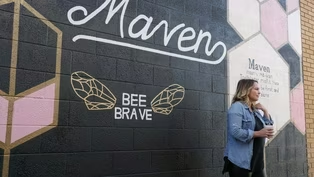
Salt Lake's Maven District Offers Business Support for Women
Video has Closed Captions
Clip: S2 Ep3 | 3m 48s | In Salt Lake City, a business community of women is thriving despite the COVID pandemic. (3m 48s)

Preview: S2 Ep3 | 30s | Many Utah women are unemployed due to the pandemic. We'll examine possible solutions. (30s)
Providing Support for PBS.org
Learn Moreabout PBS online sponsorship
- News and Public Affairs

Top journalists deliver compelling original analysis of the hour's headlines.

- News and Public Affairs

FRONTLINE is investigative journalism that questions, explains and changes our world.












Support for PBS provided by:
Utah Insight is a local public television program presented by PBS Utah