
Utah's Top Political Headlines of 2025
Season 10 Episode 16 | 26m 44sVideo has Closed Captions
As a turbulent year comes to a close, we reflect on the biggest political stories of 2025.
As a turbulent year in politics comes to a close, our panel of experts reflect on the biggest political headlines of the last 365 days. What decisions had a significant impact? Which messages resonated with voters? And what major events will have long-term effects? Journalists Heidi Hatch, Jeff Parrott, and Daniel Woodruff join host Jason Perry on this episode of The Hinckley Report.
Problems playing video? | Closed Captioning Feedback
Problems playing video? | Closed Captioning Feedback
The Hinckley Report is a local public television program presented by PBS Utah
Funding for The Hinckley Report is made possible in part by Cleone Peterson Eccles Endowment Fund, AARP Utah, and Merit Medical.
Utah's Top Political Headlines of 2025
Season 10 Episode 16 | 26m 44sVideo has Closed Captions
As a turbulent year in politics comes to a close, our panel of experts reflect on the biggest political headlines of the last 365 days. What decisions had a significant impact? Which messages resonated with voters? And what major events will have long-term effects? Journalists Heidi Hatch, Jeff Parrott, and Daniel Woodruff join host Jason Perry on this episode of The Hinckley Report.
Problems playing video? | Closed Captioning Feedback
How to Watch The Hinckley Report
The Hinckley Report is available to stream on pbs.org and the free PBS App, available on iPhone, Apple TV, Android TV, Android smartphones, Amazon Fire TV, Amazon Fire Tablet, Roku, Samsung Smart TV, and Vizio.
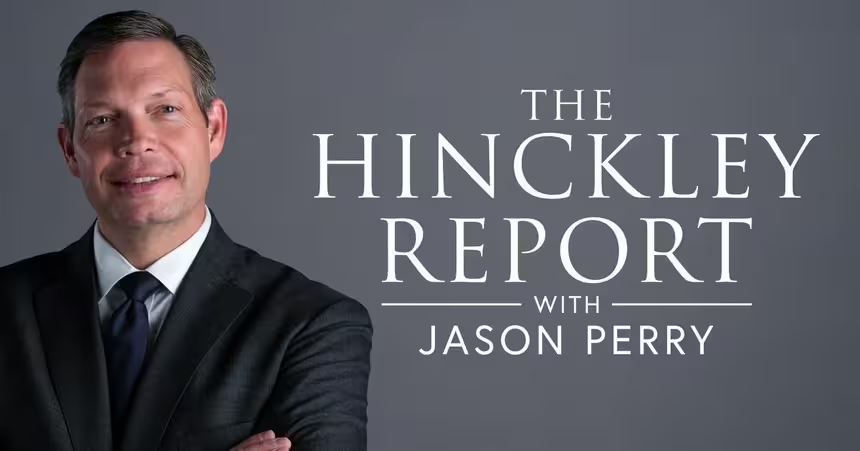
The Hinckley Report
Hosted by Jason Perry, each week’s guests feature Utah’s top journalists, lawmakers and policy experts.Providing Support for PBS.org
Learn Moreabout PBS online sponsorship- [Announcer] On this episode of the Hinckley Report, as a turbulent year in politics comes to a close, our panel of experts reflect on the biggest stories of the last 365 days.
What decisions had a significant impact, what messages resonated with voters, and what major events will have long-term effects?
Funding for the Hinckley Report is made possible in part by the Cleone Peterson Eccles Endowment Fund, and by donations to PBS Utah from viewers like you, thank you.
(bright upbeat music) - Hello and welcome to the Hinckley Report.
I'm Jason Perry, Director of the Hinckley Institute of Politics.
Covering the week we have Heidi Hatch, Anchor with KUTV 2News, Jeff Parrott, Politics Editor with the Salt Lake Tribune and Daniel Woodruff, Reporter with KSL 5 News.
So glad to be with you on this week's episode.
This is a fun episode for me every year, we're gonna break down the biggest stories of the year, or at least how you see them.
And that's particularly interesting because you've been covering these stories, you're talking to the people of the state, you know how they're feeling, you know what the impact is, and you also meet with our elected officials.
So just a particularly great insight.
So I'd like to just kind of do this, if it's all right, is we're gonna start with you, Heidi, and then we'll talk.
Just what you saw as one of the most impactful stories of the year that in particularly as it relates to the state of Utah.
- Well, in my mind, I think that Redistricting is going to be the story that's never ending and continues into next year.
But I think for me, when I think about personally, and maybe because I was a little closer than others, was really the assassination of Charlie Kirk.
When we look about political speech in our state and looking at young people who I think in this last election got involved more so than we have in recent years from both Republican and Democratic sides, we saw students get excited.
They went to Utah Valley University for a good discussion, talking politics and having a conversation.
And it ended how we know in the most awful way possible.
And I think that the reverberations from that are going to be felt from years to come in how kids or young people, college students, get involved in politics, how we all look at it.
And I think elections in the years to come.
So I think that's the biggest for me this year.
- Jeff, I know you covered this too, on the Tribune particularly did this question of political violence is one that we've been talking about at great length because has the potential also of keeping people from engaging going forward.
Talk about that a little bit and the people that you interviewed.
- I think it's not just the people engaging in politics, but like it's certainly impacting the politicians too.
That's what we've heard, you know, this year more than others, you know, the Charlie Kirk assassination comes after Democratic politicians and Congress have been targeted, governors have been targeted.
Lieutenant Governor Deidre Henderson has had threats against her life.
Governor Spencer Cox on the heels of political violence last summer, after years of not endorsing Donald Trump decided to endorse Donald Trump for the presidency.
We've seen the direct effects of political violence in the state, not just in what it's gonna do to our kids or to college students and/or you know, the court systems here in the state, but the actions of the, you know, the most senior political leaders of the state.
- Daniel, this certainly put the state of Utah on the national headlines and the spotlight too, particularly through our Governor.
Talk about that as well.
- I was with Governor Cox recently as he spoke in Washington D.C about this very topic, political violence.
He teamed up with Pennsylvania Governor Josh Shapiro, to talk about political violence generally.
But Governor Cox really talked a lot about his experience leading the state of Utah following the Kirk assassination and talking about just the impacts that we have to all grapple with now in terms of engaging with each other, how we do it civilly, how we can disagree without hating each other.
We know the Governor's made disagreeing better part of his theme for a couple of years now, but we are seeing since the Charlie Kirk shooting death, a significant focus on the part of Governor Cox to urge Americans as he put it, to find an off ramp from political violence and to urge everybody to find ways to have these conversations in a way that doesn't lead to what we saw in September at Utah Valley University.
- Turning point USA had a follow-up event at Utah State.
I understand both of you were there.
Talk about the student engagement from that perspective.
- There was a lot of student engagement and it was a big question of how many people would turn out after that.
I think that a lot of students showed up that were going to be in the first place, and then others just wanting to be there and make a statement that they wanted those conversations to continue.
I was also kind of taking a step back too, to see how much security was there, which made me sad too.
My son was at the shooting at UVU, so I was happy to see the security there, but it made me sad knowing that we were having students getting together for this conversation.
We had snipers on the roof.
We had a huge law enforcement turnout, but a lot of students were there wanting to continue on with what Charlie Kirk was doing and having that conversation.
So for me, it was nice to see that conversation continue.
The question is, can they continue on doing that and having a civil discussion in the years to come, or was it only something that could be carried on in the recent months after the shooting, - I was on campus for a few hours before the event started, and to Heidi's point, the security was really noticeable.
The amount of drone presence on campus was really interesting that I was not like something I'd seen so publicly at politics events here in the state.
But as we're talking about some of the biggest stories of the year, one of the largest, not largest stories, but a big story that also happened that day was a bomb threat on campus where a bomb squad detonated what they alleged was, you know, a device that they didn't know, which ultimately turned up to be like a wild animal tracker that was left outside under a tree.
But I was right there as that was happening and all unfolding.
Talked to a cop who just said, you know, they could not wait for the day to be over just because everyone was so on edge.
- Yeah, tensions were high.
- Tensions were high, and I, you know, the Governor was booed.
There was some good political discussion, but ultimately it ended up being, you know, a safe and, you know, good event.
- Right before we leave this one, Daniel, because I know you've been interviewing these elected officials as well.
It was interesting, just this past week, I had a chance to interview three former governors, Governor Levitt and Governor Cox and Governor Herbert, but it was Governor Herbert they all had something to say about this, but he particularly called out the fact that no matter what your party is, it's time for some civility in our debate, in our conversations.
Will you just give us just a moment about that, because that does seem to be the prevailing commentary from our elected officials.
- It is, and I will go a little further with what Governor Herbert said.
He actually called out his own party, the Republican Party, and said, we as Republicans need to do better at holding our candidates to a higher standard.
And he was specifically referring to President Trump's post about Rob & Michelle Reiner, who were murdered allegedly by their son.
And we know that President Trump made a fairly noteworthy, I'll leave it at that post about it.
That got a lot of criticism.
Some of that criticism came from Governor Herbert saying, we have to be better than this.
We cannot say things like this.
We have to have a level of civility.
That with the President's post was non-existent.
- All right, Jeff, give us a story, one that you followed closely that you found to be particularly impactful.
- What feels like 100 years ago now, and is, you know, what was, what are the old is now popular again.
(audience laughing) What we started the year with, maybe the biggest bill of the Legislative session was the anti-public union bill and that saw hundreds of people protesting pretty regularly of the Capitol from public school teachers to firefighters in uniform across the public employee, you know, came out to try to encourage Republicans to not pass that bill.
It only did pass.
The Governor, I think said shortly thereafter that he wasn't supportive of it, but still signed the bill.
The unions immediately went out and collected enough signatures to get a referendum on the ballot for next year, costing them several million dollars.
But just here in the last month, lawmakers have overturned their own bill as we go into the next Legislative Session, I don't think this story is over.
I imagine we're going to see a different version of this bill.
- Absolute in the next month?
We may, so Heidi, so this House for 267, that did eliminate this collective bargaining and what Jeff was talking about was right, and on the signatures that were gathered, it wasn't just enough signatures.
- 300,000.
- Yeah, which is more than double, well, more than the number that they needed, which showed a little bit of interest.
That's probably an understatement.
- A little bit, a whole lot.
Interestingly, I was surprised by how many they got, but I think it might be a lesson for the legislature to listen to people during the session because it's hard to figure out what's noise and what are things that people really care about.
But I think that we saw that movement during the session to people really caring about this issue, wanting to speak out, wanting legislators to listen.
And it didn't seem like they listened when that vote went through and they had no choice, but listen after they had all of those signatures.
So the question is, will there be lessons learned from this when there are people who are coming up in droves up to the Capitol, wanting their voices to be heard?
Do they listen, do they readjust their bill or do they move forward and say, we know best on this?
That'll be the big question I think after this.
- Daniel, what's interesting about this is, as it was just noted, the Legislature in a special session repealed that bill as opposed to having this referendum go on the ballot.
Talk about that a little bit because if it did go on the ballot, that's gonna impact some of these elections potentially as well.
This one went away for the moment.
Maybe you can talk about what Heidi's just saying as well the moment may be all it is.
- Some argue the Legislature saw the writing on the wall and acted ahead of a referendum vote that could have been potentially embarrassing.
I think there were a lot of factors that went into it, but ultimately Heidi brings up a good point, if you remember, and it feels like a thousand years ago.
But earlier this year, there was a Compromise with this bill, and we were all waiting for a Compromise Measure to be passed.
And we waited and we waited and we waited.
And at the end of the day, lawmakers kind of stubbornly dug in their heels and said, we can't reach a Compromise.
We're gonna pass it the way it is, we like it the way it is.
And that led to even, I think, more pushback than we had seen previously.
And so will we see in the future, as Heidi put it, the Legislature listening more to those on the Hill, but also I think there was a notion of Compromise that was present in the discussion that quickly got lost.
And now in instead of going with a middle ground bill, they just got rid of it all together.
I find that interesting, we'll see what happens.
I agree with Jeff, this issue is not over.
We'll see something down the road depends on when and what we see.
- Daniel, take a moment.
- My turn.
- Yes, your turn.
- Heidi brought it up, that Redistricting.
- oh yes that.
- This big issue and Redistricting sounds very policy and boring, but Congressional maps who represents us in Congress and for years we have had this lawsuit playing out over the 2021 Congressional map as a group of voters, argued that it was unfairly in favor of Republicans.
Well, you got Judge Dianna Gibson in the 3rd District to ultimately agree and tossed out the map.
And that led to just all sorts of chaos and craziness and back and forth celebration on the one hand, condemnation on the other hand, and it's not over yet, we're still seeing arguments in court about it.
But where we stand as of this taping is there is a new map that creates a new Congressional District, I shouldn't say new, but a Congressional district that is solely concentrated in Salt Lake County, which as we know, is much more favorable to Democrats.
And we have seen at least half a dozen, right, Democratic candidates that have entered the race, very excited about this new seat that heavily leans in favor of their party.
That is a huge deal.
Right now we're represented by all Republicans and mid decade we are all of a sudden faced with this new Congressional map.
Now the Legislature wants to appeal it.
There's still a lot of machinations about that, but as of now, this is a major groundbreaking movement in politics that stands to have a significant impact in the months and years to come.
- I'd love to break down a couple of those things that Daniel just talked about.
The first one, Heidi, if we can get get to this is at the heart of much of this, is this discussion about who has the power to draw these maps?
The Utah Constitution has a couple provisions.
Our Legislature is insisting without any hesitation is just them, which puts this initiative process as part of this conversation.
- I feel like we've all had to go to law school through the last year to try to figure out exactly what's happening.
But our Constitution does give that right and ability to our elected Legislative leaders to draw those lines.
But we also give in the Constitution our ability to have these propositions.
And Prop 4, which passed where people with the Better Boundaries movement said, we want an independent commission to look at this.
So we have both the independent commission that's constitutionally backed and also the legislative leader.
So the question is, who's right is it?
And I think what we ended up with, if you wanna look at constitutionality of it is, is probably not our legislative leaders and not that Redistricting Committee who came up with this last map.
And obviously we have celebrations from the left because they got what they wanted.
The question is, would they be celebrating in an opposite direction, you know, if it were not what they wanted.
So I think it's an interesting issue to figure out what is the right way forward in the future.
I think this is probably one of those things where middle ground probably sounds like a good idea in retrospect to Republicans on the Hill who, if they would've gone with the Redistricting Commission, probably would've gotten a more favorable, or at least a competitive District instead of this.
So it'll be interesting to see what happens.
I don't think this is going to end anytime soon though.
And I think we might have a bunch of candidates in the race who are trying to put time, effort, and money in and don't know if it's still going to be the District that stands when we get into the new year.
- Yeah, so interesting, so Jeff, this District was talked about unlike what is have been previously put forward, which is sort of, I call it the pizza approach.
You got urban and rural.
This is one section, mostly Salt Lake County, which it's not any purple.
It definitely leans blue here and it's causing a lot of Democrats to file to run.
This has a potential of really changing a lot and putting the Democrats in one of these positions that the Republicans have been in for some time where they gotta really do a process to find their candidate.
- I am really interested to see what happens to the Democrats here.
I don't think I am politicking or opining to say there is not a very strong Democratic Party in this state and so I think we're going to see what the Democrats can do in the next 12 months as they suffer through their own primary, as they campaign against each other.
I think the two of us probably covered, you know, the coup at the last primary a couple years ago.
So I'm really interested to see kind of like what Democrats come up with again, if that's, if this District and map holds.
- So Daniel, a couple things have happened in this last Special Session to get to these Congressional Districts.
One is the Legislature just moved the filing deadline until after the Session ends.
- In March.
- In March, right.
Which it used to be the case anyway.
I'm curious what you have to say about that, but also it means there's some very interesting calculations going on by who in Congress right now decides to run for what particular District.
- That's right, and you know, so much of it is rumor, but why not spread some of the rumors?
- Let's hear it down.
- The political rumors are right that the 1st District is obviously very Democratic and you see some interesting candidates on the Democratic side.
I've heard no Republicans yet.
I don't think any of you have either in that District.
But you hear rumors that Celeste Maloy and Mike Kennedy would run and Blake Moore would run for two, three, and four and that Representative Burgess Owens would retire.
That is the rumor, that is what is around in political circles.
I've heard that from more than one person.
We'll see what happens.
But I think the existing Delegation has to look at it and say, okay, who's running for where?
Because we have three seats that are pretty safe Republican, but then you've got one that clearly is not, and what are we gonna do about that?
I will also note about the Democrats in the 1st District.
I'm interested to see how that shapes out.
I think when former Congressman Ben McAdams got in the race, he's got name ID, he's got money, he's got a track record that a lot of people looked at him as, oh, the obvious choice.
But so many Democrats have gotten in that also have name ID that also have a track record and that have attracted some pretty big endorsements.
Nate Blouin, the State Senator got the endorsement from Bernie Sanders who attracted a huge crowd in Salt Lake City.
And who's to say that a lot of that crowd that was in Salt Lake City doesn't live in that First District.
And so I think it's really anybody's race right now Not necessarily Ben McAdams, just 'cause he was in Congress.
Anyone could emerge to the front of that pack - And Jeff, of course we know that the balance of power in Washington, D.C does hang on this particular issue.
Some of this happened in California.
Other states are looking at their redistricting, changing the makeup of the number of Republicans and Democrats.
And if Utah is looking potentially in the next census of getting another Congressional seat, this has the power of the opportunity to change the balance of power.
- Absolutely, every seat's gonna count, one more seat for Democrats in a very narrowly divided U.S House could mean a lot of things for the Trump administration, could mean a lot of thing for what Congress can and can't get done in the next two years ahead of a, what is, I assume going to be a really expensive 2028 presidential election.
- Probably so.
- Yeah, Heidi for just a moment on this issue too, because one of the lingering issues that may go into this next session is maybe some conversations about the initiative process itself because our Legislators have said to some extent on this that not only do they feel like they have the power to draw the lines, but the initiative process and what the courts have said of has says something up which is establishing a law that can't be touched.
Again, I think some Legislators are calling these super laws.
Who they're calling about, talk about how that plays out because it certainly is a concern for our Legislature that I think that they're gonna continue to adjust.
- Yeah, I think the legislatures used to having the final say, and I think that initiatives are difficult in our state.
There's high bars you have to meet to get things on the ballot, so it'll be interesting to see, but I think it's always depends on if things are going your direction.
Because we saw that voters voted in 2018 that they wanted the ability to have that Redistricting Commission.
Now we have signatures being gathered again to have people vote on it in the opposite direction.
So the question is, do those super laws supersede the voters who gets the power?
So I guess it's a power struggle right now of who's in charge.
We've seen that power struggle over the last few years where we saw the ballot people could vote to put the Legislature where they could call themselves into session, they didn't use to have that power, the Governor did.
So the question is who's in charge and who gets the most power at this point?
And it'll be interesting to see how it shakes out.
- Well, when we talk about how it shakes out, Daniel, you can tell us what you're hearing on this as well.
Seems like the courts are in the middle of a lot of this, right?
Let's talk about the power, the separation of powers and who can do what.
- I was gonna say, do you wanna talk about the tension between the Legislative - I was hoping.
- And Executive and the judicial branches?
Well, one proposal that is now public is the Republican controlled Legislature is going to look at adding two more seats to the Supreme Court.
They've had a lot of tension and contention with the Supreme Court over a number of rulings over the last year or two.
And we've seen a number of bills, some have passed, some haven't, kind of targeting the Judiciary.
And so that's something to watch for is will the Supreme Court expand by two seats and what impact that really has.
The Democrats are obviously criticizing it, saying that it's an effort by Republicans to get their way to overturn some of these decisions that they didn't like.
But this tension certainly hasn't gone away.
The Redistricting issue really brought it into the forefront.
You've had lawmakers calling for the impeachment of the Judge who overturned the Congressional Maps.
And to my knowledge the Judge has never been impeached in Utah.
And so something still to watch.
- There's an effort once the person resigned.
- So that.
- Yeah, go ahead Jeff.
- Let's remember, these are not liberal activists judges that somehow snuck under the radar of a Republican Governor and a Republican Legislature to somehow end up on the bench.
These are for decades now, Judges that have been nominated by Republican Governors and approved by Republicans in the Legislature.
You know, I think if you wanted to change who was making it to the bench, you could start by changing the Governor and the Legislature.
- And there are questions too about whether they really are overworked.
There's been complaints about the Judge and how long she took to get this ruling out.
And maybe we need more people in there making these decisions and making sure that people get their answers quicker.
So it'll be interesting to see how that shakes out.
But definitely the judiciary, there's a lot of arguments going on about how much power they should have and if they have more than they should.
If you speak to the leadership though in the legislature right now, I don't think their goal or what they would like the focus to be on would be in impeaching a judge right now.
I think they'd rather look at other things than that - And Jeff, they are looking at that expanding the court by two.
It's been a very long time since they have done that.
We've had some changes already.
Justice John Pearce has stepped down, a new Supreme Court Justice has been put in, which might change particularly if you add more Justices to it, to that court.
- Again, back to my point, appointed by a Republican Governor, approved by a Republican Legislature.
I think the flavor of, you know, conservative leading Justices or Judges is probably where we'll see the nominations change.
- There maybe more brains in the conversation and talking about is what they'd get.
- Okay, can I hit one more?
Remember that government shutdown?
- Was that this year?
(audience laughing) - I almost love that, right - Oh yes, that happened.
Talk about that for just a moment.
This is the longest shutdown in history.
Daniel, give us some of that context because one of the key issues at the heart of that was the Affordable Care Act.
Those extensions end on December 31st of this year.
So talk about the shutdown itself though.
- 43 days, am I right, longest shutdown ever.
And it's hard to say who won and who lost 'cause everyone kind of claims, hey, this was worth it or this wasn't.
I think the impact next year, if these subsidies truly do expire, will be felt heavily by people.
We did a piece about a family that their premium, even with just the subsidies increasing was going to go up like 10 or more fold.
And that's just a tremendous amount of money for families to deal with.
And so the shutdown is over, it's in the rear view mirror.
Economists argued, we would still feel the effects of it for some time, but let's see what happens with these subsidies.
The core issue that Democrats said they wanted to shut down the government over and then ultimately didn't get much out of reopening it, which angered many in their party.
Let's see what happens with that.
As of this taping, they're still set to expire in a few weeks and or in a few days.
And that will have an impact on people's wallets.
- That's right, Heidi, we have four Republicans this week that said that they were willing to maybe go across and have a vote on these extensions, but there are a lot of Utahans that do get funding for the affordable track in terms of these subsidies.
- Yeah, Republican families, Democratic families.
And I think that's why you're seeing some who are willing to cross the aisle because they know it's something that affects their families in the state.
The question is, can we afford to keep doing that?
And I think that's the real argument here and I think it'll be the argument as we go into this next election, the economy, because we're looking at families spending a lot on healthcare, a lot on groceries and really everything else we buy.
And so the question is, can the government keep propping that up or does there need to be a whole overhaul of the healthcare system?
Because I don't think there's anyone in private or with government insurance that feels like prices are going down or getting better for them.
- Okay, this is gonna be interesting here you go.
What stories, because you're more connected than anyone, the three of you in particular, what big stories are we gonna see in 2026?
What's coming our viewers should be watching for?
Do you have an idea how?
- I just feel like 2026 is going to be 2025.2 because a lot of the issues that we've had this year haven't been solved.
I think political violence and rhetoric are going to continue being a story in the next year.
I think we're gonna keep looking at Redistricting here in Utah and I think the economy is really going to be a big question of people.
We heard the President in a White House address just a few days ago talking about where he felt like he'd done a good job and saying that he did a great job with the economy.
I think that's where Americans would disagree.
So the question is can he turn that around and get people behind him on that issue, I don't know.
- Important time right before elections for that one.
How about you Jeff?
- I was just gonna say elections, you know, we are coming into the midterm elections.
We've already talked about the four seats that are up for grabs.
One brand new seat that, you know, Democrats are gonna be, you know, knifing and clawing over for the next few months.
And I think that's gonna be really interesting to watch.
- You have 40 seconds, Daniel, - I'll bring up one that hasn't maybe been on a lot of people's radar and that is, will the Utah Legislature continue to chip away at the income tax?
They've done it for five years in a row.
Governor Cox did not propose it in his budget, but will Republicans in the Legislature insist on a sixth year of cutting the income tax?
We know that's been a big priority of theirs.
Watch for that in the session.
What happens on that regard?
- Yeah, the budget that came out from the Governor, at least his recommendation about 700 million less than last year.
He attributed some of that to the big beautiful bill and income tax there but do you see that it's likely to come this session for another year or is it gonna?
- Well, again, the Governor didn't propose it and he doesn't seem excited about it, but we know that the Speaker of the House and the President of the Senate traditionally have been very excited about it and have made that a priority every year for the last five years.
- Okay, we'll watch that one closely, can't wait you all are generally right.
So thank you for what you've given us this evening and thank you for watching the Hinckley Report.
The show is also available as a podcast.
Thank you for being with us, we'll see you next year.
- [Announcer] Funding for the Hinckley Report is made possible in part by the Cleone Peterson Eccles Endowment Fund and by donations to PBS Utah from viewers like you, thank you.
(bright upbeat music)

- News and Public Affairs

Top journalists deliver compelling original analysis of the hour's headlines.

- News and Public Affairs

FRONTLINE is investigative journalism that questions, explains and changes our world.












Support for PBS provided by:
The Hinckley Report is a local public television program presented by PBS Utah
Funding for The Hinckley Report is made possible in part by Cleone Peterson Eccles Endowment Fund, AARP Utah, and Merit Medical.