Art Elevated: The Governor's Mansion Artist Awards
V. Kim Martinez & Jack Ashton
Season 1 Episode 1 | 27m 44sVideo has Closed Captions
Meet muralist V. Kim Martinez and former Utah Symphony violinist Jack Ashton.
Art is both something that exists in the present, as well as a gift to be given to the future. Muralist V. Kim Martinez, inspired by the Mexican muralists of the 20th Century, now passes her craft along as a professor & community activist. Jack Ashton, longtime violinist for the Utah Symphony, is honored for his work in education, introducing students to the joy of creating music.
Problems playing video? | Closed Captioning Feedback
Problems playing video? | Closed Captioning Feedback
Art Elevated: The Governor's Mansion Artist Awards is a local public television program presented by PBS Utah
Art Elevated: The Governor's Mansion Artist Awards is made possible in part by Zion's Bank, The Church of Jesus Christ of Latter-day Saints Foundation, The Larry H. & Gail Miller Family Foundation, Thomas A. & Lucile B. Horne Foundation.
Art Elevated: The Governor's Mansion Artist Awards
V. Kim Martinez & Jack Ashton
Season 1 Episode 1 | 27m 44sVideo has Closed Captions
Art is both something that exists in the present, as well as a gift to be given to the future. Muralist V. Kim Martinez, inspired by the Mexican muralists of the 20th Century, now passes her craft along as a professor & community activist. Jack Ashton, longtime violinist for the Utah Symphony, is honored for his work in education, introducing students to the joy of creating music.
Problems playing video? | Closed Captioning Feedback
How to Watch Art Elevated: The Governor's Mansion Artist Awards
Art Elevated: The Governor's Mansion Artist Awards is available to stream on pbs.org and the free PBS App, available on iPhone, Apple TV, Android TV, Android smartphones, Amazon Fire TV, Amazon Fire Tablet, Roku, Samsung Smart TV, and Vizio.
Providing Support for PBS.org
Learn Moreabout PBS online sponsorship(ambient music) - [Presenter] Art Elevated: The Governor's Mansion Artist Awards is made possible in part by Zions Bank, Church of Jesus Christ of Latter-day Saints Foundation, The Larry H. & Gail Miller Family Foundation, Thomas A.
& Lucille B. Horne Foundation, and by the contributions to PBS Utah from viewers like you.
Thank you.
(gentle music) - Art speaks to us in a language that everyone understands.
It's a connecting point.
(gentle music) The Artist Series Awards are a way for us to honor artists in the state that are doing amazing things, but also it's a way to raise funds to beautify the mansion.
(gentle music) It's a way for us to do both and celebrate artists and have an incredible moment here together at the mansion.
(audience applauding) We are proud to honor Jack Ashton and Kim Martinez.
(gentle music) The inspiration for the awards started with Governor Blood, during the Great Depression.
His daughter wanted a piano for the mansion, but the governor didn't want to spend taxpayer dollars.
Instead he held an event, a fundraiser, if you will, and invited artists to perform.
The evening was a success.
And the piano is still here today.
The event has continued with the assistance of the Governor's Mansion Foundation.
They secure funding for the upkeep and beautification of this wonderful public building.
But the event is also a time to celebrate exceptional artists.
To ensure a broad representation of Utah's art, the award nominees are selected by a diverse committee of art collectors and artists from around the state.
And I am so grateful to have the opportunity to select the winners.
(gentle music) Kim Martinez is an empathic political artist motivated by the desire to understand how power structures affect the disenfranchised.
As a professor of painting and drawing at the University of Utah, Kim has shared her skills in community mural design not only with her students, but with communities throughout Salt Lake County, empowering people to tell their own unique stories through art.
(guitar strumming) - You know how you remember moments, right?
So I was like in the first grade and I was drawing with crayons and I was drawing a boat, I put a line of blue and I realized that that made it look like the boat was under water.
So for me, that became the catalyst for me to go, I can discover things that are not just right there on the surface.
I'm a native Utahn.
My parents are both first generations and they, my mother is Anglian, my father's Mexican.
How should I say?
They're both very dedicated to religion, so I kind of grew up in a space where I've always questioned different kind of places that I live and how I've been brought up.
(guitar strumming) As a child I didn't, I wasn't part of, I didn't feel like I was part of the larger community, 'cause I, you know, looked a little bit different than a lot of people.
And I looked at life a little bit differently.
I think a lot of young artists are that way.
And so it became a place of identity for me to a certain extent.
But for me, that connection of drawing really helped me understand who I was and what made me special.
(car driving) Sometimes when you witness things that you go, I just need to talk about this.
I need to have a dialogue and I wanna share this dialogue with other people.
One of the things that happened is I was at a Rio Grande neighborhood meeting and somebody there had said, "Well, I think what we need to do is we need to ask all these Latinos for their green cards.
They're here selling drugs and we gotta find out."
And I just went, "Whoa, okay."
And I just thought, that's interesting that he would say this, you know, out loud.
And so then I made a painting from that experience.
(paintbrush dropping) I'm a political artist because it became really important for me to understand how power systems work.
A drawing is a totally illusionary place, but once I get it outta my head and I can make a drawing I can understand it better.
You know?
And I also think it's important to have a voice.
Right?
'Cause I didn't feel like I had a voice for a long, long time, as a young person.
(gentle music) So, it initially started out, I'd been at the U for like a year and a half and I decided I needed to do something to have an impact on our student body here.
Because one of the things that I realized is that we're a commuter school.
So students didn't really get to know each other.
And my experience told me that if I put people together they're gonna get to know each other more.
So I met a guy, his name was Tim Williams, and he and I collaborated, and I lived in South Salt Lake at the time, that we could get matching grants from UTA to actually paint murals in the city.
And this is back in 2001 when there wasn't very many murals at all in the city.
When Tim and I first came up with this idea, it was like, we just wanted to make this place so that everybody could see how wonderful it was.
Because at the time South Salt Lake sort of had a not so stellar reputation.
We wanted to use murals as a way to clean up the community, really, you know, I mean it was a way to add pride to the community and it was totally grassroots.
I mean we really literally drove down the street, saw this building, went in and knocked on the door and said, can we paint on your building?
And that's how it happened.
And so the students came up with this idea, you know, they wanted to kind of show the blue collar roots of the area.
When we were building this, you know, you gotta visualize, we had scaffolding all over the place, we had, you know, 30 students down here and you know, it was, you know, pretty fun actually.
(upbeat music) (ball banging) - So how we do these murals is that we invite the community to meet with us and go into dialogue.
And you know, and I ask them questions, I give 'em prompts, like, what's important to you, what do you wanna see.
Right?
And we'll try to incorporate that into the mural.
And then usually what happens is we ask, you know, we invite the community to come and paint.
One time we were painting a mural and it was raining, and one of the community members saw us out there working in the rain, and he came over with one of those gas powered heaters and set it up for us, so that we could stay warm.
It's amazing what people will do, even without asking them, when they see that you're investing in their communities.
By working with students we get to have this dialogue of back and forth and learning to understand one another.
It is much more interesting when I bring in other people's dialogues, and that's what teaching is.
It's a two way dialogue.
(upbeat music) (speaking in a foreign language) So the emotionally challenging paintings, they can be really taxing.
(speaking in a foreign language) For me to make a painting I need to go to the place and talk to people and understand what's going on.
I mean, I can make paintings about what I read in the newspaper, but for me that's not authentic, 'cause, you know, I'm examining power, but it has to be an authentic experience.
So like even, you know, for the prison images, for the border images, those paintings, I mean that's why I don't paint, stay with the same series for a long time.
Right?
Because it can be emotionally really, really difficult.
(guitar strumming) Well, you know, I started doing volunteer work within the correctional systems and while I was there I discovered that it was the only place that I saw people that looked like me that were overrepresented.
Something needs to change in our culture.
Right?
So I think that through art that can help people sort of get into, you know, take a look at their life.
Why are they making the decisions they're making, you know, ask them to question their own place and how they can create social justice in their own lives.
You know, one of the things that was interesting is I did a pre and post evaluation of a group that I was working with in the prisons.
The results came back.
It turned out that they had greater self-esteem, they had greater problem solving skills, they felt more comfortable with one another, but then their depression also went up.
And so after the testing, I said, what, why did your depression go up?
And they said, well, look, our program is ending, and so what's happening is we've kind of had the door open and now it's closing on us again.
So that made me realize that we really need the arts in situations and places like that more than we do.
(vehicles zooming) (gentle instrumental music) The Mexican Muralist had a huge impact on the art world in the 20th century.
Right?
In that, what Siqueiros said is that this is artwork for the people versus about it being on the easel where somebody could take it home and hang it on their wall.
They were really interested in changing and using art to transform, because you remember at the turn of the century Mexico had had a revolution.
Right?
And so the government commissioned all those murals, because they wanted to find a way that people could create a Mexican identity.
So in some ways my painting is reflective of the Mexican Muralist.
So it's a way to keep that Mexican tradition happening.
(birds chirping) If you look here, you can see that the youth who helped us paint this.
Across the street there's an elementary school, and so these young people would walk by, Jesus, Miriam, Humberto would come by and paint with us after school.
My favorite thing to talk about is that they would walk by with their friends and they'd always say I painted that horse, but they were nowhere near the horse, but it was the coolest thing on there and they wanted to own it.
And so, but they got to own it.
Right?
'Cause their name's on the mural.
(footsteps) 15 years later, I'm at Centro Civico and doing a project that included some dreamers.
And I was talking to this young man and he said, "You know, I wanna be a muralist."
And I said, "Well, I'm a muralist."
And he said, "Well, tell me what murals you've made."
And I started telling him the murals and I mentioned the Bonwood Bowling Alley.
And as I looked at him, I saw tears in his eyes and I said, "Wait a minute, were you one of those kids?"
And he said, "Yeah, I was."
He said, "You know, I had just come to this country and I didn't speak English very well.
And I didn't really have any friends, but I felt so connected that you let me paint on that."
This gave this kid, he said that, "It made me feel like I belonged."
And for me that's why we do this kind of thing, is, you know, so that young people like that feel like they have a place.
One of the things that was really important to me was to give back.
I think that I wanted to make it more beautiful.
Right?
And I wanted to include people in the community.
My job was to come in here and start this, but I'm not gonna end with it, because now they have a whole bunch of people that are painting murals here.
And that's what I'm supposed to do.
Right?
As an educator?
Is to start it and then let the community take over.
And as you drive through this city now, you see murals everywhere.
Right?
And so that's really exciting.
That gives me a real sense of fulfillment that it's going to continue to be bigger than me.
(easy listening music) - Jack Ashton has mentored and taught youth in Utah communities for decades, influencing countless young people in the world of classical music.
Skills he perfected throughout his illustrious career as a violinist in the Utah Symphony.
- The arts can connect to a higher degree, connect us with each other.
You get your very own baton, your very own magic stick.
You wave it and all of a sudden there's this tremendous sound, or you go like this and there's a tremendous quiet.
(intense classical music) I'm very sensitive to music, especially good music.
It's like a SugarBee apple, you just can't find anything sweeter than that.
My name's Jack Ashton.
I'm 83.
I was in the symphony for 48 years and taught at Olympus High for 35 years.
I was working so hard.
I used to come home and my children would say to mom, "There's a guy in our house.
(chuckling) Who is this guy?
Oh, it's dad."
I was doing so much.
But see, my dad died when I was a young man when, and his dad died when he was a young man.
And so I thought that I was going to die when I was 49.
And so I worked as hard as I could to get a house, get everything situated for my wife, but I didn't die.
(easy listening music) My dad and his brothers owned a dairy farm.
They were, which they were starting.
And when I turned six, I went to an eighth grade school in one building.
One day a man came to the door and asked my father, who was home for lunch, if he wanted any of his children to start music.
And he pointed to my brother and said, "He'll do the steel guitar."
And pointing to me, he said, "He'll play the violin."
That was the first I'd heard of it.
And it wasn't until we moved to Salt Lake, when I studied with a violin teacher, Melba Lindsay Burton.
And she was very technical and I had to do things just right.
I had to hold my arm just right, my fingers just right.
And bows, like that.
And she made me perform a lot.
So I practiced and I wasn't interested in being a violinist.
In fact, I wanted to play for the Pittsburgh Pirates.
(intense classical music) I met Abravanel when I was the concertmaster of the All-State Orchestra.
I was a senior in high school, Abravanel needed a ride to Logan, to the school concerts or to Provo or somewhere, and I had a big car, so I would ride with him.
And all you had to do with almost any conductor, I being a conductor myself, was ask him a question and then you didn't have to talk at all until you got to Logan.
So he filled in the time, and it was interesting stuff.
It was all about early music in Germany, in the 20s.
And when the national socialism started to rise and what happened to the musicians and he told me how he got started.
And so we became very close.
(classical music) We had auditions and I was accepted into the orchestra.
And it was a great experience for me.
Great experience, musical, I was studying German at the time and all of that German history, philosophy interlock with Brahms, Beethoven, Mendelssohn and Tchaikovsky and all of those men, and I just, so everything was dovetailing and my mind was so open, and I, it was the most thrilling time of my life.
(somber classical music) Playing in the symphony, when you're surrounded by good players that play in tune and follow the dynamics, it's a far different experience than teaching school where you have to engender all of those qualities and teach the students to do them and hope and pray at the concert they'll remember to do them.
But it was never comparable to the experience I had in the symphony, except in the way that you saw the students develop and to watch the kids excel and grow and become really excellent players.
That was so significant to me that I really enjoyed it.
And that's one of the reasons I started the Young Artist Chamber Players.
So that some of my students who weren't in schools providing that experience could have that experience.
Now there are four orchestras and I get to do two of them on tour in Utah and to Europe and to hear them play in those big cathedrals.
The kids want to go one more time.
And if I can drag my tired old bones across Europe again, but it's a great experience.
(light classical music) The actual mechanics of conducting I just have to remember not to get lost and not to point to somebody at the wrong time.
That's what happens.
The inner feeling.
I enjoy listening to how they respond and if they've been trained well enough they can make the music sound good and beautiful.
(upbeat classical music) - He makes it easy for us to understand what the audience needs to hear.
So, and as a conductor, that is absolutely, you know, chef's kiss to him that he can, he's able to do that to, especially to high school kids.
That is so hard to get high school kids to do, you know, certain things, especially to that caliber of professionalism and musicianship, to be able to convey, not only what's on the paper, but the message behind the music too.
- [Jack Ashton] These young players who work so hard, they need to learn to fit in, blend, play in tune, and that's when the music becomes good for them.
It feeds their souls.
Okay, I'll try to make sure that you're ready.
I meet them and we become good friends and those friendships last a long time.
They come over and visit and want to talk and tell me what they're doing.
(audience applauding) One, two.
(light classical music) - [Austen Lino] Jack is, he's like the grandpa that I never had.
So that's what really solidifies my connection with Jack, personally.
Is not only is he able to teach, but he also treats, not only me, but everybody around him like family.
It's a really beautiful thing what Jack does is unifies everything, making sure everyone feels appreciated for their work and making sure everyone feels connected, not only to the music that they're playing and to him, but with everyone else around them too.
(classical music) - The arts are a catalyst to learning and to gaining and bonding relationships between people.
(serene classical music) I had a dream the other night.
And in this dream, these young people, all these students who I taught came back and they were, we were seeing each other and I was seeing them as young people.
And, but they had been playing and had families.
The rejoicing that went on in that dream was so beautiful.
(intensifying classical music) Well, and I think I couldn't had that experience on the Pittsburgh Pirates.
No way.
I may have earned a lot more money, but I've been so blessed in what I've done.
(intensifying classical music) (whimsical music) (background chattering) - Jack retired several years ago from the Utah Symphony and teaching in the classroom, but still mentors many students privately and continues to direct the Young Artist Chamber Players.
Please welcome to the stage, Jack Ashton.
(audience applauding) - These young musicians are just a portion of the young people who have come into my life, but to have all these young people come into my home, into my rehearsals and enjoy their spirit and be built up by what they contribute to me is the probably makes this job the most wonderful job a human being could have.
And so I'm grateful to them, I'm grateful to you, Governor Cox and your First Lady, Abby, I thank you for this honor.
(classical music) - She's a recipient of numerous excellence in education awards.
Additionally, she's received the Salt Lake City Mayor's Visual Artist Award for her community service contributions to the Utah Department of Corrections, Veterans Association, Utah Hispanic Women's Association, First Step House and Art Access Art Positive, ladies and gentlemen please join me in welcoming and congratulating Kim Martinez.
(audience applauding) (classical music) - In the next few weeks, I will be leaving for Antarctica on a research trip, in an effort to understand and develop work that responds to global warming.
I will continue to develop artistic projects that promote social justice inequality equity in our community.
Thank you again for this prestigious award.
(audience applauding) (classical music) - We paid tributes to incredible artists and I'm going to say something.
They are great and their greatness clearly lies in their artistic accomplishments.
But I think there's something greater in both of them.
And that is that they are both teachers.
And I want to thank you both for sharing your art, more importantly, sharing your love of art with your students and making the world a better place.
Thank you.
Enjoy the evening.
And may God bless all of you this holiday season.
(audience applauding) (classical music) - [Kim Martinez] Why do I love teaching?
Because as I like to learn.
Am I listening to students so that they're teaching me, too, so that we become co-learners, 'cause I think that's the most effective way to make change.
- [Jack Ashton] As a teacher, when you see these young people play in what they're able to present musically and spiritually, that's what makes it worth it.
(classical music) - [Presenter] - Art Elevated: The Governor's Mansion Artist Awards is made possible in part by Zions Bank, Church of Jesus Christ of Latter-day Saints Foundation, The Larry H. & Gail Miller Family Foundation, Thomas A.
& Lucille B. Horne Foundation, and by the contributions to PBS Utah from viewers like you.
Thank you.
(light-hearted music)
Video has Closed Captions
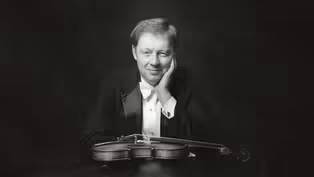
Clip: S1 Ep1 | 9m 57s | Longtime Utah Symphony violinist Jack Ashton is honored for his work in music education. (9m 57s)
Video has Closed Captions
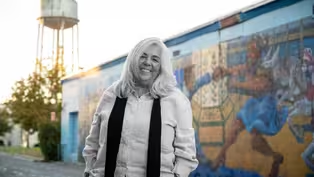
Clip: S1 Ep1 | 10m 10s | Muralist V. Kim Martinez uses her craft to teach, to learn, and invest in her community. (10m 10s)
V. Kim Martinez & Jack Ashton | Preview
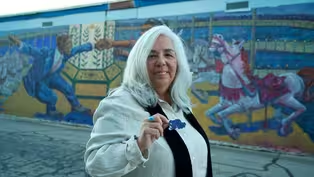
Preview: S1 Ep1 | 30s | Meet muralist V. Kim Martinez and former Utah Symphony violinist Jack Ashton in episode 1. (30s)
Providing Support for PBS.org
Learn Moreabout PBS online sponsorship
- Arts and Music
The Best of the Joy of Painting with Bob Ross
A pop icon, Bob Ross offers soothing words of wisdom as he paints captivating landscapes.













Support for PBS provided by:
Art Elevated: The Governor's Mansion Artist Awards is a local public television program presented by PBS Utah
Art Elevated: The Governor's Mansion Artist Awards is made possible in part by Zion's Bank, The Church of Jesus Christ of Latter-day Saints Foundation, The Larry H. & Gail Miller Family Foundation, Thomas A. & Lucile B. Horne Foundation.