
Vaccine Mandate, Legislative Maps, and More
8/26/2021 | 26m 46sVideo has Closed Captions
New vaccine mandate, legislative maps, and energy & climate bill.
Host Hannah Meisel (NPR Illinois) and guests Peter Hancock (Capitol News Illinois) and Kent Redfield (UIS) take a look at the new vaccine mandate, push back from Republican legislators, the legislature meeting one day to go over legislative maps and an energy and climate bill, and Nikki Budzinski announcing for the IL-13 and what that means for Rodney Davis.
Problems playing video? | Closed Captioning Feedback
Problems playing video? | Closed Captioning Feedback
CapitolView is a local public television program presented by WSIU
CapitolView is a production of WSIU Public Broadcasting.
Vaccine Mandate, Legislative Maps, and More
8/26/2021 | 26m 46sVideo has Closed Captions
Host Hannah Meisel (NPR Illinois) and guests Peter Hancock (Capitol News Illinois) and Kent Redfield (UIS) take a look at the new vaccine mandate, push back from Republican legislators, the legislature meeting one day to go over legislative maps and an energy and climate bill, and Nikki Budzinski announcing for the IL-13 and what that means for Rodney Davis.
Problems playing video? | Closed Captioning Feedback
How to Watch CapitolView
CapitolView is available to stream on pbs.org and the free PBS App, available on iPhone, Apple TV, Android TV, Android smartphones, Amazon Fire TV, Amazon Fire Tablet, Roku, Samsung Smart TV, and Vizio.
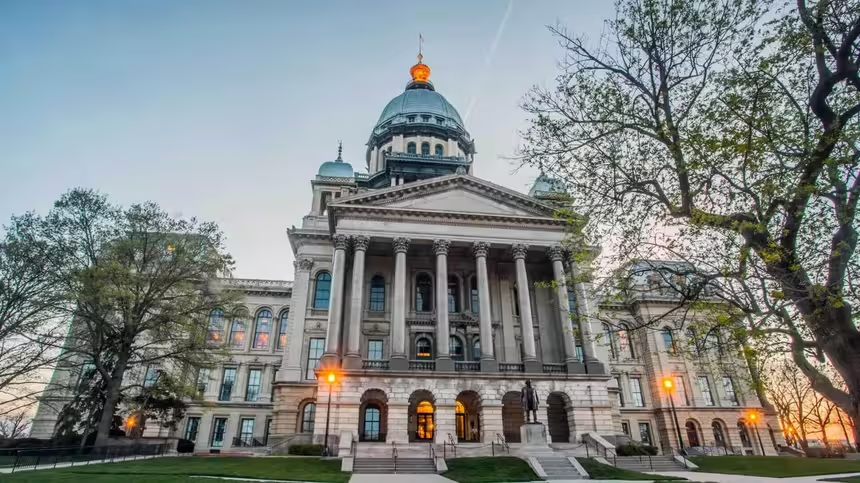
CapitolView
CapitolView is a weekly discussion of politics and government inside the Capitol, and around the state, with the Statehouse press corps. CapitolView is a production of WSIU Public Broadcasting.Providing Support for PBS.org
Learn Moreabout PBS online sponsorship(bright music) - Welcome to CapitolView where we discuss (indistinct) in Illinois state government and politics.
I'm Hannah Meisel with NPR, Illinois.
Joining us this week is Peter Hancock from Capitol News, Illinois.
Thanks for joining us, Peter.
- Hi Hannah, it's good to see you.
- And also here is Kent Redfield, professor of Meredith at the front of political science at the University of Illinois at Springfield.
Glad to see you again.
- Good to be here.
- Well, we are beginning filming this Thursday morning with some breaking news from the James R. Thompson Center, where I'm currently at.
The governor has issued a mask mandate for statewide and additionally, a vaccine mandate for all educators, all school staff from public and private schools from preschool all the way to the university level.
You know, this will make, I might count Illinois the ninth state think.
Our governors have kind of varied in their approach to the vaccine mandates that they've issued or said that they will issue.
Illinois will include an opt-out provision which will allow teachers to instead test to twice weekly if they refuse to get vaccinated.
You know Peter, was this always inevitable?
Do you feel like, you know, especially as the FDA gave the Pfizer RAN tech vaccine full approval earlier this week.
Was this inevitable for Illinois, a state that's run by a democratic governor who has staked his reelection campaign on his handling of the pandemic?
- You know Hannah, I think it really was, especially as you mentioned, when FDA gave its full approval to the Pfizer vaccine.
There's really no excuse now for people not to get vaccinated, except in very rare circumstances where you have religious objections or some sort of health exception that makes it dangerous for you to get a vaccination.
And I think you're saying the governor and the administration just kind of running out of patients.
You know, they talked about in southern Illinois where the vaccination rate is the lowest.
They're virtually out of ICU beds.
And it really in the places of the state that have the lowest vaccination rates are also the places that went into this with the lowest amount of hospital capacity.
So at some point I think you have to take action to protect public health statewide.
And so I think we all saw this coming at some point.
You know, there've been other news conferences where reporters like you and others kept asking, when are we going to see more mitigation orders?
Well, this is it.
- Right and you know the - Yeah and I think - Go ahead.
- Oh, okay I'm sorry.
I think that the data is just crushing in terms of what's going on in northern Illinois, central Illinois, and the further south you get, it's just horrendous in terms of, it really gets down to the capacity to deal with very sick people.
And we're getting more and more sick people.
Again, numbers that are starting to rival the sprain.
You know, I mean, you've certainly have gotten some isolated pushback, but it's interesting, you know, I just (indistinct) you know within the end of the governor's press conference, you've got the only federation of teachers, the only education association embracing what the governors has done.
Now, there are statements out there by the Retail Merchants Association and the manufacturers association.
And so you're seeing a lot of support for this.
There certainly is con, there's contention with particularly asked me in terms of some of the amount of vaccine, the vaccination requirements for people in particularly prisons, but other congregate settings.
There's some indication that asked me is at least without any details saying, well, we want the same deal that the teachers got, which would be essentially either vaccination or regular testing.
You know, I think there's pretty broad support for this in terms of opinion leaders, economic interests educators and that's gonna be wind at the governor's back in terms of visibility to get some movement on the things that he firmly, I mean, and if vaccinations and mask don't work, then I'm not sure what's left in the, you know, what arrows are left in the quiver at this point.
- Yeah and we should also mention that this new vaccine mandate applies to all healthcare workers, including privately run nursing homes.
You know, we've seen a lot deviation between the percentage of residents at nursing homes and the staff who actually work in those nursing homes go in and out every day.
The percentage of those folks who have gotten vaccinated.
And the governor has said, I think he said it again today, but he definitely said it when he issued the vaccine mandate for those frontline state workers like you were alluding to Kent that if they're going in and out of these state facilities, working with these vulnerable populations, including for example, veterans homes or prisons or mental, state run mental hospitals.
You know, they're bringing the vaccine in.
And like you said, asked me the state's largest public employee union pushed back on that and said, we reject any characterization that our members are part of the problem when all they've been doing, you know, they've just been dedicated, but the governor is refusing to back down on making that frontline worker mandate an absolute mandate.
You know, I asked him a couple of weeks ago whether he'd be willing to do the same deal as the federal government, which is basically the same as teachers, where if you refuse to get vaccinated, then you'll be submitted, submitting to regular testing, but he really wants it to be an absolute mandate.
Now, Peter we've definitely seen some pushback already.
You know, we've saw some pushback after the governor issued, reissued the mask mandate for schools earlier this month and the vaccine mandate for those frontline workers.
But you know, this more broad mandate, especially for teachers, that touches every corner of the state.
You know, Paul Schimpf, a former state Senator who is running for governor, you know, he a Republican obviously, he said in a statement that the governor has lost his moral authority to make decisions.
I mean, we'll likely see some more pushback later, but, and I also see that state Senator Darren Bailey issued a similar statement.
And again, we'll see a lot more pushback as time goes on, but there's pushback from those who don't want the passing mandate at all and then there's pushback from say Republican leaders like house leader, minority leader, Jim Durkin, who said I wanna be included because for a lot of the pandemic, the legislature was kind of persona non grata.
They weren't meeting.
How do folks divide between what's a criticism of process and what's a criticism of the whole entire thing that you think in the end, maybe citizens will say, well, we have to handle the pandemic somehow.
- Yeah I'm thinking, you know, Republicans in particular have been saying all along that they wanna be part of the process.
The legislature is a co-equal branch of government and they think it should be consulted in making these decisions.
I'm not sure that the decisions would be any different if they were consulted, but maybe it's just a matter of respect.
And then you have people who simply don't like government telling them what to do and there's, you know, I guess there's not a whole lot we can do about that but you know, I mean, masks and vaccinations work, and at some point the government just has to step in and protect public health.
You know, the people who say it's, I should have a choice in whether or not to wear a mask or get vaccinated.
What they seem to forget is that other people around you should have a choice in whether or not to get exposed to this virus that you might be carrying.
So, I'm not sure exactly how it breaks down as you were asking, but there's going to be pushback.
There's gonna be some resistance, but overall, I think most people are going to comply, especially teachers who wanna keep their jobs, healthcare workers who wanna keep their jobs, the students who wanna stay in school, especially higher ed students are just gonna have to grin and bear it.
- And Kent you know you've dealt with political science and public opinion for a long time.
You know, obviously people don't like, as you said, necessarily love being told what to do, but in the end, do you see folks just complying and getting on with their lives so they can work and go to school?
- Yeah.
You know, moral authority is in the eye of the beholder I think and it's not a very strong basis in which to go into a court of law and argue about moral authority.
Legal authority is on the governor's side, both in terms of his emergency powers and in terms of the public health laws that exist.
And so clearly, they can play hardball with school districts and you've got an initial list of school districts that aren't complying and then you have a growing list of people who we're getting off that list by complying because there are liability issues, they want their students to participate in either inner collegiate sports.
I mean, there are a whole bunch of things there.
And the same thing ultimately is true in terms of people with or work in school systems that work for the state that work for private employers.
I mean, you can have a more friendly process.
And it always gets down to have you know actually, how do you implement it?
How rigorously is a school district checking vaccination status?
How effectively are they doing testing?
But when you've got strong public opinion, and I think that still is the case in Illinois, then people get more and more isolated.
And so you've seen cases nationally where health workers have resigned or been terminated and then now you're getting a number of those people coming back after thinking about the trade-offs involved.
So I think it's gonna be very hard to have a systematic resistance to this in terms of, you know not that it won't happen in a few isolated places, but I think all of the leverage is on the governor's side at this point.
- Sure and before we move on from this topic, I also just wanna mention the governor has not given any sort of end date, any sort of metrics that would help citizens kind of measure when we would get out of these mitigations, especially mask mandates, this statewide mass mandate.
Now, he says, when I asked him earlier, he said, it's because we're in a different stage of the pandemic.
You know, he's also not splitting it up by regions.
You know, viewers might remember Illinois 11 regions that we had been operating under for about a year and then for a few months before that the four regions, but he says that things are different now.
Vaccines are readily available and people just aren't taking them and that's his reasoning for doing a blanket mandate for masks and hoping that that would up the uptake rate.
So we'll see, but I do wanna move on.
We have a lot more going on in state government.
Peter, the legislature will return to Springfield next week for a one day session.
You know, the state of the purpose is passing new tweaks to the legislative maps that Democrats had pushed through this spring.
They say that they're not gonna touch the congressional maps yet.
I imagine that's gonna be held off until veto session.
This all comes after the Census Bureau finally released that long awaited, kind of neighborhood data, the more exact data that usually the states are given in about April of a remap year, but because of the pandemic, it was delayed just like everything else.
But Peter, they also have to go back and we're running up against a couple of deadlines for this major energy and climate bill that we've talked, been talking about all summer.
So what do you expect to see next week Tuesday?
- Well, on Tuesday I expect we'll see new maps introduced very quickly and there'll be a pretty quick make, you know maybe a house and Senate hearing and then move it up for a vote.
I imagine they're drawing the maps right now, even though they have a series of public hearings across the state starting Thursday and going through Sunday, Saturday and Sunday to take public input.
But as you said, they push through these maps based on population estimates.
Back in the spring, turns out they were very unequal house districts, but there was like a 30% variation between the smallest and the largest district, which is clearly unconstitutional.
But I think we knew going in and that those maps were just a placeholder so that Democrats could say, we met the constitutional deadline.
Now we just have to go back and tweak 'em a bit.
There is however still a federal court case up in Chicago where Republican leaders, Jim Durkin and Senate minority leader, Dan McConkey are asking the court to kick the maps out and declare that they failed to meet the June 30th deadline in the constitution and either appoint a bi-partisan commission or hand it over to a special master.
Doesn't look like that's going to happen because of status hearing that was scheduled for earlier this week has been postponed as I understand it until after the special session.
You asked about the energy bill and from all indications I've gotten, there's still at same impasse.
The organized labor does not want to completely shut down coal and gas fired power plants.
Environmentalists absolutely insist on it.
We may see a breakthrough.
I don't know if that's going to happen Tuesday.
It is possible they could extend the special session or just go back into regular session at some point to try and pass some sort of compromise.
The question is whether or not it's a compromise the governor can accept.
- Right especially because the governor has sided with environmental groups on this question of de-carbonization and the forced shutdown of the coal-fired and natural gas fire power plants.
And he is firmly on the side of shutting them down by 2035 in less or 2045 if they can meet some pretty stringent guidelines, but we will, we'll see about that.
You know, it will be you're running up against these southerns.
You know viewers in the central and Southern part of the state, are not really powered by nuclear plants, but in all of northern Illinois as I've mentioned before on the show, Illinois is the most nuclear estate and the six plants that are run, you know, owned by Exelon, two of them already received state subsidies and they're asking for subsidies for at least three more and are threatening to shutter one beginning in September and then another in November.
And then we also have this issue of more than $300 billion that's set to be refunded to rate payers that it's money that's supposed to be helping set up Illinois burgeoning, renewable energy industry but it's money that's just kind of in limbo now.
But Kent, I wanna return to the issue of the maps because it's just the most, you know, every 10 years, it's the most nakedly political process.
You know, we didn't really see many surprises.
What we expected happened happened.
This spring, Democrats pushed through maps so they didn't lose their partisan advantage and give Republicans a 50-50 chance you know, but is it, wasn't it surprising to you to see the deep variations and the kind of miscalculations in what the maps produced by that American Community Survey data were versus what they should have been under real census data?
- Well, that there was variation did not surprise me.
What surprised me is that we were assuming that the scenario would, you know, the losses would be, you know, there would be serious losses in Chicago and Suburban Cook, and that didn't turn out to be the case.
So the miscalculations on the Democrats' part or that they had more bodies to pass around in terms of democratic districts than they thought they had.
And so they will have to remember where, you know, when we talk something being unconstitutional, we've got state constitution, federal constitution.
It's pretty clear the state constitution is basically not going to apply to whether or not the Democrats can eventually get a map.
They complied with the procedural.
Their language is squishy in terms of what data you use.
And it has substantially equal in population.
You know, there is some case law, but you know, we're dealing with federal issues and the judge was very clear, you have to fix it so that you're not in violation of one man, one vote, which means you've got to get those differentials down.
And then there was a clear message that there were other issues and everybody read that to mean that you're really not dealing with Hispanic populations in a way that satisfies the civil rights, the Voting Rights Act.
And so the Democrats have to have to fix the numbers problem, but they've also had some real serious issues with whether or not they need to comply with the Voting Rights Act.
And that may mean some trade offs in terms of more Hispanic districts and fewer districts represented by African-American or Caucasian legislators.
So this is not an easy task.
And some people I think are gonna have to bite the bullet because you're dealing with a federal judge who doesn't carry, about care about partisan advantage but he seems to be pretty concerned about both one man, one vote and complying with the Voting Rights Act so that, that's, they will get a map, but it's probably not, you know, it's gonna involve some trade-offs among their members.
It's not just about making Republicans unhappy and Democrats happy.
You know, there are significant differences among parts of the democratic coalition about how they should deal with incumbent members and the population figures that are there.
- Oh, 100%.
You know, you bring up an excellent point.
This spring, the folks who from Latino or Hispanic populations they thought they were in for gaining a lot more legislative power especially as that population continues to grow.
And also the census asked their racial ethnicity identification questions in a little bit of a different way this year, that census officials said earlier this month resulted in more accurate reporting which showed that just like every other state for the most part, Illinois is a lot more diverse than it was 10 years ago.
You know, Congress, like I said earlier, the congressional maps won't be dealt with until probably October when lawmakers come back to Springfield for a veto session.
But that's also a huge question mark, what will happen there?
And the 13th district especially where Springfield reaches into the Metro East and other parts of central Illinois.
Rodney Davis has been a huge factor in what will happen with Congress, with the, with Democrats.
Narrow majority in the US house are Republicans chances to regain the house, or he has not shied away from the fact that if Democrats draw him into a district that's gonna be kind of impossible for him to win, he's weighing a run for governor.
And he's definitely been out there criticizing Governor Pritzker a lot more than he has.
You know, we've saw Nikki Budzinski, a former senior advisor to Governor Pritzker most recently at the Joe Biden White House running the office of management and budget, long time political activists in state and local policy, state and national politics, especially in the labor movement.
So, Peter, what does Nikki Budzinski mean to Rodney Davis' future and then what does that in turn mean for the governor's race?
- Well, so far Rodney Davis has been able to fend off all commerce.
So I don't know that that's necessarily a factor ending with his decision.
What is interesting about that though is that normally a new president's party loses seats in Congress in his first midterm election.
Here in Illinois, we're losing a congressional seat and it's most likely going to be a Republican seat because as was noted, I mean, southern Illinois was just bleeding population while Chicago and the Collar counties were gaining population.
So that's gonna benefit Democrats and both, you know, because Democrats are in control of redistricting, it's probably going to be one or two Southern Illinois districts are gonna get collapsed so there'll be one fewer Republican and maybe even two fewer Republicans.
- Yup there is so much more to talk about.
We are almost out of time though.
You know, there's so much more to talk about next week when we explore the further ramifications of a pandemic that just won't end.
But I'd like to say thank you to our guest, Peter Hancock, Kent Redfield.
Thank you for watching viewers and please stay safe.
Catch you again next time.
(upbeat music) (air whooshing)

- News and Public Affairs

Top journalists deliver compelling original analysis of the hour's headlines.

- News and Public Affairs

FRONTLINE is investigative journalism that questions, explains and changes our world.












Support for PBS provided by:
CapitolView is a local public television program presented by WSIU
CapitolView is a production of WSIU Public Broadcasting.