
Vaccines, National Debt, and Utah’s Natural Resources
Season 6 Episode 4 | 26m 56sVideo has Closed Captions
With another government shutdown looming, the debate over vaccine mandates rages on.
As Utah leaders push against a federal mandate, some local businesses are celebrating vaccine milestones. Meanwhile, Congress is once again careening toward a government shutdown with the debt ceiling deadline looming. Plus, our panel reacts to the debate over the future of Utah’s natural resources. Maura Carabello, Chris Bleak, and Dennis Romboy join host Jason Perry.
Problems playing video? | Closed Captioning Feedback
Problems playing video? | Closed Captioning Feedback
The Hinckley Report is a local public television program presented by PBS Utah
Funding for The Hinckley Report is made possible in part by Cleone Peterson Eccles Endowment Fund, AARP Utah, and Merit Medical.
Vaccines, National Debt, and Utah’s Natural Resources
Season 6 Episode 4 | 26m 56sVideo has Closed Captions
As Utah leaders push against a federal mandate, some local businesses are celebrating vaccine milestones. Meanwhile, Congress is once again careening toward a government shutdown with the debt ceiling deadline looming. Plus, our panel reacts to the debate over the future of Utah’s natural resources. Maura Carabello, Chris Bleak, and Dennis Romboy join host Jason Perry.
Problems playing video? | Closed Captioning Feedback
How to Watch The Hinckley Report
The Hinckley Report is available to stream on pbs.org and the free PBS App, available on iPhone, Apple TV, Android TV, Android smartphones, Amazon Fire TV, Amazon Fire Tablet, Roku, Samsung Smart TV, and Vizio.
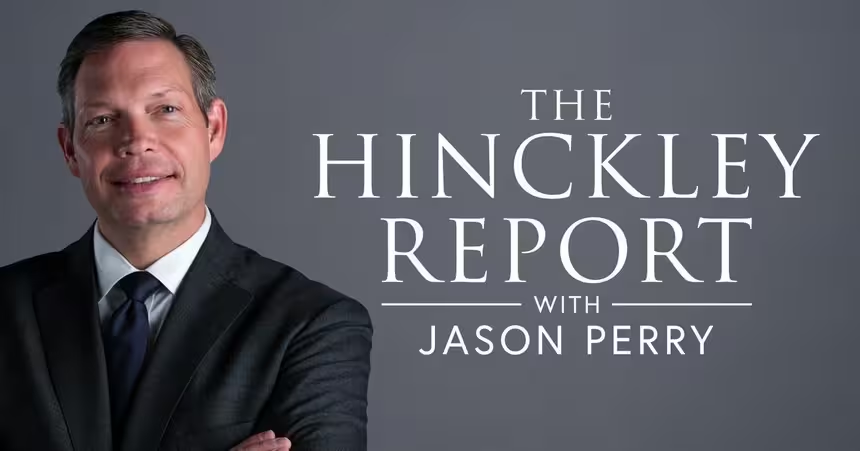
The Hinckley Report
Hosted by Jason Perry, each week’s guests feature Utah’s top journalists, lawmakers and policy experts.Providing Support for PBS.org
Learn Moreabout PBS online sponsorship♪♪♪ male announcer: Funding for "The Hinckley Report" is made possible in part by the Cleone Peterson Eccles Endowment Fund.
Tonight on "The Hinckley Report."
Jason Perry: As Utah leaders push back against a federal mandate, some local businesses celebrate vaccine milestones.
With the debt ceiling deadline looming, Congress once again nears the brink of a government shutdown.
And tensions flare as citizens debate the future of Utah's natural resources.
♪♪♪ Jason: Good evening, and welcome to "The Hinckley Report."
I'm Jason Perry, Director of the Hinckley Institute of Politics.
Covering the week, we have Dennis Romboy, editor and reporter with "The Deseret News."
Chris Bleak, a lobbyist with RRJ Consulting.
And Maura Carabello, President of the Exoro Group.
Thank you for being with us this evening.
I want to jump right into what happened in Washington DC with direct impacts on the state of Utah, and, Maura, let's start with you.
There was a time when we didn't really talk about government shutdown so much, it was like this wouldn't happen, but it seems like this is, like, a regular occurrence now.
Maura Carabello: Right, and by, "There was a time," most of our history, right?
It's a rather new phenomenon that this--what has been seen before as really rudimentary is now controversial, and it's brinksmanship.
And, you know, what it shares is that it's everyone's fault, it's Republicans and Democrats, again, and depending on what side of the game you're on is how you play this game.
But we have to get out of game playing, I think, and that's what this shows is that we bring it to the brink every time, and really as we all know this kicked the can just a skosh, right?
We have another debt ceiling conversation in less than two weeks, and then in December we will have this brinksmanship all over again.
And so, I think the more you hear about whose fault it is, the more it points to the fact that this is a singular issue in which I would give 50/50 on both parties for using this as a tool, and it's a tool with consequences, right?
This affects every single citizen, it affects Utahns directly.
And the rhetoric at a time when we're recovering or hopefully, knock on wood, recovering from a pandemic to add this level of gamesmanship, I think, is entirely unacceptable.
Jason: Well, that's just such an interesting point.
I want to get some impacts on the state of Utah, but, Chris, this is an interesting observation here too, because there will be a blame game.
We'll kick the can down the road for a while, it's not gonna shut down right now, at least not so far, right?
So, we've got it till December, how do these elected officials play this one?
President Biden's, you know, the first 100 days is one of those periods of time that everyone watches to see if he can get an agenda through, which may give an observation of what he might be able to get through the rest of his time, how do these-- really both sides of the aisle take advantage or take the blame or make sure they don't get the blame, which is-- Chris Bleak: Which unfortunately to Maura's point is really what everyone's aiming for, rather than the other points.
So, I'm gonna be on the, let's not be hypocrites, get off the hypocrisy bandwagon, that's gonna be my theme today.
It's time for them--you know, they run their quotes that if they're in the majority, they're gonna run their quote one way, if they are in the minority, they run the quote the other way, and start pointing fingers at each other.
Let's finish with that and focus on the things that matter, let's have the policy debate, let them debate amendments on, you know, Biden's $3.5 billion--trillion dollar package.
Debate that, but get rid of the brinksmanship that impacts our economy, impacts the trust that people have on us, impacts the dollar, the things that matter, and set up the stability that we've had for so long here in the United States.
So, Dennis, we talk about the political aspects of this for sure, but what everyone's hinted at a little bit is at the heart of this is the people themselves, and Utah has some experience, going back to 2018, 2019, during the last long government shutdown, and there were some very real and significant impacts on employees in the state of Utah.
Dennis Romboy: Yeah, and even going back to the 2013 shut down.
So, this has been going on for, you know, several years now, every other year it seems like.
But, yeah, our national parks, obviously, are impacted by this, and all the businesses that surround them, hotels, restaurants, outdoor recreation outfitters, that type of thing, and then we have about 5,000 employees at the IRS Service Center in Ogden, there's civilian workers at Hill Air Force base, all of them are impacted by this, their paychecks are furloughed, their paychecks are not delivered on time.
There's real world impacts here in Utah when the government shuts down, and even just the specter of a shutdown, I think, can have impacts on our tourism here in the state.
Jason: So, Maura, last time they shut down, about 10,000 people in the state of Utah were either furloughed or working without pay, and then, of note, Ogden has the highest concentration of federal workers in the west.
I mean, Utah takes a direct hit.
Maura: And we have, as Dennis said, we have more parks, state parks than anyone else, and again, this also impacts the larger economy because of the lack of faith and confidence in the financial system, and so it does affect private business when it happens.
And, as Chris said well, there's lots to argue about that's substantive.
This is essentially our budget, and this should not be a partisan issue.
And we do have to have discussions about debt and debt ceilings, but this allowance for this, what used to be really routine, we need to go back to that, because I think when you look at the international image as well as the economies that we have in the United States, it's too dependent on this queuing from our government, and if we can't get the fundamentals right, the faith and confidence that you'll see in the private system and the international community will impact not just those who get employed and paid by the government, but the markets around those.
Jason: Yeah, that's true, Chris, I'm remembering during this last government shutdown as our federal--as our national parks controlled with federal money, as those started to shut down, the state of Utah, in, kind of, in the interest of the people surrounding those employees, as Maura just said, the hotels, the restaurants, et cetera.
It was such a compelling issue that the state of Utah actually stepped in and took care of the bill for a little while to open them back up.
Chris: Yeah, which created a whole, sort of, other ripple effect on, you know, things that they have to do and getting ultimately reimbursed, which just become problematic.
And it's cutting off our nose to spite our face.
Let's--we here, let's debate the policy, let's debate the things that matter, and let's allow, you know, our tourism, our economy to continue to grow, thrive.
We've got great fundamentals here, and we don't want to screw that up with things that don't matter.
Dennis: And if you recall in 2013, the state spent $1.6 million to keep the national parks open.
Looking for reimbursement from the federal government, they received about $600,000 of that back, so that was $1 million that the state put out that they never got back from the federal government for keeping the parks or reopening the parks during that shutdown.
Jason: It was a little bit of a nod to the needs of those communities, not just those workers.
There are a couple proposals that Congress is considering right now in terms of some spending, some packages, but, Dennis, I want to go to a story that you've been writing about, because Senator Romney had some very specific comments about what he's calling The American Families Plan, which he's calling the Human Infrastructure Bill, and some of the pieces that are put inside that bill that may have some direct impacts on the state of Utah, but for him this week, particularly on marriage.
Dennis: Yeah, so he's arguing in the Human Infrastructure Bill, so called, there's provisions for penalties for people that are married.
So, for example, if you are single parents with a couple of kids--or unmarried parents with kids, that you would pay less in taxes than if you were to marry and have those kids as well.
So, that's his argument that part of this bill would actually discourage people from getting married, and that's, I mean, he's opposed to it generally, I believe, but that's another reason for him to be opposed to this bill.
Chris: And one of the things that I think is always to be concerning, you know, debate the policy, I don't understand how they're gonna pass, you know, the infrastructure bill and look to pass a $3.5 trillion bill and not lose the narrative in that, but the one thing to be mindful of is there are provisions in that bill that have not been really publicly discussed.
One that comes to mind, as you've seen our financial institutions, a big sector here in our economy here in Utah, has talked about the monitoring of transactions, or getting certain data on what transactions get done and accounts.
The Biden administration, Congress is talking about as a tax avoidance issue, making sure that people are paying their fair share of taxes.
Fair point, but the financial institutions are concerned that this could erode privacy and the ability for people to interact, you know, reasonably within the financial system.
So, I'm guaranteeing there are provisions in there that have not been fully discussed because we're focused on, in my mind, circus stuff, rather than, what are the issues that are in this bill that could have a real world impact on Utahns?
Maura: So, further context on that.
Romney was really critical to crafting the infrastructure compromise, and we know that's a written bill, and we can evaluate it.
What we're talking about is the 3.5, the second one.
I think some important things are in play here, it's not written.
So, we don't have that, and that's part of the angst, frankly, and people are now grandstanding on certain issues, and, unfortunately, I think that the marriage one is this frivolous one, because I would dare say I don't know a couple who in the throes of discussing their eternal love are also discussing what the tax consequences may be.
So, I don't--I mean, maybe, maybe for folks you know.
So, I mean, I--again, the red herringness of it.
But to it, the positioning that's going on about the 3.5, which is all it is right now, there is no written bill, it's largely in the Democrats's court, because they're having a fight, obviously, with their sides, but it is instructive how you see a senator leading the way on the bipartisan infrastructure, the bipartisan infrastructure is being held up by this larger conversation, and this larger conversation, from what I've seen so far, is lacking substance.
Chris: Well, they start to lose the battle on narrative when they don't have something concrete that they can point to.
You know, you've seen a lot of talk that there's a new tax on Venmo transactions.
Now, I don't think that's actually what's in the bill, but if they don't solidify what they're actually wanting to sell, they'll start to lose the narrative battle, which then potentially sinks what they want to do.
And that's where they've got to be careful.
You've already got the issue, is it too much money?
You know, the inflation concern, some of these things, but then you start to lose the battle on other pieces that are in it.
Maura: And to show how hard the battle is right now, we know that Pelosi is infamously known for never bringing anything without the vote.
She is an epic nose counter, and you have a rare mode with a president who was a former senator, so knows the system, he has rolled up his sleeves and started making phone calls.
So, the consequence, we talk about the first 100 days and what this means to the Biden administration, Biden is participating in a very engaged way at this point, but the Democrats are clearly having a hard time coming up with the agenda, because you haven't seen them pro offer that--those sort of core principles.
Jason: It'll be so interesting to see how we get more clarity, but also these become campaign issues for both sides into the next election.
Speaking of these issues on businesses, let's talk for a moment about this vaccine requirement put out by President Biden.
Dennis, this is a big week for Senator Mike Lee.
Nine separate bills from him put forward to address the vaccine mandate that came from President Biden.
Dennis: So yeah, so he's marching to the Senate floor pretty much every day this week and all next week to propose bills to counter this vaccine mandate for businesses.
You know, the bottom line for him is it's unconstitutional, the president doesn't have the authority to do this.
These bills are DOA, they're getting shot down immediately, which I'm sure he expects that.
And this may be more of I, I don't know if ploy's the right word, but just an attempt to call attention to this and bring up all these bills.
His Don't Jab Me Act, for example, just the title itself is a little bit inflammatory, I would say.
And, you know, these are not going anywhere, I think he's trying to make a point.
Jason: So, Chris, let's talk about the Don't Jab Me Act for just a moment, because in his statement about it, gives a little bit of an understanding of the arguments coming from the Republican Party, certainly from him as well, that I'd like to read to you and break down some of these pieces for us about how this may frame this conversation from his perspective.
Senator Mike Lee said, "President Biden now wants to force employers to act as a sort of medical police force.
They must impose a vaccine mandate on their workforce or be forced to pay a heavy fine.
Threatening the employment of millions of Americans and making employers become enforcers is not how our country will return to normal."
Chris: Yeah, I think there's a couple interesting things.
I will say I think Mike-- Senator Lee, I should say, is at least being ideologically consistent.
I don't--I haven't heard, I don't believe he's said people shouldn't get vaccinated, I believe he is, and so I think he makes a ideological, you know, constitutional argument that's a fair one to at least consider and look at.
Should the federal government be issuing, you know, rules through OSHA, as I understand it, to require vaccines?
I think that's a reasonable policy issue to discuss whether you're pro-vaccine, anti-vaccine, that's a reasonable argument to discuss, is focusing on who should be allowing that.
I personally think, and I think most of our legislature, our state policymakers agree, if business wants to mandate that for their employees, appropriate.
Let's get out of their way, but should the government be telling them what they can and can't do, those businesses?
I think that's a fair argument to be had.
Maura: We actually have an analysis from the Supreme Court on this very issue from the 1918.
So, we have had the congressional--we've had the Supreme Court discuss mandates and asked and answered on the acceptability of that mandate.
For me this is going no further than a senator who is up for re-election, and so I think that, Jason, you're right, he's holding down his ideological base, but I don't think there's a serious mindedness about it.
In fact, I think it's about bringing up issues that he's going to lean on, he's being challenged within his party, and I see this as him keeping those alive.
One thing I do also think that often gets lost in this discussion is that in these instances of what Biden is doing on the mandates and on the balance between public and private, they are largely in concert with the majority of Americans.
He is not outside of the norm for what America is thinking in terms--what most Americans are thinking, and you see this in poll after poll.
This is not an anomaly, so he is representing what tends to be the majority of American's point of view.
Devil's in the details, right, you can--and polling is about a bigger thing, the implementing of it it's quite different, so.
Chris: Well, and I wish the folk--I think the Biden administration could spend more time focusing on, if you will, sort of the moral duty or obligation that we have as Americans, as world citizens, to get vaccinated and spend the focus and time and attention there, which I think would be more beneficial.
Americans will rally to a cause, we've seen that time and time again, and this is a cause that we should be rallying Americans to.
It is your moral, patriotic duty to do it.
Maura: So, that's the route that Governor Cox has taken, and I thought he's been quite articulate and persuasive on it, and Utah's looking at a 50% vaccination rate.
Jason: Let's talk about what the businesses are doing in the meantime when they're on their own, Dennis, because a few things have happened just this week in terms of trying to motivate people to get the vaccine, apart from these discussions that we have just started having.
For example, the Public Employees Health Benefit Program for the state of Utah just announced this week, they're going to start giving cash to people who get the vaccines, $250 to new vaccine recipients over 50, $100 to those age 12 to 49, $50 to people who receive the booster, and their idea is it's going to cost them $4 million, but it's going to save them money over time in terms of healthcare.
I want to give you that backdrop, Delta Airlines is imposing a fine, well, a monthly surcharge, let's call it that, onto people who do not get the vaccine, and even the Utah Jazz are implementing vaccine or a testing requirement to come to the games.
Talk about how these businesses are approaching this, how this is being received.
Dennis: Well, you know, I don't know if they're they're taking this up on their own, or if they--some of them maybe feel that they need to get ahead of the vaccine mandate coming from the federal government.
But these are all measures that these companies that are doing on their own have, you know, they can do that, they're--just like Chris was saying earlier, there's no issue with that.
The state now is offering--or the employees, Health Employee's Association is offering some incentives for that.
Just as a side note, my niece lives in Oregon, she's 13 years old, she got a vaccine, the state gave her $100,000 scholarship.
She was lucky drawn out of a group of students and young people who received vaccines, I don't see that happening here in Utah.
But it certainly is an interesting approach to encourage people to get vaccinated.
Jason: The connection between the businesses and these elected officials is interesting, 'cause even this week, Chris, there's, like, some rumors, I'm not sure--I want to know if you think there's truth to these rumors, that our own legislature may be trying to give them a block on businesses, private businesses, doing a vaccine requirement.
Is there any truth to that?
And and put that in context with the governor coming out saying, well, "If there is, I'm gonna veto, or I'll be opposed to it."
Chris: Yeah, the conversations that I've had with legislators and those leaders in our legislature, I don't think there's really have been any serious discussion about that.
There might be members that think that we should go that route and oppose it, but I don't think there was anyone in leadership or the majority of the legislature that was really considering prohibiting vaccines.
I think they believe strongly, let's stay out of government's way, we shouldn't be mandating that businesses require it, we also shouldn't be telling businesses that they can't do it if they think that's the best for their employees or their patrons, and so I think that was not--was going to be the approach the legislature would take.
Maura: But it's undeniable and ironic the criticism that the Republicans are heaping on some private businesses who are taking some pretty aggressive measures, and what a peculiar place to be, in which you're listening to these Republican who generally very much hold down the free market line and that messaging, right now I don't hear--it's peculiar to hear Republicans, sort of, criticize and wanna step into the private business space.
Chris: Well, and you're absolutely right Maura, the Republicans right now should be touting capitalism.
It's under attack, there's threats to it, they've talked about their concerns about it in the past, and here they should be saying capitalism worked on getting a vaccine to market quickly that we can we can put in people and has benefited us, and the private market is working, let business make their decisions, what's in the best interest of their customers and their employees, get out of the way.
Why, I don't understand why Republicans can't get out of the way on that and say, it's working, it's working right now, and stop interfering with that.
Jason: Well, go ahead Dennis.
Dennis: No, I didn't have anything to add there, I'm good.
Jason: Okay so, Dennis, I want to get to one issue that is no less controversial that is also an issue that continues to be brought up, and this is an issue of public lands.
Even this week, our Governor Cox is talking to the Western Governor's Association, and he brought up, as did several folks, this continued tug of war between the states in the West, we'll just take Utah in particular, and the federal government and decisions they make that impact the state of Utah.
Is that issue bubbling up again based on what you're hearing, particularly as it's connected with decisions that may be coming soon on Bears Ears?
Dennis: Yeah, this has kind of been a perennial issue, you know, I think there's a lot of optimism among Republicans here in this state when President Trump was in office that they could maybe, you know, deal with some of these issues once and for all as far as public land is--particularly with the, with the national monuments Bears Ears and Grand Staircase-Escalante.
You know, he did reduce the size of those monuments and, now for weeks now we've been hearing that the Biden administration is going to restore those back to the size that they were originally created.
And so, yeah, this is an issue that just keeps giving, I guess, and, you know, I don't know that there's a way forward here with our Utah Republicans in office and Democrats controlling Congress and the White House.
I think it's just going to go on for a while.
And again, if it's restored to the original size, then we might see lawsuits again, and it could just go back and forth until there's some kind of a congressional solution to this.
Chris: There is a way forward, and we've seen it before when Senator Bennett and Representative Matheson, Republican, Democrat, worked together with local officials on Washington County Lands Plan.
They were able to create a compromise that has been enduring and lasting, and I hate to see, if they restore it fully, and the locals don't feel like, you know, maybe there's no winning them over, then that would be the approach that, you know, the Biden administration would take, but if they don't create some sort of enduring compromise, then it'll get restored this go around, and four years or eight years later, it'll be shrunk, and we'll go back and forth, and it won't benefit anybody and allow the stability to say, how are we going to best utilize this land and those lands around it?
We'll just go back and forth on its size, and that'll be a mess.
Maura: Well, remember the Bennett process, and it was very good.
Since then, I think Utah has largely taken a rather obstructionist point of view in which they are just unaccepting.
To the Biden administration's credit, they have dug in on this.
They've paid multiple visits here.
They have had constructive conversations with locals.
I wanna be clear, when we speak of locals, that the indigenous tribes are the ones that are asking for this restoration.
And I think there's a very credible voice there with clearly a long history of use and reverence for this area, and I do think we need to understand that the Biden administration has taken a different point of view than, perhaps, the Clinton administration back in the day, and they have dug into the issue.
And there's a difference between due diligence and maybe what our congressional Republican delegation wants, but I do think the Biden administration has done their homework here, but you're right.
So, they'll take an action, and until we decide to work with the federal government, and in this instance I would hearken to Utah leadership, and say, yes, I know you're frustrated, but in fact it is federal land, and I don't agree with the obstructionist point of view that we often come to the table with.
And I know that there's generations of frustration there, but it is federal land, it isn't state land, and so I think if we--what happened with Matheson and Bennett is they put that aside, they put down the 20 years ago, you did this, and 25 years ago I did this.
And so, unless we come to the table--so I separate the issue of Bears Ears, in which I think the Biden administration has done their due diligence on this, to the larger perennial issue, and until we decide to work with the federal government, regardless of whether it's a Republican or Democratic administration.
Jason: Maura, while you're talking about this, let's do a connection to another land issue here, talk about generations of frustration, I wanna talk about what's happening in Little Cottonwood Canyon, because all these--some of these players come together also.
You are connected to this in particular, you're not neutral, I understand that, but I wanna get some feedback on this, because this is--this seems to be coming, whether it's an eight mile gondola through Little Cottonwood Canyon, this tour, a couple of our key resorts, but just like we talked about these bigger natural resource issues, people are divided on this one as well.
Maura: Right, this is a place where people can still voice their opinions to UDOT, Department of Transportation, if they want, but it's looking at how are we going to solve the transportation problem in Little Cottonwood Canyon.
And as you suggest, this has been a formal process of solving it for probably 50 years, and several solutions have come up.
The reason that I think it's interesting and exciting to look at a gondola is because it's the first time--I've been involved in this discussion for over a decade, and it's the first time I see a feasible, and by feasible, I think it is the most environmental friendly solution that I've seen, and that deeply matters when we're talking about our mountains, particularly the canyons in proximity to such density.
We have to protect those for the next generation or Utah is not what Utah is.
So, I think the gondola provides that solution, but it's also able to be built in under five years.
Sometimes Chris and I, we've been involved in these transportation issues, and the solutions are perhaps wonderful, but they cost billions of dollars and take decades to build.
This one-- Jason: Talk about that for a minute because you have been involved in transportation projects in the state for a very long time, Chris.
Chris: I don't fully understand why there's such consternation with the gondola.
You get cars out of the Canyon, which I think should be the real goal here, let's figure out a better way to get people into the canyon, to access the opportunities that are in the canyon.
We want people involved there, we want people out in there, but moving them in and out is the key here, and so we remove congestion, we remove pollution of people being up and down that canyon.
To me, it's a no-brainer, and I don't understand why there wouldn't be more enthusiasm for that kind of a proposal.
Jason: Our last 30 seconds, Dennis, anything you're hearing from the community about this?
Dennis: I think the community's divided.
I know that--I think Mayor Jenny Wilson from Salt Lake County is not in favor of the gondola.
So, you know, I don't think everybody's on board with the gondola, but you know the alternative is widening the road, is that right?
I mean, I don't know if that's a solution either.
Jason: We'll have to wrap this up, but the bus system is the alternative.
Dennis: So yeah, and I don't know that anyone's settled on any of these solutions at this point.
Jason: Okay, I know this one's going to continue to be discussed heavily in the state.
Thank you all for your great discussion this evening, and thank you for watching "The Hinckley Report."
This show is also available as a podcast on PBSUtah.org/HinckleyReport or wherever you get your podcasts.
Thank you for being with us, we'll see you next week.
♪♪♪

- News and Public Affairs

Top journalists deliver compelling original analysis of the hour's headlines.

- News and Public Affairs

FRONTLINE is investigative journalism that questions, explains and changes our world.












Support for PBS provided by:
The Hinckley Report is a local public television program presented by PBS Utah
Funding for The Hinckley Report is made possible in part by Cleone Peterson Eccles Endowment Fund, AARP Utah, and Merit Medical.