One-on-One
Vanessa Broadhurst; Tony Russo/Michael Shapiro; Bryan Felt
Season 2024 Episode 2744 | 27m 22sVideo has Closed Captions
Vanessa Broadhurst; Anthony Russo and Michael Shapiro; Bryan Felt
Vanessa Broadhurst, Executive VP of Global Corporate Affairs at Johnson & Johnson, talks about leadership & partnerships. Tony Russo, President of CIANJ & CEO & Publisher of COMMERCE Magazine, & Michael Shapiro, Founder & CEO of TAPinto, talk media & leadership. Bryan Felt, Director of Athletics and Recreational Services at Seton Hall Athletics, talks about his commitment to collegiate athletics.
Problems playing video? | Closed Captioning Feedback
Problems playing video? | Closed Captioning Feedback
One-on-One is a local public television program presented by NJ PBS
One-on-One
Vanessa Broadhurst; Tony Russo/Michael Shapiro; Bryan Felt
Season 2024 Episode 2744 | 27m 22sVideo has Closed Captions
Vanessa Broadhurst, Executive VP of Global Corporate Affairs at Johnson & Johnson, talks about leadership & partnerships. Tony Russo, President of CIANJ & CEO & Publisher of COMMERCE Magazine, & Michael Shapiro, Founder & CEO of TAPinto, talk media & leadership. Bryan Felt, Director of Athletics and Recreational Services at Seton Hall Athletics, talks about his commitment to collegiate athletics.
Problems playing video? | Closed Captioning Feedback
How to Watch One-on-One
One-on-One is available to stream on pbs.org and the free PBS App, available on iPhone, Apple TV, Android TV, Android smartphones, Amazon Fire TV, Amazon Fire Tablet, Roku, Samsung Smart TV, and Vizio.
Providing Support for PBS.org
Learn Moreabout PBS online sponsorship- [Narrator] Funding for this edition of One-On-One with Steve Adubato has been provided by NJM Insurance Group.
Serving New Jersey’s drivers, homeowners and business owners for more than 100 years.
RWJBarnabas Health.
Let’s be healthy together.
New Jersey Sharing Network.
The Turrell Fund, a foundation serving children.
The Russell Berrie Foundation.
Making a difference.
IBEW Local 102.
Lighting the path, leading the way.
The Port Authority of New York and New Jersey.
Moving the region through air, land, rail, and sea.
Horizon Blue Cross Blue Shield of New Jersey.
Here when you need us most.
And by The Fidelco Group.
Promotional support provided by Northjersey.com and Local IQ.
Part of the USA Today Network.
And by New Jersey Globe.
- This is One-On-One.
- I'm an equal American just like you are.
- The way we change Presidents in this country is by voting.
- A quartet is already a jawn, it’s just The New Jawn.
- January 6th was not some sort of violent, crazy outlier.
- I don't care how good you are or how good you think you are, there is always something to learn.
- I mean what other country sends comedians over to embedded military to make them feel better.
- People call me 'cause they feel nobody's paying attention.
_ It’s not all about memorizing and getting information, it’s what you do with that information.
- (slowly) Start talking right now.
- That's a good question, high five.
(upbeat music) - Hi, everyone, Steve Adubato.
We now welcome Vanessa Broadhurst, Executive Vice President, Global Corporate Affairs at Johnson & Johnson.
Vanessa, great to have you with us.
- Glad to be here with you today, Steve, - You got it.
Describe your role at JNJ.
- So I lead Corporate Affairs at Johnson & Johnson, and I think of my group as having three main buckets.
First, we do the corporate branding, so corporate brand equity in Johnson & Johnson.
We also have our global philanthropic efforts, including our global health equity presence.
And then my team also does our worldwide communications.
- And let me also say that Johnson & Johnson, a longtime supporter of public broadcasting, and our broadcasting as well at the Caucus Educational Corporation.
Vanessa, talk to us about, we have a heavy focus on leadership.
You're a leader at a leading corporation.
Your leadership journey, I know it's a really broad, big picture question.
How would you describe how you got to be in the lofty position you are at JNJ?
- Well, listen, I think there are a lot of factors that go into anybody's success, but there are a few things that I've tried to keep in mind during my career.
First of all, I'm a lifelong learner, and as you can imagine, when I was younger, you know, I thought a lot about my position, my next job, et cetera.
But I've really found that my career has been a patchwork quilt.
And essentially, there've been a lot of opportunities that I've taken.
And sometimes I ask myself, when I'm taking on new opportunities, you know, that maybe seem a little bit dynamic, maybe a bit of a stretch, hey, what's the worst thing that can happen?
You can do it.
You have to have con confidence in yourself and continue to advance.
I think the other things that have really helped me outside of my learning journey is I've had great mentors in this space.
You know, everybody needs a kitchen cabinet.
And I've had a set of great ones who have been able to advise me along the way.
- You know, one of the things that fascinates me about not just your role at Johnson & Johnson but the overall effort to deal directly with the challenge of health equity, but it's not air quotes, it's real, talk about what the challenge is and how you and your colleagues are facing it directly.
- Sure.
Well, thanks for the question.
It's a great one, Steve.
Health equity is tremendously important to us at JNJ.
It should be important to everybody.
So the premise is, and really we saw this dramatically play out during the pandemic, is that unfortunately in the United States, there are black and brown communities that don't achieve the same health care outcomes as other communities.
A lot of this is multifactorial.
It has to do with, you know, where you grew up.
Your zip code that you live in is the highest determinant for your health care in the United States of America.
It's also important abroad.
And at JNJ, we feel that a rising tide lifts all boats.
For all of us to be healthy, we all need access to great health care.
Corporate America and philanthropy, more specifically at your company, describe that mission.
- Yeah, maybe I'll take it to the premise at JNJ.
I think Joaquin probably talked to you about our credo.
- Your CEO, I'm sorry.
- Yeah, yeah.
- One second, check out our website, SteveAdubato.org.
It'll come up right now.
Check out that interview with the CEO of Johnson & Johnson.
Joaquin was terrific in there.
Go ahead, please.
- Yeah, fantastic.
So our CEO Joaquin Duato, I know, was on your show and probably talked a little bit about our credo, which is our North Star document that leads us at Johnson & Johnson.
And essentially, the first paragraph of our credo is about the patients that we serve as well as the health care providers, second, our employees, third, the communities in which we live and work.
And if we do all that appropriately, we're gonna benefit our stockholders.
That third paragraph is about our communities in which we live and work.
And that has been the principle document at JNJ since its inception.
Now, importantly, when we think about philanthropy, it's not just philanthropy at Johnson & Johnson.
We really believe that we have an obligation to live into and improve our communities.
So we do do a lot of philanthropic things at JNJ.
As a matter of fact, we have a very philanthropic workforce that has contributed, you know, close to $23 million in the state of New Jersey.
And we matched that 29 million into the state of New Jersey as a corporate match.
We also have a number of different health equity initiatives.
During the pandemic, I think we saw that COVID really illustrated some of the health disparities we have but also fundamentally how critically we depend on frontline health care workers.
And JNJ has a tremendous commitment to health care workers.
We have basically supported nurses- - Nurses from all the- - since our inception.
- There's a whole campaign that's been going on that JNJ supported around nursing, the nursing profession, well before COVID.
- Well before COVID, but during COVID, we decided to make a commitment of $250 million over 10 years to supporting frontline health care workers.
As you've said, Steve, we've been supporting nurses for decades and decades.
Additionally, we have a program we call ORTHE for short, which is Our Race to Health Equity.
- And that is a- - O-R-T-H-I?
O-R-T-H- - O-R-T-H-E, - E. - Our Race to Health Equity, it's an acronym.
- My bad, I apologize.
- That's okay.
- And, you know, essentially, this is our 100... You know, during the pandemic, we made a $100 million initial commitment to Our Race To Health Equity, which was a commitment that we were going to do over five years.
We actually, as of the end of last year, had spent $80 million on this initiative in the US.
And it's really to change the course of health equity in the United States.
It is supporting and partnering with many, many community-based organizations.
You know, at JNJ, we know how to develop drugs and medical devices, and we like to have the expertise of the community come through, and partner with different not-for-profit organizations to make sure that we are getting that local impact that we know is so desperately needed.
- And so beyond the philanthropic piece, the partnering is a big deal, the sharing of resources, the doing things together.
A big part of our sister series, "Lessons in Leadership," is talking about partnerships and how organizations, private sector, not-for-profits, they're able to do things collectively and together that neither one would ever be able to do alone.
Vanessa Broadhurst from JNJ, I wanna thank you so much for joining us.
We appreciate it, all the best.
- Thanks, Steve, really appreciate your time.
- You got it.
Stay with us, we'll be right back.
- [Narrator] To watch more One on One with Steve Adubato find us online and follow us on Social media.
- We're now joined by our two longtime friends, Anthony "Tony" Russo, President Commerce and Industry Association of New Jersey and CEO and Publisher of Commerce Magazine, our longtime media partner, and Michael Shapiro, founder and CEO TAPinto and founder and CEO of Hyper Local News Network.
Tony and Michael, great to have you with us.
- Thank you, Steve.
Good to be here.
- Great to be here, Steve.
- So what's, in Italian, you know, there's a word for this.
It's called a (italian word).
Tony knows exactly what I'm talking about.
It means a marriage, sometimes arranged, back in the day, but this is a partnership between the two organizations.
Tony, talk about it.
- Yeah, thank you Steve, and I've known Mike now for a few years, and, you know, it's getting harder each month to really stay in front of people with all the information overload that's out there, both in the internet and in just people's busy lives, right?
Working remote.
So Commerce Magazine, I'm happy to say our partnership with you has been great, but we were founded in 1968, and we're always looking for ways to improve what we do and how we deliver the magazine.
And so when Mike and I saw each other last November, you know, he and I just talked about this partnership, and it's great because his platform, and I'm sure he will talk about it, just the access to that local news media, right?
In terms of the people that want to cover or want to get their news from the internet, you know, Mike's platform is great that way.
So when we signed the partnership with Mike, you know, launched a couple, about three months ago, it's been nothing but great news in the sense that our exposure now, you know, to the local communities that Mike serves with his platform has just been great.
So, and it's a way to deliver the business stories that we capture to his audience.
- And as Tony said, all of us are looking for different, innovative, creative, impactful ways of reaching different audiences.
Michael, talk about your platform, platforms and how it's connected to the work that Tony and his colleagues are doing.
- Sure, Steve.
So I founded, you know, TAPinto now about 15 years ago, and about 10 years ago, we started franchising to enable people to start local news sites in their communities.
Today we have almost a hundred franchise TAPinto local news sites in New Jersey, covering over 125 municipalities.
Each site provides original local news reporting every day.
They have to be objective, they have to follow the Society of Professional Journalist ethics.
Recently, over the last year or so, I've been approached by a number of print newspapers, radio stations, one-off hyper-local news sites who have said to me, "Hey, we love your platform.
We'd love to be part of it, but, A, we wanna be able to keep our own branding.
And two, all of the back office services that you provide to your franchisees, we'd like to be able to have them a la carte."
So in the recent months, we've been able to create the technology to enable us to white label our platform.
- What does that mean, white label?
- Yeah, basically it enables us to provide our platform to Commerce Magazine so that they're able to be on our platform, seamlessly share content and sell advertising between all of the publications in the network, yet a hundred percent keep their own branding.
So when you come to the Commerce Magazine site online, you don't see TAPinto anywhere on it, including the domain name, but it's running on the same platform.
And my view is, is that it's kind of the ultimate in collaboration.
It's publications coming together where they can seamlessly share content with each other.
So for example, when Commerce Magazine does a business story, a statewide business story, they can share that content with all of our local TAPinto sites in the network.
Similarly, if a TAPinto site's say in Westfield covers a business grand opening story, they can share that story with Commerce Magazine, and now Tony's magazine has that content.
- And Tony, a follow up on that, really the media, the competitive nature of the media, I would love to get your perspective a little bit.
Mike talked about it in terms of the collaboration and the partnership, but how do you put that competitive nature on the side for the betterment, I don't even know if that's a word.
- It is.
- Of the, thank you.
Of the viewers, the readers?
Because I just love consuming my information in a digital way.
I love also reading in print sometimes.
So Tony, talk a little bit about how you put any type of competitiveness aside to collaborate for the people.
- Yeah, it's a great question, Mary.
And I don't see, I see Mike's platform again as an advantage to Commerce Magazine.
'Cause we publish once a month, right?
So the stories that we track down and develop, they have to have a longer shelf life because it comes out each month.
And we want those stories that you don't normally see on TV or read anywhere else, whether it's, and you both know that we have about 900 members from virtually every business sector.
So it's really interesting when you find out those stories, and we like to cover those personal stories, develop it, and then using Mike's platform, it reaches local audiences that we wouldn't reach before.
I mean, we're a business-to-business magazine working with TAPinto now, when somebody's sitting in their house wanting to hear the high school sports score, or what's going on with the mayor and town council, and we're Mike's, you know, business partner, and they maybe wanna see what happens in Trenton, maybe we're covering a story of what it happens in Trenton.
It's just another resource for them.
So we don't see it as a competition.
We actually see it as like, again, a complement to, again, what Mike has done through his network.
Just a way for us to get the business stories out there to the local people that normally maybe wouldn't see it.
And that's good.
Again, we come out once a month, so, you know, it's something that we have to just be strategic about, what we're gonna cover.
Each month is a different theme.
For example, the June-July issue's gonna be about tourism and hospitality.
We'll put it up to Mike's platform and wait to see who reads it and get the feedback.
- And along those lines, my monthly column on leadership runs in commerce and has for many years.
It's an important platform for us.
But one of the things that's interesting, Michael, is that for years, Mary asked the question about competition or our perception of competition, for so many years, the print folks and the traditional TV media folks, we were too isolated, insulated, and caught up in our perception of competition to understand that the only way is to collaborate, partner with others on other platforms.
What the heck do you think took so many folks so long, Michael, to realize we just can't survive with the status quo and the way we've been putting information out?
Long-winded question, I know, but there are newspapers across this state that don't exist anymore or no more on Saturdays, or they had to know a long time ago the model had to change, Michael.
- Yeah, I mean the writing's been on the wall for a long time, but, you know, I think that, you know, people who have been doing something for a very long time tend to do things the same way for a very long time.
You know, whereas like, you know, when I started TAPinto, I, you know, candidly, and, you know, I talk about this, I had no journalism experience, and I had no sales experience.
And I think that that's enabled us in large measure to be successful because I didn't have any kind of preconceived notions of what we should be doing.
I wanted to kind of invent it and evolve it as we continue to grow to make it into the best product for our readers, for our advertisers, and to provide really meaningful local news coverage.
And you know, to your point, I mean, even today there are still publications that have walls erected to prevent people from reading their content.
And to me, it should be about breaking down walls.
You know, to me, you know, you shouldn't have to decide between paying for food and knowing what your town council is doing.
But in on many local news sites, as well as many local newspapers, you can't find out what your town council is doing without paying to get the news.
Our view is totally different.
It's to democratize the news, and we make our money through advertising.
So bring the people to the site, get them excited about the local news, get them, you know, keep them coming back, and then reach out to local businesses and say, "Hey, do you wanna reach our readers?
Here's how to do it."
- Last question on my end.
Michael, you started 15 years ago with TAPinto, right?
- Yeah.
- Is this what you thought it would be, or did you not have any idea what it could or would be?
- No, I really had no idea what it could or would be.
My original thought, like I had started it in New Providence, New Jersey, and then within a few weeks, people in Berkeley Heights and Summit reached out to me and said, "Hey, we heard about this.
Can you start it in our town?"
And then I left my job in New York to do it full-time.
I had been an attorney in New York, and my original idea was, I was just gonna build those three sites, their traffic, their revenue, their content, and I built them the profitability.
We were able to bring on a full-time editor.
But I kept getting more and more requests from people to expand to their town.
And that's what led me to come up with this idea of franchising local news, which to this day, still nobody in the country has done.
But to me, that's how you keep local news local, yet provide the infrastructure and support to publishers so that they're not worried about, "Oh, I need to invoice that client.
I need to design this ad."
They can focus on news and the advertising, and everything else is done for them.
- Mary, before I let everybody go, you get most of your information from TAPinto in Westfield.
- A thousand percent, TAPinto Westfield.
I actually know the local writer for TAPinto Westfield, and it's just, it's great, and I can't stress enough just to get that local information, especially when both of my boys were in high school, getting that local information, having your kids featured because they did something really cool.
Joey has been featured in TAPinto for writing a musical in his senior year.
- Joey, your son.
- My son, Joey, but it's just a great platform.
So Bravo to both of you now working together, collaborating when so many other people are out there just trying to like, you know, butt heads.
So it's really exciting and refreshing to see.
- Butting Heads is so boring and unproductive.
To Tony, to Michael, I can't thank you enough.
And Tony, lemme just say this, you've been a great longtime media partner, and you've helped expand our audience and our brand, and hopefully it's mutual.
Thank you.
And Michael, wish you and your team all the best as well.
Stay with us, folks.
We'll be right back.
- [Narrator] To watch more One on One with Steve Adubato find us online and follow us on Social media.
- We're now joined by Bryan Felt, who's director of Athletics and Recreational Services at Seton Hall University Athletics.
Good to see you, Bryan.
- Good to see you, Steve.
- I have to disclose, as Bryan knows, I am a hardcore, along with thousands and thousands of others, a Seton Hall University basketball fan.
Also taught at the university a few years, and they're one of our higher ed partners.
Let me ask you this, Bryan, right out of the box.
- Yeah.
- An exciting time in college athletics, but also a very uncertain time as we do this program with decisions being made by the NCA, out of court settlements, NIL.
- Right.
- The transfer portal.
What, is it chaotic, exciting, what?
- It's a mixed bag.
I think the problem is we've got more questions than we have answers, right?
And you always, you know, you start somewhere.
That's where we are right now.
There's a lot to be determined.
Certainly we've seen a lot of the news in the last, you know, week.
We were together actually, the Big East athletic directors in our annual retreat meetings in Florida when all of this was unfolding with the house NCA case.
So there's a lot to be unpacked here.
There's a lot to still come, I think in the next six months as this case, as this, you know, this settlement kind of folds and comes unfolded.
So yeah, it's exciting in a sense because we know there's change.
I personally wanted to always, I invite change.
I love change.
I think we all, you know, it's, that brings excitement, but that brings also concern and it brings questions.
You know, how's this gonna get done?
How's this gonna look?
How are we gonna do this?
You know, so there's a lot of that.
So it's a mixed bag.
- From a coaching perspective.
You have some great coaches at Seton Hall.
There's, and it's not just because I'm a fan.
There are great coaches in college sports, but to what degree, from your perspective, Bryan, has college coaching slash leadership changed if a player can only be there for a year and then leave, or you don't have enough money in this name, image, and likeness fund, right?
You and I have talked about that as well.
How much has it changed actually, the art of leading and coaching in college sports?
- Oh, I think in some aspects, it's some, in some specific sports, it's drastic.
You know, take your football and your basketball, which, you know, tend to be the two most high profile collegiate sports, primarily because they're popular and because they generate revenue.
Absolutely, you're right.
So I think in that case, those sports, being a coach at that level, it's a much different ballgame.
I mean, you've seen it, right?
We've seen the great coaches across, you know, the landscape of college basketball and football in the last several years, pick up and leave, you know?
It's just a different game in a sense now.
But that being said, there's a lot of great young coaches, as you have you pointed out.
We have, you know, several of them.
One of them specifically in men's basketball who, you know, hey, he's gonna adapt.
- Some of these so-called old school coaches or coaches at an old school style discipline, in your face, telling you some really hard truths.
The argument that some have is that with today's athletes, and I only use air quotes because I can't believe how people generalize.
Well, they're all the same.
No, they're not.
Question, do you believe that coaching slash leading with younger athletes today, young college athletes, is different because kids are different?
18, 19, 20 year olds are different.
Social media has made it different.
Our culture has made it different.
So you can't be that hard school coach, old school coach.
You've got to manage them, those players differently, or they're gonna leave.
- Yeah, I think a lot's generational, I think certainly times have changed.
Young people have changed, but so have, you know, I think it's all relative.
I do believe that, yes, to your point, yes, there is changes in the generational kind of aspect of the whole thing that you have to adapt to.
But I've seen coaches just have to, I think the big word I use with our coaches, you just have to have balance.
And that's the the key thing.
You know, you have to balance.
Yeah, you could be tough and you could really get the work.
You know, your work ethic could be one that you're just driving.
That's, a lot of our student athletes want that.
They wanna be challenged.
They wanna work hard.
If you're gonna be an athlete at this level, you've gotta put in the work.
So you've gotta be, you know, you've gotta be pushed a little bit.
But at the same time, there's balance.
Because I think this is today a kinder generation and especially with everything that they've seen in terms of DE&I and mental health.
- Sure.
- You have to be able to balance it, understanding that aspect too.
And I think if you have that balance, you can still be the kind of coach you wanna be.
You just have to bring other aspects into it.
- Before I let you go, you mentioned the mental health piece.
- Yeah.
- We're taping this conversation after the tragedy of a very talented 30-year-old player on the PGA tour, committing suicide literally days after.
One of the top players in the ladies professional golf tour.
As we literally, as we're doing this program, very young, very talented, said the pressure has been too much for her.
Talked about her mental health.
Question, to what degree do you believe that the stigma around mental health has changed significantly, Bryan, to the point where most talented, effective, successful college athletes, young athletes can acknowledge I'm struggling, without being seen as weak?
- Yeah, I think a hundred percent.
It's so critically important to what we do here at Seton Hall every day with our athletes.
We provide them mental health, you know, training and necessary tools they need to be able to cope with the things that they have to, they're challenged to deal with.
And student athletes deal with a lot.
I mean, their schedule's not like a normal student in college, you know, between practice and classes and travel and competitions.
There's a lot to balance.
And you're seeing it with these professional athletes, it's still a lot.
And I think we talk about it more.
And I think that's the good thing.
I think it's healthy to talk about it more.
I think it's healthy to acknowledge it and to be able to let people know that we're there to help.
So yeah, I think it's a hundred percent very, very real and very, very critical to our success in the athletic department.
- Tough stuff.
Well beyond the X's and O's of sports.
This you've been listening to and watching Bryan Felt, Director of Athletics and Recreational services, Seton Hall Athletics at Seton Hall University.
I'm Steve Adubato.
Thank you so much for joining us.
We'll see you next time.
- [Narrator] One-On-One with Steve Adubato is a production of the Caucus Educational Corporation.
Celebrating 30 years in public broadcasting.
Funding has been provided by NJM Insurance Group.
RWJBarnabas Health.
Let’s be healthy together.
New Jersey Sharing Network.
The Turrell Fund, a foundation serving children.
The Russell Berrie Foundation.
IBEW Local 102.
The Port Authority of New York and New Jersey.
Horizon Blue Cross Blue Shield of New Jersey.
And by The Fidelco Group.
Promotional support provided by Northjersey.com and Local IQ.
And by New Jersey Globe.
- If you register as an organ donor, you have the potential of saving up to eight lives.
- My neighbor passed away.
His eyes were actually donated and that person now can see.
- Not only can you save a life, but if something should happen to me and I'm no longer here, I know that in some small part I'll live on in someone else.
- Say yes, save lives.
- Say yes, save lives.
- Say yes, save lives.
- Be an organ and tissue donor.
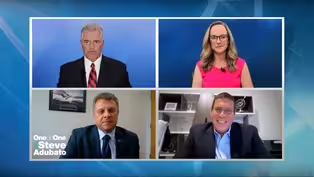
Anthony Russo, Michael Shapiro talk leadership & the media
Video has Closed Captions
Clip: S2024 Ep2744 | 11m 52s | Anthony Russo, Michael Shapiro talk leadership & the media (11m 52s)
Collegiate athletics, leadership, & athletes as role models.
Video has Closed Captions
Clip: S2024 Ep2744 | 7m 35s | Collegiate athletics, leadership, & athletes as role models. (7m 35s)
Investing in partnerships & improving quality care at Johnson & Johnson
Video has Closed Captions
Clip: S2024 Ep2744 | 8m 25s | Investing in partnerships & improving quality care at Johnson & Johnson (8m 25s)
Providing Support for PBS.org
Learn Moreabout PBS online sponsorship
- News and Public Affairs

Top journalists deliver compelling original analysis of the hour's headlines.

- News and Public Affairs

FRONTLINE is investigative journalism that questions, explains and changes our world.












Support for PBS provided by:
One-on-One is a local public television program presented by NJ PBS