One-on-One
Vanessa Lillie; Kaila Boulware Sykes; Dena Grushkin
Season 2025 Episode 2783 | 27m 56sVideo has Closed Captions
Vanessa Lillie; Kaila Boulware Sykes; Dena Grushkin
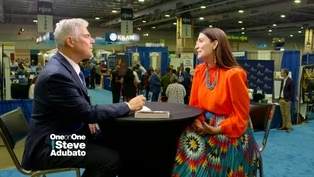
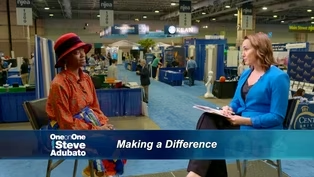
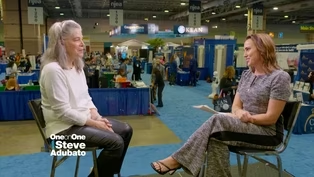
Vanessa Lillie, author of "Blood Sisters," talks about the issue of missing and murdered Indigenous women. Kaila Boulware Sykes, Co-founder of Hidden Gems Literary Emporium, talks about her non-profit’s mission to promote literacy. Dena Grushkin, Retired School Teacher and Access Educational Consultant for the NJEA, discusses the importance of integrating wellness into the curriculum.
Problems playing video? | Closed Captioning Feedback
Problems playing video? | Closed Captioning Feedback
One-on-One is a local public television program presented by NJ PBS
One-on-One
Vanessa Lillie; Kaila Boulware Sykes; Dena Grushkin
Season 2025 Episode 2783 | 27m 56sVideo has Closed Captions
Vanessa Lillie, author of "Blood Sisters," talks about the issue of missing and murdered Indigenous women. Kaila Boulware Sykes, Co-founder of Hidden Gems Literary Emporium, talks about her non-profit’s mission to promote literacy. Dena Grushkin, Retired School Teacher and Access Educational Consultant for the NJEA, discusses the importance of integrating wellness into the curriculum.
Problems playing video? | Closed Captioning Feedback
How to Watch One-on-One
One-on-One is available to stream on pbs.org and the free PBS App, available on iPhone, Apple TV, Android TV, Android smartphones, Amazon Fire TV, Amazon Fire Tablet, Roku, Samsung Smart TV, and Vizio.
Providing Support for PBS.org
Learn Moreabout PBS online sponsorship- [Narrator] Funding for this edition of One-On-One with Steve Adubato has been provided by NJM Insurance Group.
Serving New Jersey’s drivers, homeowners and business owners for more than 100 years.
The Russell Berrie Foundation.
Making a difference.
Horizon Blue Cross Blue Shield of New Jersey.
Robert Wood Johnson Foundation.
Working for a more a healthier, more equitable New Jersey.
Englewood Health.
Citizens Philanthropic Foundation.
New Jersey Institute of Technology.
NJIT makes industry ready professionals in all STEM fields.
New Jersey Sharing Network.
And by United Airlines.
Promotional support provided by The New Jersey Business & Industry Association.
And by NJ.Com.
Keeping communities informed and connected.
- This is One-On-One.
- I'm an equal American just like you are.
- The way we change Presidents in this country is by voting.
- A quartet is already a jawn, it’s just The New Jawn.
- January 6th was not some sort of violent, crazy outlier.
- I don't care how good you are or how good you think you are, there is always something to learn.
- I mean what other country sends comedians over to embedded military to make them feel better.
- People call me 'cause they feel nobody's paying attention.
_ It’s not all about memorizing and getting information, it’s what you do with that information.
- (slowly) Start talking right now.
- That's a good question, high five.
(upbeat music) - Hi everyone, I'm Steve Adubato.
Recently my colleague Jacqui Tricarico and I traveled with our team to do a series of interviews down at the 2024 New Jersey Education Association Convention Annual convention.
We talked to educators, educational administrators, authors, poets, people engaged in a whole range of activities, impacting our kids, impacting our schools in the world of education.
Here now are those conversations.
Jacqui, myself and some really interesting people in AC.
- So many interesting people here.
They're not all traditional educators, but one educator who is educating through her writing is Vanessa Lillie, who is the author of "Blood Sisters."
It's a mystery novel, and the Washington Post said that this is the 2023 best mystery book of all the other mystery books around.
Good to have you with us.
- Thank you.
- Set this up for us, "Blood Sisters."
- Absolutely.
So "Blood Sisters"'s a story of a woman named Syd Walker.
- She's an arche- - Archeologist.
Yes, exactly.
And her sister goes missing, and she's been away from Oklahoma for a while, so she returns to where she's from in Oklahoma to make sure her sister isn't another missing and murdered indigenous women statistic.
So the book deals with that crisis, but also takes me back to where I'm from in northeastern Oklahoma and sharing my community.
I'm Cherokee.
And so it's an opportunity to talk about the history of the place within the pages of a thriller.
- And actually the front cover of the book is a New York Times bestselling author, C.J.
Box.
Lemme just read what C.J.
Box said, "This book sets its hooks on page one and then pulls relentlessly and colorfully through buried secrets and rediscovered Native heritage."
That's powerful stuff.
- That's such a...
He's incredible.
I mean, he's a number one bestselling author, and so that meant a lot that it engaged him.
I think as a thriller author, we have a real obligation to readers to make sure you keep those pages turning.
And so for me as a writer, it's a fun challenge to think what history means a lot to me, what do I wanna share with people?
And then, how do I make it a page turner?
So that's what's really fun in the genre.
- But you are not just simply entertaining people with the book.
It also talks about deep, complex, multifaceted issues, environmental preservation.
We'll go through a couple.
What does that have to do with this book?
- Absolutely, so Northeastern Oklahoma, where I'm from is what was called the most toxic town in America.
Most of the bullets from World Wars I and II were pulled out of the ground in northeastern Oklahoma.
And when that industry went bust, the whole community was left with giant caverns and it became toxic to the town that lived there.
So the real community has had the aftermath.
And so I set my story there, not only because I'm from there, but because I wanted to elevate those environmental justice issues that are happening ongoing within this community.
- You also talk about in the book postpartum depression.
- Mm.
So that's an issue for me, especially in my... Actually in my debut novel, especially, I was a new mother struggling.
And so for me to write about the complexity of motherhood, to really put an issue out there that sometimes is hard to discuss is a big part of why I'm a writer, is tackling the darker side of things and just putting it out there for people to hopefully feel a connection.
That's why we tell stories, I think, is to connect with people.
So postpartum was a big part of that.
- Vanessa, let me ask you this.
Why do you think so many Americans seem to be, quote unquote, not that interested in the culture you're talking about by saying, "Well, that was then, that's not my family, that's not my heritage."
But it's incredibly, incredibly important, especially if you wanna understand our country.
- Well, indigenous history is American history.
We were here thousands of years before anyone sailed over on any boat.
And so if you care about the place in which you live, if you care about the traditions that came before you, and you must understand indigenous history and understand how it's happening now, it's not just history, it's present day there.
- What do you mean now?
- Well, right now there and there are hundreds and even thousands of indigenous communities all over the country.
I mean, for viewers within their own backyard, there is an indigenous community.
There are people who are on that land before they were there.
And likely they have events, they have ceremonies.
I now live in Rhode Island, the tribe there, the Narragansett Tribe has an annual powwow every year.
They have community outreach program, so anyone can go and connect to their indigenous community.
And I actually think that reconnection is one of the most important parts of being an American, because it helps us understand where we came from.
And I think can even heal some of the fractured nature that many of us feel right now, because you're connecting to the authenticity of the land and the people itself.
- Along those lines, being fractured, being separated, bifurcated, however want wants to describe it, is often based on misconceptions of a people, of a group of people.
The most common misconceptions about the indigenous community or indigenous communities across this country?
- There's so many stereotypes, but I think, you know, media has done that for a long time.
But what's exciting is that within publishing, within TV and film, if there are anybody who's watched maybe "Killers of the Flower Moon" or "Reservation Dogs," there's the actual voices of indigenous people are being represented authentically through them.
It's not white people telling an indigenous story.
It's indigenous people getting a chance at the microphone.
- Why is it so important?
As to, who tells a story?
In this case, you're telling the story.
- That's right.
Who tells a story is incredibly important because you don't fall into stereotypes and assumptions.
You're actually telling your own truth and story.
And I think as viewers, readers, you can feel that in a story when something is authentic.
We're smart enough with social media and everything, we know instantly if it's a perspective that comes from real lived experience or just stereotype and assumption.
- Okay, so in many ways you're working to uncover stories in this mystery, the mystery Blood Sisters, the author is Vanessa Lillie.
It's a novel mystery.
But then I go, wait a minute.
There's a piece of this that has to do with LGBTQ+ themes.
- Absolutely.
Yeah.
So two-spirit is a term used in indigenous communities- - Say it again.
- Two-spirit.
- Two-spirit.
- So I'm two-spirit.
Two-spirit could be associated with the term queer, lesbian, but the point is not necessarily about what most people would think of identity in that way, because that's a colonial idea.
This idea of a binary, it's men, it's women, right?
That came in on the boats with the churches with their religious view.
Before that ever step foot in America, there was a view within indigenous communities, a view still held that a person isn't necessarily just a man or a woman.
It's a spectrum, and not only was that an accepted view, it was a respected view.
It wasn't until colonialism, the boats came over, the church came over that people started to disparage, isolate and other people who you might think of as queer or LGBTQ+.
And so it's powerful to me as a two-spirit person to write about that, so people understand there is another way of looking at this, and it's a way that is kind and understanding and accepting of a view that way predates any of the colonists coming over.
- Well, Vanessa, as we do this program a few days after a historic and significant presidential election, new Congress as well, there are many political analysts who have argued that some of that result is pushback on the exact diversity and the exact ideas that you just described.
- What I believe in- - [Steve] What do you say to those folks?
- I believe in my heart that this country does need some kind of a healing.
And I do think the fact that we are founded by people who suppressed and oppressed, who enslaved, that does create a sickness in people.
And I think to heal our hearts and our spirits and our souls, part of that healing is understanding our indigenous history and supporting the original people who are here to make sure they can thrive successfully in communities, in ways in which they have never been allowed to thrive in this country, because suppression and oppression was the means for taking away land and resources, as any colonial state does.
So I actually do think that this election to me just says that we do need to reconnect to the things that make us great.
And part of that is the diversity of this country and actually understanding where we came from and how we can support the original people who were here.
I think that'll be a healing for us.
- Vanessa Lillie, who is the author of "Blood Sisters," powerful, compelling, important stuff, check out this book.
And we are at the NJEA Convention here in Atlantic City.
Vanessa, thank you so much for joining.
- It's been an honor to be here.
Thank you.
- You got it.
I'm Steve Adubato.
Stay with us.
We'll be right back.
- [Narrator] To watch more One on One with Steve Adubato find us online and follow us on Social media.
- Hi, I am Jacqui Tricarico, Senior Correspondent for One-on-One, and I'm here at the New Jersey Education Association's Convention in Atlantic City.
And so pleased to be joined now by Kaila Boulware Sykes, the co-founder of Hidden Gems Literary Emporium.
So great to have you with us.
- Thank you.
Thank you for having me here- - Thanks for taking the time.
So let's talk first about Hidden Gems, it's something that you and your husband Raymond created a couple years ago.
Tell us about what it is, and how and why you wanted to start it.
- That's a good question.
Ray and I, we grew up as avid readers and so when we had our son, Truth, when he was one we automatically wanted to surround him with as many books as possible.
So we'd take him to sa book store in Ocean County and we were disheartened because we didn't feel welcome.
People were pointing at us and whispering, and when we were buying our books the manager makes a phone call and tells whoever he was talking to, that we were leaving.
So we just get in the car and we're really frustrated that we had this experience with our son who was so young, and he had to be exposed to that.
And so, but honestly, we just started praying and we asked for an opportunity where we can open a bookstore where everyone would be welcome, and we promised to make the books affordable and we said we even make them free.
And five weeks later we had the biggest event in New Brunswick, New Jersey, we had to shut the street down, there was over 500 people.
Everyone got a free book and that- when things happen for you like that, it was just a clear sign to us that we were on the right path.
- What was the community support at that time, because you had something happen to you that was negative and you turned it into a positive, which not everybody does.
- That's true.
- What was the community support like in New Brunswick?
'Cause I know you and your husband went to school there and you're living there now, so talk about the community support.
- It was amazing and the response was automatic.
People would donate books to us and we would just advocate for our goals and for the world of better books and more books, and better access that we saw.
And we were overwhelmed with 1,000s and 1,000s of book donations, we had to get a storage unit very quickly, and it really just snowballed.
- What's next for where you're looking to be able to deliver these free books to people who need them and people who really want them in our state?
- Yeah.
And it's interesting the way your experiences work and how they shape you, and how they kind of also remind you of where you started.
Because when we started we had this dream and this goal of creating what we call a book Fair on Wheels.
And it was a bus that was converted into a literary magical experience that we would do and bring to our programs on our book tours, and so we really feel like that's the direction that we're going now.
So all of our programming with schools and events, community events is still running regularly, but I actually just got a call from a woman-owned construction company.
They have a bus for us, they know about our book tours, our prayer is to go from New Jersey to California this summer, and so... - So a big road trip to bring books to kids, to people all throughout the country.
- All throughout the country.
- And this is one of many, there's been others in the past, you've done book tours.
- Yes, and they're literally- and of course the first time we did it, especially our parents, like, "Are you crazy?
You wanna drive cross country, give away free books?"
But we always felt like you have to meet people where they're at, and we love our work so much and we've seen it, what happens when you put the right book in a child or an adult's hand, and how it can change their day or even their life.
And so not everyone can make it to New Brunswick, but we can make it to however many cities as possible.
One time we got a call from Florida, they were having a back to school bash, and so we planned our tour around that event.
And it was just- (sighs) I would be here all day telling you about all of the magical stories of just that tour alone.
- Talk about how you envision and where your organization is going to keep making sure books get in the hands of kids, and how important literacy really is.
- And it's hard and we talk to teachers all the time, especially after COVID and how hard it was to teach children to read during that time, and the effects afterwards.
And from the beginning, all of our programming has operated off of the fun factor.
And so even through my program with public health, we talk about intrinsically motivated behaviors.
So we can say to our children as much as we want, "You need to read, you need to read, you need to read."
But if they don't feel inside that they want to read, it's not going to be something that they take with them for the rest of their lives.
Reading, I feel like reading can make you live longer, it can help to curb things like Alzheimer's, it relieves stress.
There's so many great things that come with reading, but we have to keep that fun element in it, when we're talking about children or adults.
- Give us an example of how you've seen your work directly impact kids in our community, I'd love to hear some examples of that, during the time that you've been doing this.
- We have a program called The Read Festival.
And so it's a half day long program where we come in, everything is literacy and literarily based, but it's fun.
We bring in DJs, we have games, we have prizes.
And I remember the first time we ever did that program, it was for 500 fourth and fifth graders in Piscataway at Arbor Elementary school, they're always asking us to come back.
And at the end of the event, the very last little girl I talked to, she pulls me on my skirt and she says, "Excuse me, I'm gonna remember this for the rest of my life."
And I'm like, "That was the goal," because we all remember being in school, meeting someone or listening to someone and now you're changed as a young person, and how that can affect you for the rest of your life.
So that little girl, I will never forget this little girl.
- How'd that make you feel?
- It made me- and I was still, I was a mom at that time too.
And so when, as a mom, when you're going into schools with other people's children, it's like now everyone is your child.
This is like the- one of the teachers said to me yesterday, "The mom network."
That's what it is.
And so I'm looking at this little girl and I don't know anything about her, but I'm like- I feel like I did my job for the day.
- What is the hopes for the future of the organization, the future for you, your husband, your family in this journey that you've been on?
- For any mom or for any just person that loves your family, you just want people, your family and the people who you meet, you, to live happy, healthy lives, doing whatever it is that you wanna do; and to follow your passion.
If this is your passion, my hope for you is that you do this for the rest of your natural born life.
So for my family, our passion is service, community service, giving through books.
We also have a food distribution program run through Treehouse Cares.
And so we're just givers and we're lovers, and we always tell people that we're servants of our creator and our community.
And so that's what I want for our family, for us to continue to do the work that we do and just be happy and healthy doing it.
And for Hidden Gems, I want us to travel the country giving away free books.
I want us to keep going into schools, putting on bigger and better festivals.
And I want, and now I'm pausing because sometimes when you see- you asked us a big question, like, "What do you see?"
But we can sometimes stop our own selves from accepting what's possible, but I want to see the literacy rates get better in our country.
By the time my son is 15, we should have a much better percentage of children and adults who can read in this country.
So can Hidden Gems help with that?
I think so.
That's why- - Yeah.
We all need to do our part.
- That's right.
- What else can we do?
What can people do right now to help with your mission?
- That's a great question.
Well, I think change always starts in your own home.
Make reading more fun for your children, for the children in your immediate circle.
We talked about parenting and easing up a little bit when we're teaching our children.
Let's ease up, let them have fun and let them tell us what they want to read.
As far as supporting Hidden Gems, you can always donate to our Book Bus.
And I feel like it's right there, I feel like it's so close, we would even be bringing it to this convention next year.
And so you can donate there at gofundme.com/hiddenGemsHome.
- Great.
And we'll have the information up so people can find out more.
It's been so great to learn more about Hidden Gems and your story.
- Thank you.
- Thanks so much for speaking with us today- - Thank you.
Thank you so much.
- We'll be right back after this.
- [Narrator] To watch more One on One with Steve Adubato find us online and follow us on Social media.
- Joining me now is Dena Grushkin.
She's a retired school teacher and now is supporting educators through NJEA's ACCESS model, we'll get to in just a second.
Great to have you with us, Dena.
- Thank you.
Happy to be here.
- So, retired educator, 36 years in education.
Talk about that journey for yourself.
36 years, that's really something to celebrate.
- I have to say, and when I share my experience over with people, I always say that I was gifted a really fabulous career, you know?
I mean, it's amazing to wake up in the morning and go and do what you love, right?
We should all have that opportunity in our lives.
And so, you know, I mean, there were mornings, trust me, that I woke up and I'm like, "Ah, my God," you know?
But they really were few and far between, you know?
I really just really loved it.
I was laughing and doing what I love, which is learning and teaching and working with people who also, you know, like-minded.
We're all about kids.
And so it's been a fabulous career and one of the reasons why I'm still in this field in a different capacity.
- Right, I wanna talk about that 'cause 36 years dedicating yourself to students, to children here in New Jersey, and switching it just a little bit to then now support educators, folks just like yourself.
Talk about that, describe the ACCESS model and what it is and how you are supporting educators - in the state.
- Sure.
So I think it's important to share just a little bit about how I came to it.
As a school teacher, I was always very, very concerned.
It was of utmost priority for me to make sure that my kids were not just learning, but feeling safe and comfortable in the classroom.
And so when I came to, when this job opportunity came, it was an incredible opportunity for me to continue to do the work that I love so much, which is in the area of wellness.
And so I came on board and I've been now working as an ACCESS Consultant for the past year and a half.
This is my second year.
I was chosen to work in Trenton.
The ACCESS program works in three districts in the State of New Jersey, at Trenton, Camden, and we just started in Cherry Hill.
And so I'm working in Martin Luther King High School, working with teachers, working on a variety of different things, coaching, restorative practice work, working on curriculum, and teaching yoga.
So I'm having the opportunity to do, again, do what I love in the classroom.
- So yoga ties into mindfulness to self-awareness, to having a good mindset to be taking care of oneself so you can take care of others in so many ways, right?
- Absolutely, absolutely.
- How have you seen the educators respond to what you're teaching in terms of mindfulness and how do you see it as more important now than ever when we hear so much about teacher burnout?
- Well, you know what?
When I started in my career 36 years ago, no one was really concerned about how I was thinking and feeling.
And quite honestly, they really weren't thinking about how kids were feeling either.
And so we've evolved, you know.
I have to say, I think the problems have always been there in terms of kids experience, you know, growing up is hard, teaching is challenging, and so the levels of stress have always been there.
I think certainly over time that those kinds of things have changed, but they still exist.
And so, but the difference is now is that it's become really integral part of the program that we do.
So we work on not just how can we bring these practices to the kids, but how do we bring them to the teachers?
How do we train teachers?
How do we teach teachers, first of all, to be aware and in touch with what they need for themselves in order to be their best selves in the classroom?
And then in turn, taking those practices and turn-keying them into the classroom and teaching them to kids.
And so the response has been incredible, you know.
Rarely, I have to say, I don't even ever think I've ever heard a teacher say, "Oh, this is a waste of time."
You know...
They love it.
They love learning about what they can do for themselves and how they can bring this kind of work into their classroom, so they've been very, very responsive.
- Can you give us an example of that, how you've seen this really directly impact a teacher in such a positive way?
- At Martin Luther King, with the person that I'm coaching, 'cause that's my responsibility, to go in and coach teachers, we've been working on PLCs.
Professional Learning Communities.
And so they take place once a week and we have an opportunity to meet with teachers, the entire staff.
Not all are together, but they're broken down into groups.
And we meet with them and we work on these restorative practices.
And so we always start with breath work, sort of calming ourselves down, and then moving into this space.
We talk a lot about how we can make adjustments, sort of take a critical look at ourselves as teachers and how we can make adjustments to the way we bring ourselves into the classroom.
And that can be looking at the way, our teaching style.
It can be the way we organize ourselves.
It can be the way we choose to handle behavioral problems.
And so based on all of those, those are just an example of some of the things that we work on, based on those and working on ways in which to make adjustments to ourselves so that we can build better relationships with kids.
And so we work on that.
We work on breath work, we work on movement.
And generally speaking, by the time that PLC is done, that 45-minute period, teachers are feeling like they've been heard, they've been validated, they've shared, they got a little bit off their chest, and they're breathing better, they're moving better, and then they're headed back to the classroom.
- So we're seeing this in Trenton, we're seeing in Camden, now in Cherry Hill.
Do you anticipate it'll keep growing and be reaching other- - What I'm really, really proud of about this program is that the NJEA, we are the only union in the entire country that actually takes teachers and brings them back into the classroom.
And so it's teachers supporting teachers.
And so when I walk into a school, I'm not accountable to the administration, but I am accountable to the teachers that I work with.
So it's a really beautiful relationship because there is trust.
You know, no one feels judged.
They feel that they can come to me and they can share and we can talk.
And what happens between them and myself is strictly between them and myself.
And so I think that it is an incredible program, and I would, you know, I mean, I would love to see other unions throughout the country begin a program like this.
We're pretty special here.
- Well, Dena, thank you for the 36 years in the classroom with our students and now continuing that in the classroom with our educators.
Thanks so much for taking the time to speak with us.
We appreciate it.
- Thank you.
- So, for Jacqui Tricarico and myself, and our entire team down in Atlantic City at the 2024 New Jersey Education Association Convention, we thank you so much for watching, we'll see you next time.
- [Narrator] One-On-One with Steve Adubato is a production of the Caucus Educational Corporation.
Funding has been provided by NJM Insurance Group.
The Russell Berrie Foundation.
Horizon Blue Cross Blue Shield of New Jersey.
Robert Wood Johnson Foundation.
Englewood Health.
Citizens Philanthropic Foundation.
New Jersey Institute of Technology.
New Jersey Sharing Network.
And by United Airlines.
Promotional support provided by The New Jersey Business & Industry Association.
And by NJ.Com.
- New Jersey Institute of Technology has supported New Jersey businesses since 1881, when it was founded as the Newark Technical School and through their partnership with the non-profit New Jersey Innovation Institute.
They're igniting innovation and delivering transformative products and services throughout the state.
Learn more at NJIT.edu and NJII.com.
Bringing justice to missing and murdered Indigenous women
Video has Closed Captions
Clip: S2025 Ep2783 | 9m 35s | Bringing justice to missing and murdered Indigenous women (9m 35s)
How Hidden Gems Literary Emporium is promoting literacy
Video has Closed Captions
Clip: S2025 Ep2783 | 10m 42s | How Hidden Gems Literary Emporium is promoting literacy (10m 42s)
Integrating wellness into school curriculums
Video has Closed Captions
Clip: S2025 Ep2783 | 8m 49s | Integrating wellness into school curriculums to improve overall well-being (8m 49s)
Providing Support for PBS.org
Learn Moreabout PBS online sponsorship
- News and Public Affairs

Top journalists deliver compelling original analysis of the hour's headlines.

- News and Public Affairs

FRONTLINE is investigative journalism that questions, explains and changes our world.












Support for PBS provided by:
One-on-One is a local public television program presented by NJ PBS