One-on-One
Vanessa LoBue, Ph.D.; Margaret O’Reilly; Sakina Pitts
Season 2023 Episode 2607 | 27m 58sVideo has Closed Captions
Vanessa LoBue, Ph.D.; Margaret O’Reilly; Sakina Pitts
Graduate Program Director and Professor of Psychology at Rutgers University-Newark, Vanessa LoBue, Ph.D., discusses how COVID-19 impacts parents and their children; Margaret O’Reilly, Executive Director at NJ State Museum, highlights the museum’s connection to our past and present; Sakina Pitts, Principal of Newark School of Fashion and Design, discusses the impact of inclusive fashion.
Problems playing video? | Closed Captioning Feedback
Problems playing video? | Closed Captioning Feedback
One-on-One is a local public television program presented by NJ PBS
One-on-One
Vanessa LoBue, Ph.D.; Margaret O’Reilly; Sakina Pitts
Season 2023 Episode 2607 | 27m 58sVideo has Closed Captions
Graduate Program Director and Professor of Psychology at Rutgers University-Newark, Vanessa LoBue, Ph.D., discusses how COVID-19 impacts parents and their children; Margaret O’Reilly, Executive Director at NJ State Museum, highlights the museum’s connection to our past and present; Sakina Pitts, Principal of Newark School of Fashion and Design, discusses the impact of inclusive fashion.
Problems playing video? | Closed Captioning Feedback
How to Watch One-on-One
One-on-One is available to stream on pbs.org and the free PBS App, available on iPhone, Apple TV, Android TV, Android smartphones, Amazon Fire TV, Amazon Fire Tablet, Roku, Samsung Smart TV, and Vizio.
Providing Support for PBS.org
Learn Moreabout PBS online sponsorship- [Narrator] Funding for this edition of One-On-One with Steve Adubato has been provided by The Turrell Fund, supporting Reimagine Childcare.
NJM Insurance Group.
Serving New Jersey'’s drivers, homeowners and business owners for more than 100 years.
PNC, Grow Up Great.
PSEG Foundation.
PSE&G, committed to providing safe, reliable energy now and in the future.
New Jersey Sharing Network.
The North Ward Center.
The Port Authority of New York and New Jersey.
Moving the region through air, land, rail, and sea.
And by Community FoodBank of New Jersey.
Promotional support provided by NJBIZ.
Providing business news for New Jersey for more than 30 years, online, in print, and in person.
And by New Jersey Globe.
- This is One-On-One.
- I'm an equal American just like you are.
- The jobs of tomorrow are not the jobs of yesterday.
- I'’m hopeful that this is the beginning to accountability.
- Life without dance is boring.
- I don't care how good you are or how good you think you are, there is always something to learn.
- I did do the finale, and guess where my trailer was?
A block away from my apartment, it couldn'’t have been better!
- People call me 'cause they feel nobody's paying attention.
-_ It'’s not all about memorizing and getting information, it'’s what you do with that information.
- (slowly) Start talking right now.
- That's a good question, high five.
(upbeat music) - Hi everyone.
Steve Adubato here.
For the first time we are honored to introduce Dr. Vanessa LoBue, who is Graduate Program Director and Professor of Psychology at Rutgers University.
Good to see you, professor.
- Thanks for having me.
- We are taping on Valentine's Day.
No particular significance to that but I'm curious about this.
Your research focuses heavily on the emotional development of children, particularly around the impact three years plus into COVID.
The most significant findings are?
- Well, the most significant findings are that babies seem to be okay.
They seem to be functioning normally.
They seem to be being, they can recognize that people wearing masks are people, they can remember people who are wearing masks.
The real impact seems to be on parents.
- On parents?
- Yeah.
- Be more specific.
How are we-- - Well-- - Dealing with this?
- Well, I guess the answer is that we're not, or you know some parents are just feeling really anxious and depressed and stressed from the pandemic, which is really understandable.
But the real issue with that is that parents' mental health trickles down and affects children's mental health.
In fact, the biggest predictor of anxiety in children is anxiety in their parents.
- Let's play this out for a little bit.
All of us who are parents have experienced all kinds of emotions, feelings, and still do, not just related to COVID, just the world we're living in.
And so here's the thing I keep thinking about.
Is it our job as parents to keep from our children the anxiety, the depression, the feelings, the emotions, and the crap we're dealing with?
Is it our job?
Hey, just keep it away from the kids.
- I wouldn't say that that's our job but I think that being a parent can be, I'm a parent of two.
I have a five-year-old and an eight-year-old.
They were at home for a big part of the pandemic.
And I don't think keeping our stress away from them is necessarily the answer.
I think the answer is that we have to remember to take care of ourselves sometimes too.
So it's not that we should hide it from them, it's that we should remember that our own mental health matters.
Oftentimes we try to shield our kids from everything.
I mean, that's the instinct, right?
Shield them from our anxiety and our depression.
But I think the better response is to, you know, take care of our own mental health too, when we can.
- Let's be more specific.
So I'm heavily into "wellness," and on a sister program called Lessons and Leadership.
I do with my colleague Mary Gamba.
We talk a lot about the connection between wellness and leadership, wellness and functioning in our professional lives.
But I can't count the number of people that I've coached in that work as leadership coach.
I don't have time for this wellness thing.
I have things to do, do you have any idea what my schedule is?
Do you know what time I'd have to get up to take a walk?
Talk to those folks.
- Well, that's the very issue.
It's that our own mental health, our own wellness, our own wellbeing tends to take a backseat.
And, you know, this is true for kids, for people who have kids and people who don't have kids, right?
Like, work comes first.
All of these other issues come first.
And when you're a parent, it's like the kids obviously come first but I don't think what parents realize is that our own mental health affects them in a lot of ways that we can't control.
So we can try to shield them all we want from our own mental health issues.
Maybe you don't want your kids to see you upset but they do see it.
They notice.
And I think that we, our own emotionality shapes theirs in ways that we're not even aware of.
You know how anxious moms may be less responsive to their kids or they might be a little too responsive to their kids, you know, for the helicopter kind of parents out there.
So I think that what I'm saying is that this is an excuse to take care of yourself, right?
So taking care of yourself is actually good for your kids.
- What do they say on the airplane?
Put on your-- - Put on your mask first.
Your own mask first.
- Put on your mask first.
That is a metaphor for obviously the rest of our lives.
Shift gears if we could.
This is by the way, Dr. Vanessa LoBue, who is professor of psychology at Rutgers University, director of the graduate program there, professor talk about the learning loss of our children three years plus into COVID.
Where is it most prevalent and what do we need to do?
- That is a really great question.
So a month or two ago, the New York Times, I believe, put out this article showing this real dip in standardized test scores for kids this year after the COVID-19 pandemic.
And the headline was something about like biggest drop in 20 years or something like that.
And it is true, there was a drop in standardized test scores this year which makes a lot of sense.
But what I would say is looking at the actual data from recent standardized test scores, it-- - One second.
Sorry for interrupting.
Doctor, our team is telling us this data comes from the National Assessment of Educational Progress and team in post-production, if we could put up that website so people can find out more.
I'm sorry, Vanessa, please pick up.
- That's okay.
What I was saying was that there was a dip, but in general, if you look at the trends over the last 20, 30 years, we're doing okay.
And if you actually look at the data, it's not every child that has experienced this drop in test scores.
It seems to be the kids who were already struggling and the kids who didn't have the resources they needed during the COVID pandemic.
So I would say that the take home from this isn't that our kids are doomed.
We've been through a lot, you know, all kids go through something.
So kids after 9/11 were different than kids before 9/11.
You know, we go through these, kids before Katrina were different from kids after Katrina who experienced this.
I don't think all is lost.
But I think the thing to learn here is that the kids who suffered the most were the kids who were behind anyway.
So what the pandemic has done is it's increasing the gap that already exists.
- You know, my colleague Jacqui Tricarico, who is the executive producer of Think Tank and one of our correspondent, we went down to Atlantic City for the teacher's convention and we spoke extensively with educational leaders about supporting our teachers.
There is a shortage, I'm not gonna get into the policy questions, which we're doing with legislators on the federal and the state level and local level as to what can be done should be done.
The impact, the emotional, psychological impact on our teachers who are so incredibly important in being there for our kids.
Please, got a minute left.
- I mean, there's a huge impact on our teachers and teachers were sort of thrown in the middle of a political crossfire here where-- - Not what they signed up for.
- It's not what they signed up for.
And they're doing their best.
And many of them went back before the rest of us went back.
My husband is a middle school math teacher, September, 2020, he was back in the classroom while most of us were at home.
So I think remembering that the teachers wanna be safe but they also wanna teach our kids and they deserve our support.
We should give them as much support as possible.
The kids who are doing well are the kids who got support and resources during the pandemic.
And the kids who didn't do well are the kids who felt that they didn't have the resources that they needed.
So the thing to remember is everybody wants the same thing.
You know, everybody wants our kids to be doing well, our teachers to be doing well.
So remembering that their stressed too, and they have families at home, and that we should support them through these difficult times is important.
- Well said.
This is Dr. Vanessa LoBue, Graduate Program Director and Professor of Psychology at the Rutgers University, our state university.
Professor, thank you so much for joining us.
We appreciate it.
- Thanks so much, Steve.
- You got it.
Stay with us.
We'll be right back.
- [Narrator] To watch more One on One with Steve Adubato find us online and follow us on Social media.
- We're now joined by Margaret O'Reilly, Executive Director of the New Jersey State Museum.
Margaret, good to see you.
- Good to see you too, Steve.
- Tell folks why museums, particularly the state museum in beautiful Trenton, New Jersey, our state capital, why museums matter now more than ever in 2023?
- Well, you know, museums collect our past and preserve that past and tell us about the present day and imagine the future.
And they're places that dialogues happen.
They've been proven to make us healthier.
People who attend museums are healthier.
You have a better quality of life if you attend museums.
So they're really important, integral to our day-to-day lives.
- Explain that a little bit.
I'm around the corner from the Montclair Art Museum.
Do not go there enough.
Should go there more.
I go there and I feel better.
Why?
Explain that a little bit more so people understand.
- Because you know, I think that you connect with, you connect with yourself first of all, if you're looking at art, let's talk about art.
That's my area of expertise and that's what Montclair has.
You get a sense of wellbeing by looking at art.
It makes you calmer or it makes you think or it makes you engage in your community in a one-on-one way with a piece of art.
You're having a dialogue with a piece of art.
And I think it takes you outside of yourself and all those other worries and fears can just melt away.
- Now you've been in the museum business you've been at the State Museum 35 years.
- 35 years in May, yeah.
- First of all, congratulations.
- Thank you.
- And thank you for your service to the state.
- It's the best job in the state.
But don't tell the governor.
- Well, of course, but you want that check every two weeks.
Sometimes I make the mistake of saying I love my job so much, I can't believe I get paid.
Which is not a smart thing to say.
- Right.
- So I wanna be clear on this.
I have passion for what I do and I've expressed that enough, more times than people want.
Why do you have passion for what you do?
- You know, I got into this business because I was an artist and I started at the museum as the graphic designer here, and was trained along the way by people who knew my love of art.
And I was also trained as a painter.
And I think I've stayed because every day I learned something new.
I work with very passionate people.
You know, we're not just art curators here.
We're scientists and historians and archeologists.
And I learn something from them every day.
And when I walk through the galleries I can see the result of our work in the interactions that people are having with the artifacts on view.
It's extraordinary.
It's an extraordinary business to be in.
- I'm curious about this three years plus into the pandemic.
All of us who are heads of organizations, particularly not-for-profits.
Now are you a state, I wanna be clear on this.
Are you state entity, agency?
- We are a state agency, yes we are.
- With funding directly from the state budget.
- Yes, we get an appropriation from the state budget.
And we also have a non-government 501C3 organization, the New Jersey State Museum Foundation that helps us fundraise from folks who can't give money to government entities.
- Okay.
So during these three years plus in the pandemic the level of state funding stayed the same, did you get some of the federal money?
Talk to us.
- Yes, we got a little bit of federal money and of course we were shut down.
So we needed every penny of that appropriation to retool our operation.
We are an onsite service organization, obviously.
People come to museums.
So how do you serve entities when you can't come here anymore?
So we had to use that state appropriation to buy equipment to do video programs to do digital interactions with our visitors, to photograph some things that had never been photographed so we could share them with the public.
So that appropriation kept us going and kept our staff employed.
- Now, you talked about museums being connected to the past but museums when they're really good, yours is, also connects us to the culture that we're living in.
The Me Too movement, the Black Lives Matter movement.
How has the state museum connected to those movements which are so integral to our culture today and the very near future and beyond?
- Certainly our exhibitions try to be relevant.
So whatever topic we might be presenting we want to make sure that people see themselves in those exhibits.
It's not Margaret O'Reilly's voice in those exhibits.
It's the voice of the makers of the art, of the history that's happened in any given time.
So we wanna make people feel present and connected to what they're seeing on view here and in our programming as well.
- So I wanna be clear, it's so interesting, I talk to our producers all the time about this.
We have a lot of comedians we're interviewing today and a lot of artists and musicians.
And I think to myself, is it our job to select exhibits, guests, whatever?
And I'm not saying our work is as important as yours but there are exhibits you have that sometimes you're not a fan of, that you may not be connected to.
But our job is to ask ourselves, how do we connect to different parts of the community even if it's not something I relate to.
Am I making too much of that?
- No, no, you're absolutely right.
There are things that, and again, I'll go back to art 'cause that's my wheelhouse.
There's art that I love and there's art that intellectually I understand and I know why it's important and I know why it'll be relevant to communities, but it wouldn't be the thing I'd put necessarily in my home.
But that's important for me to show I'm a professional and we all have to do that here.
We go beyond what interests us.
It might start with what interests us, but then we go beyond that.
- Right.
Yeah, it's too narrow what interests some of us.
- Yeah, absolutely.
- Real quick, children and museums talk about that experience.
How young is too young and why is it so important?
- No, you know, no age is too young.
We have young learners programs from age six months to five years because those are the museum goers of the future.
So we wanna certainly start them early get them to understand this cultural experience.
'Cause for a lot of our young visitors we're their very first cultural experience.
They come here on a school trip or their folks bring them from one of the neighborhoods in to visit us.
So we want them to be comfortable here, feel like this is their place.
It's a place where they can learn, where they can have fun.
You can have fun at museums.
People think that we're stayed, but we're not.
- And real quick before I let you go what's the Small Explorers Program?
What is that real quick?
30 seconds.
- Small Explorers is our partner program with the PNC Foundation.
They've been funding that for more than five years now.
That helps young learners.
That's one of our major initiatives that's been going on for years.
Again, to teach them about culture, to teach them about going to museums.
To teach in literacy - Museums matter.
You just heard that from... - They absolutely do Steve.
- They do.
Margaret O'Reilly, Executive Director of the New Jersey State Museum.
The website had been up, has been up.
You can find out more about the state museum.
Margaret, wish you on all your colleagues at the State museum all the best.
Thanks so much for your service.
- Thanks so much Steve.
Appreciate talking to you today.
- You gotta stay with us.
We'll be right back.
- [Narrator] To watch more One on One with Steve Adubato find us online and follow us on Social media.
- We're honored to be joined by Sakina Pitts, Principal of the Newark School of Fashion and Design.
Ms. Pitts, great to have you with us.
- Good morning, Steve.
Glad to be here.
- Hold on one second.
First, I need a description of the school and what's up with the Parsons logo I see behind you?
- Yeah.
So we are one of the newest high schools to the fleet of Newark Public High Schools here in this great city.
We are Newark School of Fashion and Design powered by Parsons School of Design.
And so that is the logo and branding that you see in the background, and it means so much.
You know, the superintendent had a vision to extend CTE, you know, education for students.
And so along with data science, information technology, Newark School of Fashion and Design was birthed last year.
And, you know, it feels really good that Parsons locked arms with us, you know, based on a vision and a mission.
You know, this mission of a collaborative effort between K-12 education and higher ed.
And so when we talk about being empowered by Parsons they support us with writing the fashion curriculum.
They support us with vetting our fashion teachers, summer intensive programming, bringing industry experts into the space for our students.
We are looking for dual enrollment next year, creating a pipeline into Parsons, you know, when our students graduate.
So it's been an amazing journey thus far.
- Sakina, I'm curious about this.
We've had so many, again, as a Newark native, we were talking before we got on the air, you're from the south side of the city, I'm from the northern part of the city.
Your school is based in my old neighborhood in the North Ward of Newark.
And for those of us who are connected to Brick City, to Newark, our reputation precedes us, not always in a good way.
To what degree is the work at the school, the Newark School of Fashion Design, beyond the curriculum, beyond the students, beyond creating a pipeline into the fashion industry, which is so difficult to access, how much of the mission is stated or unstated predicated on changing the perception of the Newark public schools and more importantly the young men and women in those schools?
- Yeah.
- So that's why I'm glad that, you know, I have the opportunity to speak here today as a Newark student born and bred, reared by this great city.
You know, I love any chance that I get to demystify, you know, that perception and it's all about, you know, always writing the narrative, changing the narrative.
I mean, this is Black History Month, right?
And so how fitting that, you know, we're talking about this and closing equity gaps for black and brown students.
And so, you know, all of my students are either African American or Hispanic.
And so that is always the mission, you know, there is so much greatness happening here in this city.
And so anytime we get to shine a light, you know, we look forward to doing so, Steve.
- What kind of, I'm curious about this.
The students that you attract, I don't wanna say who are they because I'm sure there's a whole range of students, but do they have a strong interest in fashion or are they searching, because you'd have to have a reason to want to go to a school of fashion design and I'm curious about that.
- Yeah, so absolutely.
We have a criteria.
You can go on our website and see it, there's an admissions process.
And so what happens is students across the city have an opportunity where enrollment fairs are happening similar to colleges and universities where juniors and seniors in high school are looking at which colleges and universities they're interested in.
The same process happens here in Newark.
So every eighth grader across the city is learning about every high school, the opportunities, what they offer, the programs, and it's very competitive.
And so for Newark School of Fashion and Design, there's a criteria.
They submit a portfolio inclusive of five works of art.
We're looking at attendance, we're looking at their artwork.
You don't have to know how to sell to come.
We're a high school, so we will teach you that, right?
But we do want to ensure that there is a vested interest of every student who is joining us.
And so we're looking forward to filling 125 seats for the upcoming freshman year.
- Ms. Pitts, take this on.
I'm looking at the last week.
We're taping in February, so when Sakina Pitts talks about Black History Month we happen to be taping on Valentine's Day.
One of us is doing the right thing wearing red, the other one's not.
So that being said, so there's an article in the New York Times, I believe in the arts section and fashion, literally the headline is "Thin is in Again."
Please talk to us.
- So again, demystifying, right?
So the model here at Newark School of Fashion and Design is Newark School of Fashion and Design where artivists create fashion with a purpose.
We are constantly teaching and modeling for our students that, you know, we do not body shame.
We are advocates for every body type, all walks of life.
And so I don't know about that.
You know, we are at a age where we are breaking into the fashion industry.
Look at entertainers like Alizzo who wore Avante-garde to the Grammys where she won, you know, artists of the year, right?
And so thin is not in, all body types are in, how about that?
And so again, demystifying these misnomers, you know, it's already hard in the fashion industry for, you know, for different populations of people, and so here at Newark School of Fashion and Design it is embedded into our curriculum and how we teach students that, you know, we love all body types and so, you know, we want to support that in the world.
- You know, fashion has always been connected, fashion design always connected to culture more so it seems like ever before.
Is that just an old guy trying to interpret the situation incorrectly?
It just seems you cannot separate fashion, culture, fashion design and culture.
- Yeah, it's everywhere.
And it's inspired by definitely, right?
And so cultural relevance matters, right?
It matters in each student feeling valued in the space, right?
And that we put educators in front of them who look like them, but that they also learn fashion history.
So our freshman students learn fashion history.
How is fashion influenced by hip hop where you might see a Misa Hylton, and shout out to the Misa Hylton Fashion Academy, that's one of our partners.
But you might see a Misa Hylton capsule collection now at the museum at FIT, right?
And how hip hop culture, you know, has inspired her, you know, throughout the years.
And Dapper Dan, right?
So again, cultural relevance definitely matters.
You know, Hispanic Heritage Month here at Newark School of Fashion and Design is a big thing.
Black History Month here at Newark School of Fashion and Design is a big thing, right?
And so, you know, these are very important aspects and you hit the nail on the head when you talk about, you know, fashion and how culture, you know, influences fashion.
- Before I let you go, your passion for fashion came from, started when?
Got a minute left.
- Yeah.
So I attended Science High School with Chief Nazario.
He's the chief of staff now of Newark Board of Education.
You know, I remember us, not together, but, you know, traveling into the East Village, you know, definitely my mom having me in Bamberger's basement, downtown Newark.
Yeah, taking you back.
- Hold on.
I was the 27 bus down to Bamberger's.
What bus was you?
- Yes, yes, exactly, right?
So I was the number 13.
The 13 down-- - The 13 went this way, the 27 went that way and it all wound up on Broad Street at "Bams," "Bams."
- Yes.
Yes, exactly.
- We didn't go at the same time, but go ahead.
- Yeah, so, you know, from young, my mom, you know, dressed me in bucks, two-toned bucks, from Buster Browns on Halsey Street and Roth's Child coats.
And so it just kind of came from there.
Definitely once I got to high school and traveling into the East Village and listening to and an avid kid fan of hip hop, right?
So Grand Puba, Girbaud's hanging baggy, Tommy Hilfiger top.
Yeah, right?
So just definitely, you know, hip hop influences.
And then just learning about top designer luxury houses and just really understanding and loving fashion history.
You know, going to the city to watch documentaries on Andre Leon Tally or Iris Apfel or Alexander McQueen.
So I really have a passion for fashion history.
- Sakina Pitts, by the way, I got the reference to Halsey Street behind Broad Street where all the shoe stores were.
- Yes.
- I'll leave that alone.
Sakina Pitts is the Principal of Newark School of Fashion Design.
I cannot thank you enough for joining us.
Well done.
Best to you and all your colleagues.
- Thank you so much, Steve.
Thank you for having me.
- You make Brick City proud.
See you next time folks.
I'm Steve Adubato.
That's the Sakina Pitts.
- [Narrator] One-On-One with Steve Adubato has been a production of the Caucus Educational Corporation.
Funding has been provided by The Turrell Fund, supporting Reimagine Childcare.
NJM Insurance Group.
PNC, Grow Up Great.
PSEG Foundation.
PSE&G, New Jersey Sharing Network.
The North Ward Center.
The Port Authority of New York and New Jersey.
And by Community FoodBank of New Jersey.
Promotional support provided by NJBIZ.
And by New Jersey Globe.
How do you create change?
By cultivating hope.
And we see that every day, in the eyes of our preschoolers, in the souls of the seniors in our adult day program, in the minds of the students at Robert Treat Academy, a national blue ribbon school of excellence, in the passion of children in our youth leadership development program, in our commitment to connections at the Center for Autism, and in the heart of our community, the North Ward Center, creating opportunities for equity, education, and growth.
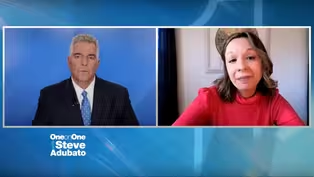
COVID's Mental Impact on Parents and Their Children
Video has Closed Captions
Clip: S2023 Ep2607 | 9m 10s | COVID's Mental Impact on Parents and Their Children (9m 10s)
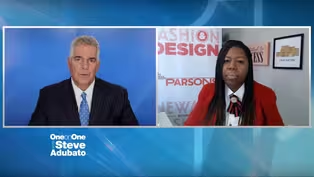
Creating Inclusive Fashion With a Purpose
Video has Closed Captions
Clip: S2023 Ep2607 | 11m 10s | Creating Inclusive Fashion With a Purpose (11m 10s)
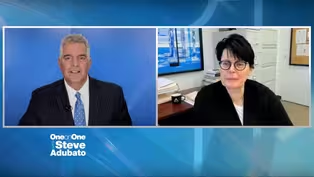
NJ Museum's Connection to our Past, Present, and Future
Video has Closed Captions
Clip: S2023 Ep2607 | 8m 10s | NJ Museum's Connection to our Past, Present, and Future (8m 10s)
Providing Support for PBS.org
Learn Moreabout PBS online sponsorship
- News and Public Affairs

Top journalists deliver compelling original analysis of the hour's headlines.

- News and Public Affairs

FRONTLINE is investigative journalism that questions, explains and changes our world.












Support for PBS provided by:
One-on-One is a local public television program presented by NJ PBS