
VA's Gubernatorial Race, Infrastructure Package, and More
11/12/2021 | 26m 46sVideo has Closed Captions
Discussion on VA's gubernatorial race, federal infrastructure package, and more.
Host Hannah Meisel (NPR IL) and guests John Jackson (Paul Simon Public Policy Institute) and Amanda Vinicky (WTTW) discuss what the Terry McAuliffe loss in VA's gubernatorial race means for Illinois, what's happening with the Illinois Democrat and Republican parties, and what the $1.2 trillion federal infrastructure package means for Illinois.
Problems playing video? | Closed Captioning Feedback
Problems playing video? | Closed Captioning Feedback
CapitolView is a local public television program presented by WSIU
CapitolView is a production of WSIU Public Broadcasting.
VA's Gubernatorial Race, Infrastructure Package, and More
11/12/2021 | 26m 46sVideo has Closed Captions
Host Hannah Meisel (NPR IL) and guests John Jackson (Paul Simon Public Policy Institute) and Amanda Vinicky (WTTW) discuss what the Terry McAuliffe loss in VA's gubernatorial race means for Illinois, what's happening with the Illinois Democrat and Republican parties, and what the $1.2 trillion federal infrastructure package means for Illinois.
Problems playing video? | Closed Captioning Feedback
How to Watch CapitolView
CapitolView is available to stream on pbs.org and the free PBS App, available on iPhone, Apple TV, Android TV, Android smartphones, Amazon Fire TV, Amazon Fire Tablet, Roku, Samsung Smart TV, and Vizio.
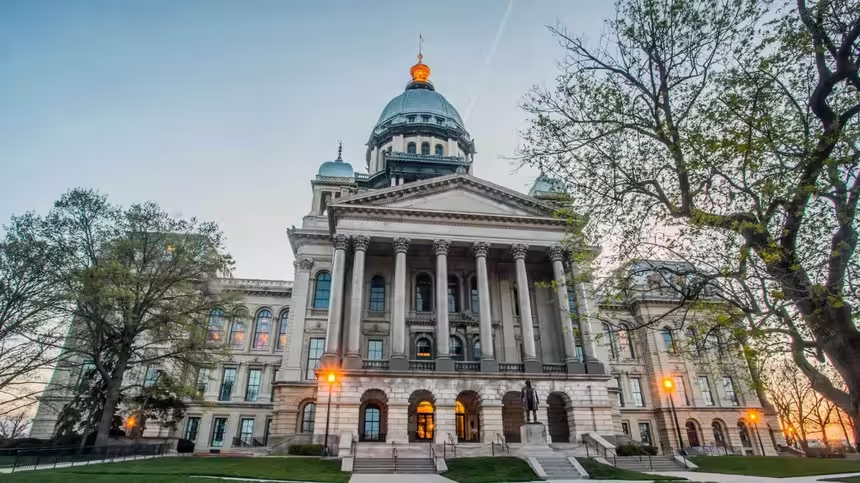
CapitolView
CapitolView is a weekly discussion of politics and government inside the Capitol, and around the state, with the Statehouse press corps. CapitolView is a production of WSIU Public Broadcasting.Providing Support for PBS.org
Learn Moreabout PBS online sponsorship(exciting orchestral music) - Welcome to "Capitol View," where we discuss the latest in state government politics.
I'm Hannah Meisel with NPR Illinois.
Joining us this week is John Jackson, Visiting Professor of Political Science at Southern Illinois University's Paul Simon Public Policy Institute.
Thanks for being here, John.
- Sure.
Glad to be here.
- And also with us is Amanda Vinicky, Political Correspondent for Chicago Public Television Station WTTW.
Glad you're here, Amanda.
- I'm glad to be with ya.
- Well, today I would like to have an informed discussion about... We've seen so many hot takes, I think, in the last week or so since the off year election last week, when folks like Democrat Terry McAuliffe lost the governor's race in Virginia, kind of unexpectedly or at least unexpectedly if you're paying attention to only certain segments of media and analysis.
Democrat Phil Murphy in New Jersey, he narrowly won reelection to the governor's office.
And Democrats kind of had a rough go of it.
And given that Illinois is dominated by the Democratic Party, I thought it would be useful to have a more informed discussion about maybe where we're heading, what we might see in a year, when we get to the midterm elections, which is also when governor J.
B. Pritzker is up for his first reelect.
So, you know, John, your initial thoughts about last Tuesday's election day.
Were you, I guess, surprised by the fact that Terry McAuliffe, who by the way, Virginia is the only state that limits its governors to, they can't do consecutive terms.
And I looked back in the history and Terry McAuliffe is, for 50 years, the only governor who tried again, except for a governor who was a Democrat in the 1960s, and then ran again as a Republican and was successful.
Very interesting.
Maybe it doesn't actually have any bearing on what happens in Illinois.
What do you think John?
- Well, I think Virginia was important.
I think it was bad news for the Democrats, but for a little different reason.
And that is because it became the narrative the next day and has continued to be that this is a referendum on Joe Biden.
This is a referendum on his policies.
We in political science have a long research history on midterm elections.
And we know some things that everybody now knows for sure, that is the party in the White House is almost always going to lose in the House and Senate in the first midterm.
You mentioned the case of Virginia.
That's a related trend there.
They almost always vote against the party in the White House for the Virginia governor's race.
So it's really a much bigger and more generic thing than that.
The loss average is 28 seats in the House and four seats in the Senate since World War II.
Doesn't matter who was president, the public policy issues.
It's one of those things almost always happens.
So it can be turned into a referendum on Joe Biden, but it's much more complicated than that.
I won't go into the reasons that it's complicated, but I do think it's important for Joe Biden because he knows that he's just got less than two years to get his policies passed.
That's why they've crammed everything into infrastructure, and now into the Human Resources Bill.
They've got what could have been 10 bills crammed into those, because they know.
He was there for Obama and the Affordable Care Act in 2009 and '10, and he saw the disaster for the Democrats in 2010, and he knows about Bill Clinton in 1994, and neither of them ever had a majority after that.
And he knows that record.
As for Illinois, I think it's complicated.
I will say quickly, I don't think it has a lot of import for the statewide races.
I think all the statewide constitutional officer candidates, you should consider the incumbent Democrats and the Democrats as the most probable.
It would be unusual, I think, for any of those to win.
Not impossible.
At the congressional level, I think it does have some impact, and I think there are only really maybe 11 of those congressional seats that are really democratic seats most likely, no matter what, but it's going to be competitive.
And wind's blowing against the Democrat race anywhere outside the city, thus the old Underwood District, somewhat reconfigured, and the (indistinct) District, were reconfigured and let alone that Downstate District, which is supposedly tailored for a Democrat.
That'll be at best a competitive district, certainly not a Democrat pickup, for sure.
So I think 13-4 is the most likely outcome.
And then finally I do think it could make some difference in the Illinois house and Senate.
I think Democrats could lose their super majority.
Not lose the House and Senate, but lose the comfortable margin, because particularly those suburban districts will be much more competitive than they might've been.
- Sure.
And you know, Amanda, one of the things that I've been reading in all of these postmortems was the Terry McAuliffe campaign, you know, I'm not there.
I don't cover Virginia politics obviously, but one of the through lines from the critiques of folks, both in his own party and not in his party is that maybe he didn't actually run the best campaign.
And one of the things that he tried to do was tie his opponent, Glenn Youngkin, who did win by a couple of points there, to Donald Trump.
And, you know, there is some analog from Glenn Duncan, a businessman who tried to stay away from the red meat, but still find a way to engage the kind of Trump base.
To Bruce Rauner, who we saw coming to Illinois.
Obviously a different time, pre-Trump.
We know that Trump has changed the GOP, forever probably.
But one of the disadvantages we have as political reporters, political analysts is that we spend a lot of time thinking about politics, which are determined by voters who maybe don't spend a ton of time thinking about politics at all, unless they feel like God, it's annoying.
Why is everything so political these days?
We saw J.
B. Pritzker in 2018 tie opponents, Bruce Rauner, tie Republicans down the ballot to Donald Trump.
We also saw the same playbook, obviously last year in 2020.
Do you think that voters are buying that?
- I mean, there's a lot there as you noted.
I'm not in Virginia, and I think something that we need to keep in mind as everybody is making all these calculus, what does this mean for the midterms, which are really about a year to the day from Tuesday away, is that all politics is local.
Unless you've met the candidate, know the candidate, know the local issues, have the background and the ties, take a breath before tying it to what that might mean for Illinois or as John noted for any of the Democratic incumbents who have name recognition.
You still have the money that Governor J.
B. Pritzker has.
We don't even know who's going to be in the GOP race to try to get the nomination to run against Pritzker.
So there's really so much there.
Things are different from two years ago, and two years prior to that.
Donald Trump is not president.
He is not currently on the ballot.
And while he is most certainly weighing in on races, he I think could come into play if he uses his platform to strike against or to endorse a particular candidate.
But what we saw with Duncan, for example, okay, y'all can walk to the middle of the road.
Trump sort of did too.
And that worked.
And as you noted, it's not as if people are living and breathing their every day by what is happening in any of these races and who has endorsed a particular candidate or not.
So I do think that the Trump effect, if you will call it that, is going to come into play.
You look at races, such as we might see if we have a Congresswoman Mary Miller running against Congressman Rodney Davis in a new district that is seemingly tailored to Davis, but at the same time is maybe not because if Miller tries to run there, will he have issues because he isn't as conservative, as pro-Trump as she is.
He's certainly going to weigh in on some of these races, but is that going to be the winning strategy at this point for, say, Pritzker?
It seems as if that's not what he's counting on.
Right now, if you look at his ads, he's counting on, I kept you safe.
I followed the science with COVID.
He's not talking about Trump, because Trump is no longer on our TVs every moment of every day for candidates to react to.
- And John, one of the things that we've seen pre-last week's election, truly in the last year or so, is this pushback from within the Democratic party saying that the left wing, the progressive wing that has truly, we've seen it in Illinois.
We've seen it in the General Assembly.
We've seen it in Chicago City Council before then.
We've seen it a little bit in Congress, too, that this progressive wing of the party has actually, finally gotten some power, enough to be kind of a nucleus.
But it seems as if a lot of people are pushing back and we should note, especially communities of color, folks who represent, say, the Black community, who is traditionally, maybe not as progressive as those folks who hold out that wing of the party you're trying to push it to be.
So do you think there is merit there?
Or do you think that that is a shot in the dark blaming by a party who doesn't really have a handle on their own voters anymore?
- Well, I don't think it's going to make much difference in Illinois because the people in charge now, particularly in the House and Senate in Illinois are going to continue to be in charge.
They're going to continue to mostly be about some very progressive kind of legislation.
And J.
B. Pritzker is pretty progressive himself and takes some pride in that.
I do think where it works is in the rural areas, but I think that's a different story and the rural areas, certainly it's frightening to them that you can put Nancy Pelosi's picture on the screen and start talking about socialism and start talking about Joe Biden's very left kind of policy agenda.
And that works in traditional Republican areas, whether they're Illinois or nationally.
I do not think it's gonna make a big difference in local Illinois politics in the sense of the General Assembly level politics.
- Sure.
And we saw the blue wave of 2018 sweep a lot of folks into office in the suburbs.
And then of course, Democrats had the power of the pen for redistricting and they shored up those districts to kind of ensure that those folks won't be swept out of office if an oppositional force comes along.
Amanda?
- Yeah.
And they certainly are doing their darndest.
We will see how the new map plays out and will Democrats actually get their wishes or if a series of lawsuits against those redrawn boundaries will be successful, and what that would mean for Democrats' attempts to shore up their margins.
I think what is interesting when you look at the General Assembly is first of all, again, who is going to be at the top of the ticket or even on the ballot when it comes to the GOP race for governor, because what is that going to mean for fundraising?
What is that going to mean for any potential down-ballot races?
Just where is the party going to go once we begin to see gubernatorial debates begin, and you have some of the candidates who are certainly far more conservative or have views that align with say Trump, that clearly didn't succeed and were not appreciated by some of these more purple suburban voters.
Then again, as John talked about, I think that there's going to be the effect of midterms.
You have a Democrat in the president's office.
There are also a whole lot of votes that Democrats in those suburban districts took that they did, I think some of them, very excitedly.
Others really had to swallow hard, and we will be watching to see what suburban voters think of those, things such as the Parental Notification Act repeal, which requires parents to be notified before they can have an abortion with a caveat that minors who have a reason, for example, potentially an abusive relationship with a parent or guardian could have a judicial workaround.
The governor has not yet, but is expected to sign that into law.
That is something that some of the polling that we've seen is something that those more moderate voters aren't going to be happy with.
Will the GOP have the money to make the case that under Democratic control, things have swung too far to the left?
Will increases in crime that we are seeing in Chicago, that we are seeing across the country, be something that Republicans can tie to the newly passed with only Democratic support criminal justice overhaul.
So these are some really big changes that will be fairly fresh.
I think again, we're just going to see, how much does that matter to moderates, particularly as we are going to see presumably down the road, as we're seeing inflation rising, new issues with the economy, with the pandemic, and also a GOP in Illinois that still does not have the chutzpah or the moolah that the Democrats do.
- Yeah, no, that's a hundred percent correct.
I mean, we have not seen a strong Illinois Republican party in some time.
We saw it briefly propped up by, of course, Bruce Rauner as well.
But you know, basically for the same decade plus, they've been running the same message that House Speaker, former now, House Speaker Mike Madigan is corrupt and he controls everything in Illinois.
Well, you know, it's kind of like an analog to Trump.
He's no longer in office.
How well will that message work anymore?
When also, ironically, I guess you could say, Madigan was also a kind of firewall to progressivism.
It wasn't till his last years in office that you saw the political winds changing and he allowed some more progressive things to go through his House.
He knew the messaging.
He knew how to temper messaging, right John?
I mean, is messaging kind of something that Democrats need to worry about, whether it's in Illinois or nationally?
Things like, okay, you want an infrastructure plan.
Maybe talk about the benefit to folks and maybe stay a little less out of the ivory castle kind of jargon about why this will benefit people and why it's necessary.
- Well, absolutely.
The Democrats have, as long as I can remember, had a terrible problem with messaging, and they don't reduce their messages to bumper stickers.
They don't do a good job of appealing to the visceral emotions of politics.
They don't latch on to something like critical race theory and run with it successfully.
And that I think brings us to the infrastructure business.
What they do well, I think it seems to me, is to pass these very heavy laden, policy-oriented things that have very practical implications.
This bill that just passed is truly historic.
They've got to compare it with the Interstate Highway System.
They've got to say, this is the biggest thing since the Interstate Highway System under Dwight Eisenhower in 1957.
And they've got to make that case that it is going to benefit everyone.
It's got money in there for the cities.
It's got money in there for the rural areas, and they've got to go out and sell that in a way that people can relate to it.
And one other point that we talked about earlier, this is going to be a godsend for J.
B. Pritzker and for Illinois in the sense that he got that bill bipartisan support in the spring of 2019, and he's got Illinois in a better position than perhaps anyone to take advantage, because all these projects demand a local and state match, and that has been a problem.
And these projects, many of them are on the drawing board.
Some of them are out there on the road, tying up traffic already.
And this was not only a one shot or two years.
This was a permanent increase and that money is in place, and it won't be a problem for Illinois to come up with.
And it allows J.
B. Pritzker on the budget front say, look, I've been fiscally responsible.
We're making progress.
Look at all the things we're doing.
This will create jobs.
This will create more income that they can deal with next year.
So it comes back around to being a real benefit for J.
B. Pritzker in terms of all the things he can talk about.
And it was bi-partisan, because it really wouldn't have passed without those Republicans, including Kinzinger, without their help, and now they're getting death threats by the way.
So that's part of the ugly underbelly of American politics at this point.
13 of those guys made the difference on the Republican side.
- That's a really good point that Illinois is poised to take advantage of this $1.2 trillion bi-partisan infrastructure bill that is heading to Joe Biden's desk.
You know, especially because we've seen this movie before, where if voters don't feel an immediate benefit, they might not be able to tie those things in their minds together.
And so if it takes years for, say, another state's infrastructure projects to get off the ground, they might not see it.
It would be a harder sell for Democrats to say, we did this.
One other thing I wanted to say about messaging before we move into some more meat of the infrastructure bill is we have seen a failure on messaging from J.
B. Pritzker.
Not too long ago, he lost that so-called fair tax.
He lost the three year campaign that he engaged in as a very early candidate to do the graduated income tax.
So we'll see if he does better on messaging in his campaign next year, not just for himself, but for all the Democrats down the ballot.
But Amanda, let's talk a little bit more about what's in this infrastructure package for Illinois.
We would get $17 billion of that 1.2 trillion.
Correct?
- Yeah.
And so, I mean, it, again, to me, I actually, speaking of messaging, wanting to hone in on sort of the failures of the Democrats, when we look back to last week's elections, when we look forward to Illinois next elections.
So you've got the infrastructure bill and then the quote, unquote, I mean, people seem to describe it as the reconciliation bill, the twin bill, the paired bill.
What does that mean to anybody?
I mean, a lot of actually what I think really makes a difference to voters.
Yes, they want nice roads.
They want their bridges to be updated.
I don't know how much voters necessarily appreciate or are tied to any politician when they're driving through traffic and there are construction cones, and they're annoyed by it.
I think politicians, of course, likes the ribbon cutting, and they like to be present for it.
John, I'd be interested if you have any studies that really tie the legislators and the lawmakers on the congressional or state level who vote for those programs, and to whether voters actually notice who did or didn't vote yes, Because the money comes into those districts regardless.
In terms of the build back better messaging, those are the sort of things I think that really could, if it passed, be noticeable to families right away on the front end.
When you think about things like tuition for community college, family leave, free school for your kindergarten child that can't get it elsewhere, as you're struggling with childcare expenses.
I mean, those are the sort of things that make a true, quick material difference.
And first of all, we don't know what is actually going to pass at this juncture, and that message has been so clouded and taken up all of the oxygen, whether that is the fault of the Beltway media, whether that is the fault of members of Congress and their spokespeople who I think have really failed on that messaging.
And again, that's where we in part can attribute some of the results in the most recent elections, Democrats in general are going to have to turn that messaging around if they are going to vote for these packages and want to ride on them and bring that home to voters.
So far, they have been incredibly lackluster at doing so.
And again, I think on the state front, there is some difficulty with doing that in some of these districts, because what Democrats see as achievements may not be perceived as such by the more moderate voters that they are wanting to keep blue or turn blue.
- John, I'll let you have the last word.
In 10 seconds or less, do you think that this so-called Human Infrastructure Bill will be successful?
- I think it probably is going to pass.
I wouldn't bet a lot of money on it, but I think the president talking as confidently as he's been talking, he must think that he's got Manchin on board.
And it depends on the congressional budget estimations.
They could hide behind that if they come in bad, but if they come in reasonable, I think it'll pass.
- All right.
Well, we are out of time for this week's edition of "Capitol View."
I'd like to thank our guests, Amanda Vinicky, John Jackson.
I'm Hannah Meisel.
Thanks for joining us, and we'll see you again next week on "Capitol View."
(exciting orchestral music) (calm music)

- News and Public Affairs

Top journalists deliver compelling original analysis of the hour's headlines.

- News and Public Affairs

FRONTLINE is investigative journalism that questions, explains and changes our world.












Support for PBS provided by:
CapitolView is a local public television program presented by WSIU
CapitolView is a production of WSIU Public Broadcasting.