
Vegetable Feast
Season 2 Episode 23 | 26m 14sVideo has Closed Captions
Tomatoes Stuffed with Grits; Risotto with Vegetables.
Tomatoes Stuffed with Grits; Risotto with Vegetables.
Problems playing video? | Closed Captioning Feedback
Problems playing video? | Closed Captioning Feedback
Vegetable Feast
Season 2 Episode 23 | 26m 14sVideo has Closed Captions
Tomatoes Stuffed with Grits; Risotto with Vegetables.
Problems playing video? | Closed Captioning Feedback
How to Watch Today’s Gourmet
Today’s Gourmet is available to stream on pbs.org and the free PBS App, available on iPhone, Apple TV, Android TV, Android smartphones, Amazon Fire TV, Amazon Fire Tablet, Roku, Samsung Smart TV, and Vizio.
Providing Support for PBS.org
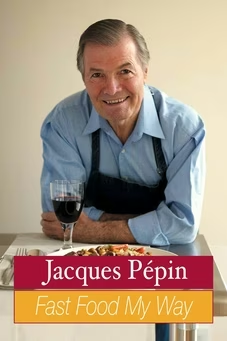
Learn Moreabout PBS online sponsorship- Hi, I'm Jacques Pepin.
In the summertime, I love to go out to my garden and see what is ripe and improvise with whatever I can find there.
Today's menu is a vegetable feast, I'll stuff fresh ripe tomato with fragrant corn meal grits, my risotto with vegetable has far less butter and cheese than the traditional recipe and is luscious.
A dessert of cheese, apple, and nut sprinkle with ground pepper, is unusual and make a zesty finish.
This is a perfect meatless menu for the summer time or anytime you're in the mood to cook for a lighter meal.
Join me, as I prepare it for you, on "Today's Gourmet".
(upbeat music) (upbeat music continues) Today we're going to do a terrific meatless meal, very light, healthy, and I know, you know, at home, in summer particularly, we eat at least twice a week, meatless.
I'm not a vegetarian, but we do eat very light in summer, particularly, and use a lot of vegetable.
And today what I'm going to do is risotto, a type of risotto.
And as you can see here, that type of rice, it a round rice, Arborio type of rice from Italy, from the north part of Italy, I've used other rice for that.
A short rice, even Thai rice or small round rice will work well with it.
But I mean the conventional risotto is done with this, even though what we are going to do today is not a conventional risotto, it's a risotto with a lot of vegetable in it.
And we'll start with chopping some onion (knife chopping) that we are going to add to a little bit of oil and butter that I have on the stove.
I have a tablespoon of oil.
I use olive oil and a tablespoon of butter, and that we are going to mix with that onion to start.
You know, the conventional risotto is cooked on top of the stove, open without a lid, adding liquid, stirring, added liquid, and stirring.
We're going to do that slightly different here, (food sizzling) first, with this.
Here we are, here.
And we want to stir that.
And in there I want to use that type of spatula, you know, flat bottom, in wood, with the wood to scrape in the bottom of the pan.
Wood against metal is munch better.
So we have our rice here, and I have a cup of rice here of that one.
And we put that in there and stir it with the onion.
Now conventionally, hmm, those onion are strong.
Conventionally, what you do, you put two or three tables full of liquid, let it evaporates, stir it, put more liquid, let it evaporate, stir it, and so forth.
In that way, your risotto, for one cup of risotto, I may go up to four cup of liquid.
It is not that it's all absorbed by the rice, a lot of it evaporate.
For us, it's going to be slightly different, because we're going to cover it.
So what I'll do first, with that cup of rice, one, two, three, three and a half here, that give me about two and a half cup of liquid, two and a half cup of liquid.
And I will let that liquid be absorbed.
Now, I have a good plain chicken stock, divided without any salt.
So I put a dash of salt in there, we're going to cover that, bring it to a a little boil, and stir it occasionally, because it has the tendency to stick.
And while this is cooking, we are going to move to our first course, which is another course with vegetable, tomato and grits inside.
I know that it's not conventional to serve grits and rice.
I mean you have two starch here, one after the other.
But this is how menu are done.
You know when you do menu, what you try to do is to use your common sense.
You don't do a dough to start with, with a quiche, and finish with a tart, with the same dough.
But after all of that, as has been said, you can come to my house and look at my menu book, and you'll find probably, a menu will start with a dough, and finish with the same type of dough.
What I'm saying is that it's a question of common sense, but if you like it, you do it.
And in that case here, we are doing basically two main dish, each one with starch.
But this is very light as you're going to see.
So what we'll start, we're going to saute a little bit of onion, garlic here, a bit of oil.
And I have some onion here too.
This is for the tomato.
(knife chopping) So we'll start by, again, chopping onion.
I use a lot of onion in my cooking.
A lot of onion, a lot of garlic, a lot of scallion, and it's good for you, it's flavorful, it's inexpensive.
(chopping continues) And the proportion, they are relatively not that important.
You could put more or less onion.
So here I have what I need.
And we, this is very nifty, you know, those pastry, we call a pastry scraper to get your vegetable on the table when you chop something.
Here we are.
Okay.
And in there, what we want to do, is to put scallion, the scallion you know, when you do it, you cut the end of it, look at the end if those leaves are damaged.
But basically, there isn't much to remove from this.
And that we want to chop coarsely, we can gather it together, there, you see I would use long knife, and move forward, down and forward in that direction.
This is the prosper way of cutting.
Remember, that you don't really go crushing on top, you go forward or backward.
You have to have the motion of cutting.
(knife cutting) And this is the way you should start with a larger knife.
The reason is that it's larger here to put against your finger and hold.
Okay, this again, we're going to saute.
A lot of color, a lot of texture, a lot of taste that we saute first.
And then garlic, with a bit of garlic.
(knife pounding) Again, crushing the garlic here, releasing the essential oil.
And we chop.
(knife chopping) Notice that... (knife chopping) I crushed the garlic here.
You see when you use a French knife, so-called French knife, there is a return to clear your finger, so you can chop, if you use that knife horizontally like this, your hand is in the way.
So you have to clear up the table to cut thin or to crush something, so that your finger are not in the way here.
And this is our garlic, which I'm going to put on top.
And then check on my rice.
The rice has to be stirred, you know, because as I say, it will have a tendency to stick.
And I can go even slightly slower than that so that it cook gently.
Here we are, now in that garnish, again, which I take the garnish for the tomato, we want to put mushroom.
And to chop the mushroom, I just washed those mushroom, I can chop them coarsely in the food processor, is very good, providing, you use the technique, just pulse and stop.
Mushroom are light, if I put it on, if I put it on without doing that type of technique, what happen is that the mushroom will fly, and with the centrifuge, with the speed, there will be a layer, you know, in the air and the other layer get into a mush.
So what you do start, stop, start, stop, so that it has a chance of falling down onto the blade, you know to have a nice, you know, a very nice equally chopped mushroom right here.
Now, those mushroom are going to render some liquid.
(food sizzling) And this is often the way you determine the cooking of mushroom.
That is, when I put it into the skillet here, you can hear it, it's sizzling, within maybe a minute on that it won't be sizzling, because the liquid from the mushroom, the vegetation liquid will come out of the mushroom and it will start boiling.
By this time, it starts sizzling again.
That liquid is evaporated and the mushroom are ready.
So this is our stuffing for the tomato, a dash of salt in there.
And now the tomato here, as you can see, I have four tomato, two are already done.
What I want to do is to cut the cap of those tomato right here, you know.
Now often, we cut that part, I like to cut the part with the stem to keep the hat to put back on top.
Now the best way to empty this, is to use one of those measuring cup, measuring spoon, because it has a cutting edge and you just go around, and cut it this way to empty your tomato.
Now what I want to do here is basically keep about one inch, you know, from the tomato, so that I have a wall of about half an inch or so all around and a nice cavity in the middle, you know.
Try to put it also in a container like this one, which accommodate the four tomato but fairly tight together, because especially those tomato which are very ripe here will have a tendency to break down, you know, to crush as it cooked.
But it's fine, doesn't really matter.
So we're going to leave it here, and that, we do a sauce with that, very simply.
Again, I put that directly into the food processor with a little dash of oil and a little dash of salt.
Very easy to make a simple sauce this way, you see that?
(food sizzling) It's starting sizzling, and it's going to be ready soon.
So now the sauce... (blender whirring) That I want to do here... (blender whirring) See there, very easy, (blender whirring) natural sauce, you know, so what we do with this, I could put that directly in the center of this, you know, because we're going to cook with it.
I'll put the sauce right in there.
So we use absolutely everything.
This is going, we're going to stuff it.
This I don't need anymore.
And now what I want to do with the garnish here, is the grits.
And what I have here, I have grits on this side first, maybe I should stir my rice again.
Yeah, you can see the rice, you can see the bottom of this as I'm pushing like this.
So most of the liquid is getting there.
Could go slightly faster now.
Now here I have grits, and yellow grits is a corn, you know you have white grits, and you have yellow grits, the corn.
And we just cook that with water, a dash of salt, and you drop that gently into the water as it's boiling, you know, and the same way that you do polenta, you know, basically that's what polenta is all about, yellow grit cooked with water and salt.
And that is used, you know, in a lot of different way as garnish and so forth.
So that would come back to a boil, boil gently for 15, 20 minute.
And what happened, I have one which is cooked right here And this is what it looks like when it's cooked, but you can see it's pretty thick, you know, and soft.
And this is going to be the base for our garnish.
So now you can see that this is dry, I can hear it sizzling, so it is ready.
I'm gonna put that directly in there.
(food sizzling) Here we are, you know, this is a terrific garnish here.
I mean, you know, you could have that as a vegetable by itself, you know, and it would be just about terrific, just serve like this.
But what we do here is just stirring it together, actually, we do that at home, and as I say, eat it just like this, other garnish, you know, you do like a little bed or a little cushion on a plate and put a piece of fish or a piece of roast chicken on top of it, or whatever.
And that's terrific.
Often in Italy that's served with rabbit, you know, rabbit is very good this way.
So what we would do here is to spread it out.
What you would do is to let it cool a bit more before using it.
But for us, we're going to use it right away.
I'm gonna bring, see if my rice is doing well.
As you can see now, the rice is starting sizzle.
(spatula clanking) So what I have to do soon is to put the vegetables.
So first, we'll stuff this, you know, in there.
And there you can be generous, you know, but if you have some leftover, it depend on the size of your tomato, put one of those on top.
Depend on the size of your tomato what I say, but don't worry about it if you have some leftover, just use it as a vegetable, you know.
Here it is.
So as you can see that starch is very moist because I have a lot of vegetable in it.
So the grit are soft, I have a lot of liquid there.
The tomato are going to get softer in the oven.
What I'm saying is that the whole dish is going to get quite moist and nice, not something dry at all.
And that's terrific.
The only downfall is that as it cook, sometimes the tomato kind of collapse on themselves.
But I don't think it's very important.
The only important thing is that it is good to eat, you know, that's about the only thing to us.
You can see, here I have a bit left, I could maybe have put a bit more on top.
And here we are.
So this now is going to go into the oven.
This could be prepared ahead, you know, and I'm gonna put it in there.
I have one ready here.
And as you can see, this is just cooked.
And as I was saying, it has a tendency to fall down on itself a little bit.
But again, I don't think it's very important.
That tomato is really cooked.
We put it there.
And a bit of that terrific sauce, you know, natural sauce on top of it and all around.
And this makes a great first course, you know, for a dinner.
So what we want to do now is to continue working on our rice.
And with that, I have the garnish that I'm going to put in the rice.
The first thing that I want to do is to put a little bit of that fennel here.
'cause the fennel is going to take longer than the rest of the mixture to cook.
So I want to put like three quarter of a cup of fennel bulb.
This is the bulb of the fennel, which I cut into half inch dice also.
You know, I put a lot of different vegetable in that rice, but you can choose all the type of vegetable.
It doesn't have to be this.
And you can see this is cooking a bit fast now.
So let me put this in there and more stock.
Now I start adding the stock just a little bit at the time, you know, and scraping the bottom.
(food sizzles) Yeah, it's starting getting stuck to the bottom.
A bit of a crust.
You know we do a crust like that sometime when you do a paella, okay?
But the liquid will release the crust as you can see now.
And of course, it's going to give it a nice nutty taste.
Not really conventional, but if it sticks in yours like it sticks in mine, just say that you planned it this way, because you like the taste of the crust in the bottom, which actually I do.
So I add here that beautiful fennel bulb, you know, this is great in salad, it has that type of, that smell of anise, you know, that taste of anise also.
And in Italian cooking it's used a great deal.
We can even keep some of the surface here to decorate the rice later on, you know, so I'll put it here.
Now I have another bunch of vegetable here, I have red pepper, I have asparagus, and so forth.
Now the asparagus here, I wanna show you an asparagus like this one and like this one.
So you can see, or maybe even this one is the best.
You can see that that asparagus here, the leaves are opening like a flowers, you know this one is tight, this is what you want.
So that asparagus, what we've done is to peel the end of it, you know, so that we can use the whole asparagus And that we're going to put inside, cut it again in little dice.
Remember, that this has to cook a couple of minutes first, but then now, putting the rest of the vegetable in it, red pepper, the red pepper here, you don't really have to to peel it.
If you really want to be fancy, you could peel it, but it really, that's unnecessary.
You want to look for color also, this is nice and red, you know, that would be good for it.
In addition to that, I have mushroom and peas, you know.
(knife chopping) Those tiny peas that I have here are frozen peas.
You can use, of course, the fresh one, but very often I use the tiny baby peas frozen.
Those are very good.
(knife chopping) So here we are all our array of vegetable.
As you can see, there is more vegetable than rice without any question, in there.
And the rice will take all together about 20 some minute to cook.
So here we are here, all my vegetable will go in.
This is the end touch of it, you know, at the end, all I'll do is to put a little bit of cheese then rice, then the pea.
This doesn't have to cook very long, you know, and a bit more stock, again to finish cooking it.
Now I don't need that, and I will still stir it.
And now what I'm going to do is to cook it uncovered, you know, a bit faster up.
I stopped the wrong one And now I'll keep this to put on top.
And what we want to do is our dessert today.
And our dessert is a beautiful combination that I have here of cheese and fruit, apple and so forth.
I have three type of cheese here.
Gorgonzola, no I'm sorry, Gorgonzola is here.
Stilton, and Roquefort from France.
And what we're going to do first is to cut that in half, take the core out of it, you don't peel it.
And that we have for dessert.
We cut that into segment like this, about three or four segment per person, you know.
And what I want to do is to put some lemon juice on top of that so it doesn't discolor, you know, and that is the citric acid.
You can put it directly on top of that, roll it.
There we are.
And a little bit of cracked pepper.
I have some cracked, some pepper here, and I can crack that pepper.
(pepper scrunching) This is black pepper, and the black pepper corn here, it's a great combination, you can do that with pear also, is to put it directly on your apple here, this way.
I have roasted pecan, so there I could arrange it, you know, a bit, scattering it around this way, you can put some pecan, that is a question of doing a combination of pecan nuts.
Cheese, can put a piece of that cheese.
We don't serve too big pieces of cheese at home, but I love the Gorgonzola, particularly.
Some green on top of that, and I have basil here and arugula, arugula, basil, and of course, don't forget with that you want a piece of bread that I have right here.
And now, let's see, our rice should be cooked.
It is cooked, so we want to put the cheese in it to mix it.
And Parmesan cheese of course is what we use.
Then... (utensils clacking) We plate that directly in that bowl.
It should be still slightly soft and soupy.
And you could see even that the crust is gone from the bottom of my pan, and the rice is ready now.
This is a great meatless menu, and I say meatless, it is not a vegetarian menu because I put chicken stock, you know, in the cooking of the rice.
You could do it with water if you really want it totally vegetarian, but it's great this way.
This is an interesting menu, you know, you don't really have a first course, a second course.
Those two course have equal value if you want.
They can be served as main course.
And the tomato is a great way actually to use leftover.
You know I have those tomato here, remember with the grits in it and the onion, all kind of vegetable.
But you know, if you have a roast, anything leftover, you chop it, use it with vegetable to stuff your tomato.
If you have fish, in the same way, you can serve that cold or hot, this is a great way to use leftover.
But with the the grits, I mean, I'm sure you're going to love it.
Then of course, the risotto.
The risotto conventionally as I say, is cooked without the lid, you know, on top of the stove you put a little bit of liquid, stir it, a little bit of liquid, stir it.
In that case here we cooked it in a different way.
A lot of vegetable at the end and it's nice and moist and that great dessert, type of dessert, which is really a meal in itself with crunchy bread and that combination of arugula, you know, which is kind of garlicy or basil with the Stilton or Gorgonzola, the nuts and those apple covered with the cracked pepper and a little bit of lemon juice on top.
That's terrific.
We have a salad with our menu, and with that, of course, we would also want to serve maybe an Italian wine this time.
We have a Vernaccia here, di San Gimignano.
It's from the Vernaccia grape.
It's very crisp and dry and it would go perfectly well with that type of menu that we have today.
I'm sure that you can enjoy this summer, or winter, meatless menu is terrific for you.
I love to cook that for my family, and I'm sure you're going to enjoy cooking it for your family too.
Try the recipe, you're going to love it.
I love cooking it for you.
Happy cooking.
- Food
Christopher Kimball’s Milk Street Television
Transform home cooking with the editors of Christopher Kimball’s Milk Street Magazine.





Support for PBS provided by: