
Velvet Peanut Butter, Sozai sushi, Detroit Food Academy
Season 8 Episode 10 | 26m 46sVideo has Closed Captions
A food-themed show with Velvet Peanut Butter, Sozai Restaurant and Detroit Food Academy.
Explore how food intersects with business, education and the environment in and around Detroit in this special food-themed episode. Learn about the creation of Detroit’s Velvet Peanut Butter company. Hear about Sozai Restaurant owner and chef Hajime Sato’s sustainable seafood practices. Plus, see how the Detroit Food Academy is cooking up the next generation of young leaders.
Problems playing video? | Closed Captioning Feedback
Problems playing video? | Closed Captioning Feedback
One Detroit is a local public television program presented by Detroit PBS
Velvet Peanut Butter, Sozai sushi, Detroit Food Academy
Season 8 Episode 10 | 26m 46sVideo has Closed Captions
Explore how food intersects with business, education and the environment in and around Detroit in this special food-themed episode. Learn about the creation of Detroit’s Velvet Peanut Butter company. Hear about Sozai Restaurant owner and chef Hajime Sato’s sustainable seafood practices. Plus, see how the Detroit Food Academy is cooking up the next generation of young leaders.
Problems playing video? | Closed Captioning Feedback
How to Watch One Detroit
One Detroit is available to stream on pbs.org and the free PBS App, available on iPhone, Apple TV, Android TV, Android smartphones, Amazon Fire TV, Amazon Fire Tablet, Roku, Samsung Smart TV, and Vizio.
Providing Support for PBS.org
Learn Moreabout PBS online sponsorship- [Will] Coming up on "One Detroit," we're focusing on food.
We'll take you on a nostalgic journey about a hometown favorite, Velvet Peanut Butter.
Plus, the chef of an award-winning restaurant talks about the importance of serving sustainable seafood.
Also ahead, we'll show you how the Detroit Food Academy is teaching young people, culinary, and life skills and we'll give you some ideas on things to do this weekend and beyond in metro Detroit.
It's all coming up next on "One Detroit."
- [Announcer] From Delta Faucets to Behr Paint.
Masco Corporation is proud to deliver products that enhance the way consumers all over the world experience and enjoy their living spaces.
Masco, serving Michigan communities since 1929.
Support for this program is provided by the Cynthia & Edsel Ford Fund for journalism at Detroit Public TV.
- [Announcer] The DTE Foundation is a proud sponsor of Detroit Public TV.
Among the state's largest foundations committed to Michigan focused giving.
We support organizations that are doing exceptional work in our state.
Visit DTEFoundation.com to learn more.
- [Announcer] Nissan Foundation and viewers like you.
(upbeat music) - [Will] Just ahead on this week's "One Detroit," we'll pay a visit to Sozai in Clawson to find out the secret behind its success and what makes it different to many other sushi restaurants.
Plus, we'll see how the Detroit Food Academy is preparing young people for opportunities in the culinary industry.
And Cecilia Sharpe of 90.9 WRCJ gives us a rundown of events you may want to check out this weekend.
But we're starting this special food themed show with a look at a product that's very familiar to Detroiters.
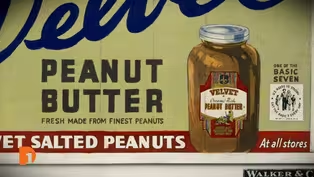
Velvet Peanut Butter was created in Detroit back in 1937 by Paul Zuckerman, who was affectionately known as The Peanut Butter King.
In this report from the Detroit Public Television documentary "Detroit Remember When: Made in the Motor City," host Erik Smith examines the brand's rise and fall and its return to popularity.
(gentle funky music) - I really think local brands help you identify with who you are.
- [Erik] Okay, so whatever happened to Velvet Peanut Butter?
- [Eric] It was a very prominent brand and I remember it being prominently displayed in the grocery stores.
And at the time, most of the grocery stores were locally owned.
Stores that used to carry Velvet Peanut but are no longer around, Great Scott, Farmer Jack, Chatham.
- [Erik] There were all the national brands, Peter Pan, Skippy, but here in Detroit, Velvet was our peanut butter.
- I don't know that I realized it was a Detroit brand at the time.
It was just the most popular brand in the grocery store.
- But it was smooth.
It was smooth.
Fresh, pure, and delicious, it was smooth.
- [Erik] Paul Zuckerman was the man behind Velvet.
He came to America from Turkey as a little boy and wound up right here in Detroit.
- It started in 1937 and the way it happened, according to Paul Zuckerman, my father, he was driving a truck when he decided he wanted to marry my mother, her parents didn't think driving a truck was so impressive and he was looking to, he was always very entrepreneurial.
- [Erik] So Mr. Zuckerman and another truck driver went into the peanut butter business.
- They bought a couple of machines and set up shop in a garage on 12th Street.
My father and Harry Gaz, and the two of them alone together did everything.
- [Erik] Harry Gaz ran production and Paul Zuckerman became the salesman.
- He would tell me that he'd fill up his car with cases of peanut butter and go out and hit the road.
And his favorite sales pitch was "I'm down to one last case of peanut butter.
I don't want to go home with it.
Just take the last one and make my day."
- [Erik] When World War II started, Uncle Sam pressed Velvet into service to help feed our troops.
- Because the government felt it was such an essential product that probably put the stamp of approval on peanut butter.
Mothers probably felt, "well if it's good enough for the soldiers and they think it's healthy."
- [Erik] The Velvet's jar came with those fresh, pure and delicious faces inspired by Paul Zuckerman's little boy Norbert - [Linda] It does look like him.
He wasn't so pure, but he was cute kid, adorable kid.
- [Erik] You know there was a time eating peanut butter was actually a chore.
The oil and the ground peanuts would separate and then they had to be mixed again by hand, Paul Zuckerman had the solution.
- It was called Velvet homogenized peanut butter, and he always claimed that they started it.
So I only can believe that, but you know, I wouldn't go to court on it.
- He was so successful with it.
He was known everywhere as The Peanut Butter King.
And if he wasn't known when you first met him as The Peanut Butter King, he made sure that you knew that he was The Peanut Butter King by the time you finished the conversation - [Erik] In 1950, The Peanut Butter King decided to diversify buying the Krun-chee potato chip company.
- Soupy Sales advertised for them.
He used to call everybody a birdbath.
I don't know why, you're a good birdbath or you're a bad birdbath.
He was just a wild guy.
- [Erik] By the late 1950s, Velvet merged with Sunshine Biscuit joining national brands like Hydrox Cookies and Hi Ho crackers.
Test kitchen cooks dreamed up dishes with ingredients like gelatin, Miracle Whip, and peanut butter.
- No, but there was a big thing those days, jello and Miracle Whip and jello and sour cream and jello and whipping Cream.
I loved it, but that does not sound like a very good recipe to me.
You can't win 'em all right.
(laughs) - [Erik] The Sunshine deal did make Paul Zuckerman a multimillionaire, but he stayed on in charge of the Velvet operation - When the brand was at its strongest we had sales in Indiana and several cities, some in Illinois, but basically it was a Detroit brand, and an unbelievably well-known Detroit brand.
- [Erik] Just a few years later Sunshine's enthusiasm for peanut butter, apparently dimmed and Paul Zuckerman bought his company back for, well peanuts.
By then, he'd be known as a philanthropist as well as The Peanut Butter King.
- His answer was, "Well, I guess I'm just a lucky truck driver."
Just a lucky truck driver, so people would sometimes would tease and make a little bit of fun about it.
- [Erik] Once again, Velvet Peanut Butter was sold to another national company that, well, shut it down in the 1980s.
- Things disappear and you don't really notice them for a long time.
And then when you can't find it anymore you start to wonder.
- [Erik] Well, now it's back in local supermarkets.
Eric Bruce, a Detroit area native, is making Velvet Peanut Butter once again - We went back to a Velvet recipe from the '40s.
Velvet Peanut Butter, just like all other brands, the recipe had changed throughout the years and we went back to an old fashioned recipe.
- It became a terrific brand.
But the real story is that it was Paul Zuckerman, you know, he made it what it is.
I guess the proof is it's on the shelf again.
Got Velvet Peanut Butter back on the shelf, which is quite a nice thing.
(gentle music) - [Will] Let's turn now to Sozai in Clawson which was named "Detroit Free Press" Restaurant of the Year in 2022, as well as one of "Bon Appetit's" 50 best new restaurants in the country.
And this year its Chef Hajime Sato was a finalist for the prestigious James Beard Outstanding Chef Award.
Sozai is among a handful of restaurants across the country serving 100% sustainable sushi.
"One Detroit's" Chris Jordan visited the restaurant to talk with Chef Sato about Sozai's mission to protect the environment.
(inspiring music) - [Lyndsay] I wanted to really celebrate restaurants that are bringing a perspective to an area.
And I think that that's what we're seeing with new restaurants, and seeing here in Clawson.
For Sozai specifically, it's that perspective of wanting to serve sustainable sushi.
- Clawson, a small metro Detroit city with a thriving restaurant scene.
During the first year of the pandemic we followed Clawson's small businesses as they weathered the storm.
But since then, a new restaurant has opened and was named the Detroit Free Press Restaurant of the Year.
Sozai run by Chef Hajime Sato.
Sozai is one of just a small handful of restaurants in the whole country serving sustainable sushi.
I met up with Free Press food critic Lyndsay Green in downtown Clawson at White Wolf Japanese Patisserie to discuss her top 10 new restaurants list and why Sozai got the top honor.
Your list struck me as very unique because as you said, all the restaurants on this list, in some way, are building businesses with humanitarian or environmental efforts.
Great food is the baseline expectation but to make that list, you know, restaurants had to be more than just great food.
- Restaurateurs really were intentional when they launched their restaurants over the past year because I think that they saw what was needed in the industry.
I think they saw that you needed to be really mindful of diversity, you needed to be really mindful of things like sustainability.
They really needed to pay attention to the impact that a restaurant has on our society, and on our community and on the world at large.
The starting point was the traditional great food, great service, great ambiance.
And so that's when I was able to really see, hey, what are they doing beyond the great food?
I mean, I think what is interesting about Sozai is that sustainability as a pillar at the restaurant goes beyond even just his sustainable sourcing.
There's also this concept of sustainability within his hiring practices.
He offers benefits to his full-time employees, I mean, he offers health insurance, which is something that, you know, you can't be sustainable if you're not creating a sustainable environment for your workers.
His philosophy of taking that extra step, going above and beyond is evident in everything that he does at Sozai.
- [Chris] As a sushi lover I needed to get the Sozai experience myself.
I booked a reservation at their sushi bar and showed up early to speak to Chef Sato and see him and his staff prep the kitchen for dinner service.
- It is really hard to think that the sushi can be sustainable.
Because that, do you eat sushi?
- Yes, I do.
- Okay, so what's your favorite?
- See now, now I feel bad to say it, 'cause I had no idea that eel is a really unsustainable fish.
- How about the yellowtail, do you like that?
- Yep.
- Okay, that's not sustainable.
How about bluefin tuna?
- Maybe.
- Do you know what kind of shrimp that you eat?
We are literally talking about four or five species that everybody has, that's probably 90% of the sales.
I cannot use any of that.
That sushi chef has to make a decision of changing that.
That's almost impossible, that's crazy, right?
So that's why maybe 10 of the sustainable sushi place in nation at the time that I switched 13 years ago, and now it's about 10.
- Wow.
- So it's not really catching on.
- [Chris] According to Lyndsay's article, the amount of sustainable seafood in American restaurants has actually decreased in recent decades, and about 34% of seafood served in America is unsustainable.
- The the thing that we really frustrates me that sushi chef who say that, well, I have kids and maybe my kid's gonna, you know, take over my restaurant in the future.
Do you understand that within like 10, 20 years you're not gonna get any seafood left, when you're doing what you're doing, sometimes I feel like you can make a little sacrifice in your life, a little bit, right?
Then that's gonna change a little bit, right?
Crazy guy like me changing the seafood sustainability in this like 25 seating restaurant, it's not gonna change anything, but think about how for the entire population that's 10% reduction on let's say, I'm not gonna eat eel all the time, but maybe I'm not gonna eat it, maybe 10, 20% of the time.
Entire population did it, or half our population did it.
That's gonna basically changed entire dynamic of anything that you see.
- [Chris] Chef Sato's advice to sushi lovers who want to eat more sustainably.
- Start with go to the sushi bar or any kind of seafood restaurant, fishmonger, just say "Where is this fish come from?"
Right, why do you have this fish?
Just a little something, Is it local?
Is it seasonal?
Whatever that is, right?
That's gonna change a little bit of people's mind or saying that, "Okay, is this sustainable or not?"
Just say that, then maybe they're gonna think twice about, "Oh maybe that's how we have to shift," right?
- [Chris] How much do you use more local fish or Great Lakes fish?
- So we use a walleye for, we call it Pure Michigan roll, and I use a smelt also from Great Lakes.
At this moment, those are the two that I use, and of course I like to increase that.
- [Chris] You also, you do more vegetarian stuff and more with vegetables than a lot of sushi places do.
- One of the things that's, I guess if you go to the sushi bar, if you say you're vegan or vegetarian then you get like just avocado and cucumber roll.
We don't do that.
We do a lot of pickled vegetables in-house and we even have omakase, which is the chef choice meal for the vegan people.
So you're gonna have a lot of choices.
And even if you get sashimi assortment, you get a lot of pickle vegetables and some people don't eat it.
It's like, "Hey, it's vegetable."
And I sometimes make them eat it.
Eat your freaking vegetables.
- And now you mentioned the omakase, the Chef's Choice experience at the sushi bar.
Yeah, tell me a bit about that.
- I want people to experience something that you would never ever eat from the menu if it's there.
And yes, you're used to deep-fried California roll with spicy mayonnaise, and today I might give you the sea snails.
But be open-minded, you might like it.
You never know what you're gonna get.
And sometimes I talk to the customers and even exactly the same omakase from the menu, I might do it touch different because I talk to the customers, maybe they like this way, maybe I can push a little bit this way.
So every time it's different.
That's why there's a counter space over here.
That's the only time I do omakase, not at the table.
I think relationship's so important, especially these days, everything's kind of a internet based and there's no human contact that much.
You know, people I think misses that part of it in a restaurant too.
It's so mechanical sometimes, right?
- Right.
- I'm more old school.
I like to have a regular customer for life.
- [Student] Flipping dogs baby.
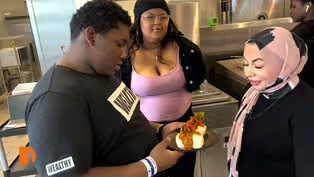
- [Will] The Detroit Food Academy is a non-profit that teaches cooking and life skills to teenagers and young adults.
BridgeDetroit reporter Micah Walker, sat down with two of the academy's instructors to talk about the organization's mission and how it not only prepares young people for culinary careers, but also inspires them to become community leaders.
(inspiring music) - [Instructor] Grab two plates.
- The Detroit Food Academy is a non-profit that works to inspire youth, young Detroiters from the age of 10 to 24 through culinary arts and food entrepreneurship.
From cooking delicious healthy meals for friends and family to facilitating complex community conversations, and our mission is to make sure that we build holistic leaders that are connected, they're healthy and they're giving back to the community.
- And what made the two of you interested in joining the organization?
- I actually was approached by a friend who was a part of Detroit Food Academy already, and they told me that they can use more men inside the organization.
And I had the capacity at the time, I had went to culinary school.
I wanted to find ways to kind of be more engaged in my community, through culinary in particular.
And Detroit Food Academy kind of fit like a lot of the little things that I wanted to do with myself moving forward.
- In 2020, I was furloughed from being at the restaurant and so I kind of didn't know what it is that I wanted to do.
Had did some meal prep for my own business during that summer and in October of 2020 had the opportunity to come on board.
Although we did have a common friend that had been working here already.
- What's cool about our particular curriculum is it's very much set up like an actual culinary school.
So we kind of start with the basics, then we go into different segments.
So whether it be different proteins, fish, chicken, beef, we go through bread, we go through veggies.
So each month we kind of focus in on a different part of culinary, and the students have the opportunity to create dishes based off of what we're studying at that point in time.
- [Student] Flipping dogs baby, flipping them dogs.
- Some of the items that the youths say that they really really loved was making tortillas from scratch.
They always wanted us to do french fries.
Once they knew like how easy it was to make french fries they're like, "We're never buying frozen potatoes again, I'm gonna make my own french fries."
Started with the theme and the youth threw out tons of themes, but then came down to being like, we actually want it to be anime.
Let's look into Detroit food and what you think about what Detroit food means.
And so from there we started to have the Detroit Anime theme menu.
- Yeah, the Coney Bao bun was probably the most popular thing that I would say throughout the entire year.
Which was the bao bun that we cut in half and made into basically a Coney dog, and we topped it with some collard kimchi.
That was by far the students' favorite dish.
I know you guys run the Advanced Leadership Program.
What does that entail?
- Months and months of planning.
But our advanced leadership program is actually where our youth who've been in the program for two years they have the opportunity to come to the advanced side where we do more life skill focus based learning, as well as deep culinary skills.
- These students have the opportunity to kind of further their culinary skills.
They've been with DFA for a while.
They've learned a lot of the basics, a lot of the knife skills, a lot of the culinary terms.
And at that point we give them the opportunity to bring it all together.
And actually do dishes more regularly, so we cook once a week as opposed to once a month.
- As the program is running, probably about six months, we kind of give them the lead where they start cooking the meals themselves and we kind of take a step back.
The youth for the advance they get the opportunity to do a a capstone project.
This year, thanks to Mister Booze, we actually were able to develop a relationship with Frame.
- What is Frame?
- Frame is a.
- Pop-up rotating restaurant establishment based outta Hazel Park.
They bring in different restaurants every month and they also have popups on the weekend.
And they allow for people to kind of like basically do stages, or monthly basis where they get to come in, excuse me, and operate their business out out of Frame.
So it culminates in us having a five course dinner at Frame, it's put on by the students.
So essentially the students come up with the menu, they come up with the theme, they come up with the dishes, the actual ingredients, we scale up the recipes to make 'em fit feeding 50 people.
- There were a lot of different elements that we added in there too.
They created their own cookbook based on the recipes that they had developed for the Frame dinner, as well as one of our past events.
It was really a lot of fun, and especially as we were curating the menu, we tested each dish.
- It's beautiful and innovative.
- And so to have the youth go from, "I'm not for sure if I actually want to make that."
to being like "This is so good.
I can't wait to show my mom and tell my friends about it."
Was like just to see that that level of engagement, that level of excitement just takes your heartstrings in a whole nother direction.
- So do many of the kids wanna go into culinary arts after taking the program?
- Out of our 20 youth, only four of them wants to pursue culinary arts.
The other ones are just making sure that they have those life skills.
- We have one student who wants to become a Master Chef, right?
She wants to be the first Black female Master Chef, and to know that DFA and our advanced class provides a space for her to kind of develop those skills early.
So before she goes out and gets a job or goes into culinary school, she kinda already has this foundation laid for her.
So Jermond and V, what's the highlight of working at Detroit Food Academy?
- How Booze and I approach it, is what didn't we have as youth that we can use to infiltrate our youth to make sure that they have that and be well-rounded.
And so the highlight is being able to see them develop, being able to see them being powerful, being able to see them using their voices.
- Planting seeds for the future with them.
Knowing that you are investing in them in a way that will help develop them to be their best person down the line.
And then also watching them in the community, watching them develop relationships, and watching them blossom.
- [Will] There are fun events for all ages taking place in metro Detroit this weekend.
From music concerts and comedy shows to outdoor activities, you'll find it all in today's "One Detroit Weekend" with Cecilia Sharpe of 90.9 WRCJ.
- Hi, I'm Cecilia Sharpe with 90.9 WRCJ.
The weekend is so close and there's a lot of fun things to do in and around Detroit.
So let's get started.
New music Detroit is hosting its 16th annual Strange Beautiful Music concert marathon through the ninth at three different locations in the city.
Friday's show is at Newlab in Michigan Central and Saturday's Show is at The CUBE in Orchestra Hall.
Friday you can see the Michigan-grown band Greta Van Fleet take the stage at Little Caesars Arena for their Starcatcher world tour.
It's going to be a very lively and entertaining concert.
Then if you feel like seeing some beautiful antique boats head to downtown Port Huron, where Boat the Blue takes place Friday and Saturday.
In addition to seeing many classic wooden boats you can also experience live music, kids' activities, a beer tent and more.
And of course, the great Dave Chappelle comes to Detroit's Little Caesars Arena Saturday night.
If you're gonna see that, get ready to bust out in laughter.
Hey, maybe after seeing Chappelle you'd like to continue on your comedy streak.
Well, you're in luck, as Planet Ant hosts Monday Night Improv every Monday in Hamtramck.
And of course, there's so much more going on in and around Detroit.
So here are other events to check out.
Have a fantastic weekend.
(gentle upbeat music) - [Will] That will do it for this week's "One Detroit."
Thanks for watching.
Head to the "One Detroit" website for all the stories we're working on.
Follow us on social media and sign up for our weekly newsletter.
- [Announcer] From Delta Faucets to Behr Paint.
Masco Corporation is proud to deliver products that enhance the way consumers all over the world experience and enjoy their living spaces.
Masco, serving Michigan communities since 1929.
Support for this program is provided by the Cynthia & Edsel Ford Fund for Journalism at Detroit Public TV.
- [Announcer] The DTE Foundation is a proud sponsor of Detroit Public TV.
Among the state's largest foundations committed to Michigan focused giving, we support organizations that are doing exceptional work in our state.
Visit DTEFoundation.com to learn more - [Announcer] Nissan Foundation and viewers like you.
(gentle upbeat music) (bright jingle)
Detroit Food Academy teaches culinary, life skills to youth
Video has Closed Captions
Clip: S8 Ep10 | 6m 22s | Detroit Food Academy cooks up the next generation of young leaders through food education. (6m 22s)

One Detroit Weekend: September 8, 2023
Video has Closed Captions
Clip: S8 Ep10 | 1m 45s | From Greta Van Fleet to Dave Chapelle and Owl City, here’s what’s happening this weekend. (1m 45s)
The Rise and Fall of Detroit's Velvet Peanut Butter Brand
Video has Closed Captions
Clip: S8 Ep10 | 5m 37s | The Rise and Fall of Detroit's Velvet Peanut Butter Brand (5m 37s)
Providing Support for PBS.org
Learn Moreabout PBS online sponsorship
- News and Public Affairs

Top journalists deliver compelling original analysis of the hour's headlines.

- News and Public Affairs

FRONTLINE is investigative journalism that questions, explains and changes our world.












Support for PBS provided by:
One Detroit is a local public television program presented by Detroit PBS