
Venezuelan migrants, Heart health, DJ Whodat, Weekend events
Season 8 Episode 38 | 26m 46sVideo has Closed Captions
Venezuelan migrants in Detroit, heart disease, Detroit DJ Whodat and One Detroit Weekend.
Church of the Messiah supports more than 60 Venezuelan migrants who have recently arrived in Detroit. New data from the medical team at EHproject show African American women are at a greater risk for heart disease than white women. Detroit DJ Whodat talks with contributor Chien-An Yuan for Women’s History Month. Plus, check out ways to spend the first weekend of spring on “One Detroit Weekend.”
Problems playing video? | Closed Captioning Feedback
Problems playing video? | Closed Captioning Feedback
One Detroit is a local public television program presented by Detroit PBS
Venezuelan migrants, Heart health, DJ Whodat, Weekend events
Season 8 Episode 38 | 26m 46sVideo has Closed Captions
Church of the Messiah supports more than 60 Venezuelan migrants who have recently arrived in Detroit. New data from the medical team at EHproject show African American women are at a greater risk for heart disease than white women. Detroit DJ Whodat talks with contributor Chien-An Yuan for Women’s History Month. Plus, check out ways to spend the first weekend of spring on “One Detroit Weekend.”
Problems playing video? | Closed Captioning Feedback
How to Watch One Detroit
One Detroit is available to stream on pbs.org and the free PBS App, available on iPhone, Apple TV, Android TV, Android smartphones, Amazon Fire TV, Amazon Fire Tablet, Roku, Samsung Smart TV, and Vizio.
Providing Support for PBS.org
Learn Moreabout PBS online sponsorship- [Narrator] Coming up on "One Detroit."
We'll take you to a Detroit church that's helping a large group of Venezuelan migrants attending Sunday Services.
Plus, we'll examine the high rates of heart disease in African-American women and what steps can be taken to lower the risk factors.
Also ahead, Detroit's DJ Whodat talks about her love for music, and we'll give you some ideas on how to spend this first weekend of spring.
It's all coming up next on "One Detroit."
- [Announcer 1] From Delta faucets to Behr paint, Masco Corporation is proud to deliver products that enhance the way consumers all over the world experience and enjoy their living spaces.
Masco, serving Michigan communities since 1929.
Support for this program is provided by the Cynthia & Edsel Ford Fund for Journalism at Detroit Public TV.
- [Announcer 2] The DTE Foundation is a proud sponsor of Detroit Public TV.
Among the state's largest foundations committed to Michigan focused giving, we support organizations that are doing exceptional work in our state.
Visit dtefoundation.com to learn more.
- [Announcer 1] Nissan Foundation, and viewers like you.
(light upbeat music) - [Narrator] Just ahead on "One Detroit," we'll talk with a cardiologist about heart-healthy habits that will help African American women reduce their high risk for heart disease.
Plus, DJ Whodat explains the inspiration behind her unique music style.
And Cecilia Sharpe of 90.9 WRCJ gets you ready for the weekend and beyond with a list of upcoming events.
But first up, the Church of the Messiah on Detroit's East side has seen an influx of migrants from Venezuela attending Sunday services.
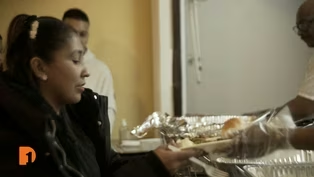
Their arrival was a surprise to church officials, but they've rallied around them to provide much needed support such as food, clothing, and English language courses.
"One Detroit's" Bill Kubota visited the church on a recent Sunday afternoon to learn more about what brought the Venezuelan migrants to Detroit and how the church is helping them.
(light upbeat music) - Hello, my name is Caroline Salazar.
- My name is Andrew Davila.
(speaking in Spanish) - Austin (indistinct).
- [Bill] Some new parishioners at the Church of the Messiah on Detroit's East side, on March Sunday.
- I am ready to bring it.
God is in the house.
- [Bill] Pastor Barry Randolph presiding.
- We noticed an influx of Latinos in the community.
Everybody in the community told them to come to the church.
They came to the church and of course, because they were immigrants, they were shipped here, it is believed from Texas.
It was kind of crazy.
So we immediately jumped into action, making sure that they had the necessities of life.
- A lot of them didn't have shoes when they came.
It was dead winter.
They didn't have boots, they didn't have socks.
They would walk around in flip flops, no coats.
So we got right on that and started getting donations.
I even got stuff from my home and reached out to a lot of other people to get stuff from their home to just bring it so they could have something that day.
- [Bill] Jennine Spencer Gilbert leads the church program.
She said more than 60 migrants originally from Venezuela have arrived since December.
They've been placed in a shelter just down the street.
- It's so funny, you always hear of Chicago, New York, you hear of these different places and you don't necessarily think Detroit.
And then lo and behold, it's Detroit.
- At Church of Messiah, we made a pantry for, not just for the immigrants, but for people that are in total need.
- [Bill] The church's computer labs turned into a distribution center for other organizations that need help too.
- Churches from all over, religious organizations, political leaders, activists, all got involved.
So it's not just Church of the Messiah, it's a lot of groups who are really helping to make this happen.
- Why we are building this boat, we are also selling it.
And you know, that's difficult because we don't have the resources.
So we've asked for people for donations and donations start pouring in, but we still need more.
So we use the phones to translate English and Spanish 'cause none of us, I don't know how to speak Spanish just a little bit.
And that's how we communicate.
(translator speaking in Spanish) - [Bill] Bellavelle Marino and her family of five came from Caracas.
- She said, I came from Venezuela four months ago with her family.
She has a special needs son as well that needs help and assistance who has been sick.
- [Bill] The church is helping place the children in schools.
(speaking in Spanish) - [Jennine] And Maria here is my lead.
In her country, she used to be a lab technician.
Her and I, we work closely together.
- Yeah!
- Yeah!
- We are building learning English and Spanish.
I've challenged her to learn five words from me a week.
I learn five words from them a week or sometimes I'm a little more challenged.
(laughs) - [Bill] The Church of the Messiah offers English classes too.
Nancy Chin and Kim Hodge provide the instruction.
(speaking in Spanish) The reasons these migrants left Venezuela, they say, economic hardship and political corruption.
Hyperinflation and poverty led to outmigration.
Seven million people according to the United Nations, some coming to the US.
(speaking in Spanish) Maria Rojas says the politicians caused the economic crisis.
And when her son joined marches against the government, he was threatened with death.
She and her family went to Peru.
It was there, she says, unfortunately, her husband died.
(speaking in Spanish) - He says, we are a family of three members.
Our trip was a little strong and hard.
We passed through eight countries to be able to get here.
Thank God we achieved it.
Were trips, were nights and day, rain, snow, sun.
But God, thank God we are here to try to fulfill each of our goals and dreams.
- We are grateful that they wound up in our neighborhood because we know that we can make a difference.
And then we also too, what is it like to have to leave your home country to go to another country to try to live and be acclimatized into that society?
That's gotta be difficult.
- So now a lot of them have just now received some of their paperwork, their IDs.
So now they're able to work, but they don't have transportation.
So they need bus passes.
We also need more funding because every week by them living in a homeless shelter, they're not getting proper nutrition.
So once a week on Sundays, we make sure that they get a full course meal.
- We always think about the population decrease in Detroit.
And we always think about how are the different ways that we can increase the population.
Well, this might be one of the things, and it's one of the things we didn't ask for.
But since they're here and they need a better place, a better environment, let's help make that happen.
- We are ready to work and ready to help this city be completely restored.
And we thank you for all the support you have given us in this moment.
Aw, yay!
- Yay!
- Whether you are from Venezuela or from (indistinct) you can come to Church of the Messiah.
We gonna make a better environment.
So let's go.
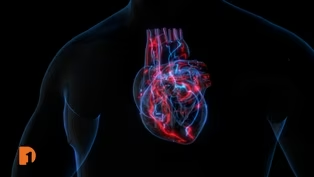
- [Narrator] Heart disease is the leading cause of death for men and women in the United States according to the Centers for Disease Control and Prevention.
African American women are particularly at risk.
More than 47% of Black women have heart disease.
American Black Journal host and "One Detroit" contributor, Stephen Henderson spoke with Henry Ford Health Cardiologist, Dr. Brittany Fuller about the steps African American women can take to lower their chances of getting heart disease.
(light upbeat music) - I don't think it's much of a surprise to many people that African American women suffer more from heart disease and its attendant complications than other people do.
But there is something about the dramatic way in which this is affecting Black women more that I think caught me by a bit of a surprise.
So I wanna start with you talking about just the numbers here and how acute this difference is between African American women and others in our population.
- So unfortunately, and it's unfortunate across the board, not just even heart health, that women, particularly women of color, African American women are dying at a much higher rate.
There's a lot of different reasons that you can say that that's different theories that we can hypothesize why this is happening.
But I think the biggest, one of the biggest things is that women, we tend to take care of everyone else and we don't take care of ourselves.
And so we ignore our symptoms and then unfortunately when we finally do come out and say, "I'm feeling this way," women, particularly Black women are ignored.
- Yeah, yeah.
I wanna come back to some of the causes a little later.
But I wanna talk upfront about the things that you think women can do and women's families can do to try to reduce this disparity.
And I say families because I think for all of us, it's helpful, and maybe even necessary that the people closest to us are as invested in our health as we are.
- So that can hit a multitude of different things from diet to everyone getting on the same page as mom, sister, you know, are trying to, cousins are trying to work on eating more vegetables, eating more lean protein, cutting out processed foods, not throwing that temptation out there.
And even some of the biases and going into family functions when you start to get in shape and lose weight and the family says, "Oh, you look too skinny," or "Oh, you don't want this, you don't want these ham hocks," like is supporting women in their journey of getting healthy.
So that's something that families can do.
Just simply be supportive and say, "Hey, I see that you're getting healthy.
I'm gonna join you on that journey, or I'm at least going to support you."
And then also, because women tend to, again, ignore themselves, if you see something is off, if you see that when they're climbing a flight of stairs or you're walking through the mall, that they're short of breath 'cause women tend to, their symptoms, they may not have that crushing chest pain.
They may just become profoundly short of breath or fatigued.
If you see that and say you're walking through the mall and say, "Hey, you just seem a little more short of breath than you normally do."
Bringing it to their attention things that they may not even realize themselves.
'Cause they're just slowing down and they just may not even realize that.
So just kind of paying attention to that too and helping them out and just bringing it to their attention, "Maybe you should see a doctor."
- Yeah, yeah.
So beyond diet, exercise, and general healthy habits, what else do you say that women can be doing to minimize this discrepancy?
- So I'm a very strong proponent of the fact that your mind and body are all one.
So taking 30 minutes a day for just you, whether that's meditation, whether that's prayer, whether that's shutting off all of your social media, your phones, disconnecting from the world and just spending that time with yourself regardless of what you do.
You can pray, you can meditate, you can do whatever you want, but just choosing that 30 minutes for you because stress hormones are, I always tell my patients, stress hormones are great when you're running from a bear, not so much in day-to-day life.
So if you can kind of find that mind-body connection, cut off the world for 30 minutes, and sometimes it's hard, sometimes it requires getting up 30 minutes early in the morning or after your kids are in bed, 30 minutes before you go to bed.
Finding that time for you and just saying, "That's my me time."
For me, I exercise, I find that 30 minutes for myself to say, "I'm gonna spend 30 minutes on the treadmill."
That's my time.
And I carve it out.
But finding that mind-body connection is important.
- Yeah.
Yeah.
So I wanna go back now to kind of the causes and the context for all of this.
Of course, you know, there's a history of unequal treatment for African Americans and especially for African American women, that no doubt contributes to all of these things.
But one of the other things that I want to kind of focus on is this dynamic where when women do speak up, go to the doctor, speak up and say, "Hey, this doesn't feel right," or "This seems like it's a problem," they often are not believed or listened to.
And I wanna talk about what we do about that.
I mean, you I think, being in the position you're in, is part of the solution, but there's gotta be other things that we should be thinking about to just change the system and the way it responds to African American women.
- And I do think that that's happening.
I think we're a very, very long way away from it being equal.
I do think there are a lot of things in play right now that making sure that people have the proper training, that everyone is not the same.
Symptoms are not the same.
I think we're recognizing more that women and women specifically, regardless of race, color, they have different symptoms, so they can have the same disease as the men, but may not present the same way.
So I think that's becoming more extreme mainstream, that again, women may have more shortness of breath as opposed to chest pain or their chest pain is different.
But I also think I always empower patients and I get a lot of these patients in my clinic for obvious reasons that they wanna see an African American cardiologist.
But I always empower people to, if you don't get the answer that you're not settled in the answer that's been given to you, keep looking.
Don't just don't just sit down and say, "It's okay, I'm fine," you know your body better than we will ever know it because you've been with it for your entire life.
If you're not getting the answer that you want, keep looking.
And keep going and going to different doctors, different hospital systems, someone will listen to you.
It's unfortunate that we have to do that, but you have to.
- Yeah.
But that requires I think a certain confidence and a certain comfort with the medical system that I also think is a hurdle for a lot of African Americans.
I mean, we still have challenges getting access to healthcare for people.
And then when they do, making sure that they can kind of take control of that and speak up and decide who they'll see and make sure they get the care that they want.
- 100%.
But I also, in that same token, I empower you to know your own numbers.
So getting everyone, I always empower patients, especially when I go out and do like community talks at churches and just community organizations and health fairs.
Know your numbers.
Get a blood pressure cuff from a drug store.
Write down some blood pressure numbers.
Know how to check your blood pressure.
When you get lab work, because when you go for just a routine physical, knowing your A1C, knowing your LDL, knowing those numbers, because the more information you have, you can go out there and actually find the doctors that you need.
But without knowing that stuff, without having that information, you're kind of powerless.
So the more you have, the more you can present and say, "Hey, my blood pressure consistently at home is 140 over 80.
This is abnormal."
I would hate to say that a doctor would turn someone away and say, "That's not true" if you're sitting there with a log in their face.
So yes, there are some things and I know that different health systems, especially here at Henry Ford, we do a lot of training and implicit bias training that I think is helping from the physician side, but we also have to empower patients as well.
- [Narrator] March is Women's History Month and "One Detroit" continues to shine a light on women making their mark in the world of music.
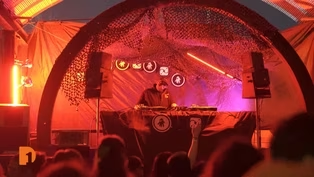
Detroit DJ and producer Terri McQueen, better known as Whodat, is a driving force in the city's electronic music scene and vibrant arts community.
"One Detroit" contributor Chien-An Yuan caught up with Whodat to talk about her love for house music and being an African American woman in the music industry.
(light upbeat music) (upbeat music) - Becoming an artist takes a lot of work.
For me, actually, the beginnings of it is learning to become an artist, believing that I was an artist.
I never considered myself an artist.
I think early on I was trying to help other people with the things that they were doing and understanding things that needed to be done and helping them navigate through things.
And over time I just realized like, you really have to take care of these things like a job.
(light music) I started to understand promotion better when I heard people talking about visibility.
So by the time I did movement, you know, there's not many people that look like me that do movement.
There's usually just a certain few.
So understanding that, like people need to see that because that's not something that I seen when I was younger and probably after movement I started seeing more people that look like me and they're like, "Yo, I seen you here, I heard you here.
I had heard about you, but now I'm seeing you more and you inspire me to do it.
It lets me know that I can do it."
When I get frustrated, is like, "Well if she got here, then I know I can get there.
I'm just gonna have to like work through whatever I need to work through to get there."
And it's important.
(upbeat music) Being from Detroit and making music is we stick to what we know.
This is what I'm doing and how I'm going to do it.
And I'm not changing my mind.
I don't care what you think.
I don't care what you like.
I don't care what you don't like.
When you're creating art, you're not necessarily thinking about like, yeah, everyone's gonna love this or like this, you're just getting your creative output out.
It's what people need to do.
Like, but when the money comes into it, you're like, "Oh man, I might lose my livelihood" or "I might lose my house" or "I might, well I already lost my house, I don't really care, I have nothing to lose."
Like 'cause I've already been through that.
What else you got?
And that's a Detroit thing.
People getting laid off or losing their job and plants closing and somebody being on drugs or somebody dying at an early age or them just having a hard life growing up or you getting like in a car accident or just whatever.
It's just like our makeup.
Like yo, I don't really care.
Like I'm working to get here and this is where I'm going.
You either in it for the ride or you can get out.
That's it.
My new toy, my first, maybe second Moog, 'cause this actually is the first one, the work stack, but you had to put together like a little kid.
So probably mostly baselines with this and experimentation.
So we made the main baseline on "Don't Know" from this sequential, but we have no idea what "Patrick" was.
It's somewhere in here, but that's fine 'cause that song's finished.
(laughs) Onto making a new one.
(quirky synth music) Timeless.
(upbeat music) If you're a good person and you have a good heart, most things are probably just coming to you.
For a long time I felt undeserving of the things that were coming to me 'cause I hadn't been doing this for a long time, but my mom was like, she explained to me, you have to understand, "You never look at all the things that you do for other people and you've always done that and you've always been that person.
So everything that you have coming to you, those are just things that you have already done."
Knowing that I understand like, well this needs to be seen so that people can start understanding like, "Okay, you can do this too and you can get over there.
You can be where I am."
(upbeat music continues) - [Narrator] Spring has sprung and there are plenty of activities in Metro Detroit to welcome this season.
You can have your pick of outdoor adventures, a film festival, a blues concert, museum activities, and much, much more.
Here's Cecilia Sharpe of 90.9 WRCJ with today's "One Detroit Weekend."
- Hi, I'm Cecilia Sharpe with 90.9 WRCJ, here to help you include some fun arts and culture events in your calendar over the next few days.
The next Greater Farmington Film Festival takes place through March 24th.
It is an independent film festival seeking to delve deep into current issues to empower people to take action.
The festival takes place at various locations throughout Farmington and Farmington Hills.
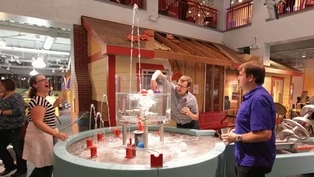
On Friday, adults 21 and over can enjoy a fun experience at the Ann Arbor Hands-On Museum.
It's the Scientific Sip & Sketch where you can enjoy your favorite drink while creating a work of art, including making a letter pressed bookmark.
Museum goers will be encouraged to find inspiration for their art from live wildlife.
Then on Saturday, the Outdoor Adventure Center is having its Lumberjack Day.
After the lumberjack pancake, run along the Dequindre Cut Greenway, patrons can take part in lumberjack-themed programming like a maple syrup and fusion.
Also, Saturday is the Motor City Blues Festival at the Fox Theatre featuring Tucka, King George, Pokey Bear, Theodis Ealey, J-Wonn, and West Love.
The concert will take you through all the emotions just as the blues is meant to do.
And you know, Easter is just around the corner and you can't have Easter without an egg drop.
On Sunday, the Bunny Brunch and Helicopter Egg Drop happens at the War Memorial.
Kids and their families can enjoy a delicious brunch with the Easter Bunny.
Then the Easter Bunny will take to the sky so kids can enjoy a friendly egg hunt.
Here are other events to check out.
Have a fantastic weekend.
(light music) - [Narrator] That'll do it for this week's "One Detroit."
Thanks for watching.
Head to the "One Detroit" website for all the stories we're working on.
Follow us on social media and sign up for our weekly newsletter.
- [Announcer 1] From Delta Faucets to Behr paint, Masco Corporation is proud to deliver products that enhance the way consumers all over the world experience and enjoy their living spaces.
Masco, serving Michigan communities since 1929.
Support for this program is provided by the Cynthia & Edsel Ford Fund for Journalism at Detroit Public TV.
- [Announcer 2] The DTE Foundation is a proud sponsor of Detroit Public TV.
Among the state's largest foundations committed to Michigan focused giving, we support organizations that are doing exceptional work in our state.
Visit dtefoundation.com to learn more.
- [Announcer 1] Nissan Foundation, and viewers like you.
(light upbeat music) (dramatic piano music)
Detroit DJ Whodat talks house music, Black women artistry
Video has Closed Captions
Clip: S8 Ep38 | 5m 28s | Detroit DJ Whodat talks with contributor Chien-An Yuan for Women’s History Month. (5m 28s)
Detroit’s Church of the Messiah supports Venezuelan migrants
Video has Closed Captions
Clip: S8 Ep38 | 5m 40s | Church of the Messiah supports Venezuelan migrants in Detroit with clothing and food. (5m 40s)
One Detroit Weekend: March 22, 2024
Video has Closed Captions
Clip: S8 Ep38 | 2m 18s | Check out some fun ways to enjoy the first weekend of spring in and around Detroit. (2m 18s)
Study finds Black women at greater risk of heart disease
Video has Closed Captions
Clip: S8 Ep38 | 9m 3s | Dr. Brittany Fuller discusses Black women’s heart health and tips to reduce risk factors. (9m 3s)
Providing Support for PBS.org
Learn Moreabout PBS online sponsorship
- News and Public Affairs

Top journalists deliver compelling original analysis of the hour's headlines.

- News and Public Affairs

FRONTLINE is investigative journalism that questions, explains and changes our world.












Support for PBS provided by:
One Detroit is a local public television program presented by Detroit PBS