
Veteran Shares Experiences Navigating Chaos and Crises
Clip: Season 3 Episode 241 | 7m 7sVideo has Closed Captions
Angela Billings is also a Louisville communications strategist and entrepreneur.
A Louisville communications strategist, author, and entrepreneur knows all too well that PR experts are far from what some would call "spin doctors." Angela Billings, a U.S. Air Force veteran, released a book documenting her experiences navigating chaos and crises, like the terrorist attacks on September 11, 2001.
Problems playing video? | Closed Captioning Feedback
Problems playing video? | Closed Captioning Feedback
Kentucky Edition is a local public television program presented by KET
Veteran Shares Experiences Navigating Chaos and Crises
Clip: Season 3 Episode 241 | 7m 7sVideo has Closed Captions
A Louisville communications strategist, author, and entrepreneur knows all too well that PR experts are far from what some would call "spin doctors." Angela Billings, a U.S. Air Force veteran, released a book documenting her experiences navigating chaos and crises, like the terrorist attacks on September 11, 2001.
Problems playing video? | Closed Captioning Feedback
How to Watch Kentucky Edition
Kentucky Edition is available to stream on pbs.org and the free PBS App, available on iPhone, Apple TV, Android TV, Android smartphones, Amazon Fire TV, Amazon Fire Tablet, Roku, Samsung Smart TV, and Vizio.
Providing Support for PBS.org
Learn Moreabout PBS online sponsorshipA Louisville communication strategist, author, and entrepreneur knows all too well that PR experts are far from what some would call spin doctors.
Angela Billings, a U.S. Air Force veteran from Louisville, released a book documenting her experiences navigating chaos and crises like the terrorist attack on September 11th, 2001.
Her book is called Command the Crisis.
She's also the communications director for the Kentucky Senate.
Republicans and recently gave a Ted talk, as you're saying here, about women's liberation and setbacks in Afghanistan, where she worked.
It was all informed by her work as a longtime spokesperson for the Air Force.
Part one of our conversation tonight begins with her recollections about the terrorist attacks.
911.
This as we began a new series on Kentucky Edition about books and authors called Turning the Page.
Well, I do want to talk about your military days and how that you kind of rose through the ranks and became really the face and the voice for NATO.
And so many ways.
So talk about that.
And during such a pivotal time in American history, during the darkest, one of the darkest days in our nation's history.
Absolutely.
So, you know, I was a public affairs officer throughout my career.
We as a nation were, attacked by the terrorist September 11th, 2001.
I had just arrived at the Pentagon weeks earlier and was really just getting my bearings about how to navigate in the building.
When the terrorist attacked in New York, Pentagon and then that fourth plane that landed in Pennsylvania, it was, it certainly galvanized, not only the United States, but the entire world.
And we changed our diplomatic approach to a country that had been war torn for decades and, and their blessing and invitation.
NATO to us was, you know, one nation stepped into Afghanistan to really root out those terrorists within and were there for 20 years.
I was there at about the halfway point, and as you indicated, I was the spokesperson, for in the International Security Assistance Force there in Kabul, the headquarters for ISAF.
So we would do, daily news releases about what our effort entailed.
We did press conferences in order to provide updates to the press, into the world about how we were providing for the security in Afghanistan.
Yeah.
Yeah.
You have described in detail to about that day and about, maybe even what that meant to you in terms of this would be a mission.
It wasn't just a job.
Absolutely.
It was a mission now.
Absolutely.
And I'm probably am not unique in that.
You know, military members, when we join, we, you know, raise our right hand sign on the dotted line and say, we're going to put our life on the line for for this country, this amazing country that we have the privilege of living in.
And so, experiencing the attacks in, in, at the, on the Pentagon, really, gave us laser focus on what our mission was.
And we knew that we had to, take a stand and to make every available attempt to rid this world of some very, very evil men.
You know, you've talked about the liberation of women in Afghanistan, and many of us are very familiar with Malala.
Yes.
Her 17 year old, who won the Nobel Peace Prize at age 17, the youngest.
The youngest, you know, shot in the head in the face by the Taliban.
And you talk about not just her bravery and courage in that, but you know why that is so important?
That moment and then going forward.
Because we know that there was a time where there was, some, some upward mobility of women in Afghanistan.
And then after 20 years of that liberation and that diplomacy, it was it was gone.
Right.
And there was a struggle for it to this day.
Absolutely.
In fact, I think that the terrorists know how very important education is.
That is why they forbid women from pursuing just your primary education and then go on to, you know, attain your professional degrees.
So, as you indicated, for 20 years, women were able to work outside the home, contribute to the local economy, provide for their families, in that way.
And then when the U.S. departed Afghanistan and, the Afghan National Army collapsed within months against a Taliban offensive and then really took that education that so many women had worked so very hard for, much like you.
And I was just torn, torn from them and and the the terrorist, feel threatened.
And that's why they've, you know, taken Islamic law and they've really just, taken it to the very extreme and saying that women now, you can't even talk to your mother, to your sister, to your friend.
So they feel very much threatened by, just those very simple, liberties that we hear in this great nation often take for granted.
Are there any lessons that we could learn as a country that is a free democracy?
From what we see in countries that do not enjoy that type of freedom, particularly when it comes to women.
Certainly.
And, and, and I addressed this in my talk to some extent.
You know, education is the single element that makes a difference in poverty and attaining, liberty, economic liberty to provide for yourself and your family.
I was the first of, six children.
I was number five of six, the first to attend college.
And that is something that my father stressed to me as a very at a very young age.
Get your education, Angela, because once you have it, nobody can take it away from you.
And fortunately, in the United States, that is the case.
Whereas in a country like Afghanistan, women have taken they've been forced to step back.
And, it's a, it's dire situation that Malala, you know, she still champions today.
It's a, it's gender apartheid.
And it's not just in Afghanistan that we should be concerned because if we don't stand up for women's rights in Afghanistan, then we might face a new generation of radical extremists that will make another attempt, like the 9/11 attacks, whether it's on the United States or another country.
Tomorrow night, the battle tested communicator will share how she's shaped messaging and responses to tense and challenging situations in the military, business and politics.
And we'll talk more about her book, Command the Crisis.
That's tomorrow night on Kentucky Edition.

Connecting Community to Local Food Systems
Video has Closed Captions
Clip: S3 Ep241 | 3m 42s | The event brings people together to see how the local food system works. (3m 42s)
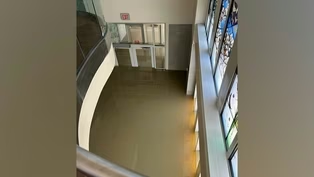
Frankfort Library Finding Ways to Serve Despite Flood Damage
Video has Closed Captions
Clip: S3 Ep241 | 3m 7s | Weeks after the water went down, the Paul Sawyer Library still isn't open. (3m 7s)

Kentucky Sees 30% Drop In Fatal Overdoses
Video has Closed Captions
Clip: S3 Ep241 | 1m 24s | Last year marked the third year in a row of decline. (1m 24s)
Recovery Program Removing Barrier for Rural Kentuckians
Video has Closed Captions
Clip: S3 Ep241 | 3m 48s | The program provides rural Kentuckians with virtual group therapy. (3m 48s)
Report: Average Teacher Pay Slips in KY
Video has Closed Captions
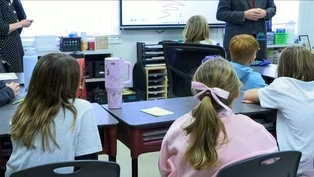
Clip: S3 Ep241 | 58s | The report says Kentucky ranks 42nd in the nation when it comes to pay for public school teachers. (58s)
Providing Support for PBS.org
Learn Moreabout PBS online sponsorship
- News and Public Affairs

Top journalists deliver compelling original analysis of the hour's headlines.

- News and Public Affairs

FRONTLINE is investigative journalism that questions, explains and changes our world.












Support for PBS provided by:
Kentucky Edition is a local public television program presented by KET