VPM News Focal Point
When Rights Collide | November 02, 2023
Season 2 Episode 18 | 26m 46sVideo has Closed Captions
What challenges do we face as one’s individual rights are hindered by another’s rights?
What challenges do we face as one’s individual rights are hindered by another’s rights? With clashes over religious beliefs, public safety vs gun ownership or the right to life vs bodily autonomy. Where are the lines, and who are the referees?
Problems playing video? | Closed Captioning Feedback
Problems playing video? | Closed Captioning Feedback
VPM News Focal Point is a local public television program presented by VPM
VPM News Focal Point
When Rights Collide | November 02, 2023
Season 2 Episode 18 | 26m 46sVideo has Closed Captions
What challenges do we face as one’s individual rights are hindered by another’s rights? With clashes over religious beliefs, public safety vs gun ownership or the right to life vs bodily autonomy. Where are the lines, and who are the referees?
Problems playing video? | Closed Captioning Feedback
How to Watch VPM News Focal Point
VPM News Focal Point is available to stream on pbs.org and the free PBS App, available on iPhone, Apple TV, Android TV, Android smartphones, Amazon Fire TV, Amazon Fire Tablet, Roku, Samsung Smart TV, and Vizio.
Providing Support for PBS.org
Learn Moreabout PBS online sponsorshipKEYRIS MANZANARES: We all have rights, both human rights, and those granted to us as Americans.
But what happens when one person's rights conflict with another's?
Tonight, we considered the space where our rights collide over the right to protest the freedoms of speech and religion and the ongoing dispute over the right to bear arms.
That's next on VPM News Focal Point.
Production funding for VPM News Focal Point is provided by The estate of Mrs. Ann Lee Saunders Brown.
And by... ♪ ♪ KEYRIS MANZANARES: Welcome to VPM News Focal Point.
I'm Keyris Manzanares in for Angie Miles.
Many of the tensions we face in society occur over a clash of rights.
We begin with the growing outcry over the bloody Israel-Hamas War in the Middle East.
Israel is bombarding Gaza from the air and land, while Hamas militants are holding hundreds of innocent Israelis and others hostage, including up to 10 Americans.
They were kidnapped during a violent attack on Israel on October 7th.
The Associated Press is reporting that 1,400 Israelis and more than 8,500 Palestinians have been killed thus far.
Next, I take a look at how this story is unfolding here with Virginians raising their voices through vigils and protests supporting Israeli and Palestinian communities.
(person singing in foreign language) KEYRIS MANZANARES: The Jewish Community Federation of Richmond held a solidarity gathering following the October 7th surprise attack when Hamas militants killed more than 1,400 adults and children, and took 222 people hostage.
Local Rabbi Sherry Grinsteiner, who spoke at the event, has family living in Israel.
SHERRY GRINSTEINER: I am very concerned for the wellbeing of my children.
They're constantly in and out of the bomb shelters.
I mean, they're living in a state of terror.
Nobody knows what they can do.
I have nephews and nieces with children.
Nobody leaves the house.
We just want to live peacefully, and we need to have the other side to understand that we are going to be here waiting for a hand that is being stretched with peace.
But again, peace need to be achieved by peace means, not by terrorist attacks, not by means of killing, and murdering innocent people.
KEYRIS MANZANARES: After Israel responded to the Hamas attack by bombing Gaza, protests erupted on college campuses.
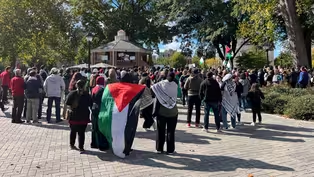
In Richmond, hundreds of demonstrators marched near Virginia Commonwealth University in late October in support of the Palestinians.
They called for a ceasefire in the Israel-Hamas War where thousands have been killed.
VCU students and community members coming together, many wearing keffiyehs, traditional Palestinian scarves, and carrying flags and signs, exercising their right to express their views through protest.
SEREEN HADDAD: In reality, all we're trying to do is fight for our freedom and fight for our rights.
I think we have, but we have been for the past 75 years.
The right for me, the right for every Palestinian to protest is so important for us because if we stop speaking up, who's going to speak up?
KEYRIS MANZANARES: 19-year-old Sereen Haddad worries about her family who is living in Gaza.
SEREEN HADDAD: We're really just waiting in the morning for text messages, trying to make sure that they're still alive.
It's really horrible.
My grandmother's house that she used to tell us stories about all the time, the other day, it actually just got leveled.
It got completely bombed, and I never got to visit it.
We never got to go.
KEYRIS MANZANARES: Reporting for VPM News Focal Point, I'm Keyris Manzanares.
KEYRIS MANZANARES: Later in the program, we'll speak with an expert on the Israel-Hamas War to learn more about the history in that region and what we can expect over the coming weeks and months.
KEYRIS MANZANARES: Inevitably, there will be times where one person's rights come into conflict with another's.
In those instances, should some rights take priority?
This is the question we posed to people of Virginia.
GARY MARSH: All rights are important, and we need to listen to everybody.
We need to pay attention to what everyone's conflicts are, and try to find the best way to resolve them, 'cause we don't seem to be doing a very good job at it.
TOREY WILLIAMS: You're going to hear things that you're not going to like, and that's okay.
But, I feel like at a certain point, we shouldn't say things that, you know, are going to have some kind of negative connotation or severely negative effect on a wide group of people.
LOGAN JAMES: I say freedom of speech.
Like, you can't, like, it would be messed up not to have freedom of speech.
Like, it's the United States of America, not like a dictatorship or something like that.
KEYRIS MANZANARES: While freedom of speech comes to mind for many, our next story explores freedom of religion and what that means for the abortion debate.
If you've seen political ads for the 2023 election, abortion may be a factor for many voters in Virginia.
It's an issue that pits a person's belief in their right to reproductive medical care against the belief that abortion is morally wrong.
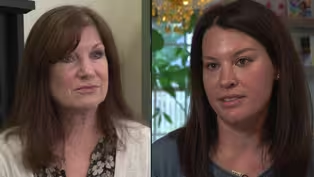
News producer Adrienne McGibbon introduces us to two women, both guided by their faith who are on different sides of the argument.
ADRIENNE McGIBBON: Kathleen Wilson has made it her mission to care for women in need.
It all began after an exchange with a pregnant woman outside a DC abortion clinic.
Wilson says it changed her life.
KATHLEEN WILSON: I really was hesitant, but I walked over, and as soon as I did, she rolled down her window and I said, 'Is there something that I can help you with?'
And she said, "What can you help me with?"
ADRIENNE McGIBBON: After that experience 18 years ago, Wilson and a few friends opened Mary's Shelter in Fredericksburg.
KATHLEEN WILSON: The women that call us, the pregnancy isn't generally the crisis, it's all the other stuff going on in their life.
ADRIENNE McGIBBON: Wilson helps women escaping abusive relationships and managing tremendous financial strains.
Mary's Shelter, which operates purely on donations, provides more than 30 bedrooms for women and their children.
Wilson says her upbringing and faith guide her work.
KATHLEEN WILSON: I come from a big Irish Catholic family.
And my dad was a police officer, so there wasn't, you know, a ton of money.
But there was never a time, ever a time, where somebody in need didn't come to my mother and she wasn't able to stay with us, or he wasn't able to stay with us, or my mom didn't feed them.
She had a quote, she'd always say.
"I can always add another potato to the pot."
ADRIENNE McGIBBON: She also sees every child as a gift from God.
KATHLEEN WILSON: I wish there weren't abortions, you know, I really do.
I mean, I wish women didn't feel that need.
I do believe that, you know, it's the taking of a life and that's a very hard thing.
That's a very horrible decision for any woman to have to make.
ADRIENNE McGIBBON: Wilson considers the care offered at Mary's Shelter as an alternative to abortion.
KATHLEEN WILSON: I don't want to take away people's rights, but I want to take away abortion.
I want to get to a point where nobody feels like they have to have an abortion.
Like, we serve these women in other ways.
If it's housing they need, if it's mental health care, if it's assistance with the child, like, I want to fund those things.
ADRIENNE McGIBBON: She disagrees with the argument that reproductive care should be kept between a woman and their doctor.
KATHLEEN WILSON: I just don't think that the decision is really there anymore.
There's been a created human.
ADRIENNE McGIBBON: Shira Zemel also grew up in a deeply religious home.
Her father was a rabbi and her grandfather was an OB-GYN in Pennsylvania.
SHIRA ZEMEL: He was an abortion care provider before and after Roe versus Wade.
I have so many memories going to Harrisburg and going around with my grandparents.
And we couldn't go anywhere without people coming up to us and telling me as a young person, "Oh, your grandfather delivered me," or "delivered my children."
I think a lot about maybe the former patients of his who would see us and maybe not come up and tell us that my grandfather helped them when they needed help.
ADRIENNE McGIBBON: Zemel heads the abortion access campaign for the country's oldest Jewish feminist organization.
She says Judaism clearly prioritizes the life of a mother over the unborn.
SHIRA ZEMEL: There's no Jewish idea of fetal personhood.
The life of the pregnant person takes precedent.
And Jewish tradition, over centuries in rabbinic literature, continues to reaffirm this, that the life of a pregnant person is our priority.
ADRIENNE McGIBBON: Zemel argues the First Amendment and freedom of religion should protect the right to an abortion.
SHIRA ZEMEL: The same way that it's the anti-abortion protestors' right to be up on the street bringing their deeply-held beliefs about abortion into the public square, that same First Amendment that protects them is the same First Amendment that should protect us to practice our religion, or if we don't have religion, as we see fit.
And for no one's religion to interfere with the laws of our country.
ADRIENNE McGIBBON: The Supreme Court's 2022 decision in Dobbs gave individual state legislatures the power to legislate abortion access.
In Virginia, the law currently allows abortion through the second trimester, with some exceptions later in pregnancy.
University of Richmond Law Professor Meredith Harbach says this could change depending on who's in office.
MEREDITH HARBACH: Its one of the consequences of this no longer being a right protected at the federal level, so it is both returned to the states and returned to the legislative branches.
Meaning they can change their minds.
KEYRIS MANZANARES: The current election cycle could have consequences for the debate over abortion in the state.
Governor Glenn Youngkin has announced his support of a 15-week cutoff on abortion access, which he hopes to pass if Republicans win control of both legislative chambers.
If elected, Democrats have vowed to protect abortion access in the state.
ANGIE MILES: VPM News Focal Point is interested in the points of view of Virginians.
To hear more from your Virginia neighbors, and to share your own thoughts and story ideas, find us online at vpm.org/focalpoint.
KEYRIS MANZANARES: Nationwide, gun deaths are on the rise.
Recently, there was another mass shooting in Maine where 18 people were killed.
Here in Virginia, around 45% of adults have guns at home.
We spoke with Virginians on both sides of the debate over the right to bear arms versus the right to be safe from gun violence, a collision of rights that is tearing the country apart.
Photographer / producer Emmanuel Tambakakis brings us this report.
EDWARD WEEDEN: I was involved in a mass shooting four years ago.
I saw the guy shoot a girl on the stairway.
She went down.
I lost 13 friends that day, over a disgruntled employee.
EMMANUEL TAMBAKAKIS: In 2019, Ed Weedon witnessed a mass shooting in a Virginia Beach government building where he worked.
He believes that no one should have a gun.
EDWARD WEEDEN: I was in the military, I still don't support it.
I was involved in a mass shooting, I still don't support it.
You will never get me convinced that gun rights are important.
PHILIP VAN CLEAVE: Your right to bear arms protects your right to be alive, protects your life, your liberty.
So they're not exclusive at all.
Now, they have to reach a very high bar to have any kind of constitutional gun control.
EMMANUEL TAMBAKAKIS: Philip Van Cleave leads a pro-gun group, famous for organizing an annual Lobby Day for thousands of activists from around the country.
They march with assault weapons to the Virginia Capitol, advocating for their Second Amendment rights in the Constitution of the United States.
PHILIP VAN CLEAVE: It says that a well-regulated militia necessary to the security of a free state, the right of the people to keep and bear arms shall not be infringed.
Now, I emphasize that because it didn't say the right of the militia to keep and bear arms.
It said the right of the people, you and me.
It means the right to protect myself, my family, even another innocent if I were in a position where I felt, you know, I knew exactly what was happening and an innocent person was about to be killed or grievously hurt, I could intervene legally.
It means the right to protect my country if something happened.
LORI HAAS: I saw just more pain than I can describe.
EMMANUEL TAMBAKAKIS: Lori Haas's daughter was shot, but survived the mass shooting at Virginia Tech.
The events of that day turned Haas into a gun control advocate.
LORI HAAS: On the morning of April 16th, 2007, I got a phone call from my daughter saying, you know, "Mommy, I've been shot."
You know, "There's shootings everywhere, it's bad."
"It's really bad."
32 students and staff were killed that day.
Another 17 were injured by gunfire, and another seven were injured jumping out a second story window, trying to save their lives.
The Virginia Tech massacre is the third worst in the country.
I work for the Johns Hopkins School of Public Health, advocating for policy and change in Virginia.
I think there is opportunity to intervene and prevent gun violence, and I think we should be doing more.
I think that when we look at rights and we fathom that they're absolute and that they apply in any and every situation, we forget the common good.
I have the right to walk down the street and feel safe, and feel safe from people who might be carrying a firearm, you know, with the intent to do harm or commit firearm death or injury in public spaces.
JOHN CUEBAS: I have a right to live, and I do have the right to keep and bear arms.
I do both, I live and I use my right to keep and bear arms as my protection.
EMMANUEL TAMBAKAKIS: And John Cuebas teaches others how to handle firearms safely.
JOHN CUEBAS: I do believe in the Constitution though, but times have changed.
You know, there's a lot of people with bad intentions, and they need to be screened to get a firearm, but if nothing comes up negative and they're allowed to have it, I'm all for it.
There are groups of people who don't like guns, period.
You know, they feel that guns kill people, but it's not guns that kill people.
It's people that kill people, guns in the wrong hands.
LORI HAAS: I have heard the sentiment, "Guns don't kill people.
People kill people."
and that's what we work on.
Who are those people?
Who's at risk of committing gun violence and let's prohibit them from having firearms, either permanently or temporarily.
JOHN CUEBAS: I believe that most people feel uncomfortable with firearms is because the way they were raised, you know, they either weren't around firearms, they didn't hunt, they didn't do anything that involved firearms, where, you know, I can talk to them, you know, and try to convince them, but that's all I can do.
LORI HAAS: The pain and suffering that families endure never goes away.
You know, there is not closure.
There's a hole in someone's heart for their lifetime, and I'm committed to doing all I can to intervene and prevent gun violence in all its forms.
PHILIP VAN CLEAVE: Do they feel the same way about automobiles on expressways?
I mean, gosh, we lose 40, 50,000 people a year to automobile accidents.
Do they feel that way about automobiles?
That'd be my question to them, because what I do in my life doesn't affect them.
You know, so they just don't like guns and therefore, they consider it infringing upon their freedom to be in a world without guns.
Well, sorry, there is no such freedom.
EDWARD WEEDEN: It's about life.
You're born and then you die.
You know, you're not born to get killed by a gun.
No city and no person is immune from it.
LORI HAAS: It's a public health epidemic that we're not doing enough about, and we should be doing more, and we should be addressing it in ways where we can intervene and prevent harm and prevent death and injury.
KEYRIS MANZANARES: The debate over rights and regulations continues.
A recent national NPR/Marist poll found 60% of Americans think that controlling gun violence is more important than protecting gun rights.
In Virginia, Governor Youngkin and Republicans support increased mental healthcare funding and tougher penalties for crimes committed with guns.
Democrats support a range of gun control restrictions, including bans on assault-style weapons and safe firearm storage laws to protect children.
We can expect a renewed clash over gun-related legislation when the General Assembly convenes again on January 10th.
KERYIS MANZANARES: Now we turn back to the Israel-Hamas War with our guest Ariel Ahram who is a professor and chair of the Government and International Affairs Program at Virginia Tech.
His most recent book is "War and Conflict in the Middle East and North Africa," where he explores the causes for fighting in that part of the world.
Thank you for joining us.
We'd like to get started with where we are right now in the Israel-Hamas War.
What's been happening this week?
ARIEL AHRAM: On the military front, Israel is accelerating its ground assault and ramping up aerial and artillery attacks against Hamas strongholds in Gaza.
Hamas and Palestinian Islamic Jihad are continuing to launch rockets at Israeli cities.
Meanwhile, the humanitarian situation in Gaza is worsening by the hour.
Israeli attacks have pulverized apartment buildings, hospitals, and other vital infrastructure.
There are calls in Europe and the Islamic world for Israel to adopt a cease fire.
A small number of wounded Palestinians and those holding foreign passports are being allowed to leave Gaza for Egypt.
The U.S. remains Israel's key ally and supporter but has become noticeably wary of escalation and is putting pressure on Israel for restraint.
KERYIS MANZANARES: What sparked this round of violence?
ARIEL AHRAM: This round of terrible violence began on October 7th when Hamas launched a surprise attack from Gaza into Southern Israel.
Hamas fighters targeted both Israeli military bases and civilian towns.
They killed over 1,200 and took 200 hostages, including citizens of Israel, the U.S., Britain, France, Germany, Thailand, and elsewhere.
KERYIS MANZANARES: This is a very complicated issue, but if we were to boil it down, what is this conflict about and what are the origins?
ARIEL AHRAM: There's a lot of mythology and self-serving narratives about the origins of the Israeli-Palestinian conflict and who is responsible for it.
Some people try to trace it back to the Bible or to the Quran, but framing this as an ancient conflict is unhelpful, and I think historically inaccurate.
About 100 years ago at the turn of the 20th century, Jewish and Arab Palestinian nationalist movements claimed the same territory as their homeland, including the holy sites of Jerusalem.
The state of Israel was established in 1948 as a Jewish homeland.
Palestinian efforts to establish a state of their own have failed thus far.
There are many people in both the Jewish and Palestinian communities and key international supporters who believe that their homelands are indivisible, and they can't be shared with others.
KERYIS MANZANARES: What should we expect to see over the next weeks and months in this war?
And do you think that there can be peace in this region?
ARIEL AHRAM: Unfortunately, in this case, in the Israel-Palestinian conflict going on right now in Gaza, the violence is probably going to accelerate at least for the next few weeks and maybe months, and it's not going to end anytime soon.
I should stress though that the region as a whole has peace in different forms.
There's a misconception or a stereotype of the Middle East as somewhere that's always on fire, always violent, and in fact that's not the case.
There are lots of areas of peace, peace that forms in local communities, peace that forms at districts and sub-districts and provinces, and sometimes peace between states.
Just a few months ago we had this, there were a lot of discussions about Israel's efforts to come to a peace treaties with Saudi Arabia and the Abraham Accords between Israel, the UAE, Bahrain and Sudan.
Those are examples of peace.
I think what we know though is that the peace of the Middle East is fragile and is maybe more fragile than in other regions and is more prone to being overturned.
We have to be really careful and attentive to the role of spoilers who don't see peace as being in their interest.
KERYIS MANZANARES: Thank you.
Thank you so much for joining us today.
ARIEL AHRAM: Thank you.
(upbeat music) ANGIE MILES: You can watch the full interview on our website.
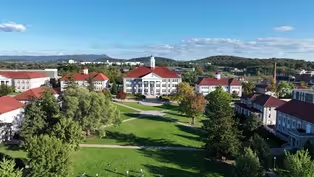
KEYRIS MANZANARES: Back in the U.S., it's an issue universities constantly have to deal with: where do you draw the line between allowing controversial speakers on campus versus allowing students to protest them?
Multimedia Journalist Billy Shields reports.
BILLY SHIELDS: On April 26th, at James Madison University's campus in Harrisonburg, Virginia, controversial speaker Liz Wheeler came to give a speech.
It was a time one graduating senior described as “crazy.
” KEN KENSKY: It was really scary for a lot of people.
Many of my friends were scared because a lot of what Liz Wheeler talks about is very anti-transgender, and many consider it to be hate speech, and they were worried about what type of people it might bring to campus.
BILLY SHIELDS: And as anger built on campus in the weeks leading up to Wheeler's talk, the question progressive students like Ken Kensky had to consider was what to do about it.
KEN KENSKY: There was a lot of discussion about, how far do we go in our protest?
There were some people who were saying that we should go attend her event.
We should disrupt it because we disagree with her ideas.
And there were other people that were saying, "No, she has a right to speak.
We should ignore her, have our own event."
BILLY SHIELDS: Parker Boggs is a senior at JMU now, and is the campus chairman of Young Americans for Freedom, the conservative group that sponsored Wheeler's talk.
PARKER BOGGS: When I think of people when they say, "Oh, it was a transphobic speech, it was hate speech."
Liz blatantly said before she did a TV interview saying that she doesn't hate people who are transgender or who identify as transgender.
She wants to just know, she wants 'em to know what's happening and wants 'em to know about the transgender ideology.
That's what she was going at, and that was her main point of this.
BILLY SHIELDS: It is a controversy playing out on campuses in other parts of the state and nationwide.
Should controversial speakers be allowed to share what some consider hurtful or even hateful views on campus, and should protestors be allowed to shout them down?
RONALD CRUTCHER: Shouting the speaker down is not an option.
BILLY SHIELDS: It's something Ronald Crutcher had to deal with when he was president of the University of Richmond.
RONALD CRUTCHER: What I felt we needed to do at the University was to help our students understand why it was important to hear perspectives that you might not necessarily agree with.
BILLY SHIELDS: Recently, JMU and UR joined a 13-university initiative funded by the Knight Foundation aimed at preserving free speech on campus.
RONALD CRUTCHER: We had a transphobic speaker on our campus, and people wanted me to disinvite him, and I didn't do that.
But yet, on the day that he spoke, students came.
They dressed in white to protest, they carried signs, but he was able to give his presentation.
BILLY SHIELDS: Back at JMU, Kensky ultimately demonstrated outside Wheeler's talk.
KEN KENSKY: My personal belief on the matter was, I don't want her to be here, but she is allowed to be here.
BILLY SHIELDS: Which went on as planned.
LIZ WHEELER: Has it been approved?
STUDENT: These are still- BILLY SHIELDS: But did get heated at times.
PARKER BOGGS: There have to be a plethora of views on campus no matter what.
BILLY SHIELDS: In Crutcher's mind, university administrators should think carefully about whom they bring in.
RONALD CRUTCHER: There has to be an intellectual rationale for that invitation.
BILLY SHIELDS: It remains a controversial part of university life.
Neither JMU nor UR's current administration would comment for this piece.
(truck motor humming) KEYRIS MANZANARES: We've reported on multiple perspectives about the complex issue of rights that continue to plague our nation and world.
For a more in-depth conversation with Virginia Tech professor Ariel Ahram on the Israel-Hamas War, go to our website, vpm.org/focalpoint.
While you're there, please leave us your thoughts and story ideas.
Thank you for watching, and we'll see you here next week.
Production funding for VPM News Focal Point is provided by The estate of Mrs. Ann Lee Saunders Brown.
And by... ♪ ♪
Campus Free Speech in Virginia
Video has Closed Captions
Clip: S2 Ep18 | 3m 27s | Where does a student’s right to protest on campus and a speaker’s right to speak collide? (3m 27s)
Video has Closed Captions
Clip: S2 Ep18 | 4m 26s | Two women, guided by their faith, end up on different sides of the debate over abortion. (4m 26s)
Impact of Israel-Hamas War on Virginians
Video has Closed Captions
Clip: S2 Ep18 | 2m 19s | Virginians are reacting to the Israel-Hamas War by exercising their right to protest. (2m 19s)

Israel-Hamas War: Origins and Potential for Escalation
Video has Closed Captions
Clip: S2 Ep18 | 7m 15s | The origins of the war between Israel and Hamas and the potential for a growing conflict. (7m 15s)

The Right to Bear Arms vs. The Right to Public Safety
Video has Closed Captions
Clip: S2 Ep18 | 5m 47s | When rights collide over gun ownership versus gun control, a look at the gun debate. (5m 47s)
Providing Support for PBS.org
Learn Moreabout PBS online sponsorship
- News and Public Affairs

Top journalists deliver compelling original analysis of the hour's headlines.

- News and Public Affairs

FRONTLINE is investigative journalism that questions, explains and changes our world.












Support for PBS provided by:
VPM News Focal Point is a local public television program presented by VPM