Virginia Home Grown
VHG Clippings: Value-Added Products
Clip: Season 21 Episode 1 | 26m 46sVideo has Closed Captions
Discover unique value-added products created by Virginia farmers.
Meet farmers taking what they grow to the next level by creating value-added products. At Wandering Cow Farm, Peggy Singlemann learns about raising sheep for wool. Christoph Herby from Tonoloway Farm visits the studio to explain how to make tree syrups including a unique black walnut variety. Randy Battle and Jen Naylor share gardening tips you can use at home.
Problems playing video? | Closed Captioning Feedback
Problems playing video? | Closed Captioning Feedback
Virginia Home Grown is a local public television program presented by VPM
Virginia Home Grown
VHG Clippings: Value-Added Products
Clip: Season 21 Episode 1 | 26m 46sVideo has Closed Captions
Meet farmers taking what they grow to the next level by creating value-added products. At Wandering Cow Farm, Peggy Singlemann learns about raising sheep for wool. Christoph Herby from Tonoloway Farm visits the studio to explain how to make tree syrups including a unique black walnut variety. Randy Battle and Jen Naylor share gardening tips you can use at home.
Problems playing video? | Closed Captioning Feedback
How to Watch Virginia Home Grown
Virginia Home Grown is available to stream on pbs.org and the free PBS App, available on iPhone, Apple TV, Android TV, Android smartphones, Amazon Fire TV, Amazon Fire Tablet, Roku, Samsung Smart TV, LG TV, and Vizio.
Providing Support for PBS.org
Learn Moreabout PBS online sponsorship>>Production funding for "Virginia Home Grown" is made possible by... (bright upbeat music) (sheep bleating) Mary, this is so fun.
>>Thank you.
>>Being surrounded by sheep and lambs.
It's a great way to start a day.
But I wanted to ask you, you've got all these sheep and you've got goats and you have horses, but where's the cow, my friend?
>>Unfortunately, the cow was a little bit too wandering and too destructive.
So he went to a different home.
>>Well then how did you switch over to sheep and goats and such?
>>Okay.
So in the beginning, we were actually primarily a dairy goat farm.
And as my kids grew up, they became 4H-ers.
And we started with chickens and dairy goats and horses.
And then my son wanted sheep and we started sheep.
And then we progressed on to cows and we- they were showy animals.
>>Uh huh.
>>Yeah.
That's fantastic.
And how many different breeds of sheep do you have?
>>Okay, so we have some influence of Rambouillet, mostly Merino, Icelandic and some Romney and Border Leicester but mostly Merino.
>>Interesting.
And I know Merino wool.
So you're basically keeping these sheep for the wool now?
>>That's exactly what we're breeding for, quality of wool.
And how do you do that?
>>Okay, so what we did was we influenced different rams.
Like we have a Cormo ram and he's been influencing our herd now.
This is his third breeding.
So it's two years influence of Cormo wool on our product.
>>So you get this long wool that's very soft?
>>Long wool that's very soft and very fine.
>>But what else would influence the wool?
Does diet or- >>Diet definitely influences the wool?
Do you ever get wool that breaks, it's called wool break.
It's from poor nutrition and poor health.
>>Interesting.
Just like human hair.
>>Just like human hair.
>>That's very interesting.
>>And then, all- you know, you- there's a lot to maintaining, parasite control is huge.
Making sure they have plenty of protein without going too far, you know, they're ruminants.
So it's forage.
>>Exactly.
>>It's all about forage.
>>Giving them a good solid, balanced diet will give you that beautiful wool that you're looking for.
>>Yes.
>>So how often do you shear the sheep?
>>We shear once a year.
I like to go a little bit later than most people, because- >>It's hot here.
>>It's hot here.
(laughs) But I like to go around April.
So some- a lot of farmers are shearing in January.
That's all too early for me.
So- and I lamb later too.
I lamb in April so I don't have to worry.
I mean, we have some on the ground now but you don't have to worry about the heat lamps in the, you know, the cold night, wet night, things like that.
>>Well, I noticed there's a few lambs running around, and one of them is very black but I don't see any black parents.
Here he is.
>>Okay.
So that's called natural color.
>>Uh huh.
>>Okay, any other color but white is considered natural color.
This is his mom.
>>Uh huh.
>>And his father is white.
So this comes from her genes.
He will lighten up and get browner.
He's not a true black.
>>Okay.
>>But he'll be dark.
>>Okay.
>>So she started out completely black.
>>Uh huh.
Too.
>>And I see how Brown she is now, it's interesting.
>>And if you open up her wool, I don't know if she'll let me.
>>Nope.
>>You can see that it- the top is sun bleached.
>>Okay.
>>So she's more like her legs, underneath.
>>I see.
>>Yeah.
>>That rich, deep black- >>That rich, deep- yeah.
Coffee brown.
>>That's beautiful.
Yes.
That's gorgeous.
Well tell me, once you've shortened the wool, you know, what are the steps?
I see you've got some there.
>>Okay, so I do have some raw wool here.
Well, it's- the first step is easy because it's called skirting the wall and you lay out your wool.
You take off the head and belly wool and then you take off any organic matter.
Take out- pick out any organic matter that's in the wool.
>>Okay.
>>You lose about 50% of the wool in that.
>>Okay.
>>And then we take the head and belly wool, we actually use it for mulch.
>>In your garden.
>>So nothing goes to waste.
>>That is fantastic.
>>Yes.
>>Now when does it last typically as a mulch?
A year.
>>Over a year.
>>Okay.
>>So if I've mulch in the fall, it's like peat moss in the spring.
Interesting.
That's great.
That's great.
So you've picked the wool clean?
>>You pick the wool clean, then it gets washed and then it- and we send it to a small spinnery.
If you had only one or two sheep, you could easily process the whole thing and spin it into yarn or make it into a roving yourself.
>>I'm amazed by all the colors in the wool.
>>Isn't it.
>>You've got white.
You have tan.
You have gray.
>>And this is like the lanolin.
Yellow is the lanolin.
>>Gone is my thinking that sheep are white and that's all- (laughs) >>Oh no, not at all.
>>But I also know that you do dye the wool.
>>I do dye the wool.
>>And you use a lot of natural plants to do so.
>>I do use a lot of natural plants.
And I colorfast with either natural tannins like vinegar and things like that.
>>So everything is natural and it's a big reel.
>>Yes.
>>Good cycle.
>>Good cycle.
>>Well, this is fun learning about sheep but you also raise goats?
>>Yes, we do.
>>Let's talk about those.
>>Okay, let's go see the goats.
(sheep bleating) We started out with 4H and dairy goats and showing and milking and making cheese.
And when my daughter who had psoriasis and eczema- >>Yes.
>>I couldn't get any relief for her from commercial or even a prescription products.
I started making goat's milk soap.
>>Interesting.
>>And then went on to lotions and other things as well.
>>Well, I'm fascinated because we have some of the soap here.
You have two, and I have two.
And somebody is very interested in them.
>>You're not going to like it.
Get down.
>>But I've got coffee here.
You use quite a number of products to make the soaps.
>>We do.
We like to use a lot of different products.
We do use a lot of goats milk and it, you know, there's a lot of enzymes and proteins and fats and goat's milk, which really makes for a nice product.
>>Does the diet of the goat affect the milk to the point where it's affecting the soap?
>>It not only- Yes.
You need a good diet.
You need a good, healthy diet.
In different breeds of goat, there's more butter fat in like a Nigerian dwarf or a nubian goat, right.
But the quality and quantity of milk from your Alpine or your oberhasli- that's an Alpine.
>>Thank you.
(laughs) >>And, you know, so different types of goats can change the quality of the milk.
>>So the consistency and the amount of fat in the milk, I would imagine would affect- >>Yes you have to adjust your recipe.
>>Yes.
I would imagine that.
Typically how much goat milk do you use for- >>We use about 30 ounces of goat's milk.
>>So this is very rich.
Very rich.
Yeah.
Not- I mean, this is our recipe and it works for us.
>>So it's your recipe and makes it individual.
That's fantastic.
(sheep bleating) Mary, I also noticed that you have some gardens here.
And so what plants do you use in the soap?
>>We grow mint, and we make mint tea.
And we use the mint tea for the soaps and we have lavender and we have calendula and there are several different plants we use to make our soaps too.
>>Oh I bet you the fragrance is really enjoyable too.
>>Oh, it is wonderful.
>>Well, what a great way.
Again, that full circle of using everything here on the farm.
And to know that it's right here made in Hanover County.
I thank you.
I thank you for what you and your family are doing for our community.
And I thank you for having us out today to share it with everyone.
>>Well, thank you for coming out on this beautiful spring day.
>>Today I wanna share with you how you can grow your own herbs in your home, porch, deck, patio or apartment.
All you need are a few things: seeds, soil, light and water.
So today we're gonna plant some dill seeds.
Dill is a very versatile product you guys, I love it on my salmon.
I love pickling cucumbers with it.
You can use it for a variety of different things.
And what I'm gonna do is take some seed starting mix put it in some cells.
You can use a smaller container, whatever you have make it work.
And take your finger, make small indention you guys.
You don't have to bury it super deep.
It's not rocket science.
Keep it simple.
Take your seeds.
Dill seeds are very small.
So what I like to do, is I like to put two in each sale.
That way, if one doesn't germinate, we have a backup plan.
Some I'm gently just gonna pop two seeds, maybe three, in each container, save the remaining seeds for next year.
And you gently wanna cover them up.
Not too much.
And there you have it.
You've just planted your dill.
And you wanna sit these in a sunny window seal.
If you're growing in a grow room you might wanna use a grow light, whatever you have, but they need as much light as possible for at least six to eight hours per day.
Now in a few weeks, what you're going to get, voila, we have dill you guys.
Now, this is the size where you wanna transplant them into a larger container.
And that's what we're gonna do right now.
All you need to do, pick your container, get you some good potting soil, not the soil from in the yard because it contains pests and things that you don't want in your home.
You don't want fungus gnats flying all around.
So all I'm gonna do is take one of my cells, gently pop it out from the bottom.
Just try to be careful you guys not to damage the root ball.
And it's not root bound, but as you can see, we have a good root system.
And we'll just gently wanna put it in our potting soil just like so.
And you've transplanted your dill.
Now you can put Rosemary, thyme, basil, whatever you'd like you guys.
These herbs are so versatile.
You can make spaghetti sauces.
You can make salsa, whatever you like.
Just remember, don't forget to label, and live, love, laugh, grow stuff and eat it.
Christoph, you've got some pretty interesting supplies right here, and it's interesting to see what you've brought and that you are tapping so many different types of trees, but here we have a very unique maple, not our typical sugar maple, correct?
>>Yeah, that's exactly right.
This is a red maple, which grows throughout Virginia and you can also tap a red maple tree just like a sugar maple.
You won't get quite as much sugar from it.
The percentage is a little bit lower, but you can tap it, boil it down and make syrup just the same as sugar maple.
>>But these grow more throughout Virginia where sugar maples are really up in the mountainous areas.
(indistinct chattering) Yes.
Yes.
And that's why we are- we do have the most Southern sugar maple forest I'll say, not forest, but syrup production here in Virginia, just a little bragging point.
>>That's exactly right.
>>Tiny tidbit of information.
But the actual tapping of the tree, would you tap a tree this size?
>>This tree is a little small.
This is my travel sized tree that I brought with us today.
Normally in the woods, you wouldn't have anything that's smaller than 10 inches diameter, and you get a lot more saffron, something a bit bigger, a 15, 18, inches diameter is a great tree to tap.
>>How far apart do you put the taps on a tree?
>>So you would only put one tap on a smaller tree, a tree larger than 18 inches, you could put two taps in.
And then when you get to the really large trees, 30 inches or larger then you might start considering three taps.
And they need to be- basically if you are tapping them in the same season, you want them to be on different sides of the tree so that you're not extracting that precious resource from the same spot in the tree.
>>Okay.
And then do you- the next year, do you rotate it or do you go to a different tree or- >>Yes, the tap does leave a little bit of scar tissue.
Just like if we were to have a little cut, there would be a scar the next year same thing happens to the tree.
And so you wanna avoid that scarred area and go at least six inches over and a foot up basically trying to avoid that area.
So you're tapping into fresh sap wood.
>>Excellent.
So you don't have to girdling the tree accidentally.
>>That's exactly right.
Because the most important thing to us is to not over tap the trees, we want them to be healthy for years and years to come.
>>That's your resource.
>>Exactly.
>>Yes.
So how do you tap a tree?
>>Well, what we do is pretty much something you can do with tools you may have at home.
We're gonna take a power drill and the size of the bit corresponds to the size of the tap that we're using.
And we're gonna find a spot in the tree that hasn't been tapped yet before.
Like I said, a few inches over and up, and in this case we're gonna find a spot right here.
It looks pretty good.
And then we're gonna drill a hole in about between an inch and a quarter and an inch and a half into the tree.
There we go.
And then we take this tap.
Now this is made just for sugaring as they call it.
This is a tap, it's meant to go into the tree.
This is actually one of the experimental taps that we're working with.
Inserted by hand, and then just a few gentle taps until it's snug.
>>Okay.
>>There we go.
And if this were a tree in the woods, we would probably start to see the first little drops coming out.
>>Immediately.
>>Exactly.
>>Well, when do you know when to put the taps in in the winter time?
>>It's a great question.
We just finished our sugaring season and up in Highland County, we are looking for the time of year when basically winter is breaking.
When we have nice cold temperatures at night, it goes below freezing at night and then above freezing in the daytime.
And it's that freeze thaw cycle that really contributes to the sap flow, the sap movement.
And it's a relatively short window, typically about six weeks in late winter early spring.
This year, it was even shorter.
About three and a half weeks was our sugaring season.
So it's the weather and the forest itself that determines that time of year.
>>What signals that it stopped?
>>The trees themselves tell us that they're done.
Now, there are a number of factors.
First of all, the first sap of the season is gonna give us really light colored syrup with the really mild flavor.
As temperatures warm up, you're getting more nutrients pushed through the sap.
'Cause the trees are trying to put leaves out very soon.
They're preparing their buds.
And so that's gonna create a darker, more rich flavored syrup.
We reach a certain point when it gets so dark, there's an overbearing flavor, it just doesn't taste good.
And at the same time, the sap flow is gonna slow down as well.
Basically the tree is healing that little tap hole that we made and it's telling us it's time to stop.
>>Yes.
It's doing COVID.
But anyway- (giggles) Compartmentalization anyway.
The other question I had is, how many miles of tubing do you have at Tonoloway farm?
>>Yeah, that's a great question.
In the old days, they would use buckets on each tree, right.
And you would haul the buckets in.
We have over 1,600 taps and not we don't have the labor to carry all those buckets.
So we use this tubing, which has made for transporting the sap.
Small tubes connect to bigger tubes, the bigger tubes flow downhill and that all goes to our collection tanks.
And so that's sort of a more let's say labor efficient way of harvesting sap.
And to answer your question, I would estimate we have at least five maybe five and a half miles of tubing in our forests.
>>Interesting.
How do you clean all that tubing?
>>It's a great question.
Because as spring comes, it warms up, you get a little bit of bacterial growth in the tubing which is not something that you want in your syrup.
And so we flush them with clean water every spring to make sure that we get in all the gunk out and then we closed them up so that nothing can get into the lines during the off season.
>>Excellent.
Excellent.
Well, speaking of sap, what did you bring for us?
>>Well, what we're doing is, we're gonna demonstrate how we check to make sure we've made syrup.
Because essentially to get from here to finish syrup there's a lot in between.
We boil it over wood-fire in a big pan, two foot by six foot pan.
And you can imagine the amount of firewood that goes into boiling that for literally days on end.
But as the steam rises up, we go from 70 gallons of sap to give us one gallon of syrup.
>>That's amazing.
>>That's the ratio for the black walnut trees, with maple trees it's a little bit better.
But all of that depends on the sugar concentration coming out of the tap.
>>Yeah.
So more water you've got to boil it longer.
>>Exactly.
But then the question, how do we know when we're done?
We're looking for the sugar percentage, it's a term called bricks.
We're looking for 67 bricks.
That's the sweet spot.
Pardon my pond, to tell us that we've got finished syrup.
And what we can do is actually check that by looking at the density of the syrup.
To check the density, we use something called a hydrometer and we're gonna float that in our syrup.
And you can see these red lines that corresponds to a specific density of syrup.
Normally this would be calibrated at well over 200 degrees.
We don't wanna have that on the table here.
And so you can see that it's floating a little high.
>>Yes.
>>If this was at 200 degrees, that red line would be right flush with the syrup, and that's how we know we finished it.
>>Absolutely perfect.
Wonderful.
So I'm very eager to taste all of this syrup because as you know, I mentioned earlier, back in my younger years, I used to tap and boil and create our own syrups when we lived up in New York.
And so I'm kind of a kind of (indistinct) so show me Christoph.
(laughs) >>Absolutely.
I'm happy to share.
Now what we have- to begin with, this is classic maple syrup.
It's got a nice Amber color.
And I mean, a lot of people don't even know that we can make maple syrup in Virginia.
And so this is a real treat to be able to share this flavor.
And these are all from trees, tapped in Highland County, and yeah, I'd invite you to have a taste first of the classic maple syrup.
>>Yes.
Wonderful.
Delicious.
>>I hope it compares well to what you've tried before.
>>It does.
>>Now to get a little bit more interesting- >>Yes.
>>We- as you know, we tap black walnut trees and that's fairly unusual, but it's also a very old tradition, and it takes roughly seven times as many trees to get the same amount of syrup- >>That intrigues me, yes.
>>And seven times as much work to produce it, which is why I'm tired.
It's been a long season and this gives us this wonderful syrup.
This is maple syrup mixed with black walnut syrup.
And I'll have you try that before we get to the pure stuff.
>>Well, we've got a minute left there so.
I like that combination, yes.
>>A little more complexity.
>>A little more complexity, yes.
Not so sweet.
>>Exactly.
And now last but not least, I'd like you to try the pure black walnut syrup, which is sort of a precious commodity.
>>Oh, that's delicious.
I'm a black walnut fan now, but boy the after taste on the tongue, This is delicious.
So where can I- I wanna say where can I get this?
(laughs) I'm sure at your farm, you have an all person options.
>>We sell it at the farm, we go to farmer's markets in Stanton, Alexandria and Richmond starting this year.
And we also have it available through our website online.
We mail all over the U.S, we sent syrup to Hawaii a few weeks ago.
Christoph, this has been fascinating.
I thank you for giving insight into actually a product that's produced here in Virginia that we've kind of all can think we can just go and put it onto the shelf.
So thank you.
>>Thank you so much.
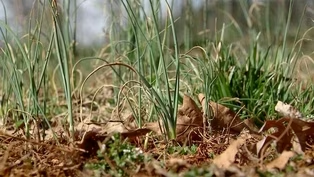
>>We are gonna be harvesting wild onions today.
They are everywhere in March.
They are fresh, local and they are just absolutely fantastic.
You can just go ahead and take the scissors out and you can snip the right at the- at closest to the ground as possible, just like this.
And you can just take the husks off and you can smell it.
Just smell of the onions.
It is same family as Allium and it looks just like chives and you can sprinkle it on different kinds of dishes or I like to go out and harvest the whole plant, including the bulbs, it's sweeter.
I'd love putting in the soups because the whole plant just gives a just wonderful flavor.
And also the bulb is packed with nutrients, just like onions or garlic.
So I encourage to go and use the whole plant.
Now in a hard clay soil it's gonna be hard to dig everything out because wild onions they really go in too deep into the ground and roots.
So what I do is just take one of these and just dig deep and pull it out.
And there they are, voila.
They're just beautiful, and they smell just absolutely exquisite.
So I'm gonna be using these for miso soup today, get out there and pick out your own, because they're available everywhere and take it home and use it as if they're normal regular chives or onions or garlic.
It adds so much flavor to your dish.
And it is nutrient packed vegetable that you can find everywhere.
Get some fresh air, go outside and harvest them wild onions and go home and cook, cook, cook.
>>Production funding for "Virginia Home Grown" is made possible by... (bright upbeat music)
Video has Closed Captions
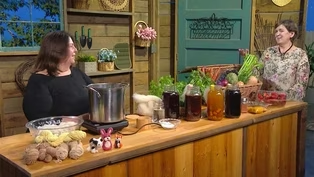
Clip: S21 Ep1 | 8m 26s | Learn how to easily create your own plant-based dye. (8m 26s)

Video has Closed Captions
Clip: S21 Ep1 | 9m 2s | Learn how tree sap becomes syrup. (9m 2s)
Video has Closed Captions
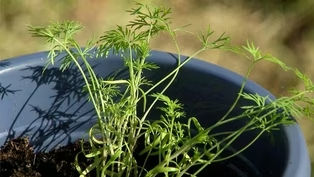
Clip: S21 Ep1 | 2m 21s | Tips for starting herbs and potting up to larger containers. (2m 21s)
Video has Closed Captions
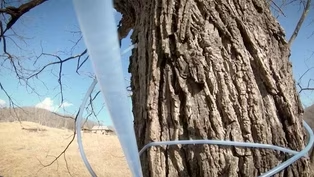
Clip: S21 Ep1 | 7m 30s | Discover unique Appalachian tree syrups. (7m 30s)
Video has Closed Captions
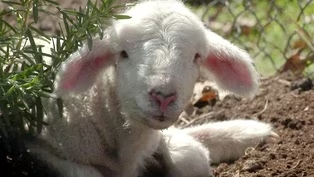
Clip: S21 Ep1 | 7m 42s | Learn about raising sheep for wool and goats for milk. (7m 42s)
Video has Closed Captions
Clip: S21 Ep1 | 2m 3s | Many people think this is a weed but really it is a tasty ingredient. (2m 3s)
Providing Support for PBS.org
Learn Moreabout PBS online sponsorship

- Home and How To

Hit the road in a classic car for a tour through Great Britain with two antiques experts.

 New Episode









Support for PBS provided by:
Virginia Home Grown is a local public television program presented by VPM