
Vietnamese Printmaker, Town Muralist, Sound Bath Healing
Season 15 Episode 1 | 28m 45sVideo has Closed Captions
Mai Tran, creates prints, Jacqui Rosenbush paints & Kari Hawes finds healing through yoga.
Mankato grad Mai Tran, creates prints that remind her of Vietnam; Jacqui Rosenbush paints a large-scale mural in Madison; Willmar-native Kari Hawes finds healing through yoga, jewelry making and sound.
Problems playing video? | Closed Captioning Feedback
Problems playing video? | Closed Captioning Feedback
Postcards is a local public television program presented by Pioneer PBS
Production sponsorship is provided by contributions from the voters of Minnesota through a legislative appropriation from the Arts and Cultural Heritage Fund, Explore Alexandria Tourism, Shalom Hill Farm, West Central...
Support provided by:


Vietnamese Printmaker, Town Muralist, Sound Bath Healing
Season 15 Episode 1 | 28m 45sVideo has Closed Captions
Mankato grad Mai Tran, creates prints that remind her of Vietnam; Jacqui Rosenbush paints a large-scale mural in Madison; Willmar-native Kari Hawes finds healing through yoga, jewelry making and sound.
Problems playing video? | Closed Captioning Feedback
How to Watch Postcards
Postcards is available to stream on pbs.org and the free PBS App, available on iPhone, Apple TV, Android TV, Android smartphones, Amazon Fire TV, Amazon Fire Tablet, Roku, Samsung Smart TV, and Vizio.
Providing Support for PBS.org
Learn Moreabout PBS online sponsorship(bright music) - [Narrator] On this episode of "Postcards."
- I'm quiet, I don't talk a lot, like, I don't really talk about my emotions.
Sometimes it's, like, it's also a lot.
So, like, I put them into my work.
- I'm always grateful for the journey within every mural that I make.
Just getting to meet so many different people in different communities.
- It's kind of like the perfect place for me to be now teaching the sound healing yoga and then making the crystal bracelets.
(upbeat music) - [Narrator] "Postcards" is made possible by the Minnesota Arts and Cultural Heritage Fund and the citizens of Minnesota.
Additional support provided by: Margaret A. Cargill Philanthropies.
Mark and Margaret Yackel-Juleen on behalf of Shalom Hill Farms, a retreat and conference center in a prairie setting near Wyndham, Minnesota.
On the web at shalomhillfarm.org.
Alexandria, Minnesota, a year-round destination with hundreds of lakes, trails and attractions for memorable vacations and events.
More information at explorealex.com.
The Lake Region Arts Council's Arts Calendar, an arts and cultural heritage funded digital calendar, showcasing upcoming art events and opportunities for artists in West Central Minnesota.
On the web at lrac4calendar.org.
Playing today's new music plus your favorite hits 96.7 Kram.
Online at 967kram.com.
(soft music) - Printmaking is a very detail-oriented medium.
It's just, it's like you have to, like, really focus and do it step by step, like, really focus and not get distracted from anything, so you can make a lot of mistake.
And then probably it's like experiment too.
It's like you never know what you're gonna get.
Every single print is gonna be a little different.
(upbeat music) (wood scraping) I am a Vietnamese printmaker based in Mankato, Minnesota, and I make woodcut print.
My focus is on Vietnamese culture and American culture.
When I spend the last seven and a half years, I try to plan the two cultures together just to share my life experiences here and also the history of Vietnam and the customs.
When we talk about Vietnam, like, lots of people are gonna think about the Vietnam War.
And then I feel like it's a little limit 'cause I want to share, like, the good part, the beautiful part of Vietnam, like, what we have.
(upbeat music) I'm from Ho Chi Minh City, Vietnam.
I lived in the south of Vietnam is formerly named Saigon.
We have a lot of mountains.
The Mekong Delta River.
My family lives in the area that, like, we have endless rice field and lotus field.
Also, lotus is our national flower as well, so that's pretty to me.
(upbeat music) So I wanted to study abroad and I decided I wanted to go to Japan, and then my family said, "Let's make a deal that if you can survive in the U.S. for the one year, then we will let you decide whatever you wanna do."
So they didn't want to fund for me to go to Japan.
I wasn't into it.
I just hated that idea, but now I can appreciate it that I'm here.
I arrived to the U.S. and then I went straight to Mankato.
So it was December of 2015 and it was winter.
So my first-ever winter in my life.
It's just different.
It's like in my home country, it's, like, 90 degrees all year long.
So it's like, it's like more like exciting to me.
It's like, "Oh, it's not hot anymore."
It's good.
This is one of my very early prints when I first started.
This is called "Trapped in the Cheese."
At the time I couldn't find any food without cheese unless I asked for it.
It was like, "Why cheese everywhere?"
It's like, you know, and this is a cheese tray.
It's funny, I don't know, it's just so American.
So yeah.
You see here is the Vietnamese pitcher with traditional clothing and the hat is the Vietnamese coffee phin filter that we use to make, like, single-use coffee, and the hat is, like, traditional hat.
(soft music) I came here for a totally different degree.
I was going for biology with a minor in graphic design.
I grew up in a family of business and science, like, art is like like, "No, no."
You got to be, I don't know, a banker, a businesswoman, or a scientist, like, "We don't do art here.
Art's like wasting time."
And then I took my first printmaking class, like, in the second semester and then I fell in love.
And then I just, like, switch completely to printmaking.
And now I become an artist.
(soft music) I'm not sure about, like, all of the, like, younger family now, but, like, to my family we are a little conservative.
And my mom has a lot of thing to do with my personal life and that's why I got so frustrated.
And then I decided to, like, you know, go away.
Now it's like they got used to it too.
So they had to fit with me, my way, so I have my own life.
That's what I like about the U.S. and, like, being like so far away from home that they care about me, but, like, in a more like relaxed way.
It took them a while to, like, to really, like, kind of start to understand what I'm doing.
Like I explain to my mom, like, anytime I call her and she's like, "I don't get it.
Why are you doing it, like, why?
Like, why printmaking?
Why art?"
So I think I always have that soft spot for Vietnam.
I just, I'm afraid of, like, if I ever visit home and then I don't wanna come back here.
I miss the people on the street.
I miss all the street foods and I miss my family as well.
(soft music) I grew up pretty Western-ish and then I wasn't really into, like, Vietnamese culture at all back in the day, like, and then it's like when I came here, then people keep asking me about, "Oh, how is Vietnam and what do you have there?"
I'm like, "Oh, I don't really know."
So that's, like, I think being here is making me find my roots.
I'm just, like, been doing a lot of research about Vietnamese culture and then what we have in the past.
There's different methods in printmaking.
We have woodcut.
We have screen printing.
We have lithography, and etching intaglio, but I specifically really into woodcut.
I'm not sure why.
It's, like, it's very ancient techniques.
It's so easy to make.
You could make it anywhere.
You don't really need a fancy tool to do that.
And I'm very curious about, like, what people did in the past, like, a thousand years ago how do people spread the word?
How do they share information?
We have a woodcut village in North Vietnam.
And I would love to, like, learn more about that and then try to, like, bring it back.
Woodcut is, like, the closet way to do that.
And then woodcut, it's not hard.
It just, like, take a lot of time to make one big block like two by four feet.
If I, like, really work on it, like, if I'm not like distracted from anything else I just like work, work, work every day, well, a month or two.
After carving the block, the next process is gonna be printing.
You should just, like, prepare all of the ink and roll the slab and it's, like, ink up the block.
(paint roller swishing) If the studio have, like, a big enough press for the big block, then I can run it through the press.
I don't have that access here in Mankato, so I usually, like, hand print it.
(paper scraping) I'm not a big talker so, like, I think a lot, but I'm quiet.
I don't talk a lot.
Like I don't really talk about my emotions.
Sometimes it's, like, it's also a lot.
So, like, I put them into my work.
I try to make it look, like, playful, but there's educational stuff going on.
Like I want to teach people about the culture and then if they, like, recognize my story and that's good.
If not, that's fine too.
It's, like, if they appreciate the print, you know, the playfulness is totally fine, that's great.
So this is one of my favorite prints ever.
I got inspiration from a picture of my mom when she was pretty young.
And I made the print in 2020 when COVID hit.
And at the time, I felt very confused and then a lot of anxiety it was like, I don't know what's gonna happen.
Like, what if I couldn't make it, what if my mom wouldn't make it?
And then I had, like, nightmare, I don't know, or a dream that my mom study abroad instead of me, so.
So I made the print with Mankato tower, water tower, that I really love to see all the time.
To me, like, in the U.S. all the water towers, there's name on it, it's very unique.
It's like we don't have that in Vietnam.
So we have water tower.
We don't have name on the water tower.
To me that's, like, a very cool thing, so yeah.
I send it to my mom, the picture to my mom.
And she, like, she loved it.
It's like, "Oh, it's what you're doing?
Okay, I kinda get it now."
Blah, blah, blah, you know.
(soft music) There's no single day that I feel like I want to do something else.
Like it was, like falling in love.
I can drop anything else to do print.
You ask me to go out, I'm just like, "Sorry, I'm working on my block."
It's like there's no, no.
I was like, I'm so into it.
I never felt like that before.
I feel like it's like, it's a very, what's the word for it?
A blast.
I finally found, like, what I really love.
It is a very tough journey, but it's all good because I learn a lot and I grow a lot, too, through prints.
(soft music) - I'm Jacqui Rosenbush.
I'm a mural artist and I'm here in Madison working on my mural called "Humming With the Earth."
(upbeat music) This is about my 10th mural of my own design.
I've been at it about 10 years and have had my hand in over 35 other projects.
So when I was designing this project, I was thinking about the new Grand Park, the instruments, the winding sidewalk, and the pollinator garden with the butterflies fluttering around.
When you walk down the sidewalk, they just become a cloud that surrounds you and it's the most magical thing.
(soft music) So I was very excited to be here painting and meeting people and I'm excited for what this mural will be as a community gathering place.
Kendra Kallevig is my assistant and she is an epic mural artist herself.
She and I have been working together for a long time on many, many projects.
And so I am just thrilled to have someone so talented working with me today.
- So the entire quilt pattern that's going behind the river and the crops and all of that jazz that was painted by the community onto these sheets of polytab, special mural fabric.
So we had these awesome paint parties over at the Mercantile and folks came through.
We gave them a paint-by-number and they just went to town and then we slapped it up, like, permanent wallpaper.
So it'll be there forever.
(uplifting music) - The hummingbird, not only is it a special pollinator, but it's this animal that is moving so quickly is always on the go is humming about.
And I like how this particular animal, though it's moving so quickly, it causes us to pause and notice it.
And it's a gentle reminder to all of us when we're humming about our business to pause and enjoy some of the lovely things.
It's great because I get to do this design work on my iPad and then I get to do painting stuff in the studio and then I get to be, like, a construction worker and, like, up on a lift.
It challenges me in all sorts of different ways and it also is a nice rhythm.
It's not always the same thing.
And so I'm always grateful for the journey within every mural that I make.
Just getting to meet so many different people in different communities and engage with the public in a meaningful way.
It's just one way I get to be involved in a lot of different communities.
(uplifting music) (singing bowls vibrating) - My whole life since I can remember had to be centered around just health.
And so a lot of it is like mindset and the mindset comes from the strength of the yoga.
So when you're in the deep practice of yoga, it's actually clearing out your mind, especially with the meditation yoga.
(singing bowls vibrating) My name is Kari Hawes.
I'm a yoga teacher.
I specialize in sound healing yoga.
It's a meditation practice.
And then I also make crystal jewelry that tie into the sound healing and to the crystals.
(uplifting music) So I was always interested in gemology from the second I was a little kid.
I would make stuff for people to gift it to 'em.
And then the day I turned 18, that's when you can actually start studying it.
So I was studying through GIA, worked for different jewelers here, worked for several high-end jewelers, and then I started working at Elmquist Jewelers in Willmar as well, and was always really intrigued in the stones and what they meant, but they're so expensive at high-end jewelry stores.
Well, with yoga crystals and malas tie together as well.
And so it's kind of like the perfect place for me to be now teaching the sound healing yoga and then making the crystal bracelets.
I find it very meditative to make the bracelets.
It's definitely relaxing.
I'm putting intention to the bracelet too, especially if I know it's for someone specifically and what they're dealing with.
I try to think of my intent with it, what I want for them.
And then I'll always go around with the bowl too before I will deliver, just so it's like freshly charged and energized for the clientele.
So when I was 15 years old in high school I was a three sport athlete, so I was pitching fastpitch softball, hitting for volleyball, and playing point guard for basketball.
And I was pounding on my spine a lot and I started to develop extreme pain in my lower back.
We went into a lot of just the classic primary care doctors and they didn't seem to have an answer.
The pain progressively got worse to the point where I'd be in a ball crying after practice, crying before practice, just struggling.
And so we had a doctor from the area refer us to a surgeon and we went into the surgeon and I'm 15 years old and I had a grade one spondylolisthesis, which is the lowest grade.
A lot of people are familiar with scoliosis, which goes this way.
Spondy just slides this way with your spine.
So your two vertebrae, one is sliding forward, but there are different grades of it.
So a tiny slide is a one, a bigger slip, two, boom, boom, boom, goes all the way up to a five where it's almost not even on that vertebrae anymore.
That surgery needs to be done, like, immediately.
I only had a one.
So the fact that I even had this extreme surgery on a 15-year-old is, like, pretty controversial.
And he immediately said, "We're gonna do the spinal surgery on you.
It's gonna fix your back and you'll never have back surgery again, and you can go back and play all three of your sports."
So at that point I was so excited because I could go play sports again.
That's all I cared about at that time in high school.
So my first surgery at 15 was the spinal fusion and then six months from that they had to remove all the hardware out.
And then in my early 20s, I think I was 20 when it fractured and then that's when I had to have another spinal fusion.
So I had three fusions and, like, two hardware removal surgeries.
So this is the hardware that came out of my spinal fusions in my back, but how they do the fusion is they attach the hardware to the vertebrae and screw it straight into your spine.
Then they put one right next to it, two below it.
So it's like a little cage that they create and then they put these guys, these metal pieces up through the middle.
And then your bone is in between here.
Now with a spinal fusion, they take out part of your hip bone, your own hip, and then they take cadaver, they blend that all together.
That's the most successful way for it to hold.
And then this pulls it together and has it sit like that in the metal cage.
(soft music) I think that alternative medicine and healing is way more important than traditional medicine because I feel as though alternative medicine should be used first.
I also really struggle that healthcare is really two separate things still.
Like we're not having a lot of crossover between Western and Eastern medicine.
I think that could just help enormously because what we're doing is so much less invasive, or side effects compared to so many of the options that may be surgery or medications.
(soft music) Looking back at my journey, thinking about what I've accomplished, I do feel proud.
I just always feel like I have so much more to go, you know?
So I feel like I'm at a good place with starting these things and getting more alternative healing options out to the world and to people.
(soft music) I want people to know that life with chronic pain is a struggle all day long all the time.
And I just want people to maybe be more aware on how they judge when they find out someone lives with chronic pain because you can't see my pain, which is a blessing in a way, but also it's a curse because people don't believe you.
And I think there are so many people living in physical pain and they're hiding it and they're acting like they're not in pain and they're trying to be okay that we just need more awareness.
We need more support.
We need more empathy in life.
(soft music) I feel like sound bowls have changed my life for the better.
Helping people, bringing community, helping with depression, grief, anxiety, chronic pain, vertigo, so many different things it's helped with, so it's so rewarding.
There's just a million things that these bowls can do to help people.
(soft music) (upbeat music) - [Narrator] "Postcards" is made possible by the Minnesota Arts and Cultural Heritage Fund and the citizens of Minnesota.
Additional support provided by: Margaret A. Cargill Philanthropies.
Mark and Margaret Yackel-Juleen on behalf of Shalom Hill Farms, a retreat and conference center in a prairie setting near Wyndham, Minnesota.
On the web at shalomhillfarm.org.
Alexandria, Minnesota, a year-round destination with hundreds of lakes, trails and attractions for memorable vacations and events.
More information at explorealex.com.
The Lake Region Arts Council's Arts Calendar, an arts and cultural heritage funded digital calendar showcasing upcoming art events and opportunities for artists in West Central Minnesota.
On the web at lrac4calendar.org.
Playing today's new music plus your favorite hits, 96.7 Kram, online at 967kram.com.
(bright music)
Video has Closed Captions
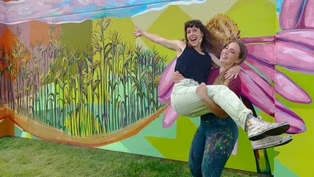
Clip: S15 Ep1 | 5m 7s | Jacqui Rosenbush paints a large-scale mural in Madison. (5m 7s)
Video has Closed Captions
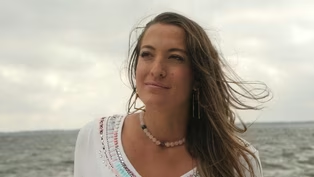
Clip: S15 Ep1 | 10m 32s | Willmar-native Kari Hawes finds healing through yoga, jewelry making and sound. (10m 32s)
Video has Closed Captions
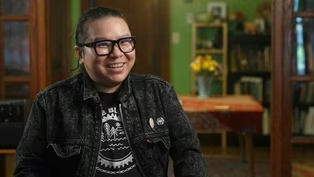
Clip: S15 Ep1 | 14m 7s | Mankato grad Mai Tran, creates prints that remind her of Vietnam. (14m 7s)
Vietnamese Printmaker, Town Muralist, Sound Bath Healing
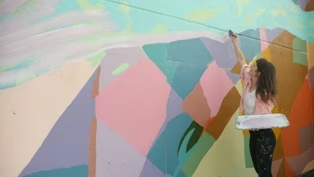
Preview: S15 Ep1 | 40s | Mankato grad Mai Tran, creates prints that remind her of Vietnam; Jacqui Rosenbush paints (40s)
Providing Support for PBS.org
Learn Moreabout PBS online sponsorship

- Arts and Music
The Best of the Joy of Painting with Bob Ross
A pop icon, Bob Ross offers soothing words of wisdom as he paints captivating landscapes.











Support for PBS provided by:
Postcards is a local public television program presented by Pioneer PBS
Production sponsorship is provided by contributions from the voters of Minnesota through a legislative appropriation from the Arts and Cultural Heritage Fund, Explore Alexandria Tourism, Shalom Hill Farm, West Central...