
Signature Dish
Vietnamese Voyage
Season 4 Episode 10 | 29m 14sVideo has Closed Captions
Bánh Mì Oi in Falls Church, VA, Moon Rabbit in Penn Quarter, Pho Viet in Columbia Heights
Seth explores the vibrant flavors of Vietnamese cuisine, starting at the Eden Center with the signature Mũi Tàu bánh mì from Bánh Mì Oi. He then visits Moon Rabbit in Penn Quarter for the Rainbow Trout, a refined take on the Vietnamese dish cá kho tộ. He wraps the episode with a bowl of the unique spicy lemongrass pho at Pho Viet in Columbia Heights.
Problems playing video? | Closed Captioning Feedback
Problems playing video? | Closed Captioning Feedback
Signature Dish is a local public television program presented by WETA
Signature Dish
Vietnamese Voyage
Season 4 Episode 10 | 29m 14sVideo has Closed Captions
Seth explores the vibrant flavors of Vietnamese cuisine, starting at the Eden Center with the signature Mũi Tàu bánh mì from Bánh Mì Oi. He then visits Moon Rabbit in Penn Quarter for the Rainbow Trout, a refined take on the Vietnamese dish cá kho tộ. He wraps the episode with a bowl of the unique spicy lemongrass pho at Pho Viet in Columbia Heights.
Problems playing video? | Closed Captioning Feedback
Where to Watch Signature Dish
Signature Dish is available to stream on pbs.org and the PBS app.
Providing Support for PBS.org
Learn Moreabout PBS online sponsorshipANNOUNCER: And now, "Signature Dish," a WETA original series.
SETH: Today on "Signature Dish," we're on a Vietnamese voyage.
We'll get baking to craft a bountiful bánh mì.
YEANIE: When it's fresh from the oven, it's really good.
SETH: Now, that's a sandwich.
We'll watch two celebrated chefs deliver next-level flavors.
So, this is your modern take.
KEVIN: Absolutely.
Traditional flavors, new visual presentation.
SETH: And we'll flip for a fiery pho.
PHI-NHUNG: I see customers sweat, and red-faced, and they change color.
SETH: Ooh.
I'm probably blushing a little bit myself.
Wow.
I'm Seth Tillman, WETA producer and DC native, and I love good food.
Nice to meet you.
That's why I'm traveling to restaurants across the DMV, at each stop, looking for the one thing you just gotta try... that Signature Dish.
We're getting things started, where else, but the Eden Center in Falls Church, Virginia.
It's here in the largest Vietnamese commercial center on the East Coast that you'll find Bành Mì Ói, a wildly popular shop slinging bánh mì sandwiches, opened by chef and owner Yeanie Bach.
YEANIE: I was born in Vietnam.
At around seven, eight years old, my mom had a bánh mì cart in front of my house.
That's the time that I start helping her doing pickles, cilantro, all of the aioli's.
I went to Missouri for college, and then after college I moved to Northern Virginia because my grandparents, my aunt and uncle, the whole family is here.
SETH: After meeting her husband and following him to Boston, Yeanie opened up her first Bành Mì Ói in the city's West Roxbury neighborhood.
In 2024, she and her growing family moved back to Virginia with plans for a new bánh mì outpost.
YEANIE: We want to build something together here in Eden Center because Eden Center to me is not just a shopping center.
It's a cultural landmark.
I feel very happy when I see grandparents go shopping with their grandchildren and I hear the Vietnamese language.
It makes me feel like home.
SETH: Yeanie's shop is one of just a handful in the DMV that bakes bread fresh in-house every day.
YEANIE: When I came back to Virginia, I try a lot of vendors.
It doesn't have the feeling of the Vietnamese baguette like I want.
I like my bread fluffy, crispy outside, thin crust.
So that's why I said, "Okay, let's make our own bread."
Bánh mì is not just a sandwich in Vietnam.
And then Vietnamese people, they make their own butter.
They make their own baguette, but it's crispier.
And then with all the fresh local ingredients like cilantro, pickles, onions, it's formed a bánh mì.
And it's kind of like a very beautiful symbol of how we take French influence and make it our own.
SETH: Chef.
YEANIE: Hi.
SETH: Nice to meet you.
YEANIE: Nice to meet you today.
SETH: I always enjoy coming out to the Eden Center and trying someplace new, and it smells amazing in this kitchen.
I think I know why.
(laughter) Uh, what are you making today?
YEANIE: So, we are doing our Mui Tàu Signature.
We named it Mui Tàu because that is the location that my mom have her bánh mì cart on the street in Saigon.
And in my mom's cart, she just sold one kind of bánh mì and that is what we're making too.
SETH: All right, so all the flavors you knew from back home in Saigon are now going to be right here in the Eden Center.
YEANIE: Yeah, bring it here.
SETH: Love it.
All right and obviously, we're starting with some pretty fresh bread here.
Tell me about these baguettes.
YEANIE: We make the baguette every single day at 5:00 a.m.
We start with mixing the flour in with cold water.
We separate the dough into smaller balls and we let it rest for a couple of minutes.
Then we shape it into our bánh mì shape and then we proof it for 40 minutes.
Then we take it out, score, then put it back to proof for another 40 minutes.
We spray water and put it in the oven for about 15 minutes.
And here is the final product.
SETH: All right.
What makes this baguette different than maybe a traditional French baguette?
YEANIE: Yeah, that I want to show you right now so you can have it.
So, our baguette is very thin crust, very fluffy, and very airy inside.
And you can just squeeze it and you don't see any dough left.
You can try a bite.
It's the best time right now.
When it's fresh from the oven, it's really good.
SETH: Oh, that has a nice chew, but the outside is so nice and flaky as well.
So how do you put this signature bánh mì together?
YEANIE: Let me slice the bread.
And then the first ingredient is going to be our soy sauce.
So, I will put the aioli on.
So, this is one of the things that I helped my mom when I was eight years old to make the aioli every day by hand, not by machine right now.
SETH: Of course.
YEANIE: One of the most important ingredients next is going to be pâté.
It's made from pork liver, milk, bread, and onions, and fish sauce.
So, it's bring the umami for the flavor.
So, we have three more kinds of pork that goes on the sandwich.
SETH: All right, so this is a pretty loaded bánh mì?
YEANIE: Yeah, yes.
Okay , so, the first one is the pork bologna.
Next one's going to be kind of like an Asian ham.
You can see the gelatin right here.
And the last one is our steamed pork belly.
We make everything in-house, and we run around like 50 pounds per day.
SETH: Wow.
YEANIE: Yeah.
To make this balanced, we have a lot of vegetables as well.
So, first of all, we have nice slice of cucumber.
So next, we will have the carrot and daikon, that pickle in-house.
We brine it in vinegars and sugars to balance all of the meat and the bread outside.
SETH: Right.
YEANIE: So, to finish our bánh mì, we will put a little bit fresh cilantro on.
SETH: And I like cilantro.
I know not everyone does, but you can load it up with cilantro as far as I'm concerned.
YEANIE: Perfect.
And then last but not least, we add some slice of big jalapeño.
SETH: All right.
So, we're definitely going to get a little kick when you bite into the sandwich.
YEANIE: Yeah, I love it.
And that's it.
Here's our Mui Tàu Signature bánh mì.
SETH: All right.
I cannot wait to try that.
YEANIE: So, let's go upstairs and eat it.
SETH: Let's do it!
YEANIE: Let's go.
SETH: All right, Chef, this Mui Tàu Signature looks so good.
Going right for it.
YEANIE: Yeah, go ahead.
SETH: Big bites only?
YEANIE: Yep.
SETH: Here we go.
(crunching) Now, that's a sandwich.
Wow.
So much freshness with the cucumbers, those daikons and the carrots.
It's such a great counterpoint to all that pork flavor because maybe it's the fish sauce and the pâté, but just so much rich, unctuous pork flavor there.
YEANIE: Yeah, that is the point of the Mui Tàu.
Some people say that, oh, they want more pâté, but I feel like the most important is the balance of everything.
SETH: And going back in for that second bite, really able to focus on the bread.
Making it in-house, just such a difference because it's so light and airy.
You get the crispiness, great little vehicle for delivering all those amazing bánh mì flavors.
And chef, as great as that bánh mì is, obviously I need something to wash it down with.
Vietnamese iced coffee with a twist here?
YEANIE: Yeah.
So, you have the egg coffee.
So, it's made from raw egg.
It's like egg nog.
And it's kind of like a layer of egg custard on top of the dark and strong coffee.
SETH: Oh, very strong coffee indeed.
YEANIE: And our coffee is from Vietnam.
We have a farm over there.
We roast it in Saigon and we fly it over here.
SETH: Wow.
So, you were getting the true Vietnamese experience with the drinks, and obviously with the table and the seating as well.
YEANIE: Yeah.
Yeah.
It's very common in Vietnam that you can sit on the low plastic table on the street, and I want to create a kind of like a slow morning in Saigon that you can people-watch and having a sandwich, having coffee.
SETH: And obviously, it looks like you're bringing some of your own unique twists to it.
This does not look like a traditional bánh mì to me, chef.
What are we looking at here?
YEANIE: So, bánh mì kind resembles of all of the influence.
So, one of the things I create here is a Nashville hot chicken that I influence from American.
I love the Nashville hot chicken in Tennessee that we tried with my husband, and he loves it as well.
Yeah.
SETH: Oh, wow.
YEANIE: It's spicy.
SETH: It's spicy, saucy, and like no bánh mì I've ever had before.
YEANIE: It's the most messy bánh mì, I think.
SETH: Yeah, you got to be careful with this one.
And, you know, bringing these new flavors to a place like the Eden Center where there's so much tradition and history, were you nervous about whether this approach would work?
YEANIE: Yeah, of course.
The Eden Center has like hundreds of places, and almost all of them sell bánh mì, and some of them they are 10, 15 years and I'm like a new kid on the block.
But I feel like I want to bring something that is more accessible to everyone, not just Vietnamese people that can bring them to the Eden Center to try not only my food, but the culture.
SETH: Well, I love that there's something for everyone here and I'll be back real soon.
Thank you so much, Chef.
YEANIE: Thank you.
Thank you for coming here and trying my food, and being a part of our journey.
Thank you!
SETH: I'm next heading to downtown DC's Penn Quarter neighborhood.
My destination: Moon Rabbit, where acclaimed chef Kevin Tien is putting a stylish spin on Vietnamese favorites.
KEVIN: I'm a first-generation Vietnamese-American, first person in my family to be born in the US.
Kind of grew up all over the place, but if people ask me what home is, I say that's Louisiana.
I really fell in love with cooking down South.
Food is the way you invite your neighbors over and show love to your friends and family.
SETH: After moving to DC in 2013 and cooking his way through several different kitchens, Chef Kevin opened his own restaurant, Himitsu, in 2016.
KEVIN: Himitsu, it's a very small restaurant, but something small proved to be really mighty and we actually got a lot of recognition from it, from Food and Wine Best New Chef to my first James Beard nomination.
So, after Himitsu, I decided to cook more Vietnamese food to really like change the perception of how people viewed Vietnamese cuisine.
SETH: Kevin opened Moon Rabbit in partnership with Susan Bae, a James Beard Award-winning pastry chef.
SUSAN: The shared vision of Moon Rabbit was that we were all second-generation Asian Americans.
I am not Vietnamese, I'm Korean, and I grew up not really embracing my heritage.
Being Asian wasn't as cool as it is now.
I think Kevin was trying to discover his cultural roots and, you know, it was the same for me as well.
We wanted to reinterpret Southeast Asian cuisine, and in specific Vietnamese cuisine, and we just got very creative with it and stayed in line with what it meant for us as Americans.
KEVIN: When guests come into Moon Rabbit, I really hope they get more than just a delicious meal.
I hope they get to see the story that we're trying to tell that talks about past recipes in this present moment, but also what the future of Vietnamese food can be.
SETH: Chef.
KEVIN: Hey, how are you?
SETH: Good to meet you.
KEVIN: Good to see you.
SETH: I am excited about Moon Rabbit.
I see some fish right down here.
What are you making today?
KEVIN: So today, we're making our rainbow trout, which is inspired by cá kho, which is normally a braised caramelized catfish inside of a clay pot.
But because we're here at Moon Rabbit, we do things a little bit differently.
SETH: So, this is your modern take on a traditional Vietnamese dish?
KEVIN: Absolutely.
Traditional flavors, new visual presentation.
The main flavor of this dish is based on our fish sauce caramel.
SETH: Ooh, all right.
I love caramel.
I see a lot of sugar over there.
Is that what you're getting started on?
KEVIN: Absolutely.
You always start off with some sugar, and whenever I'm making a caramel, I try not to touch the sugar too much.
So, I'm just kind of letting it do its thing in the middle and I'm just making sure it doesn't burn on the side.
So, we're looking at the pot, you kind of see it really forming on the bottom.
So, you always have to keep an eye on this.
This is one of those things that goes from like it's perfectly beautiful and amber, and if I like turn around for one second, it'll be scorched and burnt and your day's ruined.
SETH: And you being from Louisiana, not being able to take your eyes away, that's almost a little bit like gumbo, right?
KEVIN: It's exactly like making a roux.
So traditionally, whenever you get cá kho, it comes out and the caramel sauce is, like, super-hot and bubbling in this, like, clay cauldron with some beautiful pieces of braised catfish.
But for us, this is more of an accent towards, like, the final dish.
You see this caramel color coming in?
We're going to talk about some of the aromatics.
We have four things in here: Saigon cinnamon, some dried, uh, bird's eye chilies, star anise, and black peppercorn.
So, we're going to add in the aromatics.
We're going to let these kind of almost like fry in the sugar a little bit.
If you look at these chilies, you see they're starting to like puff up.
SETH: Talk about aromatic.
KEVIN: Yeah.
So now, we're going to add our fresh coconut water, cracked from a young coconut.
SETH: And we've got some action in the pan now.
KEVIN: So, then our fish sauce.
You would think this dish would be overly sweet, so we're trying to balance everything out with some fish sauce to give it a lot of salty umami notes.
So now, we're going to set it to the side and let it cool and rest to absorb more flavor from all the aromatics.
And we're going to focus on cooking our fish.
We're working with rainbow trout.
We brine it so it retains this, like, nice moisture and then we'll, like, air dry it, so we make sure we have a really crispy skin.
SETH: And so, getting all that moisture out, you're really concentrating the actual flavor of the fish, right?
KEVIN: Absolutely.
And now, we're just seasoning the fish.
And I'm going to start with a little bit of oil and we're going to cook this fish skin-side down the whole way because this skin will protect the meat of the fish to keep it from overcooking.
So, whenever you're cooking fish, the skin will want to like tighten up and curl on you.
And if you want like an even browning, I'm holding it down until the pressure relaxes on the skin.
SETH: You are a braver man than I am, chef.
I would not be sticking my hands in that pan right now.
KEVIN: Cooking isn't for the weak.
Now, this skin's getting crispy, and now let's see if we can get a good view beneath the camera.
You can see it's browning pretty nicely.
SETH: Oh, yeah.
KEVIN: I'll cut the heat to really low or off.
We've made this umami butter with mushrooms and aromatics, and we're going to use it to baste the fish.
And essentially, this fish is frying/cooking in butter and nothing really sounds more delicious than that.
SETH: And nothing smells more delicious.
KEVIN: And now I'm just going to baste the fish.
And as you see this butter's like cooking the fish through the top.
One last baste, and now the trout's done.
Let's take it out of the pan and let's listen to how crispy the skin is.
(scraping) SETH: Oh, yeah.
We're talking some pretty crispy skin right there.
KEVIN: So, to plate it, we're going to gently set the rainbow trout down.
We'll encapsulate the fish with a caramelized fish sauce.
We do two beautiful drop quenelles of the lotus seed puree.
Then we're going to toss some green chickpeas in this like Vietnamese chimichurri, and we'll take a little spoon of that and put over the top and to the side of the fish.
And then a garnish of a braised lotus root with a little bit of some herbal garnishes as well.
We'll finish with a circle of ramp oil, and then our rainbow trout will be ready to eat.
SETH: All right, chefs, the color and presentation on everything on this table is just exquisite.
I cannot wait to try this rainbow trout.
KEVIN: Yeah, let's do it.
And I hope you're really picking up all the different flavor profiles we're talking about.
Umami, sweet, salty, acid, savory, all in one.
SETH: That is just sublime.
The sweet caramel note hits you right off the bat, but then you start to get a ton of extra flavors in that bite with fish sauce.
There's some herbaceousness in there.
And that trout, that crispy skin sounded great in the kitchen and it delivers in that bite.
KEVIN: Thank you.
SUSAN: Make sure you get a little bit of that lotus seed puree.
It's like a nice earthy flavor.
SETH: Oh, wow.
But that ramp oil, nice little pungent flavor on the outside.
All right, and we got a little actual lotus root here as well.
KEVIN: The lotus root's a great contrast in texture.
I like this soft, delicate fish, creamy lotus seed puree, and a nice crunch from the root.
SETH: Oh, yeah.
Almost like a water chestnut.
And of course, I know the pastry program is a huge part of this restaurant and there's something really, really pretty in front of me here.
What is this, chef?
SUSAN: This is our white chocolate durian mousse.
We puree the durian and then we whip it up in a mousse, and it's served with brown butter, white chocolate streusel and passion fruit granita.
SETH: And durian's gotten quite the reputation over the years for its strong aroma, shall we say?
SUSAN: Yes, absolutely.
Called the King of Fruit in Vietnam.
It's got a very pungent aroma.
This dessert mellows out that pungency, almost undetectable.
SETH: Oh, yeah.
It's so light, and airy, and refreshing, but also some of those herbal note's kind of play nicely with what's happening here with the rainbow trout.
SUSAN: Yes.
We really do place an emphasis on using fresh herbs.
For instance, dill is incorporated into this dessert, but we really wanted to make the dessert program flow seamlessly from savory into desserts, and that was a great segue to tie it all together.
SETH: Well, it does flow really nicely.
And you know, this rainbow trout, this mousse, there's obviously the Vietnamese influences, but it just feels like maybe the lines between what's Vietnamese, what's pan-Asian, what's American, they all start to kind of fade away.
KEVIN: Yeah.
Absolutely.
I think we're charting our own path and redefining what it means to be, like, first-generation Asian American.
Down in the South where I'm from in Louisiana and Texas, Vietnamese food has found its way very prominently into the food scene.
And this is what we consider American food now.
SETH: All right, well, no matter what you call this cuisine, it is delicious.
Thank you both so much for letting me come here and try this amazing food.
KEVIN: Of course, and thank you for letting us share our story.
SUSAN: Thank you.
(glasses clink) SETH: For my last stop, I'm staying in DC, this time in Columbia Heights.
I'm paying a visit to Pho Viet, a longtime neighborhood staple run by Phi-Nhung Nguyen and her husband Minh Chau, better known to their regulars as Nina and Michael.
PHI-NHUNG: I'm from Vietnam, South Vietnam by the countryside.
And I came here with my parents, my father, my mother, my siblings.
We came here in September 1994.
I love cooking since I'm very little.
Of course, mostly I learned from my mom.
When I came, I didn't really start thinking about the restaurant business, to be honest.
I was the tailor alteration, and then luckily the family got this property in Columbia Heights, so we say, "Oh, let's do restaurant."
SETH: Nina and Michael opened Pho Viet in December 2009 in the midst of DC's legendary snowpocalypse.
PHI-NHUNG: Oh, I remember it's big storm by that time.
Big snow.
We don't really know it's a good time or not, but lucky for us, we get a lot of support from the neighbor.
Then later on from the neighbor, they talk to friend or family.
Pho is very, very popular.
You can eat breakfast, lunch, dinner.
So, I can eat all the time.
Especially my husband, he eat all the time pho.
SETH: Michael helped inspire the restaurant's runaway top seller, the lemongrass spicy pho.
PHI-NHUNG: Michael loves to eat spicy, so I get an idea and then from there I start cooking, but it's not on the menu yet.
Then one day I ask customer, you know I say, "Hey, I cook this, but I'm not sure.
Like should I put on the menu?
Can you try?"
And then he try and then he said, "Okay, it's good, Nina."
And then I decide to put on the menu.
When you go to Vietnamese restaurant or pho restaurant, you won't see lemongrass spicy like the one that we create here.
It's not authentic.
I know it's definitely not traditional, but we see more and more customers like it.
And mostly they come and say, "Oh, I want lemongrass spicy."
And of course, when you hear something like that, you really very happy because I'm the one who created it, I cooked it, and, you know, put all my energy in there, my love in there.
So, of course I'm happy.
SETH: Nina, nice to meet you.
PHI-NHUNG: Hi, nice to meet you.
Thank you for coming.
How are you?
SETH: I am doing great.
I love pho.
What are you making today?
PHI-NHUNG: I'm making lemongrass spicy pho.
SETH: I've heard about this dish.
You're kind of famous for it, so I'm excited to see what all the hype is about.
So how do you get started on this?
PHI-NHUNG: I need to start with the broth first and then we cook the lemongrass spicy separate.
To make our broth, PHI-NHUNG: That's very important.
We wait until the meat well done, then we add the onion and ginger, leave the meat in there to get the flavor from the onion and ginger.
And after that, we add the ingredients.
So... PHI-NHUNG: Maybe some other restaurant, they may use sugar instead, but for us we prefer the rock candy.
PHI-NHUNG: We put in the broth.
The final step for me I like to do, close the top to make sure the aroma stay there.
Here is the finished broth.
You can smell the aroma, right?
SETH: Yes.
Such a nice, complex aroma.
And I'm just impressed with how many steps and how long it takes to make this broth.
PHI-NHUNG: Yes, thank you.
SETH: But even more ingredients still left to go.
What are the next steps?
PHI-NHUNG: So, I start with the oil, and then I start with the garlic and white onion.
Mmm.
SETH: I'm liking that sizzle right there.
PHI-NHUNG: And then don't add anything yet until you can smell the onion and garlic mixing together.
Mmm, see?
SETH: Oh, yeah.
PHI-NHUNG: You can smell already, right?
SETH: I'm getting it all right.
Lots of aromas in this kitchen.
PHI-NHUNG: Yes.
Then we add the lemongrass in.
In Vietnam, the lemongrass very important in cooking, not just for aroma of the food, but it's also for health too.
In Vietnam, when we get flu or something, you cook the lemongrass in the water and then you cover with your blanket, and then you get the steam come out and then, ooh, we don't need to take the medicine.
SETH: All right, so, there's going to be some healing happening today.
PHI-NHUNG: Lots of healing.
Yeah.
SETH: I need that.
(laughter) PHI-NHUNG: Then the next one, I add the shrimp paste.
You can smell right away, right?
SETH: Yeah, shrimp paste, of course, giving that nice fermented aroma.
PHI-NHUNG: And now, we get MSG.
SETH: And that's just to add a little umami.
We all know MSG is good for you, right?
PHI-NHUNG: But we very limit, okay?
Not a lot.
SETH: A little goes a long way.
PHI-NHUNG: A little goes a long, yes.
Then we have some sugar, okay?
SETH: So, a little more sweetness going here.
PHI-NHUNG: Sugar.
Yes.
Mmm.
And this is annato oil.
This is how you can tell it's spicy.
(laughter) SETH: Red equals spicy.
PHI-NHUNG: Red equals spice.
And this is the final part, dried chili.
And we add together, okay?
SETH: So, this is where the spice is coming from?
PHI-NHUNG: Mmm-hmm.
That's where the actual spicy come from.
PHI-NHUNG: This is the finished one.
SETH: All right.
PHI-NHUNG: Yeah.
SETH: And it looks nice and spicy.
PHI-NHUNG: It's spicy.
(laughs) Now, we start going to build, build a bowl of pho.
We have different toppings.
SETH: Oh, beautiful.
PHI-NHUNG: This is eye round, this is tendon, this is a meatball.
They are beef.
And add on you, we can have also like, you know, brisket, flank.
SETH: So, the customer can kind of choose what toppings they want on the spicy lemongrass pho?
PHI-NHUNG: Yes.
Either less, either more, or the combination, the one we call number 11, that's have all these three.
And plus, the brisket and flank.
That's my favorite.
SETH: It's got everything?
PHI-NHUNG: Yeah, everything.
SETH: All right.
Well, if it's got everything, that's definitely the one I want.
So, number 11 it is.
PHI-NHUNG: Yeah.
The next thing, you tell me how spicy you like.
SETH: All right.
Well, you know what?
Let's start with medium.
PHI-NHUNG: Okay.
SETH: I think I can handle that.
PHI-NHUNG: You can handle for that level.
SETH: I think I can.
PHI-NHUNG: Yes, I think so.
To make a bowl of pho, I'm going to cook the rice noodle.
Make sure the water not too hot.
We just want to warm the rice noodle up.
After the noodle, we put the topping in the bowl.
Then we garnish with the green onion and cilantro on the top of it.
And the final step, the lemongrass spicy, we add on, but depend on the level.
After the topping, we ladle the finished broth to the bowl.
And that's a lemongrass spicy pho.
SETH: All right, Nina.
So many decisions to make right off the bat.
Should I add some toppings?
Then this eye of round on the top, do you suggest dipping this in the broth?
PHI-NHUNG: If you like the eye round a little cooked, then dip in there.
SETH: Well, you know what?
While that's cooking, of course the broth mixed with the spicy paste... PHI-NHUNG: Yeah.
SETH: ...I got to go straight for that.
PHI-NHUNG: Try the broth.
You'll like it.
SETH: Ooh.
PHI-NHUNG: Thank you.
SETH: Wow, the broth is so boldly flavored, but by adding that lemongrass, you're getting such a bright, citrusy note on top of that already incredible flavor.
And it has spice.
PHI-NHUNG: Spicy.
It's spicy.
SETH: I mean, for a first bite, that medium already got me a little bit.
That is incredible.
PHI-NHUNG: After you eat the spicy, I see customers sweat, and red faced, and they change color with the red spicy taste.
SETH: I'm probably blushing a little bit myself.
PHI-NHUNG: You're doing it fine.
SETH: And of course, there's a lot of meat with this number 11 combo, so got to go in for a little bit of this eye of round.
I love it.
There's so much left to attack, and yet I have to ask because I need some pho tips here, do you like to add the bean sprouts and the basil as well?
PHI-NHUNG: Yes.
I love bean sprout together with the pho.
With the basil, you just pick it... SETH: Pick a few leaves off.
All right, do a little tear.
Okay.
PHI-NHUNG: Yeah.
Yeah.
I even see someone like... like that.
SETH: All right.
PHI-NHUNG: And also, the lime too, you add a little sour taste.
SETH: I'm happy to add a little more flavor to this already flavor-packed soup right here.
PHI-NHUNG: Exactly.
You have one more jalapeño here if you like.
SETH: Yeah, it wasn't spicy enough for me on the first go round, and I haven't even had a chance to get to the noodles as well.
PHI-NHUNG: Enjoy, okay?
SETH: That is just a perfect bowl.
And I like too that also there's so many different textures, and now I'm getting the tendon.
PHI-NHUNG: Yeah, actually the tendon's difficult to hold, yes?
SETH: I was expecting kind of a chewier bite, but it just melts right in your mouth and a nice little pop of fattiness.
So, thank you for loading it up for me today, Nina.
PHI-NHUNG: Thank you.
SETH: Number 11 is going to be my go-to.
PHI-NHUNG: That's number 11.
You have the combination.
SETH: And I don't think I've ever really had a bowl of spicy pho like this.
Is this something you would traditionally find back in Vietnam?
PHI-NHUNG: I don't think so.
Yeah.
Especially where I grow up.
You know, like I'm from South Vietnam, and not everyone can afford.
To be honest, I don't even know how the taste of the traditional pho tastes like.
And I think because of my family's, you know, financial or whatever, we didn't have a chance to eat pho, you know.
So, I think this give me the freedom to, you know, cook whatever the way I want to, but it's not tradition, I know.
SETH: And you guys are clearly doing something right in the kitchen... PHI-NHUNG: Thank you.
SETH: ...since you're a small neighborhood restaurant, but you've been open now for almost 20 years.
PHI-NHUNG: Yep.
Luckily, we get the neighbors really supporting us.
I would love to say thank you to all the neighbors and also the customers, the repeat, the new ones, so... SETH: Well, I plan to become a repeat customer myself.
Definitely going to go back for the number 11.
Thank you so much.
PHI-NHUNG: Thank you.
Thank you.
Can I shake your hand?
Thank you.
(music plays through credits) ANNOUNCER: To find out more about great food in the Washington Metro area, visit weta.org/signaturedish.
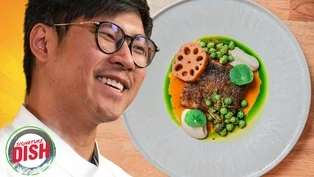
How Chef Kevin Tien Reinvents Cá Kho at Moon Rabbit in Washington DC
Video has Closed Captions
Clip: S4 Ep10 | 5m 42s | Chef Kevin Tien guides Seth through a reimagined cá kho at Moon Rabbit in Washington, D.C. (5m 42s)
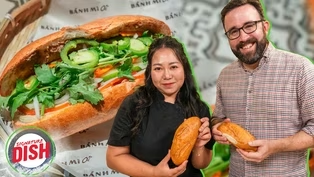
Nashville Hot Chicken Bánh Mì?! Go Inside Bánh Mì Ơi in Eden Center
Video has Closed Captions
Clip: S4 Ep10 | 5m 5s | Seth visits Bánh Mì Ơi at Eden Center in Falls Church, for their Mui Tàu Signature bánh mì. (5m 5s)
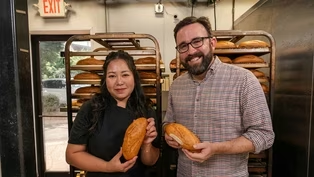
Preview: S4 Ep10 | 30s | Bánh Mì Oi in Falls Church, VA, Moon Rabbit in Penn Quarter, Pho Viet in Columbia Heights (30s)
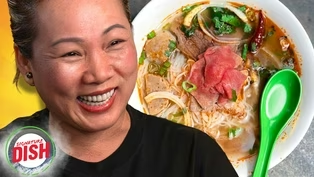
Why DC Locals Order the Spicy Lemongrass Pho at Pho Viet
Video has Closed Captions
Clip: S4 Ep10 | 6m 25s | Seth visits Pho Viet where Chef Nina shows him how she makes their spicy lemongrass pho. (6m 25s)
Providing Support for PBS.org
Learn Moreabout PBS online sponsorship

- Food
Christopher Kimball’s Milk Street Television
Transform home cooking with the editors of Christopher Kimball’s Milk Street Magazine.








Support for PBS provided by:
Signature Dish is a local public television program presented by WETA