
Viola Davis, Samuel L. Jackson and more
Season 16 Episode 1 | 26m 42sVideo has Closed Captions
Viola Davis, Samuel L. Jackson, Jennifer Aniston, Sebastian Stan, Jared Leto.
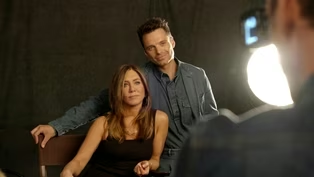
Viola Davis ("The First Lady") and Samuel L. Jackson ("The Last Days of Ptolemy Grey") share their advice for young actors; Jennifer Aniston ("The Morning Show") and Sebastian Stan ("Pam & Tommy") reveal how they spend their time in the makeup chair; and Jared Leto ("WeCrashed") and Amanda Seyfried ("The Dropout") discuss their responsibility in playing real people.
Problems playing video? | Closed Captioning Feedback
Problems playing video? | Closed Captioning Feedback
Variety Studio: Actors on Actors is a local public television program presented by PBS SoCal
Viola Davis, Samuel L. Jackson and more
Season 16 Episode 1 | 26m 42sVideo has Closed Captions
Viola Davis ("The First Lady") and Samuel L. Jackson ("The Last Days of Ptolemy Grey") share their advice for young actors; Jennifer Aniston ("The Morning Show") and Sebastian Stan ("Pam & Tommy") reveal how they spend their time in the makeup chair; and Jared Leto ("WeCrashed") and Amanda Seyfried ("The Dropout") discuss their responsibility in playing real people.
Problems playing video? | Closed Captioning Feedback
How to Watch Variety Studio: Actors on Actors
Variety Studio: Actors on Actors is available to stream on pbs.org and the free PBS App, available on iPhone, Apple TV, Android TV, Android smartphones, Amazon Fire TV, Amazon Fire Tablet, Roku, Samsung Smart TV, LG TV, and Vizio.
Providing Support for PBS.org
Learn Moreabout PBS online sponsorshipElizabeth Wagmeister: Have you ever wondered what really goes on behind the scenes of your favorite TV shows?
Samuel L. Jackson: I loved being able to lose myself in this person.
Elizabeth: Variety Studio invites you to listen in as today's most accomplished actors discuss their craft.
Sebastian Stan: I think fear is good.
Jennifer Aniston: Yeah, it's a great sign.
Elizabeth: With Viola Davis and Samuel L. Jackson; Jennifer Aniston and Sebastian Stan; and Jared Leto and Amanda Seyfried.
♪♪♪ Elizabeth: Welcome to Variety Studio, "Actors on Actors."
I'm Elizabeth Wagmeister.
Clayton Davis: And I'm Clayton Davis.
And we're back in studio from Los Angeles and New York, bringing you exclusive access to some of the most talked about television performances from the last year.
Clayton: Two of Hollywood's most decorated actors and box office draws, Viola Davis and Samuel L. Jackson, sit down to discuss their prolific careers.
Viola Davis already has an Emmy for playing one powerful woman, but now she's taken on one of the world's most recognizable and inspiring female figures, Michelle Obama, in the limited series, "The First Lady."
Michelle Obama: Oh no, I think it's interesting that you're willing to put your family in harm's way-- Barack Obama: Don't do--don't do that.
Don't do that.
Michelle: You know what?
Remember Jackie Kennedy, her blood-splattered pink Chanel suit?
Her kids had to see that.
Someone had to explain that to them, Barack.
Clayton: And Samuel L. Jackson has already conquered Hollywood as the top-grossing movie star of all time, raking in more than $13 billion at the box office.
Now, he displays some of his most challenging moments yet in the limited series, "The Last Days of Ptolemy Grey."
Ptolemy Grey: She burning up.
Oh, ho, Sissy.
Sissy: It's all right, I'm right here.
Ptolemy: Sissy, Sissy!
Come lay with me.
Sissy: I'm right here.
Ptolemy: Oh God, agh.
Coydog: Stay with me, boy.
You know what you gotta do.
Ptolemy: God, agh!
Oh no.
Samuel: The first time I remember seeing you was you were playing, like, this mean cop on "Law and Order."
Viola Davis: Oh, I loved that role.
Samuel: That was great.
You killed it.
Viola: I loved that role.
I played a serial killer.
Samuel: Yeah, yeah, I remember that.
It was like-- Viola: No one else in my family liked that role.
They didn't--they don't wanna talk about it anymore.
But I loved it, but, yeah.
Samuel: But we all passed, you know, we all had our pass through "Law and Order" phase if you lived in New York 'cause back then, well, back when I was doing my stuff in New York, that was one of two shows that was shot in New York until they started shooting "New York Undercover."
Viola: That's right, and then you--I don't know, you go along in your career and, for me, I always went to job, to job.
I never thought of the ultimate outcome.
Like, I never thought, "I wanna be famous."
Samuel: But in the beginning, I mean, there's a point when you first start doing it or--that got your attention, that made you say, "Oh, I wanna be an actor," or "I wanna be a movie star," or "I wanna be famous."
And as you do the work, if you become a real actor, all that stuff becomes in the back of your mind.
Viola: Exactly.
Samuel: You know, 'cause I remember when I got--I got "Ragtime" in 1980.
Viola: Oh, "Ragtime," yeah.
Samuel: So I went to London.
That was my first time going to London to shoot and be on location, and I thought, "Okay, it's about to happen."
And you know, "Ragtime" was over, I came back to New York, and I didn't see another movie for, like, ten years.
Yeah, at a certain point, I forgot about all that, and I was doing, you know, Pulitzer Prize-winning plays and, you know, you're fine.
So it was about the work, and it became a by-product of what happened.
Viola: Absolutely, I mean, just in terms of the work you have to do, you sort of have to get out of your way completely, get out of your way in terms of vanity, get out of your way in terms of thinking, "Okay, I'm gonna do this and I'm gonna blow up."
You actually don't even know if you're gonna fail or you're gonna succeed.
Samuel: You don't really know until you run into a director and you go, "Oh my God, this person's brilliant," 'cause they are helping you, you know?
And a lot of times you're helping yourself until you find that person that unlocks another little piece of this thing that will make you so much better than you used to be.
Viola: And it's very difficult to find those people now.
It really is.
Samuel: Oh yeah, yeah, yeah.
And I don't know who they are, you know, because, I mean, we're not part of that milieu anymore, you know?
That was a blessing for us, to be able--when I talk to young actors and they go, "What do I need to do?"
And I say, "Well, have you done a play?"
and they look at you, like..."I have no idea."
It's like, "Well, have you done anything from beginning to end?"
I mean, you can't learn to act doing scenes, you know?
Having done something from beginning to end, has been very useful in terms of this whole streaming service thing that happens now, that allows you to take something that's episodic and take the character the long road and do that.
So having been in that, how does that help you bring yourself into becoming a living person like Michelle Obama and what you had to do to get yourself in that place to portray somebody who's alive and will watch you be them?
Viola: Here's the thing: it is very difficult playing a real live person, especially someone who's occupied the space of the White House.
There is a shroud of protection, of liability.
And as an actor, that is a nightmare because when you enter into any character, you have to be armed with as much information as possible, you know, not just where did you go to school.
What do you drink?
Do you love your husband?
Do you fight with your husband?
Do you fight with your kids?
You know, what's your biggest fear?
You know, all of those things that you can't get at.
And so then you have to fill it in and you have to fill it in for an audience who feel such an ownership of that character that they don't wanna see anything mar the image, and that's exactly antithetical towards what we do.
We need the mess.
That's what makes us human.
And so, if I'm playing a real person, it's my job to give you the truth, to make you feel those moments that you have in private that I'm bringing to the public, they may make you squirm, but if you recognize it, then I've done my job as an actor, you know?
When you were doing Ptolemy Grey's, I'm sure that that was your process absolutely.
Samuel: Well, you know, well, Ptolemy--Walter wrote "Ptolemy" in a specific way and I've been living with that book for 12 years or so, you know?
I read it, like, you know, once a year 'cause I kept wanting to do it.
By the time I had an opportunity to actually portray him, you know, yeah, I had a very solid idea of who he was.
And I would say, "Well, Walter, do I have to say, 'Duh, duh, duh'?"
And he's like, "You know the book better than I do, so say what you wanna say."
And I had that freedom to, like, just go in there and make Ptolemy who I wanted Ptolemy to be, which is one of those things I was talking about.
Being able to do it as a six-part series gave me the opportunity to expand on what I knew him to be.
That gave me the opportunity to take my time and let Ptolemy breathe into people's lives, visually, watching it.
And I knew the first episode was gonna be uncomfortable for people because people who have been touched by dementia or Alzheimer's and had to care for a person that have it, it was not gonna be comfortable for 'em, but I wasn't gonna run from it and try to make it easy for 'em.
I just wanted them to know that when those people are alone or when they're sitting there and they're just staring into space, yeah, something's going on back there.
You may not know what it is, you may not be able to get them to explain it to you, but they're living in this particular thing.
And I loved being him and when people ask me what your favorite moments were doing it, some of my favorite moments were being alone with Ptolemy, or sitting there, you know, eating beans out of the can, licking the spoon, and staring out the window and walking around and picking up something that flashes back that gives you a memory of something.
Being able to be comfortable in losing myself in this person, you know, which is what, you know, we tend to do that a lot, you know?
And I play characters that, you know, I know people aren't supposed to like, and enjoyed it.
Like Stephen in "Django" or something, you know, it's like, that's my job, to make you uncomfortable, you know?
And people go, "My God."
I go, "Yeah, good," you know?
And that makes--that's satisfying for us.
Okay, I have to circle back, though, to the one question I'm sure everybody wants to know.
So when Michelle called you, did she tell you, you got it right?
[laughing] ♪♪♪ Elizabeth: Jennifer Aniston is one of the most recognizable and talked about actors on the planet.
And Sebastian Stan plays one of the most recognizable and talked about drummers in rock history.
After nearly three decades as America's sweetheart in the TV series, "Friends," Emmy winner Jennifer Aniston returns to television as a conflicted news anchor in "The Morning Show."
Alex Levy: Well, how's your life been going being associated with you?
Did you lose your career?
Did your family fall apart?
Have you been ostracized by polite society?
Does your life have any meaning or purpose left at all?
Nobody will respect me if they think that I slept with you.
Elizabeth: In a truly uncanny transformation, Sebastian Stan plays Tommy Lee, the founding member of the metal band, Motley Crue, in "Pam & Tommy."
Tommy Lee: C'mon, no, c'mon, pretty please can I come with you, please?
Pamela Anderson: No, no.
Tommy: Pretty please, with sugar on top?
With sugar sprinkles and a cherry?
Pamela: No.
Goodnight, Tommy.
Tommy: Fine.
Sebastian: Hi.
Jennifer: Hi.
Hi.
Sebastian: I'm very excited and nervous to be here.
Jennifer: So am I.
That's great, it makes two of us.
Sebastian: Uh-yah.
I'm such a huge fan of yours.
I have been for years and, you know, so for me, this is very special.
Jennifer: Now, let me--so with "Pam & Tommy," when you started it, what were you guys told in terms of tone, like, 'cause it's so--there's a definite signature to it.
It's funny and it's kind of highbrow.
Sebastian: Yeah, well, Craig Gillespie, who I worked with on "I, Tonya," him, and coming on to it, it felt sort of like I understood what we were going for with that fine line between comedy and drama.
And it was really well written.
It was in the script, but it just was weird because it was the '90s every day for 12 hours.
Jennifer: Which, by the way, feels like yesterday.
Sebastian: I know.
Jennifer: Were you familiar with them in the '90s?
Sebastian: I was--I mean, okay, like, I was--everyone, even in Europe, 'cause I was, you know, I'm from Europe originally.
I came to the States in '95, right, and-- Jennifer: From?
Sebastian: From Romania.
Jennifer: Romania?
Sebastian: Yes.
Jennifer: You were born-- Sebastian: Born and raised in Romania, yeah.
Jennifer: Wow.
Sebastian: And then--yeah, you would hear about it but I didn't really actually know what happened.
And that's kind of what was surprising about doing the show was just to find out how much we didn't know about what happened, how many people really didn't know that the tape was stolen or that they had nothing to do with it or that it tore them apart to the extent that it did, and--because I think that they did their best to sort of fight it and then kind of co-exist with it and it was just all repercussions that ended up happening as a result of it, so.
Jennifer: And how long were you in that make-up chair?
Sebastian: Like, three hours, yeah.
Jennifer: I mean, I looked at that--your body, and I was, like, "Oh."
All I think of is "That's--what time's--what's that call time?"
Sebastian: Exactly, what time, yeah.
Jennifer: I'm like, "How can we get out of here in, what, 50 minutes?"
Sebastian: Well, how do you--that's an interesting question.
I mean, do you use that time in the make-up chair now, kind of focused, like, the last sort of go-around on what you need to do, or is it a moment of just taking a breath before you start?
Or how-- Jennifer: It's a little bit of both.
Depending on what is ahead of me, but usually, like, when I do that Sunday work which really nails it into my kind of--my neuro pathways, then it's just about lines and then you just speed--I just speed through it, and then I'll just breathe and then I forget about it.
And then--or if it's gonna be an emotional, which "Morning Show" is more emotional than ever, I think I've ever been in my whole life up unto this day.
Sebastian: One of the things that I loved sort of about, you know, your performance was I feel like when I'm watching Alex is there's always sort of like this volcano underneath, that's just like almost about to, you know, and I feel like I never know when it would come or when it may come or not, and so I'm just-- Jennifer: Neither do they.
It was like, I was fun to be around.
Sebastian: Yeah, but-- Jennifer: I mean, no, I was never-- Sebastian: But that's where you kind of, you know, you can't take your eyes off of you in those situations and so I'm just curious whether, like, kind of walking with that weight and kind of keeping that, were you conscious of that a lot or was that-- Jennifer: Well, I didn't--it was one of those things where I think when I left work I had to drop it.
I had to, like, watch puppy video, you know, I just was like, listen to a funny podcast.
Because it was--literally it felt like I was unloading years of buried feelings, you know, and as my acting teacher always said, "You know, acting is a healing craft," and I never understood that more than in this particular show.
And I mean, and others as well, but this consistently, over and over and over again, you know, to just have to keep digging and you're like, "I don't know if there's anything left."
But somehow you just go, "Oop, it's still there.
There's something more."
Sebastian: Yeah, well, I don't know if you ever heard this saying 'cause I always heard it when I was--from my acting teachers and stuff, they always told, "Just bring the day with you," right?
'Cause it's like you can prepare as much as you can but then your life is still gonna happen, you know, and then you just inevitably come to work with all these other things and sometimes maybe that stuff can be useful and that was like a huge thing for me, even in auditions 'cause I, you know, sometimes you go in auditions and you're like, "Please hire me."
Jennifer: Oh, God, I was the worst in auditioning.
Sebastian: Really?
Jennifer: I hate--I'm the worst auditioner.
Sebastian: Oh my God, no.
Jennifer: Are you a good auditioner?
Sebastian: I don't know if I--I don't know if I--I don't know if anybody is, right?
But like, it was still kind of a fun--I didn't mind it so much but, you know.
Jennifer: Yeah, that's good.
I was terrified of it.
Oh God, that's just--I'm sweating just thinking about it.
Sebastian: So, with Rachel, right, for the "Friends" reunion-- Jennifer: You would have been a great cast member on "Friends."
Sebastian: I loved "Friends."
There are many times where I've gone through a lot of lonely nights with "Friends," I will tell you.
Jennifer: It's a friend to have in the room sometimes.
Sebastian: Yeah, and I--my friends and I would always go around and be, like, "Who are you--who are you most like?"
I mean, I always came closest to Chandler 'cause-- Jennifer: To Chandler?
Sebastian: Well, 'cause I'm--'cause I get very sort of like neurotic and I just--I just used to die laughing, but-- Jennifer: You were --you were Chanandler Bong.
Sebastian: Ha, ha, but, yeah, but how did it feel coming back to that after all this time and seeing everybody and, yeah, is it cathartic or is it sort of weirdly the same goosebumps kind of come back, or you're just--it's so familiar, it's easy?
Jennifer: It was all--it was all of the above, honestly.
It--I don't think we expected for it to sucker punch us as hard as it did in the emotional gut, like, each and every one of us, we walked in and it was just like, [inhaling breath] "Oh, time travel."
We kind of had rose-colored glasses on going into it.
And then it was just like, "Whoa, this is really a lot heavier than I thought."
But I wouldn't change a lick of it.
It was so fun.
You know, every time we all get together, it's just like no time has passed.
Sebastian: Yeah.
Jennifer: Oh, I wanted to ask, have you always wanted to be an actor?
Were you--did you know that, like, in--when did--growing up in Romania, when did you decide, "I wanna be an actor," and did you-- Sebastian: I didn't, I didn't, no.
I was just, I guess I was, like, really good at impressions or something.
My mom used to kind of bring me out, you know-- Jennifer: Perform!
Sebastian: Yeah, ha, ha, ha.
When we would have-- Jennifer: Perform, young man.
Sebastian: --people over.
Yeah, I know.
And--but she didn't push me with anything.
I mean, I guess for a little while she tried--I would go to these casting calls with her and I would hate it and then so she sort of just left me--left me alone.
And then when I moved to the city, I started going to this acting camp, Stagedoor Manor, and we did musicals there.
So that was a-- Jennifer: You did?
Are you a singer?
Sebastian: Well, at karaoke I'm-- Jennifer: Pretty good, solid.
Sebastian: I'm not an embarrassment, I guess.
Jennifer: You really do--you are extremely talented, a, I have to say.
And you do--you go from, like, a "Marvel" film to comedy and drama seamlessly.
Sebastian: I don't--well, I appreciate that.
I don't know.
I never tend to sort of discriminate between genre or-- Jennifer: Genre.
Sebastian: Yeah, I think it's always-- Jennifer: Do you have a favorite?
Sebastian: I mean, you know, I would--if I could just live in "Notting Hill," the movie, forever, I would.
Jennifer: Oh, wouldn't that be nice, yes.
Sebastian: Or, yeah, I mean, there was a lot of those movies that were great.
Jennifer: Those great, what do they call them?
Rom--they were romcoms.
Sebastian: The romcoms.
Jennifer: Is that a romcom?
What--why do they have such a bad rap these days?
'Cause wouldn't that be fun to do one?
Sebastian: It would be.
Do you-- Jennifer: Wanna do it?
Sebastian: Do you wanna do one?
Jennifer: I'd do one.
Sebastian: I would do one in a second with you.
♪♪♪ Elizabeth: This past year, Jared Leto and Amanda Seyfried both played young moguls that pay the price of greed.
Chameleon Jared Leto disappears yet again into the role of tech titan Adam Neumann, portraying the rise and fall of his failed startup, "WeWork."
Adam Neumann: Come with me.
It is time for the We revolution.
♪♪♪ Adam: Light.
Elizabeth: Amanda Seyfried fully becomes disgraced biotech entrepreneur Elizabeth Holmes, complete with a deep voice and icy stare in "The Dropout."
Elizabeth Holmes: Hey, don't tell Sunny what to do.
We're gonna launch in September with The Edison.
Sunny Balwani: How?
How are we-- Elizabeth: Because I put you in charge of operations and you're gonna figure it out.
Amanda Seyfried: Hello.
Jared Leto: Hi.
Amanda: Thank you for coming.
I have a question for you.
Jared: Yeah, please, please.
Amanda: I got to know the thing that connects us is that you gave Elizabeth Holmes a Woman of the Year Award and I just wanna know what that was like.
Jared: It was interesting.
I'd heard her speak before that in Palo Alto, but she was great onstage.
She was, you know, incredibly smart, gave a great talk, and then I met her after that and I liked her a lot.
You know, no indication that things weren't great in her life and at the company and then I did--I gave her an award.
Amanda: How did that happen?
Jared: A small world.
Amanda: It's such a small world.
Jared: And now I'm here with you.
Amanda: And it's just I, listen, as an actor, I'm like, I care about my character.
I'm there with her, as much as I can be as an actor outside of her world, having nothing to do with her.
I just think that I'm kind of in awe of anyone who's spent time with her because she will always be very far removed from me 'cause we weren't--we were not allowed to meet, which-- Jared: Yeah, I kind of had a similar situation where I wasn't allowed to meet but I did anyway.
But my experience with her was always quite nice and lovely and it's what, I think what's interesting about bringing a character to life, you know?
Not everyone is one thing.
No one is one thing, right?
Amanda: Right, exactly, especially with the villains that we create, or we help create.
It's incredible that you-- Jared: Did you want to meet her?
Amanda: Yeah, I did, of course I did.
I mean, I-- Jared: Did she contact you?
Amanda: No, no, we weren't allowed to.
She was in litigation and Disney was, like, very clear about what we could and could not put in the show, so I was never gonna meet her, but it was always a dream that maybe we would down the line.
But I--so why were you told that you couldn't meet Adam Neumann?
Jared: I think the question was floated around early on and I didn't get a definitive response from one person but I think, like, the blanket approach that they were taking was that the Neumanns weren't involved with our project but I was too curious.
I thought that I would regret it if I didn't meet Adam and that there was more to be gained than lost.
Amanda: And do you keep in touch?
Jared: You know, we met.
We had a top secret meeting.
Like, nobody knew that it was happening.
It was right before a shooting and it was kind of touch and go, like, you know, about where it was gonna happen.
Of course, it was during, you know, kind of prime COVID days, but anyway, we ended up just finding this little window of opportunity and I went down and I met him.
I met his wife, Rebekah.
I met all the kids and they have a lovely family and, you know, it was quite a nice experience on my end.
Would--did you guys approach it where you said, "Okay, this is--" was there a conversation about her being, quote, unquote, "the villain" of the story, the antagonist?
Like, what was the--what were the conversations like around that?
Amanda: This show was just about seeing a new perspective.
There's no point unless you're gonna get inside this person and try to figure out--I mean, we've seen enough Elizabeth Holmes stories and they're all non-fiction and they're just very informative, but she's an enigma for a reason.
She's a mystery for a reason.
And so the only reason we could make the show is if we did something different, which was maybe try to address why she made the decision she made and maybe where she came from, which is why we started back when she's, I dunno, 11 or 12 and then quickly switched to 17 which is when I came in, gave some back story because you were never gonna know anything more.
She wasn't gonna give it to--she wasn't gonna share.
So it was never about her being a villain.
It was actually, let's make this person three-dimensional like we are, and try to give the audience something to understand.
I mean, she's not just one thing, a person who put people's lives in jeopardy and lied to become powerful.
There's more to her than that, and that was always the game plan, like, let's relate to her, okay, what we can.
Jared: It's one of the contradictions that are out there and I think it's what's fascinating is people, you know, someone makes a bad decision, they think their entire life is full of bad decisions, and frequently it's not.
Amanda: Yeah, how long did it take for you to feel confident with the accent, the voice, everything?
Jared: Well, I'd come from Rome and I was doing "House of Gucci," pretty strong accent, Italian accent, and then I went right to New York and a few weeks later we were shooting.
So I had very little time.
It's not the prototypical Israeli accent, like, he pronounces his "R's" in an American--with an American accent, things like that.
And he just has a very unique way of talking, quite an energetic passionate way of talking.
I'm sure you were too but I--at the end of every day, I just was dead.
Amanda: Did you have a hard time not speaking like him when you were done with the show?
Jared: Oh, I still do some things, you know, that I did when we were shooting, like, I would say, "Bye, bye, bye, bye, bye, bye, bye."
Now I'm always saying that.
Amanda: Did you catch yourself and you're like, "Ah," and then you're like, it's kinda--it's kinda yours now?
Jared: I mean, I think it's natural for it to take a little bit of time.
You know, you make a commitment to anything and it's reasonable that it's gonna take a little time to wash away and I think that's appropriate and that's okay.
Amanda: Is this the longest you've ever had a character in the recent years?
Jared: Yeah, it was the longest and it was the most amount of material I've ever had in my life.
Amanda: So much material.
Jared: Yeah, selfishly, I loved it.
Amanda: Oh yeah.
Jared: It was like, I really--there wasn't a day on set, no matter how burnt I was, that I wasn't really happy and grateful to be there.
I thought, "God, what a--I wanna play this--" Amanda: This was, hands down, beyond anything I've ever done, this was the most fulfilling job, even better than stage.
Like, I cannot believe how hard it was to--like, I still do the--I still do things that are very Elizabeth and I catch myself doing it and I'm like, "So what?"
I don't--you know, I just--I really--it was so long and I loved every second of it.
And I never get to do that.
♪♪♪ Elizabeth Wagmeister: We hope you've enjoyed our look inside Variety Studio "Actors on Actors."
Clayton: Please join us again next time.
Viola: Listen, he almost got me in trouble, I said.
Samuel: I'm sorry.
Jennifer: My first, first job was a Bob's Big Boy commercial.
I couldn't--I would--couldn't get hired for, like, two years.
Amanda: Do you like talking about your work?
Jared: No, not at all.
Amanda: So here we meet.
Jared: Yeah, and here we are, talking up-- Samuel: We drove from Atlanta to New York, pulled into that Halloween parade down in the Village.
[laughing] And we were like, "What's going on here?"
It was like, "Wow, this is crazy."
Jennifer: Boy, I love it when they say, "Wrap."
It's just like the best words ever.
...
Viola Davis, Samuel L. Jackson and more (Preview)
Video has Closed Captions
Preview: S16 Ep1 | 30s | Viola Davis, Samuel L. Jackson, Jennifer Aniston, Sebastian Stan, Jared Leto. (30s)
Providing Support for PBS.org
Learn Moreabout PBS online sponsorship

- Arts and Music
The Best of the Joy of Painting with Bob Ross
A pop icon, Bob Ross offers soothing words of wisdom as he paints captivating landscapes.






 New Episode



Support for PBS provided by:
Variety Studio: Actors on Actors is a local public television program presented by PBS SoCal