VPM News Focal Point
Virginia Agriculture | November 22, 2022
Season 1 Episode 17 | 26m 46sVideo has Closed Captions
Modern farming, Migrant farmworkers, expanding access to healthy food in Petersburg.
Modern farmers across Virginia face challenges and opportunities; a day in the life of Latino migrant workers in Southwest Virginia; an educator and gardener has dedicated himself to expanding access to healthy to affordable food in Petersburg.
Problems playing video? | Closed Captioning Feedback
Problems playing video? | Closed Captioning Feedback
VPM News Focal Point is a local public television program presented by VPM
VPM News Focal Point
Virginia Agriculture | November 22, 2022
Season 1 Episode 17 | 26m 46sVideo has Closed Captions
Modern farmers across Virginia face challenges and opportunities; a day in the life of Latino migrant workers in Southwest Virginia; an educator and gardener has dedicated himself to expanding access to healthy to affordable food in Petersburg.
Problems playing video? | Closed Captioning Feedback
How to Watch VPM News Focal Point
VPM News Focal Point is available to stream on pbs.org and the free PBS App, available on iPhone, Apple TV, Android TV, Android smartphones, Amazon Fire TV, Amazon Fire Tablet, Roku, Samsung Smart TV, and Vizio.
Providing Support for PBS.org
Learn Moreabout PBS online sponsorshipANGIE MILES: It's a profession that's almost as old as dirt.
Farming has changed a lot over the centuries.
How's the future of farming looking from here?
Migrant workers are an essential part of the farming ecosystem.
What is life like for them?
And how can urban farming help support a community?
You're watching "VPM News Focal Point."
Production funding for VPM News Focal Point is provided by Dominion Energy, dedicated to reliably delivering clean and renewable energy throughout Virginia.
Dominion Energy, Actions Speak Louder.
The estate of Mrs. Ann Lee Saunders Brown.
And by... ♪ ♪ ANGIE MILES: Welcome to "VPM News Focal Point."
I'm Angie Miles.
In this episode, we'll explore the challenges and changes facing agriculture in Virginia.
Whether or not you have an interest in farming, it has an impact on you.
From where and how your food is grown, to what innovations can mean to the environment and the stability of whole communities.
Farming affects us all.
We begin by considering that farmers face stressors that are beyond their control, like fluctuating commodity pricing, trade wars, and the threat of severe weather.
Nationwide farming has one of the highest suicide rates of all occupations.
To help farmers cope with the emotional weight of the job, Virginia's Department of Agriculture and Consumer Services launched the AgriStress HelpLine this summer.
We spoke with Dana Fisher from the Virginia Farm Bureau who is helping to spread the word.
DANA FISHER: It's set up really to give farmers that chance to have somebody to answer the phone that can help them out in times of stress, in times of need.
We say, you know, if it's a physical injury, 911's the number to call.
If it's an another issue or another concern, the AgriStress HelpLine can help.
If it's anxiety over concerns on the farm, if it's stress, if it's financial issues that you just need somebody to talk to, the AgriStress HelpLine is a resource for our farmers.
ANGIE MILES: Virginia is one of only five states with access to the helpline.
Crisis specialists utilize a Virginia specific database of agriculture and mental health resources.
The helpline is available 24 hours a day, seven days a week.
Farmers can call or text 833-897-2474 to reach a mental health professional.
ANGIE MILES: Farm work can require intense mental concentration and rigorous physical labor.
How well do most people understand the challenges of farming?
We ask Virginians for their points of view.
SARAH LYNCH: I feel pretty lucky to know maybe more than other people want to know about food production.
We have a local farm, Polyface, that does Native American practices.
So our whole staff goes out and visits there once a year and sees how they make the things that we buy from them.
And I've seen enough of the films about mass-produced food to know to avoid it if I can.
NOAH FISHER: Farmers nowadays have a really hard time, especially small scale.
Prices of fertilizer, anything has gone up just tremendous to the point where you're kind of just paying to do it.
There's a lot of people that just barely break even just to be able to just do it because they enjoy it more than anything.
ANGIE MILES: Over the past half century, Virginia has lost more than 5 million acres of farmland.
Some of the land that was once owned by families is now part of much larger farm operations.
So how are small farms staying in business?
What are the prospects for the future?
(air hose whooshes) TRINLEY ROBSON: I teach my little brother, Remington.
(cow moos) ANGIE MILES: Trinley and Remington Robson groom their show cattle at the Virginia State Fair.
TRINLEY ROBSON: And then we wash, clip, dry, brush, and basically just like, clean them up for shows.
ANGIE MILES: These children are the fifth generation of a Virginia farm family.
They came here with their close family friend, who adores the animals, and with their mom.
KELLY ROBSON: So, they're responsible.
I'm there to help them, but they're, it's their job to feed and water and wash and clip.
ANGIE MILES: Kelly Robson enjoys watching her kids learn about responsibility and master new skills.
They have that opportunity here and on the family farm in Culpeper.
Robson, who has a degree in agriculture from Virginia Tech, came up much the same way under the tutelage of her father.
DWAYNE FORREST: I was interested in farming from the time I was a toddler.
My grandfather and father actually had a farm in Connecticut.
They started up there, then with some arm twisting and all, I got my parents to go in business with me, here on this property in '73.
(farm machine whirring) ANGIE MILES: Farming entails a lot of challenge and not a lot of profit.
DWAYNE FORREST: Well, 2014 was a good year.
Other than that, not so good.
ANGIE MILES: And inflation is making the margins even smaller.
KELLY ROBSON: So inflation, fuel, fertilizer and herbicide prices, labor, the price of labor is more, is higher than it's ever been, and it's also hard to find people that have experience.
ANGIE MILES: For most of his years here, Dwayne Forrest just been a dairy farmer but he says that became much more pain than profit.
DWAYNE FORREST: I guess it was 2018, I believe, I sold the dairy herd.
I was losing money, it's no fun.
Seven days a week, 24 hours a day running a dairy farm and not making money.
ANGIE MILES: In fact, Forrest says there are no dairy farms left in Culpeper.
Nearly all of the dairy market, he says, now belongs to the big operations.
DWAYNE FORREST: The larger dairies that are pretty much factory farms, have their own nutritionists, they have their own veterinarians, and they just have to be really, really efficient.
ANGIE MILES: In addition to beef cattle, Anchor Mere Farm also sells some hay and vegetables, mostly direct to customers on social media.
And this is the reality for family farms, which have been disappearing by the thousands each year.
America has lost more than four million farms since the late 1940s.
KELLY ROBSON: I think it's going to continue to go to either small and specialized or big, and that, the larger farmers are going to go where there's more open land.
So around here, I think it's going to have to get really specialized.
ANGIE MILES: Just a few miles from Anchor Mere, you'll find a very specialized farm, which is also part laboratory and part design center.
Sempergreen is a worldwide operation trying to get its footing in roofing in the United States.
OSCAR WARMERDAM: The temperature underneath that green roof is 75 degrees, naturally.
The moisture and then the evaporative capacity of the plants, basically cool off the building.
So the draw on our air conditioning is a lot less.
It looks good.
We sell green roofs, so that's what we do.
ANGIE MILES: Oscar Warmerdam faces the same inflation pressures as other small farmers, but he says the bigger issue is that greener, more environmentally attuned buildings, are a luxury most Americans avoid, whereas in Europe- OSCAR WARMERDAM: Over there people are just really like green-minded.
My parents recycle, they have 12 bins and they have paper and magazines and aluminum and plastics in three different colors and codes and God knows what.
So there's a huge effort by the public to be green.
ANGIE MILES: The solution here has been to turn these eco-friendly rooftops into advanced storm drainage systems, appealing to space conscious Americans.
OSCAR WARMERDAM: Either a tank or some underground storage, water storage or aboveground water storage, it all takes space.
And if they keep the water on the roof, they can utilize that space at grade, that's what they call it, and put a Starbucks there, or they can park five more cars or something like that.
ANGIE MILES: Supply chain issues also block progress for Sempergreen.
Warmerdam says he can't deliver product that's already sold because recipients have no one to install.
But that's the story of agriculture today, managing challenges and hoping things get easier.
ANGIE MILES: You can find Sempergreen installations, by the way, at the Kennedy Center and at the German Embassy in Washington, DC.
As for small local farms, many are also finding profitability in agritourism, allowing outsiders to experience farm life.
Kelly Robson says, an easy way to support small farms and avoid monopoly control of the products we all need is simply to buy local whenever possible.
VPM News Focal Point is interested in the points of view of Virginians.
To hear more from your Virginia neighbors, and to share your own thoughts and story ideas, find us online at vpm.org/focalpoint.
ANGIE MILES: Virginia agriculture is comprised of private businesses that generate $70 billion dollars annually.
The industry provides more than 300,000 jobs, often to immigrant farm workers, those who come legally with a visa, and others who live in the shadows.
When the COVID-19 pandemic hit in 2020 farm workers were labeled essential, yet many still lack basic labor protections like minimum wage, overtime pay, and the right to organize.
Multimedia journalist, Keyris Manzanares reports how migrant farm workers play a critical role in Virginia's food system and shares their experiences in their own words.
(engine revving) (speaking foreign language) KEYRIS MANZANARES: Luis Genaro Cruz Crisantos is a long way from Tlacotalpan, Veracruz, Mexico where he was born and raised.
He works at a farm just south of Richmond.
(speaking foreign language) KEYRIS MANZANARES: Cruz Crisantos is one of hundreds of thousands of immigrants who entered the US legally with an H-2A Visa.
H-2A Visas are sponsored by American farmers and allow migrants to live and work in the States for a short period of time.
(speaking foreign language) KEYRIS MANZANARES: Cruz Crisantos has been coming to Virginia for the last four years to farm and has over 20 years of experience.
He says the hardest part is leaving his family.
(speaking foreign language) KEYRIS MANZANARES: Virginia Department of Agriculture and Consumer Services Commissioner Joe Guthrie says guest workers are absolutely essential and irreplaceable.
JOE GUTHRIE: It's very important that we have immigrant workers, guest workers who come to Virginia and are able to fulfill the jobs that need to be done.
They very often bring very valuable skill sets with them.
KEYRIS MANZANARES: Guthrie says, during the pandemic we found out how fragile our supply chain and food systems are, and when writing policies, guest workers should be considered.
JOE GUTHRIE: I would certainly hope that our policies would keep in mind the welfare of the workers who are coming here from other places and the value that they provide to us.
And look at how important they are to our supply chain and to our food systems.
KEYRIS MANZANARES: But the reality is farm workers are not protected despite agriculture being Virginia's number one private industry bringing in $70 billion a year.
Virginia delegate Elizabeth Guzman says.
ELIZABETH GUZMAN: Many of them, I mean, if they are fortunate to come with a tourist visa to get a job, and then they realize that once they get here, even though they enter to this country legally through a visa, they have no rights.
They can work long hours without breaks and without not even good conditions to live.
And on the other hand, you have those who came here illegally, that it's even worse.
They cannot speak up or say anything.
KEYRIS MANZANARES: Virginia's farm workers are exempt from minimum wage, collective bargaining, and overtime protections.
Earlier this year, the Virginia Senate scaled back a worker overtime pay bill that included farm workers and would have given them the right to sue for unpaid overtime wages.
ELIZABETH GUZMAN: And I realized that all of their, all of those exemptions were tied to the Jim Crow era, people of color that were exempt to have any type of rights.
KEYRIS MANZANARES: Guzman, who has visited migrant farm camps around the state, says the pandemic highlighted the often challenging conditions that farm workers face.
ELIZABETH GUZMAN: Many of them have to share a bathroom, that many of them don't have heat, AC in the summer, or even a heat in the wintertime.
And how they just try to follow whatever they could work according to the season.
KEYRIS MANZANARES: Manuel Gago works for Legal Aid Justice Center informing farm workers of what to do when they face injustice, which Gago says can be difficult since workers are often isolated in camps across Virginia.
(speaking foreign language) (speaking foreign language) (speaking foreign language) KEYRIS MANZANRES: Gago says when Legal Aid does outreach, they mainly go to listen to farm workers so they can work to address concerns from the fields.
(speaking foreign language) KEYRIS MANZANARES: Emilio Lopez Castello entered illegally into the US in 1996 and has worked in Virginia's Christmas tree industry ever since.
Working with Christmas trees is delicate, but dangerous work.
Lopez Castello says workers must tend to the tree, trimming and shaping over years, what becomes a staple item in many households during the holidays.
(speaking foreign language) (speaking foreign language) (speaking foreign language) (speaking foreign language) (speaking foreign language) (speaking foreign language) KEYRIS MANZANARES: Lopez Castello says he would like to see Virginia farm workers like himself protected and supported.
(speaking foreign language) (speaking foreign language) (speaking foreign language) (speaking foreign language) ANGIE MILES: Nationally, there has been a push for the U.S. Senate to pass the Farm Workforce Modernization Act, a bill that would allow migrant farm workers to earn legal status through continued employment in agriculture.
It would also make changes to the H-2A Agriculture guest worker program.
Who is working on protections for farm workers?
Who is thinking about what small farms need to succeed and how does all of that affect the quality of your food and the price you pay for it?
These are some of the questions we asked in an extended conversation with those who work on these issues.
Here's an excerpt.
ANGIE MILES: What is the joy in farming that you wish more people could understand?
What is the reason why we want to attract more young people to become agricultural professionals?
CHRIS MULLINS: Well, I think, when we think of agriculture, I like to think of it as food.
We produce food.
And if you start thinking about it that way, it becomes a very important vocation.
It's something that's very important that you do.
So I think part of it is probably you love what you do because you're doing something meaningful.
BRANDON MOYER: Oh yes, every day.
You can, you know, see the new calf being born.
You plant the seed, you get to see it grow, whether it be a good year with lots of rain or not so much rain.
But it's always the cycle you get to experience of a life.
JOE GUTHRIE: And, you know, another thing as we've talked about is just the innovations in agriculture.
Agriculture is on the cutting edge of so many new technologies now that it can be really an exciting field for someone who's looking for, you know, a career in a field where they can find innovation.
CHRIS MULLINS: There's great technology out there.
You can use drones to map fields and figure out where fertilizer needs to be.
There's indoor ag systems that, you know, utilize grow lights to grow year-round.
There's so many really great things that we hope can bring young people in to get them out there doing either farming, or helping farmers in some way.
You can watch the full interview on our website ANGIE MILES: A 2020 study named Petersburg, Virginia's least healthy city.
Residents have been fighting against the negative impacts of crime and poverty for years.
Multimedia journalist, Adrienne McGibbon introduces us to a former teacher and principal who is transferring his classroom skills into building a community urban garden.
(vehicle passing) TYRONE CHERRY III: So if you look at some of the facts or stats when it comes to Petersburg, we were number one in gun violence for a year or two.
We were lowest ranked in the state for heart disease and type two diabetes, which are preventable.
You know, you look at those things which are all health related, and then you look at the fact that we're in a quote/unquote, food desert, and it's like, okay, well, you know, we see the problem, right?
So now what's the solution?
And we believe that urban agriculture, farms like this community farm, are part of the solution.
We're at the Petersburg Oasis Youth Farm.
It's a green space here in Petersburg that's dedicated to the youth.
Does it look like it grow under the ground or above the ground?
CHILDREN: Under.
TYRONE CHERRY III: It grows under the ground.
It's an opportunity for them to get an experience in gardening and farming and urban agriculture as a way to improve their lifestyle, but also as a way for them to understand the role it plays in their local food system.
When the Mike Brown tragedy had happened, I didn't know how to respond to it.
Like a lot of people were saying, "Hands up, don't shoot."
And that just didn't resonate with me.
So, we came up with "Raised grades for Mike Brown."
We said, hey, I'm going to take a group of young men who look like Mike Brown, who have similar lifestyles and family backgrounds as Mike Brown, and we're going to focus on our grades.
As that group was identifying problems within our community, one of the main ones that we identified was the the food desert issue.
And because we didn't own any land besides my front yard, we took my front yard, got rid of the lawn, put like 20, 25 raised garden beds down, opened it up to the community.
So a lot of my neighbors were coming to me, and the energy that I got from them, the inspiration I got from them, and then the young boys who worked with me not wanting to stop.
Like, Cherry, when can we do another project?
Oh, cool, let me go find some more land.
And then once people found out that we were doing it, they started offering us opportunities to continue to build community gardens.
So, it's just grown.
I was reading the newspaper one day and the front page, there was a guy on there named Mike Jackson, owns an urban farm in Petersburg, giving away produce for like a dollar a pound.
So we came up here the next day, my daughter and I came up here to the farm and he was out here sitting on his chair working the land.
The same way I felt in my front yard with the garden beds, I felt here.
And now I know it's the growth.
It's the potential of growth.
It's the life that exists here.
It's the energy that's been invested in it.
I felt that resonating.
So, he and I talked about my background being an educator.
He said that he intended on this space to be an educational space, but didn't have an educator.
So he granted us an acre of the land, told me we could do what we wanted to do with it.
So I'm going to have each person come through and you're going to use the shovel to dig a little bit of this out for me, okay?
Ever since the that initial one acre with Michael Jackson back in 2016.
Plants need nutrients.
They need sunlight and need what else?
CHILDREN: Water!
TYRONE CHERRY III: The plant wants water.
I have it in notebooks, I have it embedded in my mind that this space was going to grow the community.
Going to feed this peach tree.
CHILD: That might be too much.
TYRONE CHERRY III: We did a fundraiser, and in about three months we raised the funds to be able to purchase the property as well as start building infrastructure for the community kitchen that you see, and the chicken coop and the outdoor classroom and things like that.
So partnering with Agrarian Trust, partnering with with Happily Natural, we were able to collaborate our efforts and our energy and our expertise, and we were able to get the land and put it in that land trust.
So now it's the community's land for the next 99 years, We're going to put down something to keep the moisture in and keep the weeds down.
CHILD: Mulch!
TYRONE CHERRY III: Mulch.
As an educator, you are affecting eternity.
Let's just say you plant to seed, right?
That seed can grow.
Fruit for you can grow.
It's going to grow something for you that you, that's beyond your imagination.
You know what I mean?
Even if you do have a picture of it on the packet of seed, you don't know what your squash is going to look like.
So if a seed can grow into something that can feed me or feed my family, then that means a garden or a farm can feed the entire community.
Hey, I want you to think of some really, really happy things.
I want you to think about the life that you want this peach tree to have.
Matter of fact, I want you to think about how good these peaches are going to be.
ANGIE MILES: Perhaps you have a few new things to consider the next time you visit a grocery store or farmer's market or go online to buy direct.
Remember to find more information on all of these stories and more on our website, vpm.org/focalpoint.
Thanks for watching.
We'll see you next time.
Production funding for VPM News Focal Point is provided by Dominion Energy, dedicated to reliably delivering clean and renewable energy throughout Virginia.
Dominion Energy, Actions Speak Louder.
The estate of Mrs. Ann Lee Saunders Brown.
And by... ♪ ♪
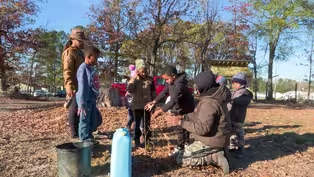
Food Deserts & Community Farming
Video has Closed Captions
Clip: S1 Ep17 | 4m 3s | A former principal turns a 5-acre farm into a classroom to address chronic health issues (4m 3s)
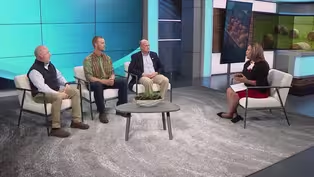
In Focus | Chris Mullins, Brandon Moyer & Joseph Guthrie
Video has Closed Captions
Clip: S1 Ep17 | 16m 40s | What are the difficulties and the opportunities before Virginia farmers today? (16m 40s)
Virginia Agriculture | People of Virginia
Video has Closed Captions
Clip: S1 Ep17 | 46s | We asked Virginians how well they understand the challenges of farming. (46s)
Virginia farmers innovate to meet modern challenges
Video has Closed Captions
Clip: S1 Ep17 | 4m 48s | Legacy farms have had to shift focus and find new ways to be profitable (4m 48s)
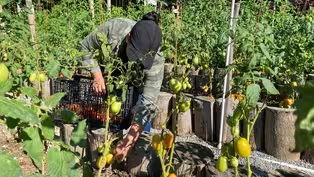
Virginia’s migrant farmworkers lack basic labor protections
Video has Closed Captions
Clip: S1 Ep17 | 8m 32s | Migrant farmworkers play a critical role in Virginia’s agriculture industry. (8m 32s)
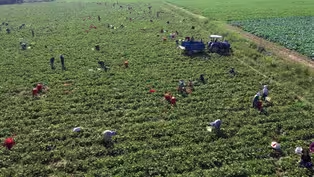
Virginia's new helpline supports wellbeing of farmers
Video has Closed Captions
Clip: S1 Ep17 | 47s | Mental health check? Virginia farmers can now call AgriStress during times of need (47s)
Providing Support for PBS.org
Learn Moreabout PBS online sponsorship
- News and Public Affairs

Top journalists deliver compelling original analysis of the hour's headlines.

- News and Public Affairs

FRONTLINE is investigative journalism that questions, explains and changes our world.












Support for PBS provided by:
VPM News Focal Point is a local public television program presented by VPM