
Virtual Town Hall: Improving Mental Healthcare Access
8/12/2022 | 26m 46sVideo has Closed Captions
ncIMPACT's Anita Brown Graham hosts a virtual town hall on workforce shortages.
The rate of NC adults reporting symptoms of anxiety or depression increased from 10% to 30% during the pandemic. ncIMPACT hosts a virtual town hall to discuss why NC has a shortage of mental healthcare providers and innovative strategies to connect more residents with the care they need.
Problems playing video? | Closed Captioning Feedback
Problems playing video? | Closed Captioning Feedback
ncIMPACT is a local public television program presented by PBS NC
Virtual Town Hall: Improving Mental Healthcare Access
8/12/2022 | 26m 46sVideo has Closed Captions
The rate of NC adults reporting symptoms of anxiety or depression increased from 10% to 30% during the pandemic. ncIMPACT hosts a virtual town hall to discuss why NC has a shortage of mental healthcare providers and innovative strategies to connect more residents with the care they need.
Problems playing video? | Closed Captioning Feedback
How to Watch ncIMPACT
ncIMPACT is available to stream on pbs.org and the free PBS App, available on iPhone, Apple TV, Android TV, Android smartphones, Amazon Fire TV, Amazon Fire Tablet, Roku, Samsung Smart TV, and Vizio.
Providing Support for PBS.org
Learn Moreabout PBS online sponsorship- [Narrator 1] ncIMPACT is a PBS North Carolina production in association with the University of North Carolina School of Government.
Funding for ncIMPACT is made possible by.
- [Narrator 2] Changing the course of people's lives.
That's the Impact UNC Health and the UNC School of Medicine work to deliver every day.
Our 40,000 team members across the State of North Carolina are committed to caring for you, our patients and communities, as well as educating the next generation of healthcare professionals.
Individually, we can do a little, but collectively we can do a lot to create impact.
- Welcome to the ncIMPACT virtual Town Hall on improving mental healthcare access in North Carolina, I'm Anita Brown-Graham.
The pandemic has thrust the topic of mental health into the spotlight.
It's revealed challenges and offered up some innovative solutions.
Joining us to bring expert eyes to the issue, Deepa Avula, Deepa as the director of the Division of Mental Health at the North Carolina Department of Health and Human Services.
Denise Williams, she's the psychiatry nurse manager of operations at Duke Health.
Anna Yaros, Anna is the research clinical psychologist with RTI International.
Deepa and Denise, welcome to ncIMPACT, Anna, welcome back.
Before we get to questions though, let's take a look at the issue.
In 2019 about one in 10 adults reported symptoms of anxiety or depression.
In 2021, just two years later, that number jumped to more than three in 10 adults.
ncIMPACT's, David Hurst, takes a look at the growing mental health crisis.
And the disparities in who is suffering.
- Shall we put off on being-- - [David] Peg Morrison still remembers the heaviness of dealing with anxiety and depression while she was in grad school.
- It's rough, it's dark.
There's no way to describe the rabbit hole that I fell down and the hopelessness, the sort of just expanding anxiety.
- [David] It's what led Morrison to her job with NAMI North Carolina.
She now uses her lived experiences to give insight to the people she serves.
- Mental illness is inherently isolating, you don't wanna be around people, you feel misunderstood.
Throw in a pandemic and you're not supposed to leave your home.
It adds a whole new level of anxiety, especially folks with health centered anxious thoughts, it made everything deeper and more difficult.
- [David] Experts say the pandemic revealed systematic challenges around access to care, especially for children.
Prior to the pandemic, there was a shortage of mental health clinicians for adolescents, inpatient beds and access to services.
- The increased population, the worsening prevalence and the lack of investment in services has led to the perfect storm where we find ourselves now throw a pandemic into the mix.
And so everything that was already bad got worse.
- [David] It's one of the reasons why North Carolina is creating additional resources to support the new mental health crisis hotline rule out in July.
The ease of remembering 988 compared to the current 11 digit hotline is expected to increase call volume by up to 30%.
Callers will be put in touch with a trained crisis counselor who will help deescalate this situation.
- And I think because so many people are hurting now, it's helping to overcome stigma.
It's helping to make this something that's all of our problem.
And I think that is generating a broad based support.
So I'm encouraged to see in many states across the country, a huge investment in mental health that we haven't seen in decades.
- [David] Morrison is also encouraged by the conversations that are now taking place about the importance of mental health.
- I can think of an example at a NAMI class.
I told my story and one of the women, she knew me as a NAMI person, a professional.
And she said, "You really get it?"
And I said, yeah, I get it.
I lived it, but it lifts them up.
It gives them hope and that's very humbling and redeeming for me too.
- Deepa, let's start with you, help us understand what is driving this increase in mental health and wellbeing concerns for our North Carolina residents.
- Sure and thank you so much for having us all here today to talk about this very important issue.
I think all of us have experienced major changes over the last two years and the way that we live and when those types of changes occur, there are significant effects that you can have related to your mental health.
So when you have increases in grief, loss, stress, trauma, unemployment, financial stability issues, and even just an impact on your daily routine for many individuals that will cause issues related to negative mental health consequences.
- So let me stay with you for a moment.
We heard the statistics about the rising number overall of adults experiencing mental illness, but I can't get my head around one in three young adults, 18 to 24 are experiencing mental illness or have during the pandemic compared to all adults what's causing this?
- Well, if you think about it, 18 to 24 year olds, it's a period of time we refer to as transitional age youth, 'cause they're already in a quite stressful time for many people.
While it's an exciting time in life, it's a time of change.
It's a time of transition.
It's also quite stressful to go from being a youth to be becoming an adult, to coming into your own, gaining independence, gaining access to different types of life that you haven't lived before.
And to have that on top of a pandemic with all of the stressors that came with social isolation, staying home, being away from your peers in many cases, or going to school differently than you normally would have, that has caused a lot of stress for our transitional age youth.
- Hmm, thank you for that.
So Anna, we've got the numbers going up and wait times for therapy sessions can be weeks, sometimes even months.
How did the mental healthcare system get so overloaded so fast?
- It's a great question.
And thank you also for having me again, Dr. Brown-Graham, as Deepa as said, I think that there are a number of immediate consequences of the pandemic that caused this.
But unfortunately I think we're also on the heels as was mentioned in the video of longstanding deficits, in the number of mental health professionals that we need, be that psychiatrist, psychologists, social workers, folks who are just there in the community to support people who are in need.
And so with the increased need and the same, or sometimes even less because certainly some health professionals were pulled in other directions.
Public health professionals were pulled in pandemic directions.
There was just as was mentioned, almost a perfect storm of not having the resources there to meet all of the need that was increasing.
- So Denise, this is a statewide show, but we always wanna recognize that all things don't affect all places in the same way.
So let's talk a little bit about some of the geographical disparities.
What unique challenges do people who struggle with mental health face in rural counties in North Carolina?
- Again, thank you for having me here.
I'm happy to be here.
Rural and North Carolina that hits close to home.
The biggest barrier, well, I'm not gonna say the largest, but is access to care, access to care.
How do I get there?
Where do I get it from?
How do I afford to get there?
Coming from and I'll use me as an example, small town in North Carolina and the closest mental health facility there is 30 miles.
- Which small town in North Carolina?
Go ahead and tell us, tell us, we wanna know.
- I grew up half my life in town called Pantego.
- I know exactly where it is.
- Pantego is our banks off the Pamlico Sound and their access to any type of healthcare is limited.
But when you talk about mental health, the nearest place is Washington, North Carolina, and that's a 30 minute drive.
So if I don't drive and a lot of people in rural North Carolina can be without licensure, they don't need it.
Somebody is down the street or somebody's gonna pick me up.
They know everybody, they don't need it, but I need somebody to pick me up and I need somebody to take me there.
And then I have to pay them for the gas.
I have to have them sit there with me all day.
That's a big challenge sometimes.
And it deters us from meeting appointments or being able to even schedule them, because I just simply don't know how I'm gonna get there.
- Deepa, how's the state thinking about telehealth and that opportunity to serve the underserved in North Carolina?
- Sure, yeah one of the things the state did right away at the start of the pandemic was really put in place flexibility to take advantage of some of the telehealth flexibilities that were offered by the federal government.
So North Carolina has really done a good job of making sure that telehealth is accessible to individuals across the state.
I think absolutely the infrastructure issue is an issue and it is something that we are looking at to make sure that we are reaching rural communities as well.
I also think that while telehealth has been supremely important and I personally believe really saved our mental health care delivery system, it is not a replacement for a face-to-face delivery system of care.
So we really ha are looking at making sure that face-to-face access to care is still accessible, is still available at while we are also doing telehealth as well.
- Terrific, well, let's take some questions from the audience.
Ann from Raleigh, ask why do so many mental healthcare providers refuse to file insurance claims for their patients compared with other healthcare providers?
Insurance is difficult to navigate at the best of times.
Amen, Ann and more so when there is a mental health issue involved.
Who wants to take that?
- I'll start, but I don't have the answers, all the answers.
It's a tough, because it's a very tough question.
I think exactly as you've described, and there are some instances where mental health providers do not take insurance and it's puts the onus on the patient in some cases.
And I think we're working against that.
So I think mental health parity laws, which have been enacted for quite some time now that require the insurance companies to provide coverage for mental healthcare have hopefully supported increased access.
But I do think that we also need services.
We need people to help folks navigate their insurance and their insurance claims.
And some insurance payers to be fair, are providing these types of services, but more can be done exactly for the reason that she described that folks who are experiencing a mental illness or a mental health crisis might not have the resources at that moment that they need to navigate the system.
- We're expecting people with cognitive impairment, executive functioning impairment to navigate a system that is hard to navigate at this.
That's what we're expecting.
- Anna, Denise, Deepa, thank you, thank you, thank you.
Thank you for all the work that you're doing and thank you for sharing your time and insights on this important and heart wrenching topic.
Audience, we're gonna take a quick break to allow for our second panel to join us.
Do not go away, will be back in a few minutes to talk about some solutions.
[upbeat music] Welcome back to the ncIMPACT virtual Town Hall on mental health.
I'm Anita Brown-Graham host of the show and director of the ncIMPACT Initiative at the UNC School of Government.
Many children face barriers in getting mental healthcare, but one North Carolina school district is seeing success in closing the mental health treatment gap ncIMPACT's, Evan Howell reports.
- [Evan] Just two years ago, the Hart County School District decided it needed to improve the way that delivered mental health services to their students in need.
[indistinct chattering] It was in response to a rising number of children who needed help, but had no access to these critical services outside the school walls.
- We saw it in the hallways where there were kids that would be having a panic attack, or there are kids who would hide in the bathroom and be scared to go to class, or there would be other outward signs that we would see where there would be kids really struggling with interactions with peers, go.
- [Evan] Barriers to care included either a student's lack of insurance or a parent being unable to take off work and bring their child to a counselor.
- Our teachers and our staff did what they could to support students.
However, they're not trained in addressing mental health concerns.
- [Evan] That year Cappola and a colleague visited next door, Lee County, which had built a system-wide team to handle mental health issues internally.
- We were lucky, fortunate, blessed to be able to have two social workers at the time that qualified to be able to provide these services.
And so the quickest thing to do was to convert their positions into mental health specialist positions, didn't cost me any more money to do it.
And so they stayed within the budget that they were already being paid from.
So that was super easy.
- So what are we gonna do?
- [Evan] The new system means that social workers and counselors can be on site and directly help students who may be in need and make referrals for others following a parent's consent.
- It is a little bit scary and mental health has a stigma and people don't really like to talk about it.
And so once we started opening that door and talking about mental health and educating people about mental health, we got more and more buy-in because teachers see the benefit of supporting our students.
- [Evan] Counselors say that changes like this aren't as difficult as some may think and say, being on site provides a suite of services critical not to just their students' mental health, but to their education as well.
- Figure out what needs to be done, talk to leadership, get them involved, 'cause it has made such a huge impact.
And we're firm believers that mental health is health and we encourage everybody to seek the help that they need.
And so I just encourage people to try and to jump all in.
- I am thrilled to welcome another wonderful group of experts, joining us to share insights and more solutions is Renee Shaw.
Renee is Durham County's mental health court coordinator.
Kate Dewberry, Kate is a partner with the law firm, Poyner Spruill and Cherene Caraco.
Cherene is the Founder and CEO of the Promise Resource Network.
We're gonna focus on some specific populations in this segment, but before we jump in, I wanna remind our guests that people on Facebook want to give you questions and comments.
And I wanna remind those of you on Facebook to please go ahead and get those in as early as you can by commenting in the chat box.
Yeah, okay, now that I've taken care of that housekeeping Cherene, let's start with you.
We saw one really innovative solution featured in that last story, share with us some other ways that community leaders can work to address the growing rates of mental illness in our state.
- Yeah, so I will use the illustration of one of the things that we're doing here in Charlotte.
So Promise Resource Network is completely peer led, which means that we are an organization that is staffed entirely by people that are in recovery from mental health and substance use issues.
And we utilize that lived experience to create an accessible space.
We do not accept insurance, we do not require insurance and everything that we do is free.
So in terms of the access barrier challenges, an organization like ours is a zero barrier access environment.
And what we offer is both putting resources and supports in the hands of people.
So we go out to people in their home, in their community, wherever they're comfortable, they can also come to us if they're comfortable.
We also have a virtual platform if that is accessible to folks and we have a 24 hour day, seven day a week phone support line, for anybody to call in our community that is experiencing emotional distress and wanting to work through it.
- Wow, this is very impressive.
So let me turn to you Kate for a moment.
Obviously we're seeing a lot of mental health related issues arise in schools.
We're also seeing them arise in the workplace.
So what are some innovations in the workplace that have come out of this moment with the pandemic and that are likely here to stay with good reason?
- Sure, thank you for having me today.
So I think that employers have as a result of the increase in remote work, the barriers between an employee's home life and their work life have broken down a little bit, which is possibly a good thing.
When we were all working from our homes and having calls and our dogs and our kids jumping in, it really kinda broke down those barriers, which I think has been helpful.
It also helped employers to realize that there is some flexibility in where employees perform the work and when they perform the work.
And so I think a lot of employers are now examining their policies around remote work and flexibility for employees.
And so doing that and giving employees options and really focusing on what works specifically for the team and making sure that employees can get their work done in the best way possible that also balances their needs outside of work.
I think a lot of employers are now making that shift as a result of the pandemic.
- But it feels like employers are doing more than making concessions about where and when work might be, maybe this is just me, but I think it feels safer to say to your employer these days, I'm just feeling burned out or I'm just really stressed or whatever the case may be.
And can you talk a little bit from your perspective about how employers respond to that kind of new openness?
- Yeah, I think that employees are feeling more empowered to come forward and ask the questions.
And whereas before, employers are really limited in helping employees, if they don't know what the issues are, right.
And so there is some destigmatization around coming forward and speaking up about what you need and knowing what the options are.
I think also employers now are really seeing the value in investing in a good EAP program.
That's their Employee Assistance Program and really promoting that.
So I think the conversations in the workplace around, that employers have accommodation policies, that employees are protected if they seek accommodations, that they can come forward and that there are more options than just working and not working.
If somebody is experiencing a mental health issue, that there are shades of gray there, and there are options available to them.
I think that has really changed the dialogue.
- Thank you for that, so, Renee, one of the other places that these mental health related issues show up is in the judicial system.
Could you talk a little bit about what is a mental health court and what role does that play in helping individuals get the treatment they need?
- Okay, thank you for inviting me and the mental health court in Durham County is designed to address the issues for individuals experiencing symptoms of severe mental illness or severe persistent mental illness.
And what we do is offer them treatment and have their case dismissed instead of going through the traditional court system.
And as the mental health court team, what we do is we connect those individuals to treatment, to services.
If you have insurance or whether you don't have insurance, we connect you to the treatment and the Durham County Criminal Justice Resource Center.
We provide some services for individuals where we don't charge, but for those individuals where the symptoms may be too severe, they need extra support that we can't provide.
We connect them with community mental health providers.
- All right, next question.
How can communities provide more urgent care mental health facilities and addiction services?
And Cherene, I'll start with you.
- It comes down to funding, right?
So part of it is the funding, these are not inexpensive environments to be able to operate.
I will tell you that, number one, I don't believe that we have a shortage of money coming in.
As a matter of fact, looking at some of the dollars, we don't have a shortage of money, but we do need to reallocate the money that we are spending, right?
So if we look at, for example, the amount of money we are spending for one day of hospitalization, on average in North Carolina, it's about $2,100 a day.
We could save a significant amount of money if we reinvested that in prevention and diversion away from the most costly and least effective way of serving people.
And yet in our states, we are up around 91% of involuntary hospitalization.
So we are spending our money in ways that ultimately are not resulting in greater benefits are more costly.
And we would have to...
I mean, there would have to be an overhaul of the way that our system is designed, it's funded and prioritized.
And some of the biases that exist within mental health service delivery systems.
- Renee, I know she's singing your song, but I'm gonna keep going on these questions because we've got quite a few more and I wanna see how many we can get through.
Christen asked, "Should we implement mental health first aid in schools by hiring community partners so that we don't burn out our social workers, counselors, teachers, and other staff?"
Great question, given the story we saw.
Renee, do you wanna take a stab at that?
- Yes, I would definitely like to take a stab at that one.
We should do mental health first aid everywhere, in churches, anywhere where they would allow us to come in, we should do mental health first aid.
The pandemic has made mental health, like it put it in the forefront even more.
And so if we train or teach everyone mental health first aid, there'll be more people who can recognize symptoms.
There'll be more people who know, okay, my family member is in trouble, what do I do?
Who do I contact?
Where do I go?
Mental health first aid is very important to our community and we should get the information out there even more.
- Renee, Kate, Cherene, thank you so much for this, for sharing your insights, for responding to our audience questions and for everything you're doing on this important topic.
And of course thank you to the leaders who are featured in this episode stories for so generously allowing us to share their inspirational work together.
And finally, we would never end without thanking our amazing audience for watching and engaging.
You know there are solutions out there if we work together, I'm Anita Brown-Graham, this is ncIMPACT.
[upbeat music] ♪ - [Narrator 1] ncIMPACT is a PBS North Carolina production and association with the University of North Carolina School of Government.
Funding for ncIMPACT is made possible by.
- [Narrator 2] Changing the course of people's lives.
That's the impact UNC Health and the UNC School of Medicine work to deliver every day.
Our 40,000 team members across the State of North Carolina are committed to caring for you, our patients and communities, as well as educating the next generation of healthcare professionals.
Individually, we can do a little, but collectively we can do a lot to create impact.
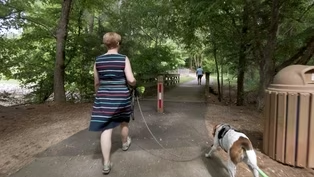
How COVID-19 affected our well-being and mental health
Video has Closed Captions
Clip: 8/12/2022 | 2m 38s | ncIMPACT takes a look at the growing mental health crisis. (2m 38s)

NC school district brings mental health services to students
Video has Closed Captions
Clip: 8/12/2022 | 2m 16s | ncIMPACT examines how an NC school district is closing the mental health treatment gap. (2m 16s)
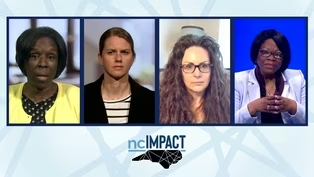
Panel examines solutions to improve mental healthcare access
Video has Closed Captions
Clip: 8/12/2022 | 27m 49s | Panelists join Anita Brown-Graham to discuss the mental healthcare solutions. (27m 49s)
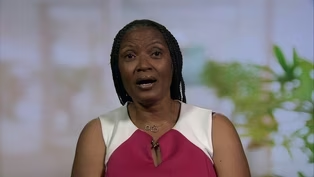
Panelists weigh in on the growing mental health crisis
Video has Closed Captions
Clip: 8/12/2022 | 22m 30s | Panelists join Anita Brown-Graham to discuss the mental health crisis. (22m 30s)

Town Hall Preview: Improving Mental Healthcare Access
Video has Closed Captions
Preview: 8/6/2022 | 20s | ncIMPACT hosts a virtual town hall on improving mental healthcare access. (20s)
Providing Support for PBS.org
Learn Moreabout PBS online sponsorship
- News and Public Affairs

Top journalists deliver compelling original analysis of the hour's headlines.

- News and Public Affairs

FRONTLINE is investigative journalism that questions, explains and changes our world.












Support for PBS provided by:
ncIMPACT is a local public television program presented by PBS NC