
Voter attitudes, Detroit update, Dr. Vitti, Mario Moore
Season 7 Episode 13 | 26m 46sVideo has Closed Captions
Voter attitudes, news from Detroit, DPSCD Dr. Nikolai Vitti, and Mario Moore’s exhibit.
One Detroit hears from voters across metro Detroit about where they land on key issues this midterm election season. Will Glover gets an update on the latest BridgeDetroit news. Plus, Detroit Public Schools Supt. Dr. Nikolai Vitti talks with Stephen Henderson about the district’s COVID recovery and future. And Mario Moore unveils an exhibit inspired by Detroit’s Underground Railroad history.
Problems playing video? | Closed Captioning Feedback
Problems playing video? | Closed Captioning Feedback
One Detroit is a local public television program presented by Detroit PBS
Voter attitudes, Detroit update, Dr. Vitti, Mario Moore
Season 7 Episode 13 | 26m 46sVideo has Closed Captions
One Detroit hears from voters across metro Detroit about where they land on key issues this midterm election season. Will Glover gets an update on the latest BridgeDetroit news. Plus, Detroit Public Schools Supt. Dr. Nikolai Vitti talks with Stephen Henderson about the district’s COVID recovery and future. And Mario Moore unveils an exhibit inspired by Detroit’s Underground Railroad history.
Problems playing video? | Closed Captioning Feedback
How to Watch One Detroit
One Detroit is available to stream on pbs.org and the free PBS App, available on iPhone, Apple TV, Android TV, Android smartphones, Amazon Fire TV, Amazon Fire Tablet, Roku, Samsung Smart TV, and Vizio.
Providing Support for PBS.org
Learn Moreabout PBS online sponsorship- [Announcer] Just ahead on One Detroit, we've partnered with the Detroit Free Press for a special report on what voters feel are the key issues in races in the November 8th election, plus Bridge Detroit's Bryce Huffman brings us up to date on three major stories coming out of Detroit.
Also ahead, Detroit Public School superintendent, Dr. Nikolai Vitti talks about the district's plans for 700 million in federal funding and Detroit artist Mario Moore's latest exhibit pays tribute to the abolitionist and freedom seekers on Detroit's underground railroad.
It's all coming up next on One Detroit.
- [Announcer] From Delta Faucets to Behr Paint, MASCO Corporation is proud to deliver products that enhance the way consumers all over the world experience and enjoy their living spaces.
MASCO, serving Michigan communities since 1929.
Support for this program is provided by, the Cynthia & Edsel Ford Fund for journalism at Detroit Public TV.
The Kresge Foundation.
- [Announcer] The DTE Foundation, is a proud sponsor of Detroit Public TV.
Among the state's largest foundations committed to Michigan focused giving.
We support organizations that are doing exceptional work in our state.
Visit DTEFoundation.com to learn more.
- [Announcer] Nissan Foundation and Viewers Like You.
(upbeat music) - [Announcer] Just ahead on this week's One Detroit.
We'll take a closer look at some recent headlines coming out of Detroit.
Bridge Detroit's Bryce Huffman provides updates on a lawsuit filed against the city by protestors.
The city's plans for $57 million in HUD grants and the start of work on Detroit's first 3D printed house, plus Detroit Public School Superintendent Dr. Nikolai Vitti sits down for a wide ranging conversation with One Detroit contributors, Stephen Henderson.
Also coming up Detroit artist Mario Moore's new exhibit at the David Klein Gallery, depicts the history of Detroit's Underground Railroad.
But first up, we're checking in on what voters are thinking about as we approach the November 8th midterm election.
Detroit Public Television has teamed up with the Detroit Free Press for an in-depth look at the voting process.
Lansing Bureau Chief Paul Egan working with One Detroit's Bill Kubota reports on what voters feel are the major issues in this election cycle.
(upbeat music) - Do you normally vote Republican or?
- I normally vote for whatever candidate I think is best to be voted for at the time.
- Okay.
Like Donald Trump for example, did you vote for him?
- Yes, I did vote for Donald Trump, but I voted him mostly because of his economic policies.
There was a lot of things that I object about both candidates.
You almost had to vote for the lesser of two evils.
- Sure.
And how do you feel about, you know, the economy today?
I guess since, since President Biden took office.
- I'm not exactly happy with the way the economy's going right now, which is pretty much mainstream for the rest of us.
- What are your thoughts as you look forward to the election in November?
- Well, I've got some fairly deep concerns and most of my concerns are centered, you know, in my opinion, the epicenter of all this stuff has to be the economy, being a retiree and you know, 401k assets, benefits, those kinds of things.
You know, we work on limited amount of cash and to see it plummet, you know, and we're down with 25% this year and I think it probably all started with the pullout of Afghanistan and what's coming back to bite the United States today about $500 billion of assets were left there and now being used against.
And those could have been transported or shipped potentially to Ukraine, which we support, you know, my wife and I and family love to, hopefully that all works out well for those kinds of people.
- What do you like and maybe not like about, about Governor Whitmer?
- Governor Whitmer I think probably did the best that she thought she could do during the pandemic and during her stretch as governor.
I know she pretty much got elected for a large part on the basis of fixing the roads.
It seems to be that we're getting all of our roads fixed all at the same time because it's an election year.
So it makes it very difficult to maneuver as a commuter driving back and forth to wherever you're at.
- And how did you feel about the way she handled the pandemic?
- I think she did the best she could do with the pandemic.
I do not agree with her putting COVID patients in with nursing home patients.
She put COVID patients in with the most vulnerable population that we have in Michigan.
- What do you think of Governor Whitmer's performance over the last four years?
- She has blundered things the way COVID was handled.
It's now, you know, and after the fact that there's no need to shut down schools as much as it was, right in within five miles of here, there's probably a dozen restaurants that no longer exist.
Small businesses no longer exist, and it was as firm fisted we'll get back to you and let you know when things are okay to go.
Well, if I'm not mistaken, casinos and other kinds of operations were allowed to stay open, were considered vital to the economy, which did make a whole lot of sense when it was crickets in most other businesses.
- And the Republican candidate Tudor Dixon, what are your impressions of her so far?
- It, she needs to get her name out there more.
I think she made a couple of errors in judgment.
Her opinion of abortion rights is such that whether, and I think the way she should frame her thoughts, on abortion is, I personally don't agree with it, but I'm gonna let the people vote for what the people want in that situation.
- And so, Julie, looking at the governor's race, how do you feel about Tudor Dixon the Republican candidate?
- Well, I don't really know a lot about her, but I don't agree that she should be as conservative and not have some leeway for female issues.
- It sounds like you might be talking about abortion.
How is that all affecting your political decisions?
- Well, I know that she has four young girls and Governor Whitmer has too.
So I believe that there should be some concessions made in certain instances.
- Let Gretchen back in and finish what she's doing.
This, that, that other woman, I don't think she would be right for Michigan.
I really don't.
Just listen to some of the things that she has said.
She wanted Michigan to be more like Florida.
When she gets in, she's gonna turn Michigan into another Florida.
What the heck does that mean?
Why do we wanna be Florida?
This is Michigan.
I think Michigan is doing okay by themselves.
We don't need to be another Florida.
- And so having issues with both Governor Whitmer and Tudor Dixon, have you been able to make a decision yet how you're gonna vote in the governor's race?
- No.
- [Announcer] And make sure to watch One Detroit on November 3rd at 7:00 p.m. We'll have a special hour long show with our partners at the Detroit Free Press, focusing on the upcoming election.
Now let's check in on some of the latest news coming out of Detroit.
I caught up with Bridge Detroit reporter, Bryce Huffman, to talk about the settlement of a lawsuit filed by Detroit Will Breathe Protestors, How the city plans on spending $57 million earmarked for flood recovery efforts and the start of work in the city's first 3D printed house.
(upbeat music) - Today Bryce, you're joining me to kind of give us a little bit of an update on what you've been working on over at Bridge Detroit.
And one of the things that I thought we could start with was where we are with the BLM, the Black Lives Matter and the Detroit Police Department, there's a lawsuit going on, so if you could just real quick bring us up to speed on what happened, how we got to this point and where we're at now.
- Yeah, so first, thanks for having me on Will.
It's always pleasure.
Back in 2020 after George Floyd was killed by Minneapolis Police Officer, Detroit was one of the cities, like many across the country and across the globe actually, that protested the way police treat people, particularly Black people.
So in Detroit there were a series of protests and different groups that came together to talk about the way the Detroit Police Department treats people.
And one of those groups that was the most prominent of the groups really was Detroit Will Breathe, started by two Detroiters.
They protested for over a hundred straight days in 2020.
And during those protest, police officers, Detroit police officers, I should specify, were pretty terrible to them according to, you know, videos and court documents.
They were pepper sprayed, they were hit with rubber bullets, they were beaten, all sorts of terrible things.
And a lot of this was happening, you know, with people's phones and cameras getting footage of the action.
There's actually a photo of Nikki Wallace, who's one of the founders of Detroit Will Breathe being placed in what is now in a legal chokehold.
So the, you know, the groups sued the city and the police department and back in, I wanna say it was June, the city actually made an offer to say, hey, Will had met wrong doing if we can kind of just resolve these cases now and not have officers take the stand and testify.
So they officially gave that offer to the protest groups in July.
The offer was over a million dollars to Detroit Will Breathe and other plaintiffs, basically who were all involved in these protests and who faced police brutality at the hands of Detroit Police.
And the protestors recently just accepted that offer.
- Next up is the 57.6 million dollars that the city of Detroit has to address the flooding issues in the city.
So with this, where's the money coming from?
What's it gonna be used for?
Just gives a little background on that.
- We had a, what people were calling in a thousand year flood basically, we got hit with so much rainwater in such a quick time that many areas of the city experience just massive flooding.
There's a famous photo of cars on the freeway and a kid kind of playing next to it, and it looks like cars are floating in a river, but lots of different parts of the city experience flooding, Lots of Detroiters faced thousands and thousands of dollars of damage to their homes and their property.
So obviously people want a resolution to that.
So the city got 57.6 million dollars from the US Department of Housing and Urban Development back, I believe in March or April.
And the whole idea was get Detroit this money to help them not only fix the issues that this flood caused, but also to figure out ways to prevent it from happening again.
- Finally, something I guess a little more positive, you know, they're doing work on the sewer systems, that's good.
But one of the stories that you just recently wrote about was the fact that Detroit is going to be getting Michigan's first 3D printed home.
So this to me is very exciting.
Where's the home going?
Who's behind the project?
- The home is actually gonna be going in the Island View neighborhood, Southeast side of the city again, not all too far from Jeffersons Charmers.
And right now they are printing the walls inside of they being Citizen Robotics.
- Why Detroit?
And what is the impact what, you know, we're, it's one 3D printed home, which is great, but what does that mean?
Is there investment dollars coming behind it?
Is it just a proof of concept?
Is it the beginning of a larger neighborhood?
Just give us more insight into that.
- Yeah, so Tom Woodman, the executive director at Citizen Robotics, actually said that one of the reasons Detroit was one of the first cities he really wanted to build one of these homes in was because there is such a need for affordable housing in the city, but also there's a lot of vacant land.
I think there is something like 19 square miles of vacant land in the city.
So obviously when you combine that stat with the fact that our city is doing more and more housing demolitions by the day, there's the need for homes and a need for homes that can be built and sustained over a long period of time that are affordable and energy efficient.
So that's kind of what this pilot idea, pilot house really is about.
It's about figuring out, all right, this is a new way to build homes.
Is it sustainable?
Is it really gonna be cheaper in the long run than conventional construction?
Is it gonna be more energy efficient in the long term?
What sorts of home repair projects would have to go into these style of homes as opposed to the more traditional housing stock in the city?
So those are all things that are being figured out right now.
- [Announcer] Turning now to our exclusive interview with Detroit Public Schools Community District Superintendent, Dr. Nikolai Vitti.
One Detroit contributor Steven Henderson sat down with Dr. Vitti at the school at Marygrove for a live town hall on the current state of the district.
They talked about the impact of the COVID pandemic on student achievement and unprecedented $700 million in federal funding.
And what lies ahead for students and staff.
(upbeat music) - So I wanna start here.
You are back full time in person, every school, every child.
It's been a long time since we were there and a lot has changed.
We lost a lot of ground during that time.
Talk about the opening of school this year, the challenges ahead and how you're facing them.
- Yeah.
Well, you know, last year all of our children were back in personnel schools were open, with the exception about 3000, who were 2000 that were in the virtual school.
But a lot of stopping goals last year.
You know, surges, infection rates high close contacting, quarantine.
So although we were back last year, it just didn't feel normal.
- Yeah.
- We were managing COVID, I would say 80% of my job and probably teachers, principals just heavy on COVID this year when we opened, you know, we've been open now for about over 20 days.
It just feels a lot better.
Feels more normal.
We're still dealing with the challenges or lingering challenges of the pandemic, but it feels better.
It feels more normal.
And I think that there's an energy, a positive energy of just now seeing some momentum in a clear pathway forward to just get back to the student achievement work.
- Yeah, we lost ground here in Detroit where that doesn't make us unique because most school districts had a hard time with it.
But things visit on our kids, our families, our community, really differently than than other places.
Talk about some of the things that happened, that really you have to focus on and maybe have your concerns still.
- Yeah.
- As we go forward.
- Well, when you look at just running the district and what are the challenges that we're facing.
So one enrollment, so we lost about 3000 students.
When you look at where we were when the pandemic hit March, 2020, we are at the highest level of our enrollment.
First time we saw an increase in two decades at about 51,000.
We're, we just turned the corner on count.
It looks like we are now down maybe 2000 to 1500 compared to our peak before the pandemic, so enrollment.
Other issue is just disrupting the normal flow of attendance just last year over with online learning, no devices, parents feeling comfortable, young children not going to school, not being comfortable online, a lot of disruption and coming to school on a day to day basis.
So last year, even though we were in person, 80% of our students missed 18 or more days.
- Wow.
- And so just the sort of the regularity of coming to school every day was highly disrupted.
The surges online learning, but also just close contact and quarantine, students that weren't vaccinated had to quarantine for 14 days, even if they weren't sick.
- Right.
- And then that got dropped to 10 and then all that negatively impacts student achievement.
- I wanna talk about the $700 million that is coming in through ARPA to help with infrastructure in the schools principally.
I've covered schools for a long time in the city.
I don't know that we've had many bond issues that have brought us more money at one time to do that.
So, talk about what you wanna do and why it will matter to kids every day.
- Well, I think that the biggest impact for children and staff will be air conditioning.
- Yeah.
- You know, right now only about 20% of our schools have air conditioning and people will say, oh, well I went to school, we didn't have air conditioning.
Well, it's, you know, 2022.
- Yeah.
- And air conditioning is sort of part of our life.
- Right, right.
- And when you get into June and even, you know, certain months and in August or days in August, in September, it can be hot.
We have to close schools or go half days and it gets uncomfortable when it gets warm.
So that's a significant, But going back to neighborhood schools, investing in a brand new Pershing building, brand new Cody building, a new building in Southwest Detroit with a probably an arts focus to feed into Detroit School of the Arts.
So on a day to day basis, just buildings that are not going to disrupt learning around just better HVAC systems, better roofs and sort of mending day-to-day things that can be highly disruptive to learning, but beyond that, innovative in some new school buildings, especially to preserve some neighborhood schools.
- Yeah.
I want to talk just a little about the future, right?
Things are getting back to normal.
What are your expectations or what would you tell a parent their expectations should be for how quickly we recover from everything that's happened over the last three years?
- Well, I think that the long lasting, there'll be long lasting negative impacts of the pandemic.
- Yeah.
- I mean, I think I'm dealing with it, you know, it was not easy.
- Yeah.
- Managing the district during the pandemic.
- Oh sure.
- So, and that affected our teachers, our principals, our parents who lost loved ones, our children.
So there is no magic wand to say, we have to live with that history.
But I am confident and I would tell any parent this is that by the end of this academic year, if you send your child to school consistently, we're going to not only show a years of growth, but probably two years of growth and be even closer to being at and above grade level performers.
- Yeah.
- I know it's not a matter of I wish I hope, in 1819 we did it.
We moved the needle academically.
- Right.
- And I know we can, it's not about doing things radically different, it's just going back to the work that we were doing.
And I think adding and filling some gaps that we had around mental health and some broader holistic approaches to supporting families, which I think we're doing a lot better as a district.
So, the average parent needs to know that at the end of this year, we're going to see improvement in student achievement.
We just need parents to do their part by sending their children to school on a day to day basis.
- [Announcer] And you can see Steven's entire interview with Dr. Vitti on the One Detroit Facebook page.
And finally, One Detroit Arts and Culture host Satori Shakoor visited the David Klein Gallery in Detroit to talk with local artists, Mario Moore, about his new exhibition titled Midnight in Canaan.
He explained how the stories about Detroit's historic Underground Railroad inspired him to create this series of hyper realistic paintings.
(upbeat music) - I have the absolute pleasure to be joined by Mario Moore.
Mario, thank you for joining us here.
- Well, I'm glad to be here.
- So what inspired this exhibition Midnight in Canaan?
- So it was actually stumbling upon a book at my museum exhibition, and I found this book called The Fluid Frontier, and it was about the Detroit and Canadian borderland.
What really caught my attention was the story about the Black Burns.
And the Black Burns were a young couple that escaped from Kentucky, made their way to Detroit and the Black abolitionist and the small but powerful black community that was here helped to freedom to get to Canada.
So it really ignited in me an idea that helped me figure out where does Detroit's black militancy come from?
And that story is kind of the origin of it.
And it starts this whole kind of thunder roll of events that kind of changed the dynamic between the Canadian and Detroit borderlands and also change the dynamic for Black people that are looking for freedom during the Underground Railroad.
So what happens from that moment forward is that the black community in Detroit and also in Canada kind of coalesced and create kind of the structure for the Underground Railroad Movement.
- So who are you depicting in these wondrous works?
- In a lot of the works, you know, I'm really interested in the past and the present and trying to bridge and create a through line between, you know, what was and what is now.
Because I think oftentimes when, we think about the position we're in as a country, we ignore the past.
So there's no physical photograph or paintings of the Black Burns, so there's no known image of them.
So I use friends of mine to pose as the Black Burns, but also to correlate, you know, some of the other paintings that aren't necessarily historical figures, like the self-portrait of myself or friends of mine like Tiff Massey or the great abstract artists, Ali McGee, that's really connecting us to now.
And it's kind of like a statement on these Black Detroiters that are here now, you know, contributing to Detroit culture.
How do we make sure we're staking a claim for our place here, right as the city is constantly changing.
- What do you want people to know as they're looking at this exhibition?
- I would hope that as people come in and they see the work, they can think about the contribution that Black people made here in the early 19th century.
And they can also continue to think about the cultural significance that Black people contribute to Detroit now.
Right because the show really is about black agency.
I think a lot of times when we are looking at a lot of these movies that deal with slavery and abolition, it's a lot of White saviors in the films and reading and doing research, it's so minimal the amount of White people that helped, right?
'Cause you hear about, oh, they, they put them under a wagon and then they, there was a safe house here.
It was mainly Black people helping Black people.
And I really wanted to really highlight that for the show and just kind of shine a light on some of these figures that don't get a lot of prominence.
Right?
There's a drawing in the show of Sojourner Truth.
Everybody knows Sojourner Truth, but a lot of people don't know George de Baptiste.
A lot of people don't know William Lambert.
I didn't.
And I think they're so important to our story as Detroiters, all Detroiters, and Canada and Windsor.
So I think it's so important to understand who these people were and what they did and what role they played.
Man I'm just hoping people come and be like, man, that's a dope painting.
- So you're gonna have an artist talk and that's gonna be awesome for people to come here and actually meet you and hear you tell these stories.
When is that?
- So the Artist Talk is October 29th and it's at 4:30 p.m.
So I'm really excited for people to come and ask me any questions they want, you know, about the history, about the work, and just to, you know, see the work again, see the show again.
- All right well mark your calendar.
Saturday, October 29th, 4:30 right here, the David Klein Gallery.
Thank you Mario.
- Thank you.
- [Announcer] And you can check out Mario Moore's exhibit at the David Klein Gallery through November 5th.
That will do it for this week's One Detroit.
Thanks for watching.
Make sure to come back for one Detroit Arts and Culture on Mondays at 7:30 p.m. Head to the One Detroit website for all the stories we're working on.
Follow us on social media and sign up for our weekly newsletter.
- [Announcer] From Delta Faucets to BEHR Paint.
MASCO Corporation is proud to deliver products that enhance the way consumers all over the world experience and enjoy their living spaces.
MASCO serving Michigan communities since 1929.
Support for this program is provided by the Cynthia $ Edsel Ford Fund for Journalism and Detroit Public TV.
The Kresge Foundation.
- [Announcer] The DTE Foundation, is a proud sponsor of Detroit Public TV.
Among the state's largest foundations committed to Michigan focused giving.
We support organizations that are doing exceptional work in our state.
Visit DTEFoundation.com to learn more.
- Nissan Foundation and Viewers Like You.
(upbeat music)

Detroit in October: The latest news with Bryce Huffman
Video has Closed Captions
Clip: S7 Ep13 | 6m 7s | Catch up on the latest news from Detroit with BridgeDetroit reporter Bryce Huffman. (6m 7s)
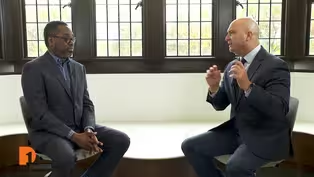
Dr. Nikolai Vitti discusses DPSCD’s COVID recovery, future
Video has Closed Captions
Clip: S7 Ep13 | 6m 24s | COVID recovery, absenteeism, and investing in infrastructure: A look at DPSCD’s future. (6m 24s)
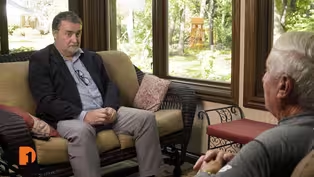
Voters react to key issues, races in 2022 midterm election
Video has Closed Captions
Clip: S7 Ep13 | 4m 48s | Michigan voters share how they feel about absentee voting, abortion and the next governor. (4m 48s)
Providing Support for PBS.org
Learn Moreabout PBS online sponsorship
- News and Public Affairs

Top journalists deliver compelling original analysis of the hour's headlines.

- News and Public Affairs

FRONTLINE is investigative journalism that questions, explains and changes our world.












Support for PBS provided by:
One Detroit is a local public television program presented by Detroit PBS