
Voter Laws/Woodson Exhibit
Season 49 Episode 40 | 26m 46sVideo has Closed Captions
Voter Laws/Woodson Exhibit | Episode 4940
A controversial petition drive that could change voter laws in Michigan gets the go ahead to collect signatures. I’ll talk with the chair of the Michigan Democratic Party about concerns over the proposed voting restrictions. Plus, this year’s Kresge eminent artist, Shirley Woodson, is here to talk about a new exhibition of her work at the Detroit artists market. Episode 4940
Problems playing video? | Closed Captioning Feedback
Problems playing video? | Closed Captioning Feedback
American Black Journal is a local public television program presented by Detroit PBS
Voter Laws/Woodson Exhibit
Season 49 Episode 40 | 26m 46sVideo has Closed Captions
A controversial petition drive that could change voter laws in Michigan gets the go ahead to collect signatures. I’ll talk with the chair of the Michigan Democratic Party about concerns over the proposed voting restrictions. Plus, this year’s Kresge eminent artist, Shirley Woodson, is here to talk about a new exhibition of her work at the Detroit artists market. Episode 4940
Problems playing video? | Closed Captioning Feedback
How to Watch American Black Journal
American Black Journal is available to stream on pbs.org and the free PBS App, available on iPhone, Apple TV, Android TV, Android smartphones, Amazon Fire TV, Amazon Fire Tablet, Roku, Samsung Smart TV, and Vizio.
Providing Support for PBS.org
Learn Moreabout PBS online sponsorshipJust ahead on "American Black Journal," we'll talk about how a controversial petition drive that could change voter laws has gotten the go ahead to collect signatures.
I'm gonna talk with the chair of the Michigan Democratic Party about concerns over the proposed voting restrictions.
Plus this year's Kresge Eminent Artist, Shirley Woodson is here to talk about a new exhibition of her work at the Detroit Artists Market.
Don't go anywhere.
"American Black Journal" starts right now.
ANNOUNCER: From Delta faucets to Behr paint, Masco Corporation is proud to deliver products that enhance the way consumers all over the world experience and enjoy their living spaces.
Masco, serving Michigan communities since 1929.
ANNOUNCER: Support also provided by the Cynthia and Edsel Ford Fund for Journalism at Detroit Public TV.
ANNOUNCER: The DTE foundation proudly supports 50 years of "American Black Journal" in covering African-American history, culture and politics.
The DTE Foundation and "American Black Journal," partners in presenting African-American perspectives about our communities and in our world.
ANNOUNCER: Also brought to you by AAA, Nissan Foundation, Inpact at Home, UAW, Solidarity Forever, and viewers like you.
Thank you.
(upbeat music) Welcome to "American Black Journal."
I'm Stephen Henderson.
The Michigan Board of Canvassers has given the go ahead to a really controversial petition drive that calls for stricter voting laws.
The group, called Secure MI Vote, now has six months to collect the 340,000 signatures it'll need to put the petition before the legislature.
The proposed Republican-backed rules include giving voters who show up at the polls without a photo ID up to six days after the election to present a valid ID to their city clerk or have their ballot discounted.
Also voters would have to include a partial social security number or a photo ID with their absentee ballot.
And election officials would not be allowed to mail absentee ballot applications unless they were requested by voters.
Petition organizers say these new rules are gonna prevent voter fraud, but others, including the Detroit branch of the NAACP, Lieutenant Governor Garlin Gilchrist and the Michigan Democratic Party say this is an attack on democracy and an effort to make voting more difficult and more confusing.
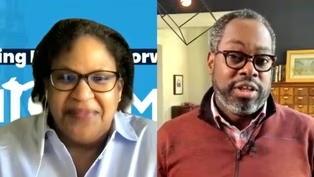
I spoke with the chair of the Michigan Dems, Lavora Barnes.
I wanna start here.
This is a kind of a deja vu moment, I suppose, with these proposals to try to restrict voting in the state of Michigan.
But I wanna start by reminding people of the incredible step we took forward in 2018 at the ballot box when we decided that we were gonna really open up the ways that people can vote, the access that people have to the ballot.
That was major, major news here in Michigan.
And we saw it pay off in 2020 when so many more people voted in ways that they wouldn't have been able to before.
That's exactly right, and we did it by a large majority in 2018.
Like these are numbers that frankly, a candidate would dream of, right, the, the victory that happened in 2018.
And the fact that the Republicans, what they saw is that, in 2018, we did this change, in 2020, we as Democrats did a terrific job using these new rules.
And frankly, because of COVID, needing to use them to allow more people to vote absentee and more people to access the ballot in the ways that had been changed in 2018, Republicans lost, so their response to this is to try to roll back what the people of Michigan decided they wanted to do in 2018, back even further than, worse than it was before 2018, in order to try to win victories in 2024 and going forward, right?
This is all about the big lie.
This is all about they think that we cheated by using the law and following the law very carefully.
They think that they can continue this idea that there was something wrong with those 2020 elections by suggesting to people that they have to secure the vote by passing this ballot initiative.
None of it's true, it's all lies.
Yeah, yeah.
I mean, and we should be clear, not a single instance of voter fraud or phantom voters or any of these things that you hear people talking about has been, not only not proven.
I mean, there hasn't even been any evidence put forward that would suggest any of that happened.
No, good, clean elections up and down the ticket, run by terrific non-partisan election officials who are good at their jobs, professionals, who did their work and did it well.
And the Republicans who are not buyers into this idea of the big lie also agree that this was a good election and they've tried everything, the other side has tried everything to try to point to something, and it's all made up.
It's all, you know, people who don't understand the process who think they saw something, you know, people delivering food to TCF Center in Detroit, they assumed there were ballots in the food bags.
Like it's just, it's ridiculous, the lies that they will hang onto to try to prove there was something wrong with that election when there was not.
Yeah.
So let's talk a little about the specifics of this particular ballot initiative.
What would it do, what would it require that we don't now?
Right, so the big changes are around absentee voting, right?
What they want to do is require that you prove your identity every time you vote absentee, despite the fact that you've already proven your identity when you registered to vote and when your clerk decided to send you a ballot.
So they want you to have to include, whoo, this scares me in terms of the world of security, right?
The last four digits of your social security number.
Nobody wants to write that on a piece of paper and drop it in the mail.
I struggled to understand why they think this is a good idea in terms of voting, but they wanna do that.
They also wanna restrict clerks' ability to send you your absentee ballot, right?
They wanna make that harder for the clerks to do.
And they wanna make sure that the clerks can't get funding and support from other sources.
The same time that Republican legislature is not fully funding clerks to make sure they have the funds they need to do their jobs, they wanna stop the clerks from finding other sources of nonprofit funding to help them do their jobs.
All of this designed to try to block access to the ballot, slow down the process, make it more difficult and make voters believe that there is something wrong with a very safe, very secure process.
And we should also spend a little time trying to explain how this works.
This is a quirk in the government of Michigan, the ballot and electoral process that allows a very small minority of the overall population to try to end run electoral outcomes.
Talk just quickly about how that works.
So, Stephen, this is what I struggle to explain to folks who haven't seen it happen before, because it does, frankly, sound a tiny bit absurd, but with just 340,000 signatures, they can bring this language to the legislature, which is run by Republicans and the legislature can vote for it and bypass any opportunity for the governor to veto it, bypass any opportunity for the rest of the electorate to vote yay or nay on it, but just make it law.
This is in Michigan's constitution.
It's a process that's been there, it's been used before, but this is, I think, the first time I've seen someone attempt to use it to directly and straight up overturn what the people of Michigan said they wanted just a few years ago.
It's an abuse that is really, it's even hard to put words to how egregious this abuse is.
And we've got to do everything we can to slow it down and stop it.
And when you say slow it down and stop it, what does that mean?
What does that mean for you as the party, the Democratic Party, but what does that mean for individuals?
Right.
So for us and for individuals, what we're saying to everybody is we have to decline to sign.
When you're gonna see these folks out, they're gonna have this petition in their hand, they're gonna claim it makes it easier to vote, they're gonna claim it secures your vote.
They are lying to you when you make those claims, and we need to make sure our friends, our family, our neighbors all know that these are lies, and to not sign this petition.
We're gonna ask people to let us know where they see petition gatherers, so that we can send our volunteers there to help educate the voters who are being asked to sign this petition about what it is they're actually signing and encourage them not to sign.
This is going to be an aggressive campaign, but again, that number is so low, it's hard to imagine that we can stop them, but perhaps we can slow them down, maybe discourage some of the petition gatherers who don't actually know what they're gathering petitions to do from doing that work and perhaps stop them.
And then, you know, assuming they get the signatures, we have a team of lawyers already in place working hard on figuring out what our strategy is in terms of legal strategy for whether or not this is a constitutional change that we can push back on in the courts.
Yeah, yeah.
And we should also talk a little about how this fits in the national context.
Oh gosh, yeah.
Republicans in lots of states are up to this kind of initiative to try to roll back the gains that people who want people to be able to vote made in many states, but there's a debate in Washington right now about legislation that would at least, from a national perspective, make some of these things harder to do and would protect some of the ballot access that we have here in Michigan.
Yeah, that's absolutely right.
This is definitely part of a national effort on the Republican side to subvert the will of the people, to change the way people access the ballot, to block people from having access to the ballot.
I know folks have heard the stories about the laws that they'll say you can't give somebody a drink of water when they're standing in line to vote.
This sort of thing is happening all over the country, and this here in Michigan is just a piece of that.
There is legislation in Congress right now that's being debated, worked on, that would fix a lot of this.
It would not fix all of it for us here in Michigan, but would fix a lot of it, and we need to push hard and help support our Democrats who are trying to make that happen in Washington DC, with as much support as we can give them.
These changes are important to us, for securing democracy, frankly, because as we know, part of what it means to be an American is to be able to have access to this ballot and to participate and to vote.
And when these folks make it harder and harder for folks to participate, it is frankly just un-American and un-small D democratic.
Yeah, and there's also no question that these kinds of measures affect certain communities- Absolutely.
More than others, and those communities happen to look different than much of the population in Detroit, African-Americans Latinos, Arab-Americans, folks from the Middle East.
When these kinds of measures are put in place, it really means that fewer of us vote because fewer of us feel like we can do that safely.
We feel discouraged from the very idea of participating.
That is exactly right, and that's exactly their goal, right?
Many of us, you and I will still vote, but many folks who will hear these stories, and I'm gonna tell you this, we're hearing from clerks, people are already hearing this story and are already worried about their access to the ballot and whether or not they have to follow these rules now, before it's even happened.
So we know that this causes confusion and the whole point of them doing this is to make sure that more Black and Brown people don't vote because when Black and Brown people vote, when we vote, Stephen, good people who happen to be Democrats, get elected, bad people who happen to be Republicans do not.
That's just the fact of the matter.
So their goal here is to stop as many folks who look like us from voting as they can.
Yeah.
Before we end, I wanna go back just briefly to something you said earlier about if this does get 340,000 signatures and somehow passes the legislature, which seems like it might be pretty easy, there still is a legal process that would have to unfold, and the question will be whether this is a constitutional change that requires more than just this process, which I think is important because we changed the constitution in this state as a state, all of us went to the polls and decided to change the constitution to allow these measures.
There is a fundamental fairness question, really, about whether you can undo that through this process that essentially nullifies what is already in the constitution.
That's exactly right.
And you know, I'm not a lawyer, but we have some terrific ones who are part of the team here, who are looking at each and every piece of this in ways that we can come at it from the legal standpoint.
They started, frankly at the board of commissioners, and I think did a great job of getting them to change that 100 word summary to actually describe what is in this petition, and I think that there are just steps all along the way that we can take, and we will continue to take until we have exhausted every option on the legal side, to make sure that we're protecting people's access to the ballot.
We turn now to a celebration of this year's Kresge Eminent Artist, Shirley Woodson.
A new exhibition at the Detroit Artists Market features the work of the Detroit artist and educator whose career spans six decades.
The show is called "Shirley Woodson: Why Do I Delight?"
It's curated by Leslie Graves and showcases Woodson's signature colorful paintings and collages, which can be found in museums and galleries all over the country, including right here at the Detroit Institute of Arts.
The exhibit also includes tributes and works from several of her proteges.
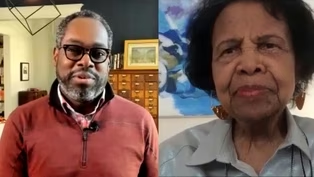
So here's my conversation with the legendary Shirley Woodson.
So I wanna start with, congratulations, you being named the Kresge Eminent Artist.
Give me a sense of what your reaction was when you heard.
Well, I was speechless, and I'm still speechless.
(both laughing) It's like the phone rang and I answered it and it changed everything.
(laughs) Yeah, yeah.
It's a well-deserved, well-deserved honor.
I would love to start with you telling me about how you got started as an artist.
What was it that made you wanna make this your life?
I think an honor like this kind of inspires that question, how did this all begin for you?
Well, I guess as far back as I can remember, other than my dolls and other toys and that sort of thing, certainly with school, my kindergarten experience, I guess, was probably my first, you know, actual realization that there was something wonderful out there that I wanted to do.
Mm.
And so, you know, it just sort of carried me right on through.
Mm-hmm.
And for you, is art a vehicle for certain kinds of messages?
I think many artists are using the medium that they work in to say something.
Art, for me, was always the key to something else.
I learned history or I learned to understand more about history through the art that I saw, that I think really, it just brought about so many connections.
When I was in school, I took French.
I was an art student by that, of course, by that time, but when I took French, when I first took French, I said, well, if you take French, then you have to go where they speak French.
Mm-hmm.
(chuckles) And (laughs) I didn't know anything about Toronto and all that, but the source, certainly the art source was Paris, was France.
And, you know, I could go to the museum and see those works.
And so, that was always a, that was also a destination point for me, to see work and anything that I studied, I could always make that connection through history.
China, the beautiful ceramic works of different periods, of course.
So you also have a new exhibit at the Detroit Artists Market, which is one of my favorite institutions here in Detroit.
Tell me about that exhibition and how you put it together.
Just prior to the call from Kresge, I had received a call from the Artists Market asking me to have an exhibition.
And so of course I said, yes, I mean, I thought that was, that was certainly a nice surprise, and began looking forward to it.
And then the Kresge call came.
So it was like a double, they just sort of went together in that way.
And so I'd been working, I work all the time.
My practice is ongoing.
And so, I had work that I was involved with at the time.
And so I thought I would show works, you know, a lot of works that had not been seen before.
I concentrated on drawings that I had not shown in a group in that way, and that had a real drawing exhibition.
And so, I was able to include, that work and other paintings related to my theme, one of my themes is water and I started another series.
And so I was just sort of, just sort of gathered it together in that way and then I also was showing some work that was really adventurous for me.
I did four neon works and that related to my writing.
Mm-hmm.
And so that's sort of how it all got pulled together.
Yeah.
There is also some work of your proteges in this exhibit.
Oh yes.
I've had wonderful students, as an educator, I've had wonderful students and since, as we've known each other for so many years, if I had, for example, my student Elizabeth Youngblood, we're, of course colleagues at this point.
And so when we talked together, I said, yeah, we went to Tappan together and we had a class together at Wayne or wherever I was teaching, I had to refer to them in that way when they were students, but they were colleagues as well.
Yeah, yeah, no, that's very exciting.
So you have six decades of work.
Yes.
To share with the world at this point, and it's in places all over all over the country, including here at the DIA.
Yes.
A lot of the work is, of course, telling the stories of African-American life.
And I wonder if you can talk some about how important that dimension of your work is.
Well, that work is important.
African-American artists have all kinds of stories.
It just added some, it's one more story there.
Jacob Lawrence definitely told the stories, Romare Bearden, Elizabeth Catlett and all, they definitely told the stories of wherever they were, whatever their life was about or whatever the life that they were encountering was about, and my story is the same.
My thoughts, my experiences, I sort of, I always wanted to be a totally abstract artist.
In fact, I said, at one point, I said, I'll never paint any people.
I just wanna paint ideas and other, sort of otherness kind of a quality, which I did, but I eventually had to relate both of those so that the viewer, the people would be able to see themselves somehow in the work and see if that added to their experiences.
Yeah.
To enlighten their own experiences.
And that was basically my approach.
Yeah, yeah.
I also wonder if you can talk a little about what the last year and a half has been like.
I've been asking artists of all kinds how the pandemic, how the massive protests about police violence, all these tumultuous things that are happening around us, they always influence the work.
Have you seen that in yourself yet?
Yes.
I think I saw it, although these were ideas I had before, I saw it, in my neon work and in the text work that I did.
Beginning to use text, I've used it in other ways, but I'd never really used it in painting or in that sense, but I began to, you said I, since my work has such a span on it, I did a lot of work with, within those tumultuous times prior to this terrible pandemic.
You know, in the '60s, I did works that involved sort of statements in my work with collages and other kinds of things.
And my work with Broadside Press with Dudley Randall and designing the book covers for those works, those young poets and who are my peers, many of them who weren't, but just, I feel that my work has been involved in that.
The pandemic this past year and a half has just, well, it's obliterated time.
I mean, I have no sense of time.
What is today?
I don't know what, today's Thursday, no, it's Tuesday.
I mean, there's nothing that distinguishes, really, one day from another.
You're in a constant state of waiting, waiting for it to go away, subside and all of the other events that have been a part of this, and it's made a difference in people.
I mean, I think, and I think art, I think my colors became even brighter during this period because we just wanted more joy up here in the world.
And that Shirley Woodson exhibition runs through October 23rd at the Detroit Artists Market.
That's gonna do it for us this week.
Thanks for watching.
You can find out more about our guests at americanblackjournal.org.
And as always, you can connect with us on Facebook and on Twitter.
Take care and we'll see you next time.
(upbeat music) ANNOUNCER: From Delta faucets to Behr paint, Masco Corporation is proud to deliver products that enhance the way consumers all over the world experience and enjoy their living spaces.
Masco, serving Michigan communities since 1929.
ANNOUNCER: Support also provided by the Cynthia and Edsel Ford Fund for Journalism at Detroit Public TV.
ANNOUNCER: The DTE Foundation proudly supports 50 years of "American Black Journal" in covering African-American history, culture and politics.
The DTE Foundation and "American Black Journal," partners in presenting African-American perspectives about our communities and in our world.
ANNOUNCER: Also brought to you by AAA, Nissan Foundation, Inpact at Home, UAW, Solidarity Forever, and viewers like you.
Thank you.
(twinkling music)
Video has Closed Captions
Clip: S49 Ep40 | 10m 47s | Woodson Exhibit | Episode 4940/Segment 2 (10m 47s)
Providing Support for PBS.org
Learn Moreabout PBS online sponsorship
- News and Public Affairs

Top journalists deliver compelling original analysis of the hour's headlines.

- News and Public Affairs

FRONTLINE is investigative journalism that questions, explains and changes our world.












Support for PBS provided by:
American Black Journal is a local public television program presented by Detroit PBS