
Voting Laws/The Metro Detroit Black Business Alliance
Season 49 Episode 15 | 26m 46sVideo has Closed Captions
Voting Laws/The Metro Detroit Black Business Alliance | Episode 4915
Detroit NAACP president Wendell Anthony is here to talk about republican efforts across the country to change election laws and suppress voters of color. Plus, Black business owners in metro Detroit form a coalition to help each other succeed. Episode 4915
Problems playing video? | Closed Captioning Feedback
Problems playing video? | Closed Captioning Feedback
American Black Journal is a local public television program presented by Detroit PBS
Voting Laws/The Metro Detroit Black Business Alliance
Season 49 Episode 15 | 26m 46sVideo has Closed Captions
Detroit NAACP president Wendell Anthony is here to talk about republican efforts across the country to change election laws and suppress voters of color. Plus, Black business owners in metro Detroit form a coalition to help each other succeed. Episode 4915
Problems playing video? | Closed Captioning Feedback
How to Watch American Black Journal
American Black Journal is available to stream on pbs.org and the free PBS App, available on iPhone, Apple TV, Android TV, Android smartphones, Amazon Fire TV, Amazon Fire Tablet, Roku, Samsung Smart TV, and Vizio.
Providing Support for PBS.org
Learn Moreabout PBS online sponsorshipWe've got a great show coming up for you on American Black Journal.
Detroit NAACP president Wendell Anthony is here to talk about Republican efforts across the country to change election laws and suppress voters of color.
Plus black business owners in Metro Detroit form a coalition to help each other succeed.
Stay right there, American Black Journal starts right now.
Announcer 1: From Delta faucets to Behr paint, Masco Corporation is proud to deliver products that enhance the way consumers all over the world experience and enjoy their living spaces.
Masco serving Michigan communities since 1929.
Announcer 2: Support also provided by the Cynthia and Edsel Ford Fund for Journalism at Detroit Public TV.
Announcer 1: The DTE Foundation proudly supports 50 years of American Black Journal in covering African-American history, culture and politics.
The DTE foundation and American Black Journal partners in presenting African-American perspectives about our communities and in our world.
Announcer 2: Also brought to you by AAA, Nissan Foundation, Ally, Impact At Home, UAW Solidarity Forever and viewers like you, thank you.
♪♪ Welcome to American Black Journal.
I'm Stephen Henderson and as always, I'm glad you've joined us.
A number of civil rights groups are filing suit against the State of Georgia to stop its restrictive new voting law from taking effect.
Now that law does things like restrict early and absentee voting and it limits the number of drop boxes that can be distributed in the state for ballots.
There are a number of other States that are considering similar laws, including right here in the State of Michigan, where Republicans are pushing similar measures.
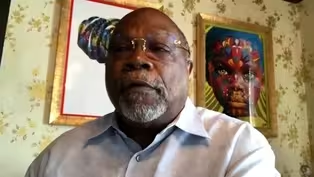
I talked with Detroit NAACP president, Reverend Wendell Anthony, who's also the recent recipient of that organization's National Activist of the Year Award, about what's happening in Georgia, in Michigan and all around the country.
Welcome back to American Black Journal.
Thank you Stephen Henderson, always good to be with you.
Yes, and of course, congratulations on being named a National Activist of the Year for the NAACP.
That's a huge award and any year you might win it is a big deal but I feel like especially for the last year.
You think of all the things that have happened in our country that required an activist response.
The way it's been this year, it's an even bigger deal.
Thank you, man.
I appreciate it.
You know, I don't do the work for the award or for the reward of being able to help people but I'm very appreciative of it.
And in my acceptance, I think, an acceptance for all of the activists across the country who never get mentioned, who may never get called, who are not in proclamations in the paper but they just do the work.
There are millions of people that do this kind of work and never be heralded.
But I thank God that I can say something for them.
And awards mean two things, work that has been done and work that has yet to be done.
We still have some work to do and you know that.
Yeah, yeah, so here we are in 2021.
More than 55 years since the passage of the Voting Rights Act, more than 150 years since the ratification of the 15th amendment to the constitution.
And we are still having an argument and a very spirited one right now about the black vote.
There is still a significant portion of the white population of this country that feels threatened by black votes.
And I think all of the things that we're seeing in Georgia and Michigan and in these other States is an affirmation of that.
This is about fear of the black vote.
You're absolutely correct, Steven.
And it's also 53 years after the assassination of Dr. King on April 4th in Memphis as he stood up for the rights of sanitation workers in Memphis, Tennessee.
All carrying signs saying, I am a man.
In other words, recognizing me, I have purpose.
I have value.
Well, it still seems as though our lives are not valued but we've gotten victories.
Stephen, if we have not been victorious in 2020, if the number of black people had not shown up, they would not be trying to do this.
There is no evidence of voter fraud, voter irregularity in terms of behavior or cheating by black and brown people in this nation.
Even Republican leaders of States, particularly in Georgia, the (indistinct) said there's no evidence of voter fraud.
Even Kemp, the president, I mean the governor of Georgia said that, which is why he couldn't do anything because he had no power.
But yet, because Donald Trump, former president said I need 11,780 votes fellows.
I don't care what y'all do, get me these votes and they couldn't do it.
And he said that he was sorry he supported Kemp.
And he said if y'all had put things in position and place then I would be president right now.
Well, these legislators have gone back and they're putting things in place so that they can overturn elections.
The black and brown vote is not what they are planning on and they believe that if they don't do this, if they don't cheat, if they don't suppress the vote then they will lose the vote.
Rather than expanding their policies, they're trying to reduce our ability to participate in the voting process.
I mean, you can't serve people water and food while they stand in a line?
Mean I can't get my grandmama or granddaddy or mama, daddy, auntie a bottle of water as they stand in line for 8, 9, 10, 11 hours which you have created by you removing drop boxes, by you're shortening the time period in which people can vote?
And now Stephen, 47 States with over 361 bills of introduction are now trying to implement this.
And right here in the good old home state, pure Michigan they are trying to introduce 39 bills to suppress the vote.
And so we cannot abide that, we are not going back to the plantation.
I don't care what they do, we ain't going back.
So you might as well get that memo.
We are not going back.
Our voting rights have been won by the blood, sweat, tears, bones of our people, (indistinct) black folk, white folk and brown folk.
We've won this and we're not gonna let you take it from us.
Yeah, so one of the interesting dimensions of this debate is the role that corporations have been asked to play in some cases.
And in some cases have stepped up to play on their own.
And I feel like in Georgia that was reactive, right, to what they passed.
I wonder if there's an opportunity here in Michigan since we haven't had votes on this, since we haven't seen the legislature actually act on it where's corporate Michigan?
Where is corporate Detroit in trying to make it clear that this is not okay?
That you can't win by making sure that people don't exercise their right to vote.
You hit the nail on the head, Stephen.
That's one part of the trilogy of which we are working.
I've been in contact with several corporations.
You know, last year we brought the corporations together.
Downtown Detroit, they made commitments about racial equity, fighting against systemic racism.
Some have implemented programs, some were addressing it, some were still yet to address it.
But we've in communications with Ford, General Motors, TCF, Quicken Loans, The Ilitch Foundation or the Ilitch Group, Henry Ford Health System, Blue Cross Blue Shield.
All the ones that were there and others last year.
Some have responded to the degree that they are opposed to this but how they will come out?
I don't need you to just state we are for racial equity if you don't put that in the practice.
Coca Cola, Delta Airlines, the major league baseball pulled out of Atlanta, out of Georgia because of this stuff.
And several companies, Lyft, Uber, Microsoft, a number of them have gone on record, American airlines are opposing this.
These companies have African-American employees, Latino employees that work with them.
They have some managers.
You need to speak up for your people.
We drink Coca Cola, we drive your cars.
We use your software, we do all the things that we do.
We are a significant constituency and so you need to pay attention that.
Stephen, 72 African American CEO has spoken out against this tension now and others, they took out a big full page ad in the New York Times.
They're calling on other corporations to do the same thing to oppose this.
They're saying, use your lobbyists.
Use your PAC dollars, your political action committee dollars.
Don't fund, how are you gonna fund good and evil at the same time?
How are you gonna be for racial equity for following George Floyd and then be for voter suppression following the introduction of these bills?
And let's not wait until the horse has left the gate.
Let's do it before he leaves.
Don't wait to the ink is dry and the deal is done to say you are against this, come out now.
That's what we're pushing for, that's what we're fighting for.
And we've gotten some good response, but it's not enough.
Following the Business Roundtable, which has a milquetoast statement about, well, we believe in racial equity, we believe in the right to vote.
Fine, then do something about it.
Tell your Republican colleagues and friends that you don't support this.
Tuesday, Steven, we, meaning the coalition of community organizations, NACP, Council of Baptist Pastors, the Divine Nine, fraternities, sororities, labor organizations.
We will be in Lansing on the steps of the Capitol to rally and protest this.
Join us folk, Tuesday at 12 o'clock noon in Lansing to let them know, the legislators come back in the office in that section on that day.
We wanna greet them and meet them and say we do not support this.
And we're asking corporations to do the same thing.
They ain't gotta get out there and march with us but march your money away from these people.
March your lobbyists to these people and say, no, this won't go.
Everybody has a stake in this.
Yeah, and it all just reminds, of course, of, you know, the award that you got earlier, the activism that's necessary still to make sure that, you know, we not only fight for the right to vote but think of all that work that we did in the last year or the last two years to make sure people exercise it.
To make sure they show up and cast their ballots at the polls.
And that's something you've been working on for- Right, but, you know, Steven, last year 3.3 million Michigan citizens voted by absentee ballot last year.
30,000 registered on election day, 250 post election audits were conducted in this state with over 1300 Republican, Democrat and Independent clerks.
Now they wanna change that.
They want to add on ID for absentee ballot.
They want to prevent the secretary of state from mailing absentee ballots to all Michiganders, Republican Democrat, Independent.
She's sending out applications for everybody to be able to vote.
We should not be allowing folks to prohibit the use of an absentee ballot in a drop box.
So you gonna stop them from dropping in the box at 5 o'clock and don't give them any stamps to return this.
What is this about?
This is about voter suppression.
When you put all those dynamics together, it's a puzzle.
It works for one conclusion to suppress, negate and obviate the vote in the State of Michigan.
We can not abide that, everybody has a stake in this.
It's not a Democratic issue, it's not a Republican issue.
It's not an Independent issue, it is an American issue.
Democracy is the underpinning of our nation.
If we lose that, we lose everything.
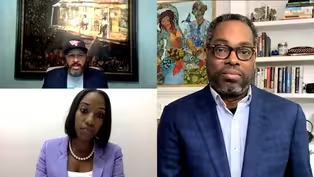
A group of black business owners in the Detroit area has formed a new coalition to help entrepreneurs of color remain viable and successful.
The Metro Detroit Black Business Alliance was created in direct response to the economic challenges caused by the COVID-19 pandemic.
Organizers are gonna develop programs and advocate for policies that lift up African-American businesses.
Here's my conversation with the group's president and CEO, Charity Dean and board chair, Charles Nolan.
So Charity, I'll start with you.
You say this is a direct response to some of the challenges that black businesses have been experiencing over the last year.
Of course we have seen all kinds of businesses have a real hard time during COVID.
But talk just a little bit about the particular problems and challenges that black businesses are experiencing right now.
Yeah, thanks, Steve.
So, you know, black businesses have had this challenge long before COVID, right?
In 2018, the Kellogg Foundation issued a report that talks about the business case for closing the racial equity gap.
And it talked about over 60 billions of dollars that Michigan stands to gain if we actually close that gap, that was 2018 pre-COVID.
And just like the virus, you know, the impacts of COVID hit black businesses harder than any others.
I'll give you an example and I talk about this a lot.
It's something that's been remedied but you imagine when businesses were shut down and everyone is saying to the government we need some sort of relief.
Government issues out PPP in its first round and the number of black businesses that were unable to attain PPP because they issued it and you had to have a lending relationship with the bank.
And so we know that black businesses don't lack lending relationships with the bank because they don't want them, But there has been a series of policies over the years that have prevented black business from having that same access.
And so when you are hit with a pandemic and then your first option for help is saying you have to have something that you've been denied, that's an example of systemic racism.
And so this organization, the Metro Detroit black business Alliance is really here to not only help have programs to help black owned businesses but also advocate for policies to say you know what does this really make sense, our solution is not actually fixing the problem.
Yeah, yeah, so Charles, just talk about the idea of this coalition forming, this coalition who's in it and the kind of things that you hope to accomplish.
Yeah, well, thank you.
The people that are in this coalition are all small business owners.
It came about as Charity mentioned during the pandemic.
We were sitting around and we figured out there was no one really advocating for the small black businesses in the city Detroit on the level that that is needed.
There are other organizations out there but specifically being an advocate and understanding of the needs of the small black businesses.
And that's why we felt it was important for all of our board members to be small black business owners.
Charity, there are a number of other organizations that help black businesses, that advocate for black businesses.
Distinguish this new group from some of those others and talk about the opportunities to work together.
Yeah, absolutely.
So when I talk about that 69 billion dollar number, right, it takes collaboration and partnerships to get there.
No one is gonna do that on their own but some of the things that distinguished the Metro Detroit Black Business Association is we hope to establish business resource centers.
Really all across the region but we're gonna start in downtown Detroit this year where our business owners are black owned business owners.
Whether you're doing hair on the West side of Detroit or you own a coffee shop, you can come and have access to free internet and coworking space downtown.
And launching a black business directory that will include every single black business in Wayne, Oakland and Macomb County.
And then our cornerstone program is really gonna be our capital connect program.
And we are launching that really, really soon as the clock is ticking on this second round of PPP.
But what we see as the barrier, the biggest barrier for black businesses is access to capital in all of its forms, loans, grants, abatements.
Opportunities for black businesses to access the resources that they need and so our capitol connect program, which is gonna be launching pretty soon is definitely one of those things that will distinguish us from other organizations.
Yeah, and will there be a lot of sort of cross work and collaboration with other organizations as well?
Oh, absolutely.
I mean, again, we talked about this at our opening at our launch event that we cannot, actually will not accomplish our goals if we set to do it alone.
And so everything that you'll see us do, you'll see us doing it in collaboration.
Anybody that is connected or anybody that cares about closing this racial equity cap, we invite them to work with us because were gonna need their help.
If you think about the number of black businesses in Detroit alone is huge, right?
And then you start thinking about Wayne County and then Oakland County and Macomb County.
So we need about three other MDBBAs to be working in order for us to even hit what we think our goal is.
Yeah, Chuck, as we said earlier, we've been talking about these things, these challenges to black businesses in Detroit for a really long time.
I wonder if you can give our viewers a sense of what the landscape looks like right now for black businesses in Detroit.
There's been some progress of course but give us a sense of the kind of things that you face and how COVID maybe has even made those things worse.
Yeah, COVID definitely has set a lot of small black businesses back and unfortunately, a lot of them won't reopen.
One thing we plan on bringing to the table that we have an advantage of is mentoring-ship.
So those businesses that are in business, say for instance when I started off 17 years ago in the restaurant industry we opened a Cutters Bar & Grill.
purchased a Cutters Bar & Grill.
I didn't have a mentor.
So just imagine how far ahead I could have been if I had a mentor.
So mentorships are very important to us and we're gonna lend our expertise in individual fields.
So we're covering hospitality fields.
We have people in the construction industry.
People in the beauty salon and hair industry.
So we're gonna try and make sure that we connect the right people with those that are currently in business looking for resources and also that need mentors.
Yeah, and Chuck, coming out of the pandemic a lot of things are gonna look different.
I mean, they're gonna look different for good.
Talk about some of the things that you expect to face even when the world kind of gets back to normal.
I think that wealth gap and that financial challenge is still gonna be there.
So we're gonna try to bridge that gap for people, for individuals.
Businesses are going to need long-term financial support.
The PPP loans are great that are out there.
There are other programs coming out.
I can speak specifically to the restaurant industry that I think there's a restaurant relief fund.
That's gonna help people stay in business.
But those people from gyms to shuttered venues, concert venues, all those industries are gonna need support.
And we're gonna try and provide that support through our financial and capital connect program.
Yeah, yeah, Charity, you come to this work out of the mayor's office.
I wonder if you have thoughts about the ways in which government and particularly government in this city might do more to try to strengthen that black business environment that's so important.
Yeah, I keep referring back to the Kellogg report because I think it's so important.
Every single entity, every single institution has a role to play.
And we're here to remind everyone of that role.
You think about the racial wealth gap that exists did not happen by accident.
And in fact there was intentionality from governments, from financial institutions.
And so everybody has a role to play in closing that gap including government, including city government, including state and federal government.
So we definitely will be advocating for policy that makes sense, policy that that is inclusive and policy that is intentional around helping black businesses thrive.
Yeah, and what about the relationship between non-black owned businesses and black businesses in Detroit?
We've seen, of course, an influx of new businesses in the city that are not owned by our community.
They're investing, they're starting to serve people in the city.
How well is that working alongside the need to invest in black businesses and grow them and are they playing an important role?
Yeah, so our organization is membership based and we actually have a membership for everyone.
So no matter what category you fit in, there's a role for you to play because we really do believe that we need everyone in order to accomplish our goal.
The other beautiful thing about the work of equity is that when you push for equity, and I saw this in the government, right?
So when you push for equity, the effects of a more equitable system benefits everyone.
No one loses when you are pushing for equity.
Processes are simpler, they're easier to access.
And so we see our work as really having an impact on every single business in the Wayne, Oakland and Macomb area.
And if you don't mind real quick, we were fortunate to have a great partner that supported our organization right out the back with TCF.
Gary Torgow was an amazing advocate for community.
And we wanna thank Gary for the gift that TCF has provided the organization.
And we just need more Gary Torgows in the world and I think it would be a lot easier for people to come together.
TCF is doing a number of things around (voice fades), invest in Detroit and in Detroiters.
Chuck Nolan and Charity Dean, great to have you both here on American Black Journal and congratulations on the new organization.
Thanks you Thank you very much, Steve.
That is gonna do it for us this week.
Thanks so much for joining.
You can always find out more about our guests at americanblackjournal.org and you can keep up with us on Facebook and on Twitter.
We'll see you next time.
♪♪ Announcer 1: From Delta faucets to Behr paint, Masco corporation is proud to deliver products that enhance the way consumers all over the world experience and enjoy their living spaces.
Masco serving Michigan communities since 1929.
Announcer 2: Support also provided by the Cynthia and Edsel Ford Fund for Journalism at Detroit Public TV.
Announcer 1: The DTE foundation proudly supports 50 years of American Black Journal in covering African-American history, culture and politics.
The DTE foundation and American Black Journal partners in presenting African-American perspectives about our communities and in our world.
Announcer 2: Also brought to you by AAA, Nissan Foundation, Ally, Impact At Home, UAW Solidarity Forever and viewers like you, thank you.
The Metro Detroit Black Business Alliance
Video has Closed Captions
Clip: S49 Ep15 | 10m 17s | The Metro Detroit Black Business Alliance | Episode 4915/Segment 2 (10m 17s)
Video has Closed Captions
Clip: S49 Ep15 | 11m 59s | Voting Laws | Episode 4915/Segment 1 (11m 59s)
Providing Support for PBS.org
Learn Moreabout PBS online sponsorship
- News and Public Affairs

Top journalists deliver compelling original analysis of the hour's headlines.

- News and Public Affairs

FRONTLINE is investigative journalism that questions, explains and changes our world.












Support for PBS provided by:
American Black Journal is a local public television program presented by Detroit PBS