VPM News Focal Point
VPM News Focal Point Election Special: Beyond the Ballot
Season 3 Episode 13 | 26m 46sVideo has Closed Captions
Community dialogue, analysis and reporting around election issues in Virginia. 3 of 3.
Election integrity and other issues are covered through community dialogue, expert analysis and feature reporting. Hear directly from fellow Virginians and gain a deeper understanding of the perspectives, hopes and concerns that drive voter decisions at the polls. Part 3 of 3.
Problems playing video? | Closed Captioning Feedback
Problems playing video? | Closed Captioning Feedback
VPM News Focal Point is a local public television program presented by VPM
The Estate of Mrs. Ann Lee Saunders Brown
VPM News Focal Point
VPM News Focal Point Election Special: Beyond the Ballot
Season 3 Episode 13 | 26m 46sVideo has Closed Captions
Election integrity and other issues are covered through community dialogue, expert analysis and feature reporting. Hear directly from fellow Virginians and gain a deeper understanding of the perspectives, hopes and concerns that drive voter decisions at the polls. Part 3 of 3.
Problems playing video? | Closed Captioning Feedback
How to Watch VPM News Focal Point
VPM News Focal Point is available to stream on pbs.org and the free PBS App, available on iPhone, Apple TV, Android TV, Android smartphones, Amazon Fire TV, Amazon Fire Tablet, Roku, Samsung Smart TV, and Vizio.
Providing Support for PBS.org
Learn Moreabout PBS online sponsorshipSELENA HUBBARD: I think a big challenge we are facing is trusting each other.
I think that's a big one.
CHERYL LUNSFORD: Misinformation.
It's caused a divide in even my own personal family.
ELLIOTT RANDOLPH: I think one issue facing this country, especially around election time, is, the way that the two party system can kind of... People can kind of lose their identities within the groups, and assume things about the characters, of people on the other side.
ANGIE MILES: When the election is over, when the polling places have all closed and the votes have been tallied, will you trust the results of election 2024?
Will your family members, coworkers, friends, and neighbors believe that the outcome is fair and accurate?
At a time when people have a hard time trusting what is and isn't true, what do you need to know?
You're watching Beyond the Ballot, a special edition of VPM News Focal Point.
Production funding for VPM News Focal Point is provided by The estate of Mrs. Ann Lee Saunders Brown.
And by... ♪ ♪ ANGIE MILES: Thank you for joining us for this special elections coverage on VPM News Focal Point.
I'm Angie Miles.
Virginians are divided deeply.
As is our nation.
This is probably not news to you, but if you're like many Americans who'd like to see things improve, you may be looking for news and information that can objectively and reliably help point to possible ways forward.
This fall, Focal point is branching out from our usual coverage.
For three seasons, our journalists have delivered stories of everyday Virginians managing life that's shaped by the social issues and public policy decisions of our time.
This fall, we are using our same focused, comprehensive and nuanced approach to bring you special reporting on issues relevant to many decisions before you in this election year.
For these episodes, weve sought input from Virginia neighbors from Appalachia to the Atlantic, from our borders with Tennessee and North Carolina up to the bedroom communities of Washington, D.C. Focal Point also consulted academics and other experts, asking them to bring their research and wide-ranging experience to bear on the big questions, helping us to find real facts in what can seem sometimes like a sea of noise.
For our regular segment, People of Virginia, we've been asking your neighbors throughout the state for their points of view about the issues that concern them most.
Greater than 50% of those we've asked have told us it's the political divide that has become an us versus them proposition too much of the time.
GAIL WEATHERFORD: The divisiveness that has developed in recent years is very concerning.
And I don't know what the answer is.
DARRELL OLDHAM: Everybody's trying to pull in different directions, and is too worried about themselves and what they believe instead of listening to other people.
GABE KALINA: I think we need to stop fighting over opinions and realize, how can we fix this entire place, because we're only on here for so long.
Might as well make it a good place.
SHAVONNE HARDY: We could all use a little more Willie Nelson in our lives.
Music definitely blurs the color lines.
Nothing like kicking back with a little bit of good music.
And Willie Nelson does that.
Brings people together.
Maybe him and a little Ray Charles.
I dont know, it's just good for the soul.
ANGIE MILES: A lack of trust is one of the hallmarks of this divide.
Research by Pew Charitable Trusts shows public confidence in the federal government has fallen precipitously since the 1960s, notably since Vietnam and the Watergate scandal.
It seems to increase somewhat during times of crisis, such as following the Kennedy assassination and after 9/11.
A recent Gallup poll finds that the number of Americans who trust the media is far exceeded by those who have no trust at all in media news reporting.
Republicans report far less faith in mass media than do Democrats.
In this climate of mistrust, encouraged by some political figures and aided by peddlers of misinformation or outright disinformation, Focal Point is asking two important questions.
First, how trustworthy is our voting process?
And secondly, how protected is your vote?
For the first matter, We're talking about election security, which is what many Republicans have begun to question.
KEITH BALMER: Welcome to the Office of Elections here in the city of Richmond.
And I just want to give you a little tour about how we operate here.
ANGIE MILES: Keith Balmer seems excited to talk about his job.
KEITH BALMER: Here is the voter registration team.
Their job is to process voter registration applications as we get them.
On Election Day, this is the hub... ANGIE MILES: as the Chief of Elections for the city of Richmond, he oversees staff and systems for 72 voting precincts.
KEITH BALMER: The way it works on Election Day is that we ask our precinct chiefs at our 72 different voting locations to once the results tape print from the machine, call us as soon as possible.
ANGIE MILES: Okay.
KEITH BALMER: Because the media and the public want those results.
ANGIE MILES: Listen closely and you might detect a sense of pride.
KEITH BALMER: And this is where I must speak up for my colleagues, not just in Henrico, Chesterfield and the greater Richmond area, but across the state.
We all train our election officials on how to use the poll books and the voting equipment.
And we we train them on how to do all the paperwork to ensure, again, that our process is conducted with integrity.
So I'm gonna stand up for my colleagues.
Take a moment.
ANGIE MILES: As Balmer describes being serious, careful, even meticulous in getting everything right as he and colleagues statewide make the most of technology and more expansive voting methods to conduct inclusive, honest elections.
KEITH BALMER: So there are regulations that mandate registrars, if they're going to use a drop box, we must be able to record and keep that footage of the drop box for as long as we have it, until the state Board of Elections certifies the results of the election in December.
So this is our Tritek machine, which it is awesome.
So we can just put a batch of ballots in the machine and just open them all up and then it can actually distribute them based on precinct.
ANGIE MILES: Election security has become a point of contention in recent years.
Balmer says that the law, the election worker vetting process, the training and the reasons people come forward to be election workers in the first place help to ensure the integrity of the vote.
KEITH BALMER: But what I want more so than anything else is for the public to trust the people who are running elections.
We don't have an agenda.
We're not changing votes.
We're counting votes.
ANGIE MILES: But there is a huge trust gap and it's visible by party.
You can see that Democrats have high trust in election results, and election officials.
Republicans, to a large extent, mostly trust Donald Trump.
Nationally and statewide, the evidence shows election wrongdoing is practically nonexistent.
In Virginia, in the past decade, there have been, on average, just two voter fraud convictions each year.
Half of those are connected to a single case where staffers of a Republican congressman were convicted of falsifying signatures to get a third party candidate on the ballot as a way to help their boss.
KEN BLOCK: The narrative that only Democrats commit voter fraud is absolutely incorrect.
It's a bipartisan endeavor when it happens, but it happens in very small quantities.
There's not a lot of people who are going to risk a felony that involves five years in jail and up to $10,000 in fines to take two bites of the electoral apple.
ANGIE MILES: After the contested 2020 election, the Trump campaign hired Ken Block's firm to investigate whether widespread cheating had cost Trump the election.
And what were those results?
KEN BLOCK: There was not sufficient voter fraud to have impacted any of the election results in any of the swing states.
That's a cold, hard fact.
ANGIE MILES: Block says any report suggesting that voter fraud is rampant is probably misleading and may be driven by partisan agendas instead of by facts.
We asked him to review a white paper that made the claim that Virginia is plagued by voting irregularities.
KEN BLOCK: Published by a firm called Virginia Analytics.
This purported to be a scientific look at what happened in 2020.
When you look at the claims that were made in this white paper in Albemarle County, there were a couple of precincts that were highlighted as having many more votes cast than there were registered voters.
And the claim was made that in some of these precincts, thousands of votes were cast.
But when I looked at the data from the county, the number of votes cast in 2020 for those precincts was in the hundreds, not the thousands.
And nobody in Virginia should pay that report much heed.
ANGIE MILES: Block once ran as a Republican for governor of Rhode Island after founding a moderate party in that state.
He says the real reason Trump came up short of votes in 2020 is that scores of GOP moderates supported down-ballot Republicans but did not vote for Trump.
In “Disproven,” his new book, Block suggest ways to improve voting processes.
He says by focusing so much attention on a non-existent problem, voter fraud, America is overlooking a much bigger issue.
KEN BLOCK: What people who consume conservative media need to understand is that they're only hearing one half of the story.
And what they're not hearing is any factual evidence that refutes those claims of fraud.
ANGIE MILES: Block says if Americans can have regular access to the same information presented factually, the country will be better equipped to handle its ballot business and much more with greater confidence and trust.
ANGIE MILES: A highly trusted database of voter fraud cases is maintained by the conservative Heritage Foundation, and you can find that database online.
There you'll see a number of individuals who broke the law to try to get their candidates elected.
In some contests, that has become more difficult for Republicans.
Notably, the last GOP candidate to win the popular vote for president was George W. Bush in 2004.
Before that, it was his father in 1988.
Among Democrats, there is some concern that voting laws and voter rolls have come under scrutiny or outright attack, not to ensure fairness, but as a way to stop those who might choose Democrats from voting at all.
JASON MIYARES: Just last year, we removed nearly 80,000 deceased voters from our rolls.
And shockingly, we also identified over 6,300 individuals without US citizenship.
Also on our Virginia voter rolls.
They have also been removed.
ANGIE MILES: In the name of election security, Virginia has taken some highly publicized steps to protect the vote, including the establishment of an election integrity unit in Attorney General Jason Miyares office.
The removal of tens of thousands of names from state voter rolls and the rollback of automatic vote restoration for former felons.
Among Republicans in particular, there's been a hard push for more poll watchers to keep an eye on polling places and report concerns back to the party.
And this year, there's also been a push for more Republican poll workers to actually administer the elections in official capacities.
It is mostly Republicans who seem to be worried that there are bad actors and potential fraud affecting the outcome of our elections.
A Washington Post poll found far more Republicans than Democrats believe there is widespread fraud in elections.
And NPR polling revealed in 2021 that 90% of Democrats were concerned about ensuring access for all eligible voters.
While 75% of Republicans said stopping illegal voting was more important.
Virginia's efforts to allay fears and consistent approach to removing names from voter rolls has led to lawsuits.
ANNA DORMAN: We are suing on behalf of the League of Women Voters VACIR, which is the Virginia Coalition for Immigrants Rights, and ACT, which is African Communities Together.
The lawsuit argues two things.
The first is that pretty straightforwardly, these sorts of removal programs within the 90 days directly preceding an election are illegal under federal law.
And the second thing is that the way Virginia is implementing this policy is discriminatory because it disproportionately impacts naturalized citizens.
ANGIE MILES: The Department of Justice has filed a lawsuit against the Commonwealth, claiming the Youngkin administration has illegally swept voters from the rolls less than 90 days before an election.
Governor Youngkin says no, the removal of these individuals is technically inbounds since each person is self-identified individually as a non-citizen.
ANNA DORMAN: So these purges are going on daily based on Department of Motor Vehicles data, which is problematic.
So this DMV data could be up to 20 years old and just a lot can happen in 20 years.
So people could have had changes of their naturalization status over that point in time.
We are excited that the Department of Justice is interested in this issue and our litigations overlap substantively and that we are both very concerned about these ongoing removals during that 90 day protected window.
ANGIE MILES: Youngkin calls he DOJ lawsuit politically motivated.
On the other side of that opinion are people with concerns.
“VICTOR”: I was in my mid- thirties when those rights left as part of my conviction.
My voting rights were restored, but now I'm confused whether or not I'm allowed to vote.
ANGIE MILES: Victor, who does not wish to be identified on camera, says he's very concerned that this campaign for fidelity is actually discouraging Virginians from voting.
“VICTOR”: The fact that there are any hurdles at all to a process that's supposed to be in place for you to work through and get your rights restored is going to weed out another layer of people that would have wanted to vote and feel like they can't.
Or even worse, are intimidated if they get as far as a polling place.
Having to even think about that has a chilling effect on voters in general.
Across the board, Republican or Democrat.
And that part needs to change.
ANGIE MILES: Restoration of rights following incarceration has been considered a social justice issue for decades during the Civil Rights Movement, leaders addressed poll taxes, literacy tests and grandfather clauses as veiled attempts to keep some voters from casting ballots.
Human rights advocates today have suggested that the old threats are just resurfacing in new ways.
“VICTOR”: I believe in some states there are people who showed up and been jailed for voter fraud after having been told their rights were restored, having a piece of paperwork in their hand saying that, and they've been turned away or arrested.
That feels political.
ANGIE MILES: In Virginia and nationwide, those who make laws, those who enforce laws and those who must abide by laws are all working within a system that is being tested by a lack of trust and possibly by a need for more goodwill as well.
ANGIE MILES: Adding another layer to the challenges of voter integrity and voter protection, there is the issue of what happens after the ballots are counted.
And the specter of the now infamous date of January 6th, when protesters stormed the Capitol in an apparent attempt to stop the certification of the vote and thereby halt the peaceful transfer of power.
There are many Virginians who still believe that Donald Trump won the election of 2020, despite a lack of evidence from reputable sources.
What do people of Virginia think about this?
LANDON BOGGS: Joe Biden won, and Trump, he lost.
And there might have been some election interference, but there's no substantiated evidence towards that.
ALAN SMITH: January 6th was total chaos.
Even though I'm a Trumpster, I didn't think it was right.
I wish it hadn't happened.
It was bad for everybody.
SUSAN BUTTERWORTH: It was very frightening to see our Capitol charged on and to have so many things going on that no one could control.
And it was just...
It's not America that's not democratic.
ANGIE MILES: Focal Point had extended conversations with likely Virginia voters about a number of issues on their minds this election season, including the validity of election results.
We found these participants using varied methods, including recommendations from community members and people affiliated with VPM.
ANGIE MILES: What is on your mind right now, as we move closer to Election Day, what kinds of issues are you contemplating, reflecting on?
DAVID PEAKE: This particular election has made me very much aware of how important democracy is.
And I have seen some indication that it could be eradicated in some areas, which concerns me.
CHUCK HANSEN: I was Republican until 2016 and I didn't like Trump.
And so while I hold on to probably some of my more conservative fiscal opinions, I'm a one issue person and that is Trump needs to go.
That is to be defeated at the ballot box.
ANGIE MILES: There are probably conservatives who say that they don't like Donald Trump at all.
However, if they feel that Donald Trump is a means to an end, they will be willing to support him.
Can you understand that viewpoint?
CHUCK HANSEN: I don't understand how they can make that leap to voting for Donald Trump.
I think when you have a guy who says he wants to terminate the Constitution, that kind of overrides the rest of that.
SCOTT SHAW: I don't think that the American democracy is so weak that it can be brought down by a single individual.
It's been around too long, and it has too many people that still believe in it to just basically topple overnight.
SCOTT GOODWYN: You know, first we have to have, you know, election integrity.
I really feel like, this is a bipartisan issue.
Should be.
AMY MENDELSON CHEELEY: I don't know that any election officials actually said that there was a problem.
There are outside agitating people.
And campaigns that are saying there's a problem.
SHARALYN GARRARD: The election integrity also doesn't just it didn't just include what happens on Election day, but it's the concerted effort to disenfranchize the people that you don't want to vote because they're not going to vote for your side.
ANGIE MILES: Do you think we need more safeguards in place?
CD VAUTERS: Are people voting that are not citizens?
DAVID PEAKE: No.
CD VAUTERS: Okay, so then, you know, it's just all part of this... lies and distraction and and diversion.
And it's not even true.
SCOTT SHAW: I'm not sure it really makes any difference trying to argue with somebody who is encouraged by misinformation because if somebody gets something in their mind, it's very difficult to change that.
But you can gently promote them to maybe look around at other sources before digging their heels in.
ANGIE MILES: I do want to know about extremism and January 6th.
Right.
And the threat of a return to that, if Donald Trump does not win.
We have militia members saying if he does not win, there will be violence.
And are on record saying it.
CHUCK HANSEN: Well, the January 6th, he calls them political prisoners or whatever.
He complains that, you know, demonstrations in 2020, why weren't they arrested?
Why weren't they jailed like the January 6th people?
So I looked it up and 1100 people were arrested and charged January 6th.
17,000 people were arrested during 2020.
During those demonstrations, thousands were charged.
He's wrong.
BILL OGLESBY: If you're 18 years old and you're voting this year, you were nine years old when Donald Trump came into power.
You've never known anything really, but Trumpism.
And I'm sorry, but demagoguery cannot be allowed to rule the day.
And that's what's happening, at least among a large segment of our citizens.
And we have to get back to what it really means to be an American.
CD VAUTERS: When are we going to start seeing, getting at the root of the problem and coming together like this and start working on solutions?
ANGIE MILES: The hope that America will transfer power peacefully in 2024 and beyond is shared by political analyst Hank Chambers at the University of Richmond.
We asked Professor Chambers to put the risks and the worries into context, and to explain for us what we should expect beyond the balloting.
HANK CHAMBERS: President Trump lost the 2020 election.
Period.
Full stop.
So anything that suggests that he won the election is problematic and calls the election is problematic and calls into question an election that was perfectly fair.
Are there irregularities in every election?
Sure.
There are some votes that get counted that maybe shouldn't.
There are votes that don't get counted, that should.
But the question is whether the irregularities are big enough to swing an election in any of the particular states that we're talking about.
And that simply wasn't the case, as every court found.
What folks tend to think about as election security oftentimes, is voter suppression.
I recognize that in-person voter fraud typically doesn't occur.
I also recognize that when you're talking about mail-in ballots and absentee ballots, typically speaking, yes, you could engage in fraud, but it's just not, generally speaking, what occurs.
But for other people who are particularly skeptical, particularly folks who don't really know how elections work, their notion is, oh my goodness, unless you show up with certain information at certain spots, at certain times, I won't trust the result.
That's why I say in order for those people to think that an election is secure, they will tend to say, we need to stop certain people from voting and that necessarily becomes voter suppression.
Part of what's going on is that folks are simply refusing to take their losses because they just don't want to feel as though they've lost.
Well, that's the way life goes.
I guarantee you, Nixon was not happy that he lost to Jack Kennedy, but he accepted and he moved on.
Jimmy Carter wasn't happy that he lost to Ronald Reagan, but he said, hey, I got beat.
The notion that, ‘I got beat is something that's okay, because it doesn't mean that you as a person are less or less than.
It just means that the American people elected somebody else.
That shouldn't be a cause for folks who take up arms.
It's a cause, particularly not in this day and age.
It's a cause for us to say, okay, let's see how we can make the next four years.
Still the best years of America moving forward, So for all those folks who claim to love the Constitution, for all those folks who claim to love the flag, you can't just love the flag when you win.
You got to love the flag when you lose.
ANGIE MILES: And now comes the call to action for each of us who's eligible to vote in this year's contests.
It's possible you've not only registered, but have voted already given the advent of early voting, expanded absentee voting, and much more.
But what more do you need to know?
Officials with the Virginia Department of Elections say they've got you covered.
You can find out more about when and where to vote by visiting the Citizen Portal or the State Board of Elections website.
Access them both through VPM.org/elections.
Now, all that's left is deciding which candidates you'll choose for national, state and local offices in 2024.
And that is up to you.
We do hope our special Focal Point coverage has shed necessary light for you in ways that have you feeling more prepared and empowered as a voter, more aware and engaged with your Virginia neighbors, and more understanding of their varying points of view.
Finally, we have a recommended reading list for those who want to explore more about topics covered in our elections reports.
You can find that on our website as well.
Thank you for being with us for VPM News Focal Point.
I'm Angie Miles and we hope to see you next time.
Production funding for VPM News Focal Point is provided by The estate of Mrs. Ann Lee Saunders Brown.
And by... ♪ ♪
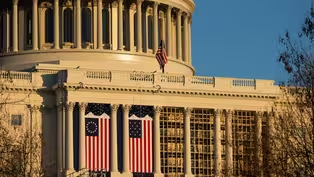
Video has Closed Captions
Clip: S3 Ep13 | 5m 39s | How secure is the vote? This is the question many are asking across the political divide. (5m 39s)
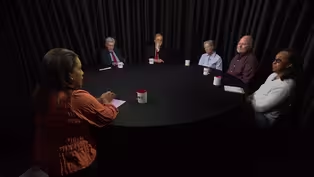
Likely voters share what’s on their minds
Video has Closed Captions
Clip: S3 Ep13 | 4m 19s | Democracy, election integrity & misinformation are on the minds of likely voters in 2024. (4m 19s)
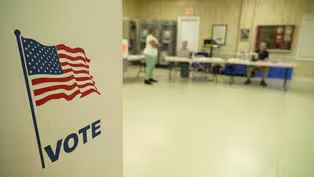
Video has Closed Captions
Clip: S3 Ep13 | 4m 45s | The line between election security and voter suppression. (4m 45s)
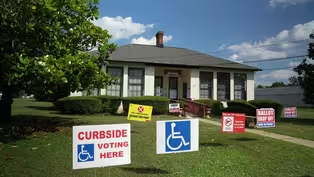
Video has Closed Captions
Clip: S3 Ep13 | 2m 43s | With an eye on election integrity, Chambers discusses why we should trust the vote (2m 43s)
Providing Support for PBS.org
Learn Moreabout PBS online sponsorship
- News and Public Affairs

Top journalists deliver compelling original analysis of the hour's headlines.

- News and Public Affairs

FRONTLINE is investigative journalism that questions, explains and changes our world.












Support for PBS provided by:
VPM News Focal Point is a local public television program presented by VPM
The Estate of Mrs. Ann Lee Saunders Brown