VPM News Focal Point
VPM News Focal Point Election Special: Common Ground
Season 3 Episode 12 | 26m 46sVideo has Closed Captions
Analysis, feature reporting and community dialogue; election issues in Virginia. 2 of 3.
With less than one month to go before election day we share community dialogue, expert analysis and feature reporting about the issues. Is there common ground? Hear directly from fellow Virginians and gain a deeper understanding of the perspectives, hopes and concerns that drive voter decisions at the polls. Part 2 of 3.
Problems playing video? | Closed Captioning Feedback
Problems playing video? | Closed Captioning Feedback
VPM News Focal Point is a local public television program presented by VPM
The Estate of Mrs. Ann Lee Saunders Brown
VPM News Focal Point
VPM News Focal Point Election Special: Common Ground
Season 3 Episode 12 | 26m 46sVideo has Closed Captions
With less than one month to go before election day we share community dialogue, expert analysis and feature reporting about the issues. Is there common ground? Hear directly from fellow Virginians and gain a deeper understanding of the perspectives, hopes and concerns that drive voter decisions at the polls. Part 2 of 3.
Problems playing video? | Closed Captioning Feedback
How to Watch VPM News Focal Point
VPM News Focal Point is available to stream on pbs.org and the free PBS App, available on iPhone, Apple TV, Android TV, Android smartphones, Amazon Fire TV, Amazon Fire Tablet, Roku, Samsung Smart TV, and Vizio.
Providing Support for PBS.org
Learn Moreabout PBS online sponsorshipMORGAN NICELY: If you don't have the exact same opinion as the majority of people, you are a bigot, or people jump on you or think that you're just simple minded.
MARTHA HOWES: Like Facebook, if you put out a comment or an argument or a disagreement about something and other people chime in and escalates to something that it never was in the first place.
GARY MARSH: The number one challenge in America right now is for us to agree on facts.
That somehow know we need to come to the conclusion that we are working with the same set of facts.
ANGIE MILES: Virginians are thinking about, are talking about the election of 2024.
And with less than a month to go before Election Day, we are focusing on issues of high importance to Virginians.
We are about to hear from experts, academics and a diverse, often divided assortment of voters in this program.
You're watching Common Ground, a special edition of VPM News Focal Point.
Production funding for VPM News Focal Point is provided by The estate of Mrs. Ann Lee Saunders Brown.
And by... ♪ ♪ ANGIE MILES: Thank you for joining us for VPM News Focal Point.
I'm Angie Miles.
Since its inception three years ago, Focal Point journalists have been traversing the state, asking Virginians pointed questions about how social issues and public policies are impacting their everyday lives.
This fall, we bring you a series of special reports to help those of us who live, work and travel in Virginia.
Our coverage includes voices from Hampton Roads to the Blue Ridge Mountains from Northern Virginia to Southwest Virginia.
We have been curious, as you may be now, about what is on the minds of friends and neighbors as they choose the next leaders of the commonwealth.
For this special coverage, we've also consulted academics and other experts who've offered their time and objective insights to separate fact from fiction.
To help you make more informed decisions in the presidential, congressional, state and local races.
And our Focal Point election coverage will bring voters with a range of political viewpoints together to talk directly with one another, helping each other, and you to better understand their points of view and to see what common ground may be possible.
For a host of reasons, aided by a media landscape that makes it easier than ever to retreat to silos of singular opinions where one rarely has to hear any news or information that challenges preexisting viewpoints, we are deeply divided.
Quite possibly, one of the biggest sources of disagreement is the basic notion of fitness for office.
In this presidential contest, there are a record number of Republican leaders from highly ranked military officers to GOP governors and state representatives who have said they will not vote for Donald Trump or whove endorsed Kamala Harris outright.
One of those Republican leaders hopes hes shouting loudly enough for you to take notice.
ANGIE MILES: Denver Riggleman stays busy helping his wife of 35 years with running their Nelson County distillery.
The former Virginia congressman says even though he hates running for political office, he's going to do it again.
DENVER RIGGLEMAN: The worst thing I ever did was run for Congress.
The best thing I ever did was serve in Congress.
And I don't want to ever go back to Congress.
And if I run, it will be for an executive position.
It will not be in the legislative body.
ANGIE MILES: Are you announcing that you're running for governor?
DENVER RIGGLEMAN: Well, not this term.
I will eventually.
I'll run.
People better watch out, because I'm going to be dragging an ax with me.
ANGIE MILES: Riggleman, a lifelong Republican who lost his bid for a second term in the 2020 primary process, has become an independent and a Never Trumper.
A vocal Never Trumper.
DENVER RIGGLEMAN: He really figured it out during The Apprentice on how to make money and how to pull the wool over people's eyes.
If you're selling gold watches and Trump medallion coins and NFTs, that's a freak show.
There's nobody who's ever been president or runs for president that should be selling themselves in that way.
A billionaire who's had multiple affairs paid off porn stars and Playboy bunnies is a known felon, found liable for sexual abuse, loves Putin, is a conspiracy theorist and helped J6 happen.
I'm out.
Because at this point you have cognitive dissonance on a level that I can't even break through.
ANGIE MILES: Riggleman has lots of company.
Hundreds of high profile Republicans, a who's who of recent Republican leaders, have not only disavowed Donald Trump, but have endorsed Kamala Harris and have attempted to sound an alarm about needing to vote for the Democratic ticket.
Earlier this year, former Virginia Congresswoman Barbara Comstock was a co-chair of the Nikki Haley campaign.
BARBARA COMSTOCK: He just doesn't stand for freedom.
He's only standing for himself, those dictators that he loves.
You know, we love freedom.
Republicans love freedom.
The Republican Party that I knew and worked for for 40 years.
And Olivia Troye, who also spoke at the Democratic National Convention, served as a counterterrorism adviser in the Trump White House.
OLIVIA TROYE: I saw how Donald Trump undermined our intelligence community, our military leaders, and ultimately, in the end, our democratic process.
He's still doing that today.
ANGIE MILES: Experienced in military intelligence and a former technical advisor on the January 6th committee, Denver Riggleman is right at home here.
DENVER RIGGLEMAN: You know, when I saw the text messages, when I saw all the emails, when I saw the data and the proof from the January 6th committee, it's hard as an American to see that anybody would support a president like this that not only incited the insurrection, but actually identified those people around him who would help it.
If you think about the money that was made on Stop the Steal, you're talking about over $250 million raised.
You start to get this feeling that there's not a lot of truth to Stop the Steal or any of this stuff.
Maybe it's just a moneymaking venture.
ANGIE MILES: Among audience members at this Harris campaign event was Reed Howard.
The Virginia Beach native says these leaders are welcome role models for young people like himself, who still believe in the values of the Republican Party, but who believe Donald Trump is aligned with none of those.
REED HOWARD: My generation of Republicans has had very few examples of what courage looks like.
And leaders like Barbara Comstock and Denver Riggleman, who are speaking up to put country over party, are showing us what character and courage look like in the public sphere.
ANGIE MILES: Howard has been actively recruiting other young Republicans to join the campaign for Harris, and he says this is actually for the good of the GOP.
REED HOWARD: The Republican Party can't get healthy until we defeat him resoundingly.
And that's why it's important for Republicans who care about our conservative values and principles to vote for Kamala Harris.
We've got to defeat Trump.
Then we can get back to the important work of putting together a positive vision for the country.
ANGIE MILES: And this is the very thing that Riggleman wants to impress upon independents and current members of his former party.
DENVER RIGGLEMAN: Kamala Harris is the best option for America.
She's sane, she's rational.
She's put out an economic plan that makes sense.
Her foreign policy chops.
It sounds like she's a conservative right now when it comes to her positions.
Those are the four big things.
The fifth thing she's not Donald Trump.
And I think that right there, those five things to me, it's cut and dried.
ANGIE MILES: Interestingly, Riggleman is speaking out from an area known as a Pivot County, one of five Virginia localities which voted for Barack Obama twice and then voted for Donald Trump twice.
These five counties did stay true to Trump in 2020.
We wondered how those localities are leaning in 2024, so we set out to find out.
ANGIE MILES: Welcome to Nelson County's Route 151.
The Craft Beverage Trail.
Nelson in the fall is a place for sightseeing, music, festivals and spirits of many types.
♪ ANGIE MILES: Possibly spirited conversations and of a political variety as the election draws near.
Greg and Alice Brown moved here several years ago.
ALICE BROWN: It was so beautiful here, and the people here are so nice.
And and you go down the road and everybody waves to you and it's like, well, who are they waving at?
GREG BROWN: Yeah its like there's no strangers here.
Everybody waves to everybody.
ALICE BROWN: It was... we fell in love.
ANGIE MILES: In one of the most idyllic settings in Virginia, the Browns say election talk is everywhere at the gas station, the grocery store, wherever people gather.
And what are people saying?
GREG BROWN: They want the border shut.
They want to be able to afford to buy groceries.
And that's that's two biggies.
ANGIE MILES: As one of five pivot counties in the state, Nelson went for Obama in 2008.
In 2012, before voting for Trump in 2016 and 2020.
Caroline is another county that swung from Obama to Trump.
GABE BELL: It's very much about change, change, change, change.
People want something new.
They want something better.
ANGIE MILES: And Caroline is talking about the big issues as well.
DUANE FIELDS: Obviously, the economy is one.
Immigration is another.
A womans right to choose.
These are all things that are being talked about within this county.
Theres a lot of misinformation out there that a lot of our young people are getting.
However, I do sense that there is a sense of excitement again.
GABE BELL: The biggest issue I hear with Kamala is, “Well, I don't think she's qualified.” There's a lot of talk about, how repetitive she is and how kind of circulatory her speech is.
And then for Donald Trump, I think people just are still, “Well, he's racist.” And I think people just don't trust Donald Trump.
ANGIE MILES: As a veteran and a devout Christian, Gabe Bell is most interested in... GABE BELL: A heart for veterans or at least the better interest of veterans in mind.
Our national security and, you know, our economy.
On topics like abortion we try to find candidates that more align with what we believe is morally right, scripturally speaking.
ANGIE MILES: Other evangelical residents of Caroline say they are hyper focused on character.
DUANE FIELDS: Scripture talks about some of the traits that we ought to have.
They ought not to be divisive.
They ought not to be full of hateful rhetoric.
It's our job to love everybody.
And so, character means everything.
ANGIE MILES: If you had to make a prediction, who would you say Caroline is going to go for this time?
DUANE FIELDS: I don't know who's going to wind up winning, but I just know how important it is to vote.
One of the things that we're pursuing at our church is we want to vote at a rate of 100%.
GABE BELL: No matter who it is, we pray that God blesses them and their time because they are still, whoever it is, is going to be our president.
ANGIE MILES: Greg Brown says the change from Obama to Trump does not seem strange at all to him when he reflects on what voters are really after.
GREG BROWN: Nelson County is a blue collar community.
They work hard, but they can't work hard enough sometimes to pay all their bills.
Your blue collar worker is paying for all the rich, paying for all the poor, paying for all the people in the middle, so...
They don't see politics has been changed from the status quo.
Big companies are still getting the tax breaks.
They're not paying taxes.
They got record profits, they're putting on the books, while the guy that's actually working for them can't pay these bills.
Those folks didn't get the change they were really looking for from Obama, but they're still looking for change.
And that's all Trump is selling is change doesn't really have a plan, but he's going to fix everything, right?
ALICE BROWN: And I don't think one person can change the world.
And I think a lot of people are having their faith put in one person.
I don't know the solution, but I just wish that we would come together more instead of being divided.
And work together and hopefully one day that will happen.
ANGIE MILES: It appears that in 2024, Pivot County voters are poised to move towards whichever candidate they truly believe will deliver change that is much more than a campaign promise.
ANGIE MILES: When likely voters speak about the economy as a pain point.
It can be difficult to know their voting intentions.
The latest polling data demonstrates that some feel Trump is better for the economy But over time, Harris has taken the lead in a number of these surveys.
But what about other issues?
When speaking with people of Virginia over many months, sometimes their outspoken views can provide clues about the candidates they may favor.
KIMBERLY MARCIANO: For me, something that really concerns me is women's rights and, bodily autonomy.
Those are the things that worry me the most right now.
KEVIN CRAWFORD: People are demonizing Trump.
I'm actually a Trump supporter.
Seeing all the stuff that's going on with Trump and the stuff that's going on with Biden and how they're not demonizing him, but they're demonizing Trump.
ARTON WILLIAMS: A lot of business and industries dont have no respect for the environment.
So I think because of the economic development of the United States and the commerce that they're doing internationally, they disregard the life of fish and wildlife just to get a profit.
ANGIE HURT: Bringing God back in school.
I think thats whats wrong now Gods not in the school no more.
They dont do pledge of allegiance, they don't pray anymore.
ANGIE MILES: When asked an open ended question, people of Virginia told us more than half the time that their number one concern is the level of division and lack of civility that can feel like it's tearing the country apart.
ALYSSA CLEMENS: I think we're just so divided at the moment, and that we are just so ready to fight one another and just be separate.
I think we really just need to get back to trying to understand one another, put ourselves in each other's shoes and really just think, “I might not agree, but why do they think the way they think?” THOMAS HANSEN: Stop looking at labels and stop looking at identity politics, and start coming from a place of how we can fix this.
It's not a time for division, it's a time for dialog and making progress.
And yeah, I just think that we need to stop fighting and, you know, just talk.
ANGIE MILES: Sitting down to talk is exactly what we did with a group of willing Virginia residents.
We found each one using diverse methods, including recommendations from community members and people affiliated with VPM.
We asked only about issues and not about preferred candidates, but some, as you will hear, felt that the candidates and in particular fitness to serve is the essential starting point for any political discussion today.
ANGIE MILES: Should there be new or different parameters or guidelines?
As far as what makes someone qualified to run for high office?
JACK HICKEY: We should definitely have some moral guidelines as opposed to, you know, age 35 and not a felon.
ANGIE MILES: We've never had a convicted felon run for office before.
SCOTT GOODWYN: He's appealing all these.
He says he's going to win all of these appeals.
So we'll see.
And I do think, you know, the government was weaponized against him.
That might not be a popular thing to say, but I do believe that's true.
I think that, that's not the politics we want to have in this country I don't think.
It's just awful.
AMY MENDELSON CHEELEY: I'm not sure about the weaponization.
I do believe in the justice system.
And, I want to keep believing in the justice system.
COREY NICHOLSON: Picking up on the other thing you said about fitness.
ANGIE MILES: Fitness to serve.
COREY NICHOLSON: Fitness to serve in terms of can we believe what you are saying?
This whole idea that whatever Donald Trump says is true because he's gone... they've gone beyond party to, its got to be Trump or no one else.
SCOTT GOODWYN: I think a lot of the reason that these Republicans, you say, are Trump or no one else is because he's not one of them.
He's not a government person.
They feel like if anybody can clean up the government, maybe this guy can.
ANGIE MILES: I'm going to ask you about two other, really important topics, one being immigration and the other being abortion.
Those are huge issues for people this year.
ROXANNE HARRIS: As a woman, as a mother, grandmother and working with women my whole career, yes, I believe women have a choice that needs to be made here.
That conversation needs to involve the men and for men to take responsibility as well.
ANGIE MILES: So you're describing it as a contraception issue mainly.
So taking responsibility, when you say here... ROXANNE HARRIS: Yes.
ANGIE MILES: I think you mean beforehand, before theres a... ROXANNE HARRIS: Yes, I have a choice here.
He has a choice here.
TERRY HICKEY: I grew up when Roe v. Wade was not, was not there.
So, and I knew people my age growing up who needed to have abortions or would just need birth control, and you couldn't even get that.
So, Im very supportive of reproductive rights, and it's a major reason why I would support a candidate one way or the other.
SHARALYN GARRARD: And now we're also talking about women who have medical reasons, having to wait until they're almost dying before a doctor will feel like they can perform an abortion.
And to me, that is just punishing women for having babies.
ANGIE MILES: Another hot topic immigration.
CHUCK HANSEN: There have been multiple multiple efforts since the 90s to pull together comprehensive immigration fixes.
And every time they've been torpedoed from one side or the other.
There's a big, broad middle consensus to just get stuff done.
And they're just afraid of their wings on both sides.
JACK HICKEY: You need to have the compromise between keeping the borders secure, but having empathy for the people who are longing to get into the United States.
They wouldn't do it if they weren't in desperate situations.
ANGIE MILES: Is democracy in danger right now?
Why or why not?
KRISTEN PINGRY: I think this kind of, divisiveness, worries me because it's feels like to me that it's maybe trying to suppress certain ways people want to vote or their belief system.
And people come here, move here, emigrate here because of, it seems like a democracy where everybody has a chance to make it.
And I just love that about America.
I mean, that's kind of who we are.
ANGIE MILES: One of the issues discussed by roundtable participants was abortion and reproductive rights.
Some news sources share horrible, heartbreaking stories of women and families who've suffered, even died because of health care services having been denied.
Other sources say to ignore those stories as distorted or untrue.
We have in Virginia a respected leading voice on this topic.
We asked Naomi Cahn to tell us what is true and to help us understand the facts.
NAOMI CAHN: In 1973, the Supreme Court decided the famed case of Roe v. Wade, and in that case, the Supreme Court said there is a fundamental right to an abortion in the United States.
Abortion remained legal until the Supreme Court decided Dobbs versus Jackson Women's Health Organization in June of 2022, and at that point, the Supreme Court said there is no fundamental or even federal constitutional right to an abortion.
As a result, there are 14 states with bans and another eight states have severe restrictions, and other states have reacted by trying to shield health care providers who provide abortions to out-of-state patients.
The truth is, if you talk to physicians in this situation, abortion, they are worried about losing their medical licenses or going to jail if they perform an abortion in the states that have banned abortion.
That makes trying to act in the best health interests of their patients quite difficult.
And I think the best answer to that is to talk to physicians and other health care providers who feel caught in a system where they are unable to exercise their best medical judgment or look to see what has happened in abortion banned states to maternity health clinics or to other reproductive care providers to see the exodus of physicians who feel they cannot provide the care they believe they should.
So, Virginia abortion providers, there's much more.
As a result of Dobbs, there's far more abortion demand in Virginia than there was prior to Dobbs.
That is, prior to June of 2022.
So that's one change.
More out-of-state people, just under 20% of abortions in Virginia are for out-of-state residents.
ANGIE MILES: What are the considerations when it comes to fertility treatments?
NAOMI CAHN: Anecdotally what we're hearing is that when embryos are created through assisted reproductive technology, they are being sent to other states for storage.
The disposition of those excess embryos is called into question, depending on when personhood starts and when the law will kick in to start to protect that embryo that has been created.
ANGIE MILES: At a time when there are more places and more ways than ever to find news and information, or to avoid news and information while still immersing yourself in media that suggests or shouts, opinions, propaganda, or outright lies.
How does a person know whom or what to trust?
For some advice, we referred back to an enlightening conversation with Charles Salter, the head of the News Literacy Project, who says the lack of agreement, but also of understanding about what reliable information is, is at the heart of our political polarization.
CHARLES SALTER: Now as a country, we actually live in different information realities and that's got to change.
And there have been studies that have shown that when folks are exposed to different media outlets than what they normally watch, their opinions broaden and sometimes change on a subject.
And so that takes us back to the importance of news literacy and why we should start there, to help people start to at least enter back into that civic dialog with at least a shared set of facts and understanding of what is true and what is not.
We will always disagree.
I think when you look at the history of the country, one could make an argument.
There's very few times that we've been totally united as a country.
I don't think we need to to set as a goal for ourselves, “Let's stop fighting and arguing about things.” That's the nature of democracy.
That's why we're all here.
But we're no longer even talking about the same thing when we're arguing with each other.
And that is not sustainable.
And so I think news literacy can really help people move past that.
One thing I do want to say about that, that is concerning in a small town in Virginia and in states across the country, actually everywhere are these areas that we consider news deserts, where there is no local journalism anymore.
And that is actually one of the greater tragedies that when you have a local newspaper and you know who's running that paper in your county or your town, you're much more likely to believe it than a paper that is produced in a very large city very far away, or a news program of people that you will never meet.
And so that's also, again, I said, there's many solutions.
There's many things that we need to address.
That's actually something that the News Literacy Project, just as an aside, is beginning to champion as well, that we need to champion the local news that exists but help rebuild, our local news infrastructure as well.
ANGIE MILES: We hope that this program has helped you to better understand the positions of those who are thinking differently than you.
As well as given you insight and resources to support or refine your own points of view.
Please see us online for more election coverage at VPM.org.
Also, we have a recommended reading list for those who want to explore more about topics covered in our special reports.
I'm Angie Miles and this is VPM News Focal Point.
Production funding for VPM News Focal Point is provided by The estate of Mrs. Ann Lee Saunders Brown.
And by... ♪ ♪
Fact or fiction within the media landscape?
Video has Closed Captions
Clip: S3 Ep12 | 2m 17s | How do mis- and dis-information impact us? Charles Salter discusses the media landscape. (2m 17s)
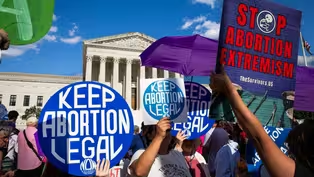
Law professor speaks on abortion issues
Video has Closed Captions
Clip: S3 Ep12 | 2m 44s | With reproductive rights on many voters’ minds, what are some important facts to consider? (2m 44s)

Pivot counties weigh options for president
Video has Closed Captions
Clip: S3 Ep12 | 4m 33s | They chose Obama and then Trump. Who’s next for pivot counties? (4m 33s)
Virginia Republicans say they are repelled by Trump
Video has Closed Captions
Clip: S3 Ep12 | 4m 30s | They say they are putting country over party. High-profile Republicans are defecting. (4m 30s)
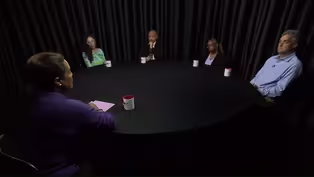
What’s on the minds of potential Virginia voters?
Video has Closed Captions
Clip: S3 Ep12 | 4m 13s | Virginia residents talk about issues on all sides in the leadup to the 2024 elections. (4m 13s)
Providing Support for PBS.org
Learn Moreabout PBS online sponsorship
- News and Public Affairs

Top journalists deliver compelling original analysis of the hour's headlines.

- News and Public Affairs

FRONTLINE is investigative journalism that questions, explains and changes our world.












Support for PBS provided by:
VPM News Focal Point is a local public television program presented by VPM
The Estate of Mrs. Ann Lee Saunders Brown