VPM News Focal Point
VPM News Focal Point Election Special: Virginia Votes
Season 3 Episode 11 | 26m 46sVideo has Closed Captions
Community dialogue, analysis and reporting around election issues in Virginia. 1 of 3.
Community dialogue, expert analysis and feature reporting around the 2024 elections. Hear directly from fellow Virginians and gain a deeper understanding of the perspectives, hopes and concerns that drive voter decisions at the polls. Part 1 of 3.
Problems playing video? | Closed Captioning Feedback
Problems playing video? | Closed Captioning Feedback
VPM News Focal Point is a local public television program presented by VPM
The Estate of Mrs. Ann Lee Saunders Brown
VPM News Focal Point
VPM News Focal Point Election Special: Virginia Votes
Season 3 Episode 11 | 26m 46sVideo has Closed Captions
Community dialogue, expert analysis and feature reporting around the 2024 elections. Hear directly from fellow Virginians and gain a deeper understanding of the perspectives, hopes and concerns that drive voter decisions at the polls. Part 1 of 3.
Problems playing video? | Closed Captioning Feedback
How to Watch VPM News Focal Point
VPM News Focal Point is available to stream on pbs.org and the free PBS App, available on iPhone, Apple TV, Android TV, Android smartphones, Amazon Fire TV, Amazon Fire Tablet, Roku, Samsung Smart TV, and Vizio.
Providing Support for PBS.org
Learn Moreabout PBS online sponsorshipKEVIN HARRELL: Many of us are struggling to, pay bills and go to the grocery store.
And, and that's not really discussed.
Its kind of glossed over.
SUEANNE KIMBLE: I do see a lot of kids suffering from mental abuse, drug abuse, whatever you may call it.
ELSIE TAYLOR: Drugs, drugs and guns.
GREG BROWN: The border.
Obviously its the number one question on everybody's mind.
When's it going to close?
DEBRA HOUSER: If they come in the United States legal, that's okay.
But not the way they're coming.
DARCY ASHMAN: Political extremists, kind of, divisiveness.
ANGIE MILES: What's on the minds of Virginians as we prepare to go to the polls?
We're about to hear from experts, academics, and a wide array of Virginia voters in our special coverage of this consequential election season.
Virginia Votes a special edition of VPM News Focal Point is next.
Production funding for VPM News Focal Point is provided by The estate of Mrs. Ann Lee Saunders Brown.
And by... ♪ ♪ ANGIE MILES: You're watching VPM News Focal Point.
I'm Angie Miles.
For three years, Focal Point has been traversing the state, listening to people talk about their challenges and triumphs, sharing stories of how social issues and public policy matters impact the lives of Virginians in both minuscule and massive ways.
This fall Focal Point is bringing you a series of special reports to help those of us who live, work, and travel in Virginia.
Our coverage will include neighbors from the ocean to the mountains, from the D.C. suburbs to the far southwest, expressing concerns, asking questions, and describing their motivations as they prepare to vote.
We'll also hear from academics and other experts who study the issues and can speak to the facts of the matters we're exploring.
They're prepared to dispel myths to inform your choices for presidential, congressional, state and local races.
Our Focal Point election coverage will bring voters with wide ranging political viewpoints together to talk directly with one another and helping one another and you to better understand their points of view, to see what common ground may be possible.
We begin with a focus on voter engagement.
While the baby boomers continue to represent the largest bloc of registered voters, younger Americans, specifically Millennials and Gen Z, are on pace to become more than half the electorate within a decade.
A major push by both parties for several years now has been to engage and register more young voters.
We'd like you to meet two Virginia teens, each of them about to cast presidential ballots for the first time.
They have very different ideas about the right way to vote, but when you hear their stories, you may be able to understand how they've arrived at the choices they're making.
First, meet Noah, a young man who's driven by his faith, patriotism, and true desire to make a positive difference in his community.
ANGIE MILES: Noah Teets may not look like a political influencer He may not sound like your idea of a mover and shaker, but in this northwestern part of Virginia, he is exactly these things.
NOAH TEETS: When I was younger, I was very much shy through public school and all of that.
In my own way I felt outnumbered because I felt like I was different from everybody.
But obviously that's changed.
ANGIE MILES: Even though Noah was only nine years old at the time, this is the moment, he says, when he first took an interest in politics.
NOAH TEETS: I remember vividly in 2015 when Donald Trump announced that he was running for president.
I was sitting in my grandma's living room watching the TV, and something about it just struck me to turn to the TV and just pay attention.
ANGIE MILES: And from then to now he is increasingly convinced that his voice matters in determining the fate of the country.
NOAH TEETS: I follow Jason Miyares, the attorney general, for Virginia, a lot, and Ive watched the stats and stuff that he said about fentanyl Increases in the state have gotten really out of hand.
And I've also had personal issues with drugs and things not that I've done, but with people around me.
Throughout the years.
I've seen it get worse throughout our whole community.
ANGIE MILES: Noah says his deep Christian faith compels him to do something.
NOAH TEETS: I believe it's about the love you show to people and about the courage and positions that you take to show that kind of love and things to people.
And that's where God comes in, because God is love.
Mother Autumn is not only proud of her son...
AUTUMN TEETS: Noah's heart.
Oh my gosh.
Noah's heart is huge.
So Noah had a rough start in life.
He was born to two teenage parents, myself being 17, as well as his biological father.
I dropped out of high school to raise him.
I had to get a full time job.
His father wasn't really involved.
I had to be that mom first before anything else.
ANGIE MILES: Autumn Teets is also inspired by Noah to be more involved in her community as well.
AUTUMN TEETS: I was never a big politics person, but seeing how excited Noah got, it got me looking into things and doing my research and seeing how it could positively affect me.
And so because of my son, I vote.
ANGIE MILES: Noah and his mom both work retail jobs and Noah has a second job doing tree work.
He says over the past decade, he's seen too many people go from relative financial security to more struggle than he thinks should be necessary.
That struggle is one reason he's campaigning for Donald Trump.
NOAH TEETS: Under the four years of President Trump, we saw a record economy.
We saw gas prices at an amazing level, and groceries were sustainable.
People were able to live.
We were able to enjoy life.
We should probably also let the state police know.
AUTUMN TEETS: ...Virginia State... NOAH TEETS: I believe he is the better leader for the country.
Him being the one hit with COVID, I believe he could have done a little better.
But the transition to the next administration, that was a rough patch for everybody, and I believe they could have done a lot more to make it better.
That's where I stand on that.
MAN: Are you Noah?
NOAH TEETS: I am.
MAN: Good to meet you.
NOAH TEETS: You as well.
MAN: Love our country.
Love our president.
BOTH: Yep.
ANGIE MILES: Noah is inviting others to stand with him and to ride with him for his candidate.
He's organized rallies like this one from Winchester to Leesburg.
NOAH TEETS: It's an adrenaline rush of being with other people that are like minded, like you.
It makes you feel good that you feel like you're doing something good for your country and your community.
I'm worried about this election because of the future of my life and for my brothers and my sister and all the generations after me.
Right now I'm 18 years old and before I was always being told, “You can't vote.
Your opinion doesn't matter.” Now I can vote.
Now, according to other people, my opinion does matter now.
ANGIE MILES: Noah, like a majority of Americans, says the country is moving in the wrong direction, but he says it can be turned around with a lot of work and he's ready to do his part.
ANGIE MILES: The economy is a major factor for NOAA, just as it is for scores of American voters.
BOB ENGLISH: The economy, specifically inflation at this point.
SETH MORITZ: It's very difficult to really afford much of anything like basic necessities that people have just because the wages are staying the same.
W. HOWARD MYERS: It's hard for families to survive, you know, with the rental increase in housing costs.
KENDRA CARTER: Finances, trying to stay afloat in this economy, everything else is going up and theres jobs being taken.
BREASHA GRIFFIN: It's harder to get jobs like higher paying ones.
Definitely.
CRYSTAL BLINKINSOPH: I don't think we're making enough to pay for even basic groceries.
And it's adding healthcare and car payments and school fees and all of that on top of it.
It's a lot to keep up with.
SHANTELL CARTER: You go buy a loaf of bread is going to be higher, but theres no extra loafs in it.
Nothing has changed.
But the prices have, rent going up.
But I didn't get an extra bedroom.
You know, nothing has changed, but the prices have.
ANGIE MILES: Virginians share in the pain of trying to make their household budgets work, even as the price of everyday goods and services have skyrocketed.
For 19 year old Oliviana.
It's concerns not only about her financial future, but also about how the most vulnerable among us can afford to just live, that are informing her vote.
ANGIE MILES: Long before she was a college student.
OLIVIANNA WATKINS: [ ] Our presentation.
ANGIE MILES: Olivianna Watkins became a political observer.
OLIVIANNA WATKINS: I really got interested in politics right around the Trump and Clinton election, which is kind of weird because I was like ten, but it was like a really cool thing to see because I was like, we might have a female president That didn't happen.
I was very upset, but that's when I really started getting involved.
Now that I'm older, I can vote.
Im in a different area now I'm really excited for this election.
ANGIE MILES: Her excitement she's translated into action on behalf of her preferred candidate.
OLIVIANNA WATKINS: She's already done so much.
Shes become the first female vice president.
We'll finally have a woman leading our country.
I'd be so happy to see that.
ANGIE MILES: When she's not studying here at George Mason University, Olivianna is putting her energy and enthusiasm behind the effort to get Kamala Harris elected.
She says her perspective is informed in part by her strong belief that Donald Trump is unfit to hold office.
OLIVIANNA WATKINS: Especially considering the things he's said about women, people of color, LGBTQ rights, immigrants.
And just like, why is this the person we want running our country?
You're so obviously a very hateful person.
ANGIE MILES: In contrast, Olivianna believes that Kamala Harris is genuine and will deliver policies that protect and uplift average Americans.
And she says the Harris Walz ticket will build on what she considers recent economic successes of the Biden administration.
OLIVIANNA WATKINS: With Biden and Harris working to cap the price of insulin, they really do care about the middle and lower classes in trying to make life more livable and more comfortable for them, especially regarding, honestly life saving medication.
However, former President Trump has tried to repeal Obamacare.
I mean, people are having to choose between getting medication and getting groceries for that month.
ANGIE MILES: When it comes to groceries, gasoline, housing, living expenses that she says many young people have struggled to manage.
Olivianna says she sees how world events have impacted these costs, and she puts her trust in Kamala Harris.
OLIVIANNA WATKINS: When the war broke out in Ukraine, gas prices, everything went up because that's what conflict does.
GROUP: Everyone say, “Young Dems.” Young Dems.
ANGIE MILES: The president of Virginia Young Democrats who's out campaigning alongside Olivianna and others, says he's excited about the enthusiasm and voting power Millennials and Gen Z voters are bringing to the ballot box.
MATT ROYER: About two out of three times, the Millennials and Gen Z voters are breaking towards the left.
What we're seeing is gun violence is a huge part of what people are voting on.
Climate change is another part because we want to be able to actually have a future and a future planet to live on, Royer says.
ANGIE MILES: Royer says Olivianna is emblematic of what his party wants to see in many of Virginia's hotly contested areas.
MATT ROYER: Our college towns are really where a lot of our battleground districts are, so a lot of those districts are heavily Republican.
But all of these students are living there the majority of the year, whether it's out at James Madison in the sixth District or it's the fifth District with UVA, the ninth District with Virginia Tech, or even down in Hampton Roads with any of the colleges in those areas.
If we had more of these college kids voting, we would get so many more votes for Democrats.
And we see that from our college Dems like Olivianna.
ANGIE MILES: Olivianna is not a native Virginian but hails from Michigan.
She intends, however, to make Virginia home after graduation, working in international policy.
She says that President Harris would represent America well on the world stage.
But she says she's hopeful, too, that her choice for president will approach difficult issues like abortion.
OLIVIANNA WATKINS: Most people did not want Roe v Wade overturned.
I want to have the ability to make my own decision about my body and my future.
ANGIE MILES: Issues like gun violence.
OLIVIANNA WATKINS: Having more gun control laws so making it harder to get automatic weapons.
ANGIE MILES: On a host of issues.
OLIVIANNA WATKINS: For gasoline, for example, reduce our reliance on foreign gasoline, but also not damaging the environment.
ANGIE MILES: She's researched and studied and decided that parties are arguing about topics she says should be not partisan at all.
And for this election cycle, she says, Harris is the way to a better future.
OLIVIANNA WATKINS: If I didn't think these things were so important, I would not be sitting here right now.
This is going to have a big factor in the next few years of my life and I want to be able to have a role and a voice in deciding that.
ANGIE MILES: Later in the program we'll hear from an expert on the current state of our economy and what we might expect, depending on how Virginians and Americans vote this season.
You've heard now from Virginians on economic factors influencing their decisions as they select leaders for national, state and local offices.
But can you guess the number one answer people of Virginia shared with Focal Point when asked to name a challenge facing the country and our state?
ARIANA MORRIS: Everybody tends to have very strict opinions or extreme opinions from one another.
And so it's hard to please everyone.
PAT DEAR: We can't agree on anything.
I can't find anything.
You have to find the same people who think about things as you do.
You can't debate.
You can't converse.
You can't disagree.
Hard to find common ground.
TED SWEDALIA: Mending fences between people over the silliest thing in the world, which is politics.
When you look at history in our world and not just our country, politics have torn apart countries for a millennium.
And I hope it doesn't happen to our country.
MATTEO HIREL: Everyone who doesn't know each other are scared of each other and they make preconceptions of each other.
And I think that's something we have to help break down and bring people together in this country and in this state.
ANGIE MILES: That divide has become familiar to virtually everyone.
And one of the ways to decrease the distance is to bring people together for a respectful conversation.
We convened several roundtables with Virginians talking about issues and we used diverse methods to select participants, including recommendations from community members and people affiliated with VPM.
We had extended deep discussions about what's most pressing for each of them, certainly the economy, but also a host of related issues that impact their wallets and yours.
ANGIE MILES: Do you feel that you are a pocketbook voter?
Is the economy your number one thing?
And to what extent do you think other people vote really just based on how they're doing economically?
DAVE HEILBERG: I think we overrate the role of any president in being able to control the economy, especially after only four years in office.
What I do see is the real world.
And I had to fill up my tank yesterday.
And over in Charlottesville and that side of the Blue Ridge, you can fill up for as low as $2.93 a gallon.
So in the real world, there is definitely easing of inflation.
It's not just bookkeeping from the federal government.
PATRICK FITZ: Unfortunately, a lot of folks truly don't understand how the economy works like or even what the economy is, right.
They'll point, and I hear it a lot, particularly among, say, my peers socioeconomically, where we're honestly most of us are truly getting by maybe a little bit better than paycheck to paycheck, but not much.
We are one financial emergency, whether it's medical or something like that, away from from significant financial stress.
But it's the unchecked corporate greed that has allowed allowed the American consumer to be drained of this money.
And for them to say, oh no, no, no, no, it's inflation.
ANGIE MILES: What do you think?
ERICA SAYERS: I think in schools we need to do a better job at personal finance.
You know, as a banker I actually volunteered at our local middle school to do some finance classes.
And I brought along our marketing department, our chief experience officer, our investments, the retail banker who could teach them about credit scores.
In my opinion, it's something we're dropping the ball on is teaching children the importance of, you know, saving a dollar and not spending more than you make.
JACK HICKEY: There's a lot of people that are struggling to make ends meet finding a place to live.
It's becoming harder and harder.
The market for rentals and ownership is just out of the reach of a lot of people.
And I think we need to take a long look at income inequality.
BILL OGLESBY: I do think that people do tend to be pocketbook voters, and I think that that has worked against President Biden, because if you look at the economy, you look at the economic figures across the board, he's done very well, even on inflation.
If you compare it to other countries, we've done quite well.
But here's the deal people don't vote their pocketbooks based on European inflation.
They voted based on inflation here at home.
JENNIFER BROWNE: I think a lot has to do with what side of the economic spectrum you're on.
My company did not give me a pension.
But then there are other people who, are working for the government and they'll have a pension for for life.
And it affects their, their way of, living and voting and, and how they approach economics.
CHUCK HANSEN: And then there are other people who are living paycheck to paycheck or behind paycheck to paycheck JENNIFER BROWNE: Exactly.
CHUCK HANSEN: And it's pretty hard to have a conversation about how, no, it's working.
And then they go to the grocery store and it doesn't feel like it's working.
JENNIFER BROWNE: Or their children are coming back home and living with them because they can't find, worthwhile employment.
They can't make enough.
And so then the parents who thought that they were going to have empty nesters are having the boomerang kids and trying to deal with that.
Yeah.
It's tough.
ANGIE MILES: Even though the economy figures prominently in how Virginians are choosing to vote, professional economists say few Americans understand how the economy actually works.
To bolster our understanding, we sought input from Bob McNab, head of the economics department at Old Dominion University.
ANGIE MILES: The perception, among voters is that the economy is influenced largely or maybe totally by whomever is president at the time.
Is that true?
BOB McNAB: Well, just look at the conversation around gas prices.
Presidents love to claim credit when gas prices are low.
They love to say it's not my fault when gas prices are high.
Gas prices are a function of oil prices.
Oil prices are determined on a global market.
And so consumers will say, well, we must be producing less oil because gas prices are higher.
And yet, if you look at the data, the US is actually producing a record amount of oil in 2024.
We've actually increased oil and natural gas production over the last four years.
But because of global conditions, the price of crude is higher and thus gas prices are higher.
We also have a refinery constraint.
We can pump as much oil as we want, but if you can't get it through the refinery system, doesn't mean that gas prices are going to be lower.
So what we're seeing right now is a decline in gas prices because of seasonal demand.
A switch to winter blends out of summer blends.
And so consumers are going to feel better about that.
Whether or not they say that's because of the president or not because of the president is another story.
ANGIE MILES: Some people understand that it's global factors.
And they will say, well, it's because of what's happening with Russia and Ukraine, and the United States needs to isolate from that.
And, that would also protect us from these inflationary factors.
Do you think that's the case?
BOB McNAB: Russia's invasion of Ukraine is tightly tied with US national security policy.
This is not something that is happening within a vacuum.
We have seen Russia's encroachment in Georgia, and we've seen its meddling in politics in the United States and also in Europe.
And if you talk to our allies in the Baltics, or if you talk to our ally in Poland, they would say a very simple thing.
If we abandon Ukraine, we're next.
And if you think commodity prices are uncertain now, imagine what would happen if Russia controlled Ukraine and then made moves on the Baltics or Poland.
That would be a much wider geopolitical conflict, which would create significant instability in commodities prices globally.
It is in our national security interests, in my opinion, to provide aid to Ukraine.
ANGIE MILES: Finally, we'd like to offer some recommendations from an expert on mending social and political divides.
Ben Klutsey of George Mason University's Mercatus Center says despite appearances, there are ways forward, and ultimately he's optimistic that Americans can come together.
BENJAMIN KLUTSEY: When we engage in conversations with people across differences, and when we facilitate these conversations, we talk about three very, very important principles.
Well, even before those principles, we go in saying, look, we're not trying to change your mind about anything, because once you say, I'm going, I want to change your mind about something.
Or they perceive that you want to change their minds about something, they become very defensive.
It's about who wins and who loses.
But we say, look, there are three principles that we care about.
Number one is respect.
The ideas that we're one another as dignified equals in a democracy of, you know, self-governance among equals.
We have to respect one another.
So we're equal.
We're going to respect one another.
If we agree on that principle, we can go on to the next principle, which is authenticity.
I'm not masking my views, youre not masking your views.
I'm going to be as honest as possible because I respect you so much.
And then we can move to the third principle, which is curiosity.
We cannot learn anything about each other if we are not able to ask questions.
So, so long as we agree on these principles, respect, authenticity and curiosity, we can now begin to have a conversation.
And oftentimes, the way we start is that we're engaging in reflective listening.
It's not about, hey, tell me why you're pro-guns or tell me why you're anti-guns.
No, we say, why might Angie think this way about guns?
I might go through some ideas and I try to put myself in your shoes when I'm putting myself in your shoes, I'm being very charitable, very generous, and giving a lot of grace.
Right.
And then you'd say, well, what did I get right?
And what did I get wrong?
And then you can correct me, fill in the blanks.
But you notice that I'm really making an effort to understand your perspective before we even get into the conversation.
And you do the same for me.
And I think that eases and brings the tension down.
And it makes for a much, much, much better, productive conversation.
ANGIE MILES: We hope that our program has provided some new perspectives on the political passions of diverse Virginians, as well as some of their reasons for believing and voting as they do.
For more election coverage, go to VPM.org.
I'm Angie Miles.
This is VPM News Focal Point.
Production funding for VPM News Focal Point is provided by The estate of Mrs. Ann Lee Saunders Brown.
And by... ♪ ♪
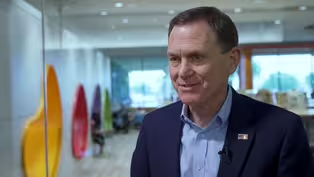
Candidate Mike Clancy, VA10 (R)
Video has Closed Captions
Clip: S3 Ep11 | 6m 32s | Hear directly from the republican candidate for US Representative from Virginia for District 10. (6m 32s)
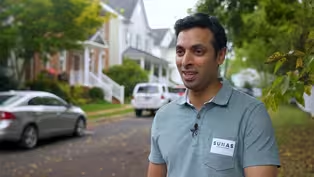
Candidate Suhas Subramanyam, VA10 (D)
Video has Closed Captions
Clip: S3 Ep11 | 6m 42s | Hear from the democratic candidate for US Representative from Virginia in District 10. (6m 42s)
Can civil exchange solve sociopolitical divides?
Video has Closed Captions
Clip: S3 Ep11 | 2m 8s | Ben Klutsey of George Mason University discusses civil exchange. (2m 8s)
Professional economists say few Americans understand how the economy actually works
Video has Closed Captions
Clip: S3 Ep11 | 3m | The economy is prominent in voters' minds but economists say few people understand it. (3m)
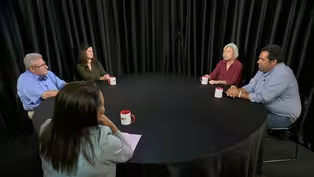
Talking politics with Virginia residents
Video has Closed Captions
Clip: S3 Ep11 | 4m 10s | Coming together - Virginia residents discuss priority issues for the 2024 election. (4m 10s)
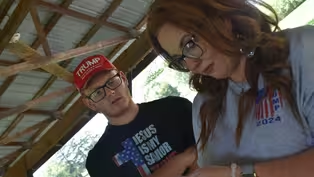
What election topics inform one young Republican's choices?
Video has Closed Captions
Clip: S3 Ep11 | 4m 24s | Faith, patriotism and a desire to make a difference drive one first-time voter’s choices. (4m 24s)
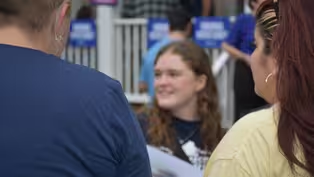
What informs one young Democrat’s election choices?
Video has Closed Captions
Clip: S3 Ep11 | 4m 22s | Concerns about vulnerable citizens and economic factors inform one young person's vote. (4m 22s)
Providing Support for PBS.org
Learn Moreabout PBS online sponsorship
- News and Public Affairs

Top journalists deliver compelling original analysis of the hour's headlines.

- News and Public Affairs

FRONTLINE is investigative journalism that questions, explains and changes our world.












Support for PBS provided by:
VPM News Focal Point is a local public television program presented by VPM
The Estate of Mrs. Ann Lee Saunders Brown